Missed Call Text Back for Orthodontists
Missed call text back for orthodontists: every unanswered call gets a text in under a minute, with scripts for parent consults, aligner enquiries and after-hours calls.
Missed call text back automatically texts a caller within a minute of an unanswered call to your orthodontic practice, with a link to book a consultation. The parent or adult patient replies or taps instead of ringing the next practice — so a missed call becomes a booked consult instead of a lost case.
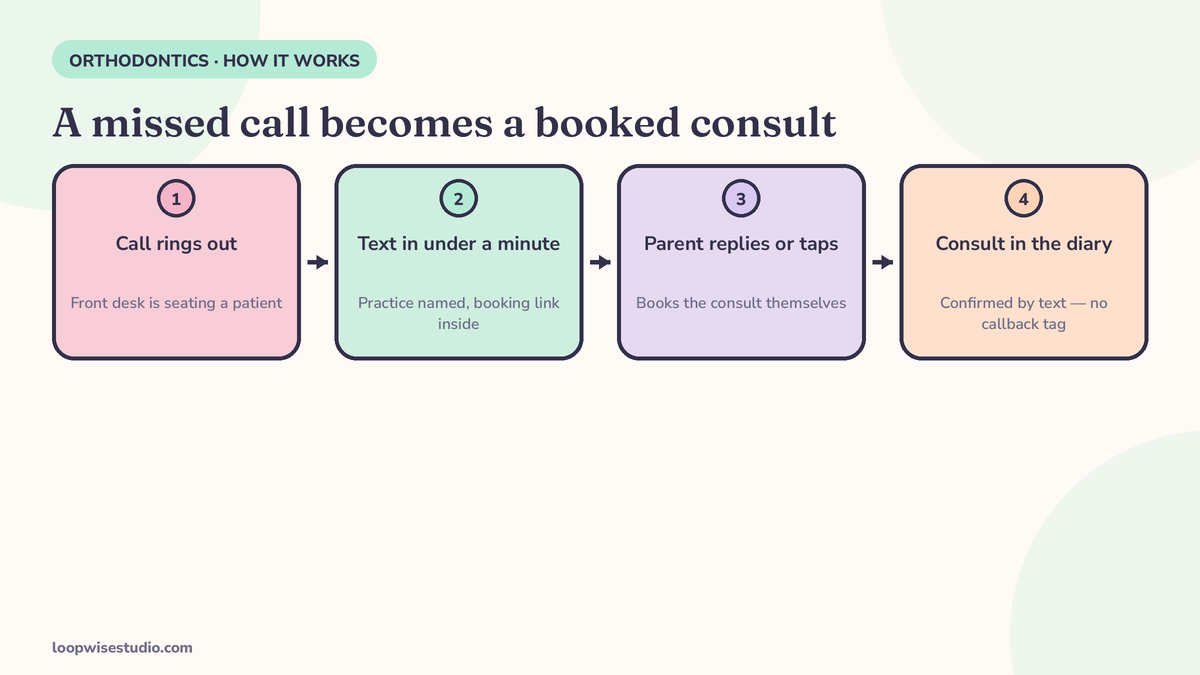
Orthodontics runs on the phone more than most specialties. A parent finds you on Google, compares two or three practices, and calls during a lunch break. Your front desk is seating a patient, checking out another, and answering a question about retainers — all at once. The call rings out. The parent does not leave a voicemail. They call the practice two listings down.
Text back closes that gap without adding staff. It is not an answering service and it is not a robot answering your phones. It is one automatic text, sent the moment a call goes unanswered, that keeps the conversation alive until your team can pick it up — or until the caller books a consult themselves.
This page covers how it works for an orthodontic practice specifically: the four kinds of calls you actually miss, the exact text each one should get, how business-hours and after-hours messages differ, and what to do with the replies. It is the same system we build for dental and med spa clients — our guide to missed call text back for dental practices covers the general mechanics — tuned here for consults, parents, and two-year treatment plans.
Why ortho misses different calls than a general dentist
A general dentist mostly misses hygiene and toothache calls. An orthodontic practice misses a stranger mix:
- A parent booking a first consult for a child. The patient is not the caller. The parent is scheduling around school hours, often calling from work, and will not call twice.
- An adult comparing aligner providers. They are price-shopping two or three practices in one sitting. Whoever responds first with a consult time usually gets the case.
- An existing patient mid-treatment. A poking wire, a broken bracket, a lost retainer. They need reassurance and a fix-it slot, not a sales conversation.
- A teen patient calling directly. Short patience, no voicemail, ever.
Each caller needs a different first text. A generic “Sorry we missed your call!” treats a parent about to spend thousands on treatment the same as a patient with a loose bracket. That is why generic tools underperform in ortho — and why the message has to know which call it is answering.
There is a second difference: the prize. In general dentistry a recovered call might be a cleaning. In orthodontics a recovered new-patient call is a consult, and a consult that starts is a full course of treatment. The orthodontic trade press makes the same point about call handling generally — one widely read piece in Orthodontic Products frames a single new-patient call as a treatment opportunity worth thousands of dollars, and notes that practices pay real money per click to make that phone ring in the first place. Letting it ring out is the expensive part.
How it works, minute by minute
The flow is simple enough to explain in four steps:
- A call goes unanswered — busy line, front desk with a patient, lunch hour, or after closing.
- A text goes out in under a minute, from your practice number, written for that kind of caller.
- The caller replies or taps the booking link. The link shows live consult times — including after-school slots — not a form that promises a callback.
- Your team sees the thread. Anything the automation cannot finish lands with a named person at the front desk, with the caller’s name and what they asked for.
Two details matter here. First, speed: the text has to arrive while the caller is still holding their phone, not in a batch an hour later. Second, the text is the start of a two-way conversation, not a notification. If the parent replies “do you have anything after 4pm?”, someone — or a smart reply flow — has to answer that, or you have rebuilt voicemail with extra steps.
If your practice already loses calls in the evening, the pattern will look familiar from our page on how to stop losing bookings after hours at a clinic — the fix is the same: answer instantly in writing, book the appointment, hand a human the summary in the morning.
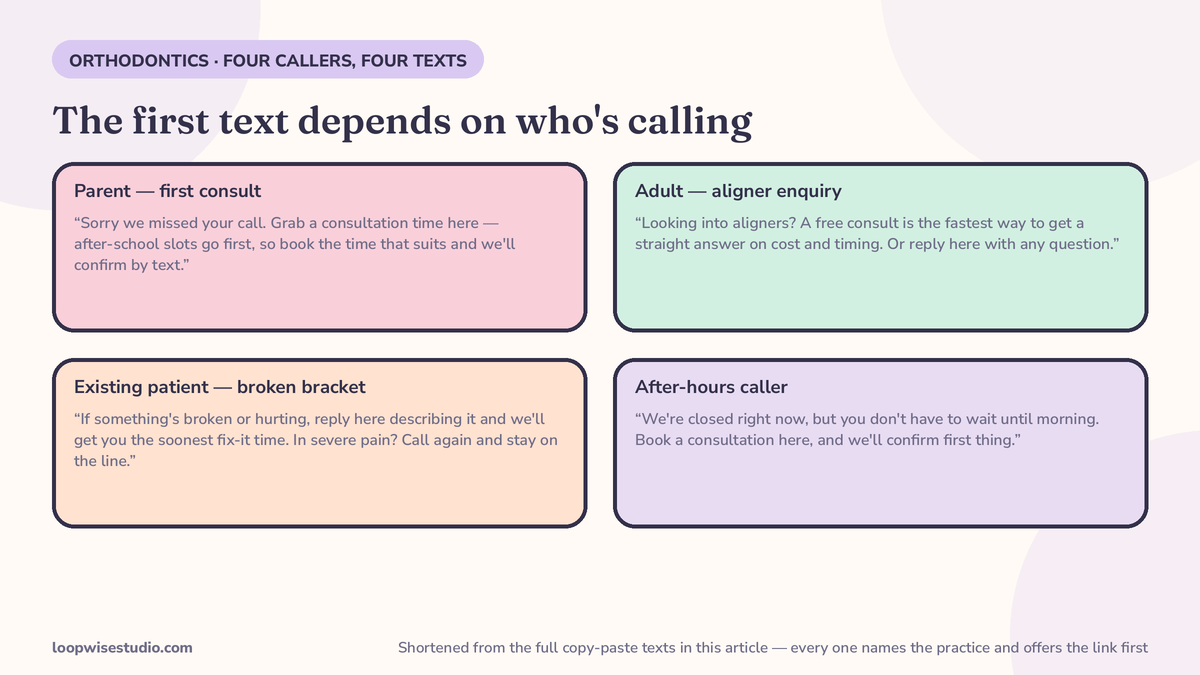
The four ortho call types — and the right text for each
This is the part no software template gives you. Copy these and adjust the names and links:
| Caller | What they actually need | First text |
|---|---|---|
| Parent, new consult | A consult time that fits school hours | “Hi, this is [Practice] — sorry we missed your call. You can grab a consultation time here: [link]. After-school slots go first, so if you need one, book the time that suits and we’ll confirm by text.” |
| Adult aligner enquiry | A low-pressure way to compare and book | “Hi from [Practice] — sorry we couldn’t pick up. If you’re looking into aligners, a free consult is the fastest way to get a straight answer on cost and timing: [link]. Or reply here with any question.” |
| Existing patient, problem | Reassurance + a fix-it slot, fast | “Hi, this is [Practice]. Sorry we missed you — if something’s broken or hurting, reply here describing it and we’ll get you the soonest fix-it time. If you’re in severe pain, call us again now and stay on the line.” |
| After-hours caller | A booked consult or a clear next step | “Hi, this is [Practice] — we’re closed right now, but you don’t have to wait until morning. Book a consultation here: [link], and we’ll confirm first thing. If this is urgent pain, reply URGENT and we’ll tell you what to do next.” |
Two rules run through all four. The text names the practice (callers ignore texts from numbers they cannot place), and it offers a booking link before it asks for anything. “Call us back” is not a next step — it is the thing that already failed.
A note on the existing-patient text: a broken bracket is not a sales opportunity, and the wording should not treat it like one. Speed and calm win loyalty here, and loyal patients mid-treatment are where your referrals come from.
Business hours and after hours: two messages, not one
The most common setup mistake is one message for every missed call. A call missed at 11am because the desk is busy needs “we’ll be right with you” energy and a live booking link. A call missed at 9pm needs honesty that you’re closed, the booking link, and an urgent-pain path.
Set the two variants separately, and make the after-hours one do the heavier lifting — it cannot promise a reply in five minutes. It should promise a booked consult and a confirmation first thing in the morning, and then your morning routine has to keep that promise. This is also where a virtual consult option earns its place: a parent who cannot face another school-hours phone call will often book a video consult from the sofa at 9pm. If your practice offers them, the after-hours text is where to say so.
What the text must do next: end at a booked consult
A text that starts a chat but cannot finish a booking leaks the same cases, slower. The link in the text should open a booking page that:
- Shows real consult availability, split into in-person and virtual if you offer both
- Asks for the patient’s name and age (the parent is booking for someone else — forms that assume caller = patient confuse exactly your main booker)
- Lets the parent pick after-school times without calling to ask
- Confirms instantly by text, and adds the appointment to your diary
If booking a consult still means “we’ll call you to arrange a time,” the text-back has just moved the phone tag from voice to text. The booking page is half the system.
What it costs to leave it manual
We will not quote you a benchmark here, because there isn’t an honest one — the figures circulating in vendor marketing for missed-call recovery are not published studies, and your practice’s numbers are the ones that matter anyway. Do the arithmetic with your own:
Your missed new-patient calls per week × your consult booking rate × your consult-to-start rate × your average case value.
Worked example, with assumptions stated so you can swap in yours: a practice misses 6 new-patient calls a week. If half of those callers would book a consult when texted promptly (3 consults), and 1 in 3 consults starts treatment (1 start), and your average case is worth what your own fee schedule says — that is roughly one extra start per week from calls you already paid to generate. Even if your real numbers are half of that, the text-back pays for itself against one start a month. Run it with your call log, not our example.
That same discipline — your diary, your numbers — is how we approach the wider question in our piece on how much revenue med spas lose from missed calls; the maths transfers, the invented industry percentages do not.
If chasing missed consults after the fact is your bigger leak, pair this with the follow-up system in our guide to reducing no-shows at an orthodontic practice — text back catches the call, the follow-up sequence catches the consult that did not show.
The replies are the job: who owns the thread
The text goes out automatically. The replies should not be handled automatically, at least not beyond the simple confirmations. Decide in advance who owns the thread during opening hours — in most practices, the same person who owns consult bookings — and what their standard is: every reply answered within the hour, same day at the latest.
Three reply patterns cover most of what comes back:
- “How much does it cost?” Don’t dodge and don’t quote blind. The reply: a consult produces the actual plan and the actual number, payment options exist, and here is a link to book one. Deflection without a next step loses the parent; a made-up price loses them later, louder.
- “We only need after school.” Send the link filtered to late-day times if your booking page can, and say so. This parent is telling you the exact obstacle — remove it while they’re looking at their phone.
- Silence. One follow-up text the next day, short and easy to answer (“Still want us to hold a consult time for [child’s name]? Reply YES and pick a time here: [link]”). Then stop. Two touches total; a parent who feels chased tells other parents.
Log where each recovered call ended up — consult booked, started, or lost — even in a spreadsheet. After a month you’ll know your own recovery rate, which is worth more than any benchmark anyone tries to sell you.
DIY app, software add-on, or done-for-you
- DIY automation tools (a Zapier-style trigger, for example — an orthodontist-specific template for exactly this exists) are cheap and fine if someone on your team will own the message copy, the hours logic, and the reply inbox. Most practices set it up once and never touch the copy again.
- A phone-system add-on (if your VoIP or practice platform offers missed-call texting) is the fastest start, but the message is usually one generic text, the booking link is yours to sort out, and nobody is watching the replies as a front-desk job.
- Done-for-you means the four message variants, the booking page, the hours logic, and the hand-off to your treatment coordinator are built and written for your practice, and tested with real test calls before it goes live.
Whichever route you take, test it the way a parent would: call your own number from a mobile at 7pm, let it ring out, and read what arrives with fresh eyes.
If you’d like us to run that test on your current setup and show you exactly where consult calls leak, get a free audit — we’ll map your missed-call moments and quote the fix as one fixed price.
What text back will not fix
Honesty about the limits, because the trade press is right about this part: text back rescues calls you miss. It does not improve the calls you answer. If your front desk answers within a few rings but consult callers get put on long holds, quoted prices coldly, or pushed to “call back when the doctor is in,” the leak is training, not technology. It also does not replace your treatment coordinator’s follow-up for consults that booked and didn’t show — that is a separate system (and a separate article).
What it does do, quietly and every day, is make sure that the parent who called at the wrong moment still ends up in your diary instead of someone else’s.
FAQs
Does missed call text back work with our existing practice software? Yes. It sits on your phone number, not inside your practice management system. The booking link points to a booking page that writes to your diary or syncs with your calendar; your existing software keeps doing what it does.
What if the caller is an existing patient, not a new enquiry? The message variants handle this: existing-patient calls get a problem-first text (describe what’s wrong, get the soonest fix-it slot), not a consult pitch. If your system can see the number is a current patient, it picks that variant automatically.
Will parents find an automatic text impersonal? Parents find ringing out and voicemail impersonal. A text that arrives in under a minute, names the practice, and lets them book an after-school consult is the opposite experience — and they can always just reply and talk to your team like a normal message thread.
Can it offer virtual consultations? Yes — the after-hours and aligner variants are the natural place to offer a video consult option alongside in-person times, on the same booking page.
What happens if someone replies with something complicated? The thread lands with your front desk or treatment coordinator with the full context. Text back handles the routine (booking, confirming, simple questions); humans handle anything clinical, financial, or upset — with a head start instead of a cold callback.
How fast can this be live? The build is the messages, the booking page, and the hand-off rules — days, not months, once we have your consult types and hours. The free audit comes first so the setup matches how your practice actually runs.
If missed calls are costing you consults you already paid to attract, get a free audit and we’ll show you the leak in your own call pattern — then fix it with one system, one fixed quote.