Reduce No-Shows at a UK Beauty Salon: Reminders + Deposits
Cut beauty salon no-shows in the right order: a full reminder sequence with copy, deposits sized by service, a fair policy, and a refill plan for gaps.
Reduce beauty salon no-shows in this order: automated reminders first, deposits second, and a clear cancellation policy as the backstop — not the other way round. Most no-shows are forgotten appointments, not bad clients, so the reminder sequence does most of the work; deposits protect the expensive slots; the policy exists for the repeat offenders.
Most no-show advice hands you the same six tactics in a random order and wishes you luck. But the order is the strategy.
Booksy’s UK guide breaks down why clients no-show, and forgetfulness sits at the top. A policy can’t fix a forgotten appointment — by definition, the client never saw it coming. A reminder can. So this guide builds the system in the order the causes demand: prevent first, protect second, punish last.
What a no-show actually costs a UK beauty salon
A no-show is not just the appointment price. It is the slot itself, the walk-in or phone enquiry you turned away for it, the products you prepped (mixed colour, set-up lash bed), and the hole it knocks in the rest of the day’s rhythm.
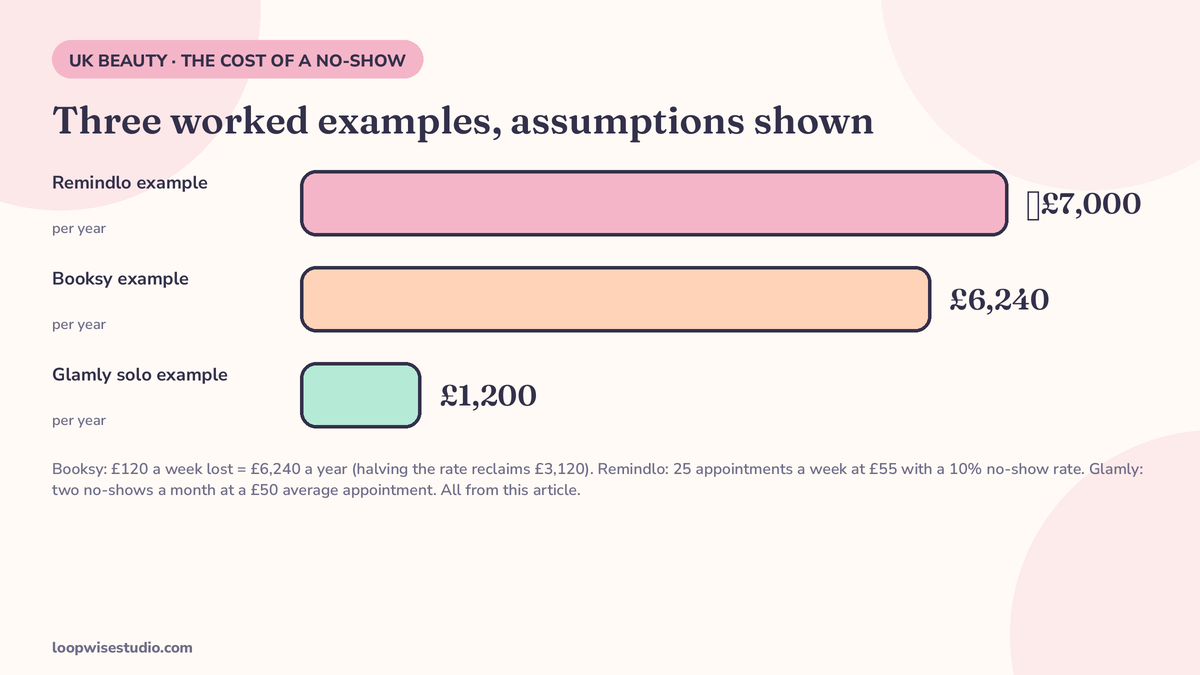
Two worked examples from UK sources, both labelled arithmetic on stated assumptions:
- Booksy: losing £120 a week to no-shows is £6,240 a year — and halving the rate reclaims £3,120 of it.
- Remindlo: a solo operator doing 25 appointments a week at an average of £55, with a 10% no-show rate, loses roughly £7,000 a year.
And Glamly’s smaller version, for solo beauty pros: at a £50 average appointment, just two no-shows a month is £1,200 a year gone.
Calculate your own rate first
You need one number before anything else. Booksy gives the formula:
No-show rate = no-shows ÷ total bookings × 100
Its worked example: 17 no-shows out of 150 bookings in a month is an 11% rate. Booksy puts the average no-show rate across service industries at between 10% and 15% — so if your number lands there, you are not unlucky, you are average, and average is expensive.
Track it by service and by time band, not just as one monthly figure. Three-hour colour appointments and Saturday lash sets are where the money is; a 20-minute brow tidy is not worth the same armour.
Why clients no-show — and what each cause actually needs
Booksy’s UK guide reports the cause breakdown below. One honesty note: Booksy attributes the figures on its page only to “research shows,” without naming the study — so treat them as a well-placed marketplace’s reported picture, not settled science. The shape is still useful, because each cause has a different cure:
| Cause (as reported by Booksy) | Share | The fix that matches it |
|---|---|---|
| Forgot the booking | 28.4% | Reminders — a policy can’t help someone who forgot |
| Last-minute issues (traffic, childcare) | 27.6% | Easy rescheduling, so a problem becomes a move, not a vanish |
| Forgot to cancel | 10.7% | A reply-to-confirm message that makes cancelling one tap |
| Unable to cancel | 9% | A cancellation route that isn’t “phone us during opening hours” |
| Changed their mind | 7.5% | Deposits on long services, so changing your mind has a moment of thought first |
| Lack of funds | 6.9% | Deposits spread commitment; clear pricing at booking |
| Couldn’t get to the location | 4% | Reminders early enough to rearrange travel — the 48-hour message |
Add the top two rows: over half of no-shows are memory and logistics, not malice. That is why reminders rank first in this system, deposits second, and the policy — the only part most guides lead with — comes third, as the backstop.
Fix 1 — The reminder sequence that prevents most of them
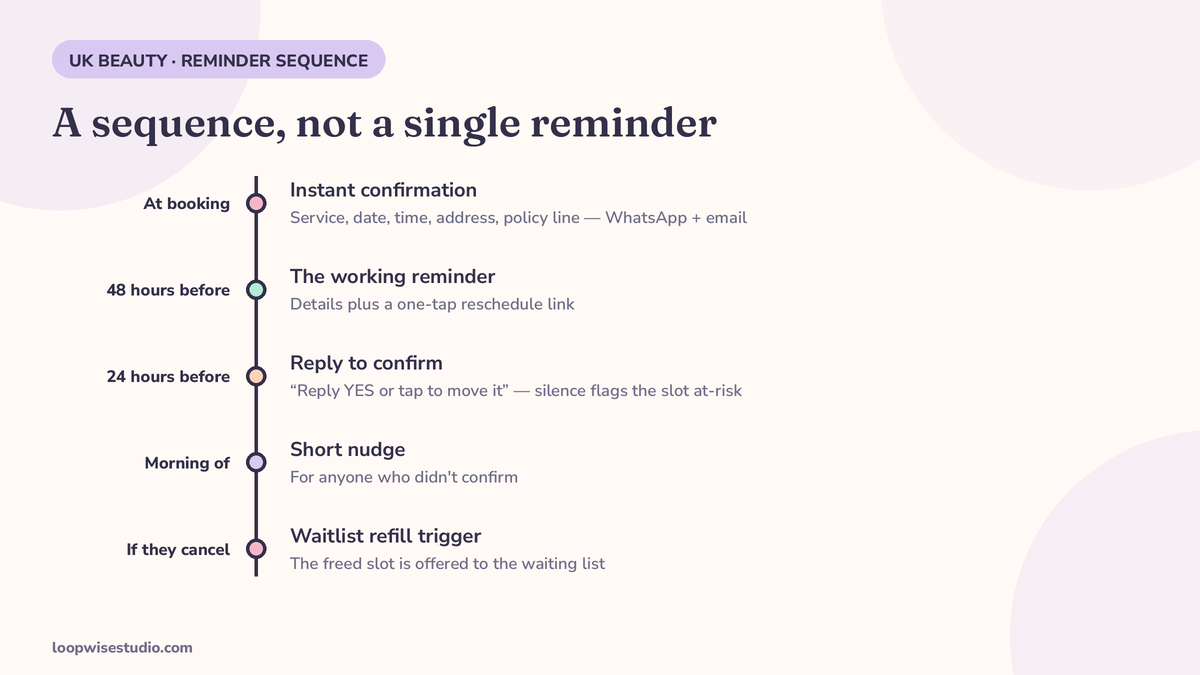
One reminder is a hope. A sequence is a system. Here is the full run, with the copy — WhatsApp first, because that is where UK clients actually reply, with SMS as the fallback for clients who don’t use it:
| When | Message job | Channel |
|---|---|---|
| Instantly at booking | Confirmation: service, date, time, address, deposit/policy line | WhatsApp + email |
| 48 hours before | The working reminder: details + one-tap reschedule link | |
| 24 hours before | Reply-to-confirm: “Reply YES or tap to move it” | WhatsApp or SMS |
| Morning of | Short final nudge for long or early appointments | WhatsApp or SMS |
| Patch test (colour/tint) | Separate reminder 7 days ahead — Treatwell’s Connect sends its patch-test reminder at 7 days, for reference | WhatsApp or SMS |
Copy-ready messages:
Confirmation: “You’re booked in, [Name] — [service] on [day] at [time] with [therapist]. We’re at [address]. Need to move it? Just reply here or use this link: [link]. Full details of our cancellation policy: [link].”
48 hours: “Hi [Name], looking forward to seeing you on [day] at [time] for your [service]. Running late or stuck? Reply here and we’ll sort it — moving is always easier than missing. [Salon]”
24 hours: “Quick check, [Name] — still good for tomorrow at [time]? Reply YES to confirm, or tap here to pick a new time: [link]. If we don’t hear back we may release the slot.”
Morning of: “See you at [time] today, [Name]. We’re at [address] — the [door/parking detail]. Running behind? Reply here.”
The beauty-specific case: patch tests
Colour and tint services have a no-show category hairdressing-general guides miss: the patch test. A client who books her colour but skips the allergy patch test booked 48 hours before it hasn’t just lost you ten minutes — her colour appointment now has to move too, because the test can’t legally be skipped. Treat patch tests as real appointments in the diary: booked at the same moment as the colour, confirmed on the same sequence, and reminded separately in good time (Treatwell’s Connect sends its patch-test reminder seven days ahead). A missed patch test caught at the reminder stage costs a message. Caught on the morning of the colour, it costs the whole slot.
The part nobody writes down: reply handling
A reminder sequence that accepts replies creates conversations. Decide in advance what happens for each reply:
- “Can’t make it” → offer the two nearest alternative slots in the same thread, then trigger the refill workflow (Fix 5) for the freed slot.
- No reply to the 24-hour confirm → one morning-of message, then flag the booking as at-risk in the diary. For a first offence, that is all. Repeat silence is what the ladder (Fix 4) is for.
- A question (parking, prep, patch test) → answer it in the thread. A client who asked a question is a client who is coming.
The sequence above is also why channel matters: a reminder a client can answer is worth three she can only read. It’s the same principle behind WhatsApp appointment reminders for UK clinics — the reply is where the reschedule, and the saved appointment, happens.
Fix 2 — Deposits and card capture, designed properly
Deposits are for the slots where a no-show really hurts: long, expensive, prep-heavy appointments. Designed badly, they scare off your best regulars. Designed well, clients barely notice them.
Published UK practice to anchor to: Glamly suggests fixed deposits “for example £10–£20,” or a percentage of the treatment cost; Booksy’s guide gives a £20 upfront deposit as its example. A sensible by-service layout, built on those anchors:
| Appointment type | Sensible protection |
|---|---|
| Short appointment (brows, tidy-up, under 45 mins) | Card capture only, or no deposit for known regulars |
| Standard appointment (gel set, lash infill, cut — 45–90 mins) | £10–£20 flat deposit |
| Long/high-value (full lash set, 3-hour colour, bridal) | £20 deposit or a percentage of the treatment, plus a patch-test booking where relevant |
Deposit or card capture? A deposit takes money now — strongest commitment, more admin, and a refund conversation when life happens. Card capture takes nothing unless the client no-shows — softer, and usually the better first step for existing regulars. New clients booking long services online: deposit. Regulars booking their usual: capture. That split keeps the protection where the risk is.
Introducing deposits to existing regulars — the script:
“Quick update from us: from [date], longer appointments will need a small deposit to book — £[amount], which comes off your treatment price. It’s the only way we can protect the diary from no-shows and keep the times you like available. Your next booking is already in, so nothing changes until the one after.”
Sent once, on WhatsApp, before it applies — never sprung at the till. Framed as protecting their slots, which is true.
Fix 3 — A cancellation policy that’s clear, fair and actually usable
Keep the policy. Just stop relying on it to do a reminder’s job. A good policy is short, seen before booking, and enforceable because it is reasonable. (This is general good practice, not legal advice — if you charge fees, the terms need to be fair and prominent to hold up, so keep them proportionate and impossible to miss.)
Template wording:
Our cancellation policy. Life happens — if you need to move or cancel, please give us at least 24 hours’ notice and there’s no charge, ever. Inside 24 hours, or if you don’t show, your deposit is kept (or a £[amount] fee is charged to your card) — because that slot was held for you and can’t usually be refilled at short notice. You can move your appointment any time here: [link].
Where it must appear: on the booking page before payment, in the confirmation message, and in the 48-hour reminder. A policy a client meets for the first time in a fee dispute is not a policy, it’s an argument.
On fee levels, Booksy’s guide describes the common ladder — 50% for a late cancellation, up to 100% for a no-show. Whatever you choose, charge it consistently or not at all: one waived fee, mentioned in a review, makes the next one a fight.
Fix 4 — Repeat offenders: the graduated ladder
Booksy’s version is one line: track repeat offenders, and after three misses, walk-ins only. It works better as a ladder, where each step has a message and the client always knows where they stand:
- First no-show → friendly message, no fee if your policy allows discretion: “We missed you today, [Name] — your slot was held until [time]. Want me to rebook you? [link]”
- Second no-show → deposit required for all future bookings: “From now on I’ll need a deposit to hold appointments for you — it’s the only way I can keep a slot aside. It comes off your treatment as usual.”
- Third no-show → prepay in full, or booking by phone only: “I can still book you in, but appointments will need paying in full upfront / booking by phone so we can confirm together.”
- Still repeating → walk-in only, said kindly and finally: “I won’t be able to hold appointments in advance any more, but you’re always welcome to try for a walk-in slot.”
Every step assumes good faith and prices the risk instead of punishing the person. Most clients settle at step 1 or 2 — which is the point.
Fix 5 — When it still happens: refill the slot inside an hour
Even a good system leaks. The last piece turns a cancellation from a loss into a near-miss:
- The moment a cancellation or at-risk flag lands, message your waitlist in order — clients who wanted that day, that service, that therapist.
- One message, first reply wins: “A [service] slot has opened today at [time] with [therapist] — first reply gets it. [link]”
- If the waitlist doesn’t bite within 30–45 minutes, widen it: lapsed clients due that treatment, then a gap-fill broadcast to the segment that matches the slot.
The full mechanics — waitlist order, broadcast timing, what to send — are in our guide to filling cancelled appointments automatically. And once the diary is protected, the same list and the same messages fill your quiet weekdays too — see our system for filling quiet weekdays at a UK salon.
The weekly habit: track, don’t guess
Ten minutes, once a week, diary open:
- How many no-shows, out of how many bookings? (Your rate, weekly.)
- Which services? Which time bands? Which were first offences?
- How many freed slots got refilled?
If reminders are working, the rate falls within a month. If one service or one time band refuses to move, that’s a deposit-design problem, and you now know exactly which cell of the table to fix. If you run a nail salon specifically, deposits and timing differ by service length — our nail salon booking system guide covers the UK setup for that trade.
Want this built and run for your salon — sequence, deposits, ladder, refill list — instead of pieced together on your evenings? Get a free audit and we’ll cost out your current no-show rate and the system that brings it down.
To recap: measure your rate, fix forgetfulness with a reply-friendly reminder sequence, protect long appointments with deposits sized to the service, keep a fair policy as the backstop, ladder the repeat offenders, and refill what still cancels. Prevention first, punishment last.
Ready to see the numbers for your own diary? Get a free audit — we’ll work out what no-shows cost you now and which fix pays back first.
FAQs
How much deposit should a beauty salon charge?
Published UK guidance clusters in one place: Glamly suggests £10–£20 fixed, or a percentage of the treatment cost, and Booksy uses a £20 upfront deposit as its example. Match it to the slot: little or nothing on short appointments, £10–£20 on standard ones, and a deposit or percentage on long, high-value services like full lash sets and three-hour colours.
Do reminders or deposits work better?
They fix different causes, and the causes aren’t equal. Booksy’s reported breakdown puts forgetting (28.4%) and last-minute problems (27.6%) far ahead of everything else — reminders and easy rescheduling fix those; deposits fix changed minds and low commitment. Run reminders first, deposits on the expensive slots, and measure your rate between each change.
Is it legal to charge a no-show fee in the UK?
Salons commonly charge late-cancellation and no-show fees — Booksy describes 50% for late cancellations and up to 100% for no-shows as typical practice. For a fee to be fair and enforceable, the terms need to be clear and shown before booking. This article is general guidance, not legal advice; if you charge fees, keep them proportionate, publish them at booking, and apply them consistently.
What should a salon reminder message say?
Service, date, time, therapist and place — plus one action. At 48 hours, offer the reschedule route (“reply here and we’ll sort it”). At 24 hours, ask for a reply to confirm. Keep the morning-of message short. The copy-ready versions for each step are in the sequence table above; the key is that clients can reply, because a reply is where a no-show becomes a rebooking.
What do I do about a client who keeps no-showing?
Climb the ladder, don’t jump to the end: friendly rebooking message after the first, deposits required after the second, prepay or phone-only booking after the third, walk-ins only if it continues. Each step has a message (written out in Fix 4 above), and most clients settle at step one or two.
Should I use WhatsApp or SMS for reminders?
Use WhatsApp where your clients are on it — replies are faster and the conversation stays in one thread — and SMS for everyone else. What matters more than the channel is the sequence: instant confirmation, 48 hours, 24 hours with a reply-to-confirm, morning-of. A one-way reminder on any channel underperforms a reply-friendly one.