How to Fill Quiet Weekdays at a UK Salon (No Discounts)
Fill quiet Tuesdays and Wednesdays by moving the clients you already have: a 4-week diary audit, slot-only offers, interval rebooking and WhatsApp gap fills.
Fill quiet weekdays by moving the clients you already have, not by finding new ones: audit four weeks of your diary to find the exact holes, offer slot-specific incentives to regulars who can come at those times, and rebook every client by treatment interval into Monday to Thursday. Discount the slot, never the service.
Here is the pattern every salon owner recognises. Saturday has a waiting list. Friday evening is a fight. And Tuesday at 11am, a stylist is folding towels.
The usual response is a “20% off Tuesdays” post — which trains your Saturday clients to wait for a cheaper Tuesday and gives away margin on appointments that would have been booked anyway.
This guide is the other system: five steps that treat quiet weekdays as a timing problem. Your clients exist. Their appointments are just landing on the wrong days.
Step 1 — Count the holes: the four-week diary audit
You cannot fill a hole you haven’t measured. As Nuzzel’s “Quiet Tuesday” essay puts it: start by counting the holes. Look at the last four weeks of your diary and mark, for each day, which hours were empty — by stylist and by service, not just by day.
Most salons find the holes are not whole days. They are shapes like these:
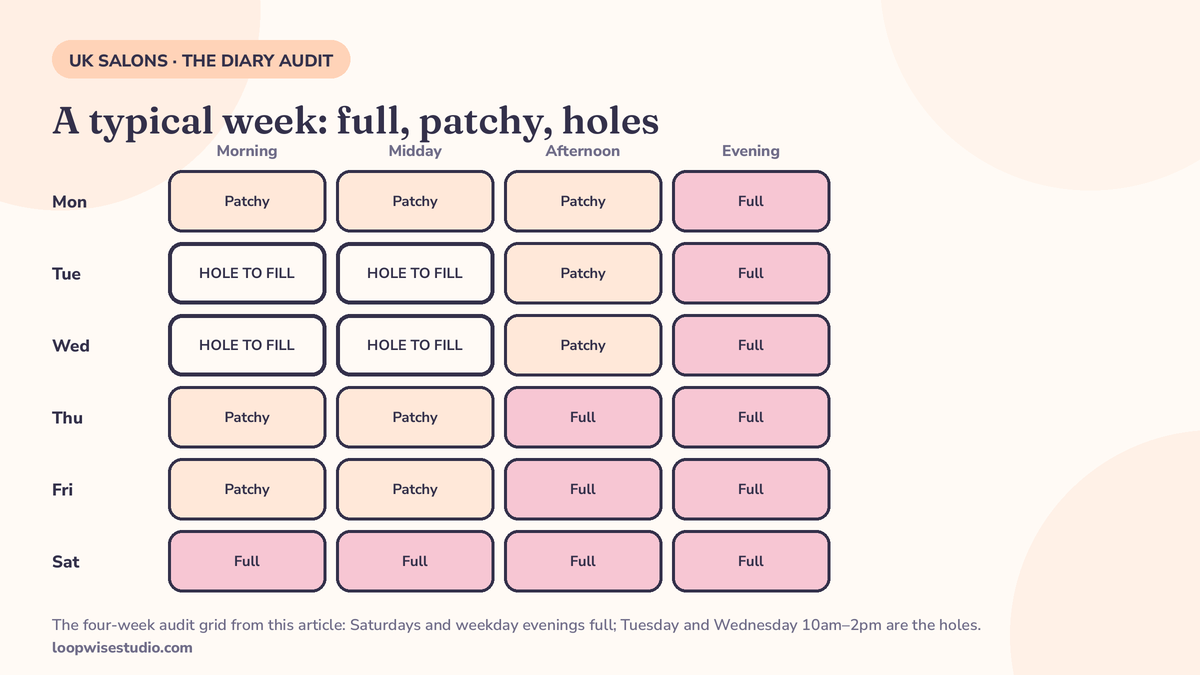
- Tuesday and Wednesday, 10am–2pm
- The first appointment of the day, every day
- The whole of the last week of the month
- One specific stylist’s column, while another is booked out
The shape matters because each shape has a different fix. A 10am–2pm hole is a school-hours and retiree opportunity. A last-week-of-the-month hole is a payday problem, solved by rebooking intervals, not offers. A single stylist’s empty column is a client-matching problem.
Write the holes down as a simple grid:
| Morning | Midday | Afternoon | Evening | |
|---|---|---|---|---|
| Mon | ||||
| Tue | ||||
| Wed | ||||
| Thu | ||||
| Fri | ||||
| Sat |
Mark each cell full, patchy or empty for a typical week. That grid is your campaign plan for the next month — every message you send from here aims at a specific empty cell.
Step 2 — Move demand you already have: discount the slot, not the service
The core idea, again from Nuzzel’s essay: you don’t need more clients — you need the clients you already have to come in at a different time. And the rule that protects your prices while you do it: only ever discount capacity that was about to expire.
A Saturday colour client who moves to Tuesday is worth more at full price than a discounted Tuesday client who would never have come on Saturday. So the offers go to people who are already booked into your peak, or already due a visit:
- Time-shift offers. A regular with a Saturday booking gets a message: same service, Tuesday 11am, with a free treatment upgrade (not money off) if she moves. She gets a quieter salon and a bonus; you get a Saturday slot to sell twice.
- Expiring-capacity offers. A specific empty slot, offered to a short list, with a deadline: “Thursday 10.30 has opened up — first reply gets it, with a free conditioning treatment.” The slot was worth £0 unsold. The service price never moves.
- Bundles, not percentages. Treatwell’s own partner guide uses the right shape here: a bundle like “cut, colour and consultation for £99” rather than “50% off everything.” A bundle fills two chairs’ worth of time and reads as a treat, not a sale.
Who gets these messages? Not your whole following. Thirty lapsed or flexible regulars who match the hole — parents who book in school hours, retirees who prefer mornings, hybrid workers home on Mondays and Fridays. A short list, sent on WhatsApp, beats a public discount post every time, because the offer stays invisible to the clients paying full price on Saturday.
The money, honestly
Run this as labelled arithmetic on your own prices. Say a colour appointment is £85. Moving one Saturday colour client to Tuesday at full price keeps £85 and frees a Saturday slot you can sell again. Discounting that Tuesday appointment by 20% to attract a stranger gives away £17 — and teaches the stranger to wait for the next offer. The time-shift is worth more before you count the second Saturday sale.
The same logic prices the hole itself: a two-hour Tuesday gap in a staffed salon is rent, wages and heating already spent. Filling it at full price, even with a free £5-cost upgrade thrown in, is almost pure recovery.
Step 3 — Rebook by interval, into weekdays
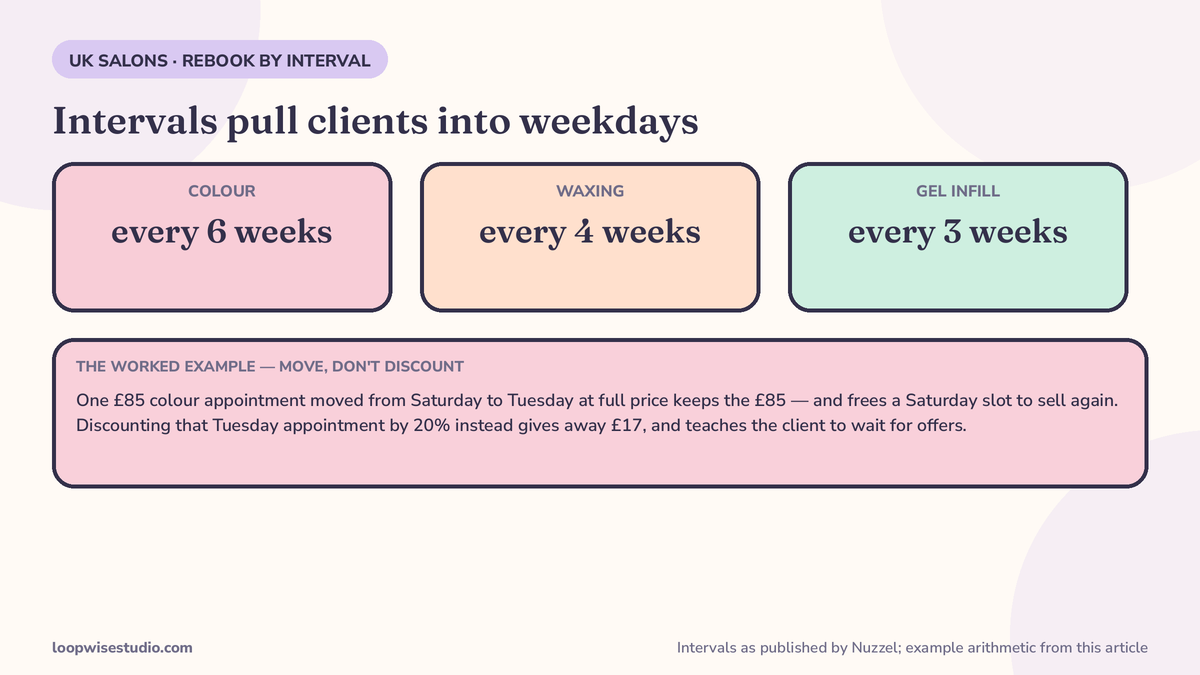
The cheapest weekday booking is the one made before the client leaves the salon. The mechanic is the interval: every treatment has a natural return window, and the next appointment should be booked against it — into a weekday slot, while the client is still in the chair.
Nuzzel publishes the intervals it works to:
| Treatment | Rebooking interval |
|---|---|
| Colour | Every 6 weeks |
| Waxing | Every 4 weeks |
| Gel infill | Every 3 weeks |
Count six weeks forward from a Saturday colour appointment and you usually land midweek. That is not a coincidence to waste — it is the system. The client gets the date her roots will actually need it; you get a Tuesday booking made six weeks early, at full price, with no campaign at all.
The in-chair script is thirty seconds:
“Your colour will want doing again in about six weeks — that lands on Tuesday the 14th or Wednesday the 15th. Shall I put you in now, while you’ve got the choice of times? You can move it any time.”
Three details make it work: a specific date (not “in a few weeks”), a weekday offered first, and permission to move it (which kills the fear of committing). If the client won’t book, the interval still goes in the diary notes, so the reminder system can pick her up at week five — the same rebooking engine that powers weekday fill systems for hair salons in the US, run here on WhatsApp instead of email.
Step 4 — Last-minute gap fills: the cancellation list and the WhatsApp broadcast
Some holes only appear the day before: a cancellation, a colour client who moves to next month. These are filled from a standing list, not a public post.
Build the list from three groups: clients on a waiting list for peak slots, lapsed regulars (HD Brows’ brand guide suggests reconnecting with clients you haven’t seen in six months — weekday gaps are exactly where to aim them), and clients whose interval says they’re due.
The mechanics that matter:
- Send to the segment, not the world. A Tuesday 10am gap goes to school-hours clients and retirees. A Thursday evening gap goes to workers. Twenty well-aimed messages outperform 800 followers seeing a Story.
- One slot, one message, first reply wins. Scarcity is real here, so say it plainly.
- Reply-to-book. The message must end in a booking, not a phone call: a link, or a reply that your system turns into a confirmed appointment.
Copy-ready templates:
Gap fill: “Hi [Name], a colour slot has just opened this Thursday at 10.30 with [Stylist] — yours if you want it, with a free conditioning treatment. Reply YES and I’ll book you in. — [Salon]”
Interval nudge: “Hi [Name], your last colour was [date] — most clients rebook around now to keep it fresh. I’ve got Tuesday 11.00 or Wednesday 13.30 this week. Want me to hold one? — [Salon]”
Lapsed regular: “Hi [Name], it’s been a while — hope you’re well. We’ve got some quieter weekday mornings at the moment, so if you fancy a [service], I can do [day/time]. No rush if not. — [Salon]”
One discipline keeps this list working: ask permission and keep it short. Every client on the list should have agreed to hear about last-minute slots — ask at the till or in a normal reminder — and two or three messages a month is plenty. A gap-fill list that gets spammed becomes an opt-out list, and then Tuesday’s hole has no audience at all. Treat the list like the asset it is: it is the difference between a cancellation costing you a morning and costing you ten minutes.
If cancellations are a recurring hole rather than an occasional one, pair this with a proper refill workflow — our guide to filling cancelled appointments automatically covers the waitlist mechanics in full. And if no-shows are creating the gaps in the first place, fix that leak first with a deposit and reminder system for UK beauty salons.
Step 5 — Weekday-only products: give Tuesday its own menu
The final step is making weekdays bookable in their own right, not as Saturday’s leftovers:
- Express lunchtime services for office areas: 30–45 minute services that only exist 12–2pm, bookable online, in and out inside a lunch break.
- Maintenance plans valid Monday–Thursday: a monthly blow-dry or gel-maintenance plan priced for weekday use. The client gets a keener price for off-peak loyalty; you get predictable weekday revenue. The discount is bought with timing, not given away.
- Training and model slots: junior stylists’ model appointments placed in the holes, clearly labelled, at model prices — capacity that builds your team’s skills instead of sitting empty.
- Retail-attached returns: HD Brows gives the neat version — £5 off the next treatment with a product purchase. The client buys retail today at full margin and returns on a weekday to use the reward.
Notice what none of these do: cut the price of a Saturday service. Weekday products are a separate menu, so peak pricing stays clean.
If you’d rather have the whole system — diary audit, reminder and rebooking engine, gap-fill broadcasts — set up and run for you, get a free audit and we’ll map your holes and the campaigns that fill them.
Own your list vs renting the marketplace’s off-peak demand
Treatwell’s answer to quiet times is its off-peak toggle: turn on offers inside Connect and let the marketplace send you its demand. Treatwell’s own guide notes that clients you upload yourself are commission-free — but clients the marketplace finds you are the marketplace’s channel, on the marketplace’s terms, and new-client commission applies to marketplace bookings.
The honest comparison:
| Your own list (WhatsApp) | Marketplace off-peak | |
|---|---|---|
| Who you reach | Regulars and lapsed clients you already know | New clients browsing the marketplace |
| Cost per filled slot | A message — pence | Commission on marketplace bookings |
| Price control | Full — slot offers, bundles, upgrades | Offer-led, inside their system |
| The relationship afterwards | Yours: she rebooks with you | Theirs: she rebooks through the app |
Marketplaces are genuinely good at one thing: introducing strangers. They are an expensive way to move your own regulars from Saturday to Tuesday — a job your own list does for pennies. Use each for what it’s for.
A one-week campaign calendar (worked example)
For a salon whose audit shows Tuesday/Wednesday 10am–2pm holes and a thin Monday:
- Monday 9am: Send the interval nudge to colour clients due this week — aim at Tue/Wed slots.
- Tuesday 8.30am: Check today’s gaps. One gap-fill broadcast to the school-hours segment if a slot is still open at midday.
- Wednesday: Book-at-the-chair push — brief the team: every client leaving today gets a weekday rebooking offer with a specific date.
- Thursday: Lapsed-regular message (five names, personal, weekday mornings only).
- Friday: Review: which cells filled, which messages got replies, what to repeat. One hour, diary open.
- Saturday: Nothing. Saturday sells itself — your only job is moving its overflow into next week’s weekdays at checkout.
Run that rhythm for four weeks before you judge it. Weekday habits compound: every interval rebooking made this week is a weekday filled six weeks from now.
To recap: audit four weeks to find the real holes, move existing clients into them with slot-specific offers at full service price, rebook by interval into weekdays, and keep a WhatsApp list for last-minute fills. The demand was never missing — it was standing in the Saturday queue.
Want us to run the audit on your diary and set up the campaigns? Get a free audit and we’ll show you exactly which hours are leaking and the messages that fill them.
FAQs
Should I just run a discount on quiet days?
A blanket discount is the weakest tool. It cuts the price for clients who would have booked anyway and trains everyone to wait for offers. Discount the slot instead — a specific empty appointment, offered to a short list, with the service at full price and something small added (an upgrade, a treatment). As Nuzzel’s quiet-weekday essay argues, only discount capacity that was about to expire unsold.
How do I fill Tuesday mornings specifically?
Tuesday 10am–2pm is a school-hours and retiree slot. Aim interval nudges and gap-fill messages at parents who book while children are at school and retired clients who prefer mornings, offer express services that fit the school run, and rebook Saturday parents forward six weeks — the date usually lands midweek on its own.
What’s the difference between this and Treatwell’s off-peak offers?
Treatwell’s off-peak toggle fills slots with marketplace clients, and marketplace bookings carry new-client commission; Treatwell also notes clients you upload yourself are commission-free. This system moves your own regulars and lapsed clients into weekdays over WhatsApp, so the booking — and the next one — stays yours at full price.
How long before quiet weekdays actually fill?
Expect the gap-fill broadcasts to work in week one for individual slots, and the interval rebooking to take one full treatment cycle — roughly six weeks for colour — before the weekday diary visibly thickens. Measure with the same four-week audit you started with, comparing like for like.
Do I need special software to run this?
You need three things: a diary you can read four weeks back, a way to message a segment of clients (WhatsApp broadcast or your booking system’s messaging), and booking links in those messages. A salon booking system with WhatsApp reminders built in makes the interval nudges and gap fills automatic, but the system works manually at small scale — the discipline matters more than the tool.
What if my quiet problem is no-shows, not empty slots?
Different leak, different fix. If slots are booked but people don’t turn up, start with deposits and a real reminder sequence — that’s covered in our guide to reducing no-shows at a UK beauty salon, linked above. Fill campaigns assume the bookings you make actually happen.