Online Booking System for Nail Salons in the UK
What a UK nail salon booking system must actually do: per-tech diaries, deposits, soak-off-aware slots and WhatsApp reminders — plus what the tools cost.
For a UK nail salon, an online booking system needs a per-technician diary, deposits at booking, and automatic reminders. DIY tools that do this run from free (Fiinq) to £35–£49 a month (SereniPlanner), plus per-text fees. A done-for-you alternative is your own website with booking built in and reminders sent on WhatsApp, so you own the client list instead of renting it from a marketplace.
That is the short version. The longer version matters, because most “booking systems” sold to nail salons were built for hairdressers or dentists first, and nails have mechanics those tools quietly get wrong.
A full set is not a 45-minute slot. A BIAB infill is not a polish change. If your system treats them as interchangeable diary blocks, clients book the wrong length, your day runs over, and the client who did everything right waits on a plastic chair while her nails soak.
This page covers what the system has to do for nails specifically, the three ways UK salons take bookings today, what each route costs, and the one part almost nobody automates: WhatsApp.
What “online booking” actually has to do for a nail salon
Strip away the marketing and a nail salon booking system has six jobs.
One diary column per technician. Clients follow techs, not salons. A returning client wants her tech, at her usual time, for her usual service. If your booking page shows one merged diary, clients either book the wrong person or give up and message you instead.
Slot lengths that know about soak-offs. A set removal plus a fresh full set takes far longer than the set alone. The system needs durations per service including removal, and it needs to add that time automatically when a client books “full set” after wearing extensions — not rely on her knowing to mention it.
Patch tests and health questions before the slot is confirmed. SereniPlanner, one of the UK diary tools, builds patch-test checks and health questionnaires into its booking flow — that is the right instinct. A client who has never had the product before should not be able to take a Saturday slot that you then have to cancel by phone.
A deposit on the long services. Full sets, nail art and Saturday appointments are where a no-show hurts. Short services can stay deposit-free; a two-hour set cannot. More on sizing below.
Reminders that go where clients actually read them. Email reminders are the default in most diary software. In the UK, the message clients open is a WhatsApp or a text. Fiinq charges 6.25p per text and SereniPlanner 5p per text on top of a £2.50 monthly bolt-on (prices as published, October 2026) — cheap, but you are still paying per nudge, and neither is WhatsApp.
The next infill booked before this one ends. This is the job no booking page advertises, and it is where nail salons make or lose their money. It gets its own section below.
Everything else — reports, takings by payment method, pretty themes — is decoration. If a system cannot do those six jobs, it is a calendar with a logo.
The three ways UK nail salons take bookings today
Every salon we look at is on one of three routes. None of them is automatically wrong. They fail in different places.
| Marketplace app (Booksy / Fresha) | DIY diary software (SereniPlanner / Fiinq / StudioOps) | Your own website + booking + WhatsApp | |
|---|---|---|---|
| Who owns the client list | The marketplace — you see names inside their app | You do, inside the software | You do, on your own site and number |
| What it costs | Commission/fees on marketplace bookings (third-party reported — check current terms) | £0–£49/mo + per-text fees | One build + a flat monthly fee, no commission |
| Deposits | Yes, configurable (e.g. per-service rules on Booksy) | Yes on paid tiers; Fiinq gates card payments behind £14.99–£24.99/mo | Yes, set per service |
| WhatsApp reminders | No — app notifications/email | No — SMS at 5–6.25p per text | Yes, built in |
| Setup | You configure it yourself | You configure it yourself (SereniPlanner offers paid onboarding) | Done for you |
| Your bookings live at | Their app and their search results | A booking page on their domain or a widget | Your own domain |
The marketplace route has one genuine advantage: discovery. Someone searching the app in your town finds you. The cost of that discovery is that the relationship lives in their app — your regulars rebook through a platform that also shows them your competitors, and your client list is not really yours to take with you.
DIY software fixes the ownership problem and is honestly priced. What it does not fix is the channel problem: your clients still get email reminders they ignore and texts you pay for per message, and your “website” is usually a booking page on the software’s domain rather than a site of your own. That last point matters more than it sounds — the whole reason a booking page on your own website turns visitors into booked appointments instead of enquiries is that it sits on your domain, under your name, next to your prices and your gallery.
The third route — your own website with booking built in and WhatsApp doing the reminders — is what we build. It is not the cheapest route on day one. It is the only one where the asset (site, list, number, reviews) belongs to you.
If you are comparing routes for a different kind of studio, the same logic applies: our guide to a booking system for tattoo studios in the UK, with deposits works through the same marketplace-versus-your-own-site maths for artists.
The part nobody automates: WhatsApp
Here is how nail bookings actually happen in most UK salons. A client finds you on Instagram. She does not click a booking link — she sends a DM. Or she WhatsApps the salon number: “Have you got anything Saturday for a BIAB infill and a bit of art?” Someone replies between clients, or at 10pm. Three messages later she is booked — or she has gone quiet, and you never find out why.
Every tool on the first page of Google for this search treats WhatsApp as a place to paste a booking link. Fiinq mentions sharing your link on WhatsApp. StudioOps uses WhatsApp to deliver booking links. Nobody builds the flow the other way round: the client messages your WhatsApp, and the system handles it.
That flow looks like this:
- Client messages your salon WhatsApp number (from Instagram, Google, or your website).
- The system replies in seconds, any hour: which service, which tech, and the live slots for that service at the right length.
- She picks a slot. If the service needs a deposit, she gets a payment link in the same chat. Slot confirmed only when the deposit lands.
- Confirmation lands on WhatsApp. So does the reminder. So does the “you’re due” message when her infill window opens.
No app to download. No account to create. No new behaviour for the client to learn — she was already messaging you. The change is that the replies are instant at 11pm and nobody on your team types them.
The same flow, pointed at a different problem, is also how you reduce no-shows at a UK beauty salon: deposits plus WhatsApp reminders, working as one system instead of two separate habits.
Deposits that protect long sets without scaring clients off
Deposit anxiety is real, and it is usually based on a bad first attempt: the salon turns on a 50% deposit for everything, bookings dip, and the owner concludes “my clients won’t pay deposits.”
The fix is not no deposits. It is deposits sized to the risk:
| Service type | Suggested deposit approach |
|---|---|
| Polish change / short tidy (under 45 min) | No deposit — the slot is easy to refill |
| Standard infill or gel set (45–90 min) | Fixed small deposit (£10–£15) or card on file |
| Full set, nail art, Saturday peak slots (90 min+) | 30–50% of the service price, paid at booking |
| New client, first visit | Deposit regardless of service — she has no track record with you yet |
Two wording rules make deposits land better. First, call it what it does: “This holds your appointment and comes off your bill on the day.” Second, pair it with a fair move policy — free to move once with 48 hours’ notice, deposit follows the booking. Clients accept deposits they see as a reservation. They resist deposits that feel like a fine.
And be honest with yourself about what a deposit is for. It is not punishment money. It is what turns a casual “book me in x” into a commitment — and on the rare no-show, it covers part of the slot your tech sat empty through.
If you want the numbers for your own salon looked at — deposit levels against your service mix and your actual no-show pattern — you can get a free audit. No pitch deck; we will tell you what we would change and what we would leave alone.
The infill loop: the retention engine hiding in your diary
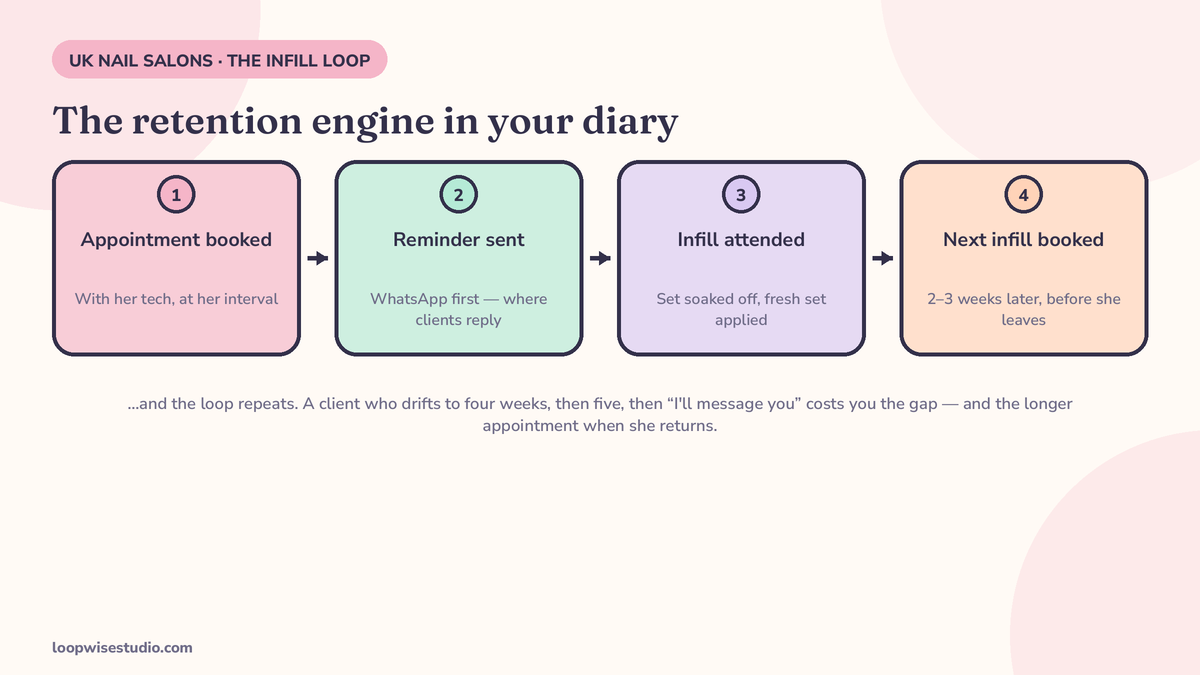
Nails are a cycle business. A BIAB or extension client needs an infill roughly every 2–3 weeks — that is the interval the systems themselves are built around (SereniPlanner’s booking flow and Fiinq’s reminder features both assume it). Every cycle a client drifts — books at four weeks, then five, then “I’ll message you” — costs you twice: the gap itself, and the longer appointment when she finally returns with grown-out nails.
Your booking system should run the loop without you:
- At the appointment: the next infill is booked before she leaves, at her interval, with her tech. This is the single highest-value habit in nail retention and it costs nothing.
- If she leaves without booking: a WhatsApp goes out when her window opens — “You’re due for your infill this week. I have Thursday 2pm or Saturday 10:30 with [tech].” Two taps and she is in.
- If she drifts past her interval: one more message, warmer than a sales text: grown-out sets lift and break, and a timely infill is genuinely better for her nails. That is true, and clients know it is true, which is why it works.
- If she goes quiet entirely: she drops into a win-back list, not a daily nag list. One message a month, max.
This is also where UK nail salons quietly beat the US version of this setup. The American version of this page — our online booking website for nail salons guide — runs this loop on text messages, because that is the channel US clients read. In the UK the same loop runs on WhatsApp, which your clients are already using to book you manually.
What it costs: software fees vs a done-for-you system
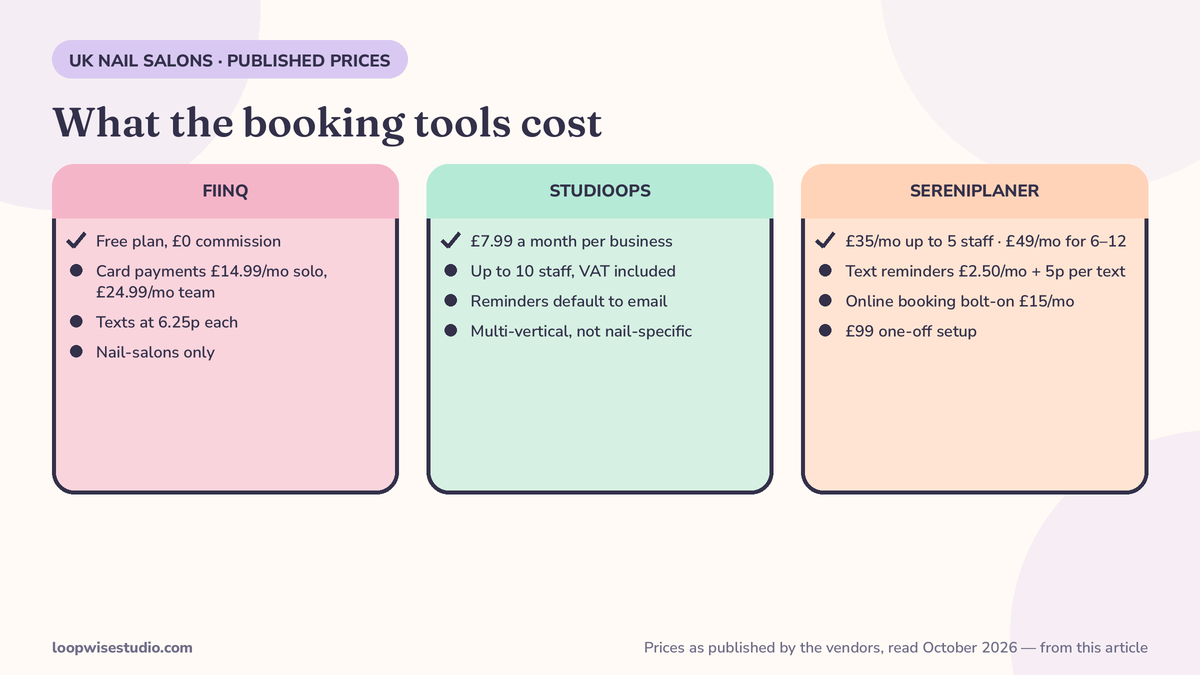
Honest numbers, all from the vendors’ own pages, read on 21 October 2026. Check current pricing before you decide — these tools change prices often.
| Option | Published price | What is not in that price |
|---|---|---|
| Fiinq (nail-salons-only) | Free plan, £0 commission; card payments £14.99/mo solo, £24.99/mo team | Texts at 6.25p each; reminders by email on the free route |
| StudioOps | £7.99/mo per business, up to 10 staff, VAT included | Reminders default to email; multi-vertical, not nail-specific |
| SereniPlanner | £35/mo (up to 5 staff), £49/mo (6–12), £99 one-off setup | Text reminders £2.50/mo + 5p/text; online booking bolt-on £15/mo |
| Phorest | No price published — quote only; no commission on bookings | Priced and built for larger salons; WhatsApp is not the reminder channel |
| Your own website + booking + WhatsApp (Loopwise) | Fixed quote after a free audit — we do not publish a rate card | — |
Add the per-text maths up before you dismiss it. A four-tech salon sending confirmations plus two reminders per appointment, at 300 appointments a month, sends roughly 900 texts. At 5p that is £45 a month in reminder fees alone, on top of the subscription — every month, forever, for messages your clients would rather get on WhatsApp anyway.
The DIY route is cheaper in cash. It costs you in time: you configure the diary, write the reminder templates, set the deposit rules, and rebuild it when you change tools. The done-for-you route costs more in cash and nothing in evenings. Which one is right depends on whether you have evenings to spare. Most salon owners we talk to do not.
How Loopwise builds it / what you get
We build the third route from the comparison table: a website on your own domain, built for nails, with the booking system and WhatsApp automation set up for you.
- Your website: your services with real durations (soak-off time included), your techs, your gallery, your prices — on your domain, not a booking page on someone else’s.
- Booking that fits nails: per-tech diaries, per-service durations, patch-test and health questions for new clients, deposits on the services you choose.
- WhatsApp automation: enquiries answered instantly, bookings taken in the chat, confirmations and reminders on WhatsApp, and the infill rebooking loop running at each client’s interval.
- Your list stays yours: every client who books is in your system, exportable, forever. Leave us and it goes with you.
- Set up for you: we configure services, durations, deposits and message wording with you, then it runs. You do nails.
FAQ
Do I need a website if I already take bookings on Booksy or Fresha?
You do not need one to take bookings — the marketplaces do that. You need one to own the relationship. Bookings made on a marketplace live in their app, under their rules, next to your competitors. A website of your own is where your regulars book direct, where Google sends people who search your salon’s name, and where your client list is actually yours.
How much should a nail salon charge as a deposit?
Enough to protect the slot, not so much it feels like a fine. A workable pattern: nothing on short services, a fixed £10–£15 on standard infills and sets, and 30–50% on long sets, nail art and peak Saturday slots. New clients pay a deposit on their first visit whatever they book. Always let the deposit come off the bill on the day and follow the booking if they move it with notice.
Can clients book through WhatsApp instead of a booking page?
Yes — and in the UK it is usually the better front door. The client messages your number, the system offers live slots for the right service and length, takes the deposit if one applies, and confirms in the same chat. A booking page is still worth having on your website for Google visitors, but WhatsApp is where your existing clients already are.
How long does it take to set up?
DIY software can be live in a day if you configure it yourself — Fiinq advertises setup from a photo of your price list. A done-for-you website with booking and WhatsApp automation takes longer, because the service durations, deposit rules and message wording are set up with you rather than guessed. Ask us on the audit and we will give you a straight timeline for your salon.
Will an online booking system work for a solo or home-based nail tech?
Yes — arguably better, because you have no receptionist and no spare hands. The solo case is where instant WhatsApp replies matter most: every enquiry answered while your hands are literally in someone else’s soak-off. Pick per-business pricing (StudioOps charges £7.99/mo per business, not per user) or a done-for-you setup, and keep the deposit rule for new clients — home-based techs get stood up too.
What happens to my client list if I leave my current software?
It depends on the tool, and it is worth checking before you sign anything. With your own website and booking system, the list lives in your system and exports with you. With marketplaces, you generally keep access only while you subscribe. Whatever you choose, export your client list regularly — it is the most valuable thing your salon owns.
To recap: the right booking system for a UK nail salon is per-tech, deposit-aware, duration-honest — and it talks to clients on WhatsApp. If you’d like us to build it on a website you own, get a free audit and we will map your services, slots and deposit rules before quoting anything.