How to Reduce No-Shows at a Salon in Australia
Cut salon no-shows with a system, not a scolding: a written policy, deposits sized by service, a 48-hour two-way text, waitlist refills and an offender ladder.
Australian salons cut no-shows with three things working together: a written cancellation policy (commonly 24 hours’ notice, a fee of 50% of the service, capped), a deposit taken at booking for long or first-time appointments, and a two-way reminder text 48 hours before that lets the client confirm or reschedule by reply.
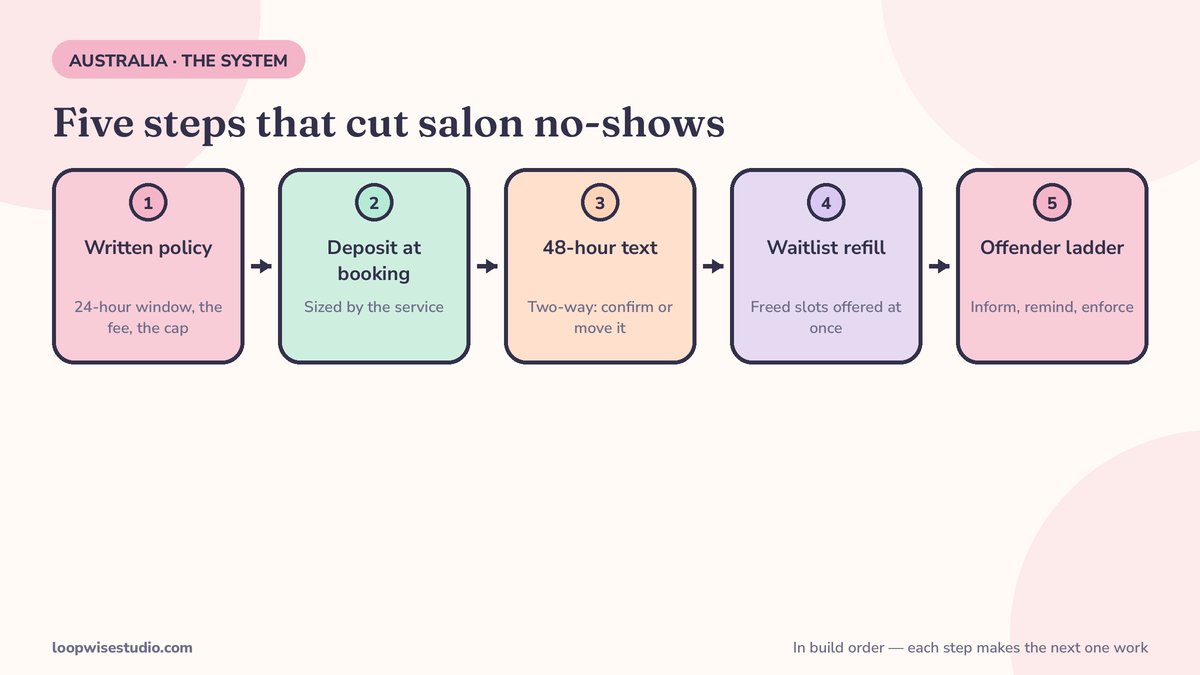
Most no-show advice fails because it hands you those pieces as a pile. Deposits without reminders feel like a tax on your good clients. Reminders without a policy have no teeth. A policy nobody enforces is wall decoration. The fix is a system — five steps, in order — and it sits on the same foundations as our pillar guide to reducing no-shows at a med spa, adapted here to how Australian salons actually run.
What a no-show actually costs a salon — a worked example, assumptions shown
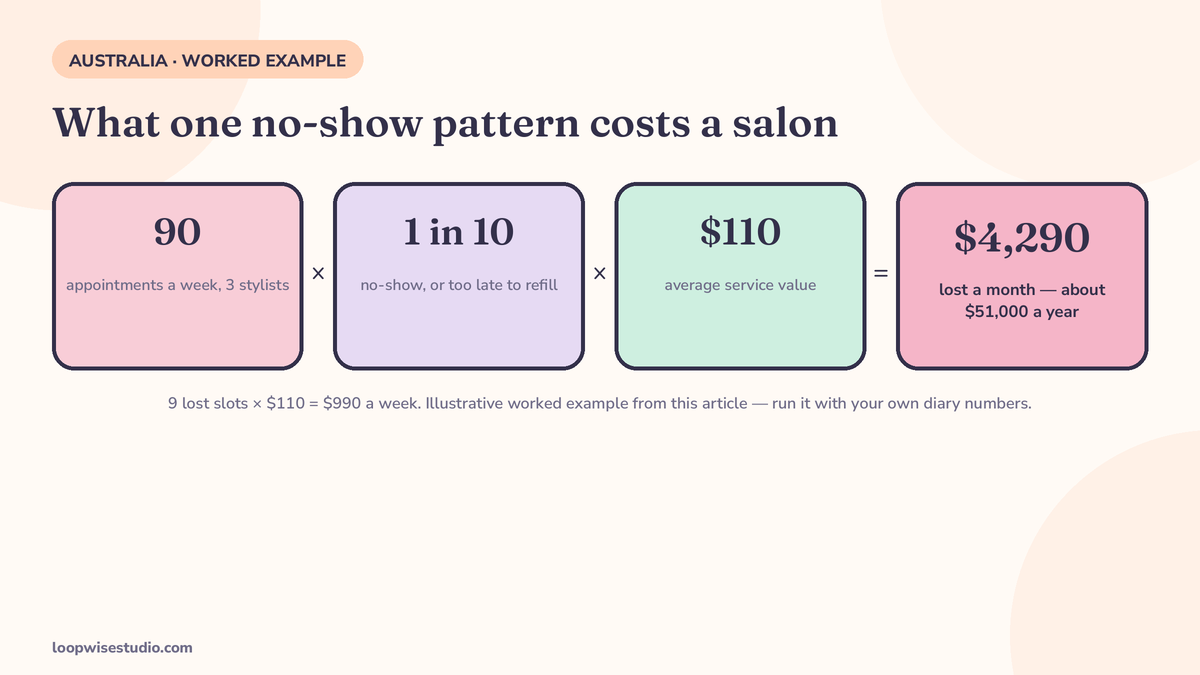
You will not find a trustworthy published “Australian salon no-show rate” — we looked, and the figures floating around trace back to unnamed “studies” or vendor marketing. So don’t borrow one. Do this arithmetic with your own numbers instead.
Worked example (illustrative — your numbers will differ):
- 3 stylists, 90 appointments a week between them
- 1 in 10 appointments no-shows or cancels too late to refill: 9 lost slots a week
- Average service value: $110
- 9 × $110 = $990 a week ≈ $4,290 a month ≈ $51,000 a year
Run it with your diary: appointments per week × your honest no-show count × your average service price. However the maths lands, it prices the problem — and it tells you what a deposit system, reminder software or a done-for-you setup is worth paying for. Every step below exists to shrink that middle number.
Step 1 — Write the policy down: the 24-hour window, the fee, the cap
The most specific published Australian salon system comes from Lilliane Caron of Caronlab, writing about her own salon (Smooth & Tan) in Professional Beauty: cancel with less than 24 hours’ notice and the fee is 50% of the service, capped at $100.
Copy the shape of that, in writing, in three places: on your booking page before the client confirms, in the confirmation text, and on a sign at the desk. A policy the client met at booking is a term they agreed to. A policy they first hear about after they’ve no-showed is an argument.
Keep the framing fair and simple:
Life happens. Cancel or move your appointment with 24+ hours’ notice and there’s no charge. Inside 24 hours, a fee of 50% of the service (max $100) applies, because that chair was held for you and can’t usually be refilled at short notice.
One honesty note: keep fees clearly disclosed at booking and tied to the slot you genuinely held — that’s basic fairness to your clients, and it’s the version of this policy that survives a chargeback dispute and a bad review. This is general information, not legal advice; if you want the legal position for your state, that’s a question for your adviser.
Step 2 — Take a deposit at booking, sized by the service
Deposits are not for every appointment. They’re for the appointments that hurt. Caronlab’s rule: $50 deposit on appointments over $100. Kitomba, the AU/NZ salon software vendor, targets the same shape from the other direction: deposits for appointments over 90 minutes, colour services, first-time clients, repeat offenders and Saturdays.
Take the deposit at booking — online, by card — never at the door. A deposit collected at booking does three things a policy alone can’t:
- It makes the appointment feel owned. People protect what they’ve paid toward.
- It funds the fee automatically if they vanish, so nobody has the awkward collection call.
- It filters the casual double-bookers, who simply won’t pay to hold two chairs at once.
What about the softer alternative — Caronlab also offers a 10% discount for prepaying in full? It’s worth seeing clearly: a discount pays every good client a margin cut to solve a problem caused by a few. A deposit costs your good clients nothing (it comes off their bill) and charges only the behaviour you’re trying to stop. For most salons, deposit beats discount.
Step 3 — The 48-hour two-way reminder: copy included, reply to confirm or move
Forty-eight hours before is the sweet spot — near enough to act on, far enough to refill. Kitomba’s published cadence runs 48h / 24h / 2h; Caronlab’s salon sends a 48-hour SMS and follows up by phone the same day if there’s no reply. Either way, the 48-hour text must ask a question:
Hi [Name], it’s [Salon]. Your [Service] with [Stylist] is [Day] at [Time]. Reply YES to confirm, or R and we’ll help you move it. Running late on the day? A quick text saves your slot.
No reply by the evening before? For long services: “Hi [Name], we haven’t heard back — please reply YES by 8pm or we’ll release your [Time] slot to the waitlist.”
The reply is the product. A one-way notification tells the client something. A two-way text tells you something — confirmed, moving, or silent — while there’s still time to act on all three. And once your booking and reminder system is connected, the same texts run themselves on your own website: our page on online booking websites for Australian salons with text reminders lays out that setup and what it costs.
If you’d rather see this whole sequence — policy, deposits, texts, refill — mapped onto your salon’s services, get a free audit and we’ll do the mapping with your real prices and appointment lengths.
Step 4 — Refill the gap: the waitlist text that goes out the moment a slot frees
Every cancelled slot older than a few hours is nearly unfillable by phone tag. By text, it’s a race your waitlist usually wins.
Keep a standing waitlist: clients who wanted Saturday, clients happy to come earlier, clients on cancellation watch for a specific stylist. The moment a slot frees — a reschedule reply at the 48-hour mark, a morning cancellation — one text goes to the handful who fit:
Hi [Name], a [Service] slot with [Stylist] just opened: [Day] at [Time]. Reply YES and it’s yours — [Salon]
First YES takes it; the rest get a polite “it’s gone, you’re still on the list” automatically. This step is what converts your reminder system from damage control into revenue: the no-show still happened, but the chair didn’t stay empty. It’s the same refill mechanic we detail in our guide to filling cancelled salon appointments automatically — here it runs on SMS, because in Australia text is the channel that gets answered.
Step 5 — The repeat-offender ladder: inform, remind, enforce — and note the file
Caronlab’s ladder is the fairest published version, and it’s worth copying almost exactly:
- First offence: fee waived. Note on the client file. Friendly word at the next visit — “we’ve popped a note on your file; next time the policy applies.”
- Second offence: fee waived again — but from now on, this client prepays or leaves a deposit to book.
- Third offence: the fee is charged.
Two things make it work. First, the file note: the ladder only exists if every offence is recorded, so the third conversation is factual, not emotional. Second, senior staff handle the enforcement conversation, scripted and calm — Caronlab is explicit that this is not a job for your junior on a Saturday rush.
The ladder’s real message to your good clients is that the rules bend once, bend twice, and then hold — which is exactly why they’ll respect the reminder texts that arrive before it ever gets there. UK salons run a near-identical ladder over WhatsApp; our guide to reducing no-shows at a UK beauty salon is the same system in a different channel, if you want the comparison.
The awkward conversations, scripted — so your team doesn’t improvise them
Systems fail at the human moments: the phone call where a client argues the fee, the desk conversation where a regular is told they now prepay. Script both, the way Caronlab insists senior staff own them.
The fee conversation (second offence, at rebooking):
“Totally fine to move things around — we just ask for 24 hours’ notice so we can offer the chair to someone else. Because this is the second short-notice one, I’ll take a deposit to hold Saturday’s slot. It comes straight off your total on the day.”
The prepay conversation (third offence, kindly and final):
“I want to keep looking after your hair, and the honest problem is the empty chairs. From here, I’ll book you in with prepayment — that way your slot is guaranteed yours and neither of us is chasing the other. If life blows up, 24 hours’ notice and we move it, no fee.”
Notice what neither script does: apologise for the policy, blame the client, or negotiate the rule itself. And notice the exceptions both leave room for — genuine emergencies happen, and a salon that waives the fee for a hospital visit buys more loyalty than the $50 was worth. The ladder governs patterns, not tragedies. Note the exception on the file like everything else, and the system stays both firm and fair.
The no-reply rescue (when the 48-hour text gets silence before a long service):
“Hi [Name], just checking you’re still good for [Service] tomorrow at [Time] — reply YES and we’re set, or R and I’ll find you a better time today.”
One text, one deadline implied, no chase beyond it. If silence continues, the slot goes to the waitlist that evening — that’s Step 4 doing its job, and it’s why the ladder rarely has to be climbed at all.
The Australian footnote — your reminder’s sender name after 1 July 2026
One wrinkle no overseas guide will tell you: since 1 July 2026, a branded sender ID for your texts must be registered on ACMA’s SMS Sender ID Register. If your reminders go out under your salon’s name and that name isn’t registered, the sender ID is replaced with “Unverified” and the messages are grouped into a single thread that phones flag as possible scams.
A reminder your client never trusts is a reminder that doesn’t work. Check what your texts actually say on a client’s phone — send yourself one. If it reads “Unverified,” register the ID through your SMS provider before you tune anything else in this system.
Measure it — your no-show rate, monthly, by service
Close the loop, or the system quietly decays. Once a month, count: appointments booked, no-shows, late cancels, and how many freed slots the waitlist refilled. Split it by service — if colour no-shows and cuts don’t, your deposit rules should know that.
That’s your benchmark. Not a vendor’s “up to 30%” claim, not a number from an American blog. Yours, measured the same way every month, so you can see the month the ladder and the texts started working.
Keep the tracking stupidly simple — a one-page sheet, filled in on the last day of the month:
| Month | Booked | No-shows | Late cancels | Slots refilled | No-show rate |
|---|---|---|---|---|---|
| (example row) | 380 | 21 | 14 | 9 | 5.5% |
Three patterns to watch for in your own rows. If no-shows cluster on one service, that service needs a deposit or an earlier reminder, not a salon-wide crackdown. If late cancels cluster on one day, look at how far ahead those appointments are booked — the longer the gap between booking and chair, the more Step 3 has to carry. And if refills climb while no-shows hold steady, the system is still winning you money: an empty chair refilled is a no-show that cost you nothing. Measure the refill rate alongside the no-show rate, or you’ll underrate the waitlist and over-blame your clients.
Summary
Policy in writing, deposit at booking for the appointments that hurt, a two-way text at 48 hours, a waitlist that refills what still frees up, and a ladder that’s fair twice and firm the third time. Run it as one system and the no-show stops being weather — it becomes a number you manage down.
Want the system built and running on your salon’s own booking page? Get a free audit and we’ll cost it against your real no-show maths.
FAQs
How much deposit should an Australian salon take?
A common, published rule of thumb comes from Caronlab’s salon system: a $50 deposit on appointments over $100. Size it to the slot, not the client — long appointments, colour, first-timers and Saturdays are where deposits earn their keep. The deposit comes off the bill when the client attends.
What cancellation fee is fair?
The policy Caronlab publishes for her own salon is 50% of the service for cancellations inside 24 hours, capped at $100. Whatever you set, disclose it clearly at booking and keep it tied to the chair time you actually lost — fairness at booking is what makes a fee defensible later.
When should the reminder text go out?
48 hours before is the key touch: early enough to refill a freed slot, late enough that the client can commit. Add a short same-day message if you like, and follow up an unanswered 48-hour text with a phone call for long, expensive services.
Should I charge a client the first time they no-show?
The fairest published system says no: waive it, note the file, explain the policy. Waive it a second time but require prepayment from then on. Charge on the third. The ladder works because it’s predictable — clients can see it’s a system, not a mood.
Do deposits put clients off booking?
The honest answer: a deposit puts off the bookings you don’t want — the tentative, double-booked, maybe-I’ll-show ones. Clients who intend to come barely register it, because it comes straight off their bill. If a particular service’s bookings dip, exempt that service and watch the numbers rather than guessing.
My reminder texts arrive as “Unverified.” Does that matter?
Yes. Since 1 July 2026, unregistered branded sender IDs are replaced with “Unverified” and grouped in one thread flagged as possible scams. A client who doesn’t trust the sender doesn’t read the reminder. Register your sender ID through your SMS provider — it’s a form, not a project.