How Much Revenue Do Med Spas Lose From Missed Calls?
How much revenue med spas lose from missed calls depends on four numbers. See the formula, worked examples, and a table to calculate your own figure.
How much revenue med spas lose from missed calls depends on four numbers you can find this week: how many calls you miss, how many days you are open, what share of those callers would have booked, and what a booking is worth. For a mid-sized spa, a 2026 analysis by Lani AI estimated the loss at more than $100,000 per year. For a solo operator it will be smaller. For a busy six-day spa it can be larger. This page shows the maths behind the headline, so you can put your own numbers into it instead of borrowing someone else’s.
That matters, because almost every big number in this space comes from a company selling the fix. Ours is an agency that sells a version of the fix too, so we will be careful in the same way we would want others to be: every figure below is attributed, every assumption is on the table, and the last section of this article argues the number down as well as up.
Where the “$100,000 a year” figure comes from
The number you will see repeated across the internet traces back to one source. On 3 March 2026, a press release on 24-7PressRelease announced an AI receptionist from a company called Lani AI. Its exact wording was:
“A new industry analysis reveals that med spas across the United States may be losing more than $100,000 per year in revenue due to missed calls, delayed follow-up, and inconsistent booking systems.”
The release went further with a specific example:
“According to internal performance benchmarks analyzed by Lani AI, even three missed calls per day can result in more than $130,000 in lost annual revenue for a med spa with a $600 average booking value and a 30% call-to-booking conversion rate.”
Three things to notice about that claim.
First, the source is the vendor. “Internal performance benchmarks analyzed by Lani AI” is the whole methodology. No sample size, no number of spas studied, no third party. That does not make the figure false. It makes it unverified, and you should treat it the way you would treat a before-and-after photo with no date on it.
Second, the same release was syndicated widely. Versions of it appeared on several financial news sites and a city news site, lightly rewritten or word for word. If you searched this question and saw the same number five times, you did not see five studies. You saw one press release five times.
Third, the maths hides a fifth number. Take their own inputs: 3 missed calls a day, 30% of whom would have booked, at $600 each. That is $540 a day. To reach roughly $130,000 a year from $540 a day, you need about 241 days. In other words, the claim silently assumes a spa open about five days a week. Open six days and the same inputs give about $168,300. Open all year and they give $197,100. The headline is not wrong on its own terms, but the terms were never printed. That is the gap this page exists to fill.
The formula, with every assumption showing
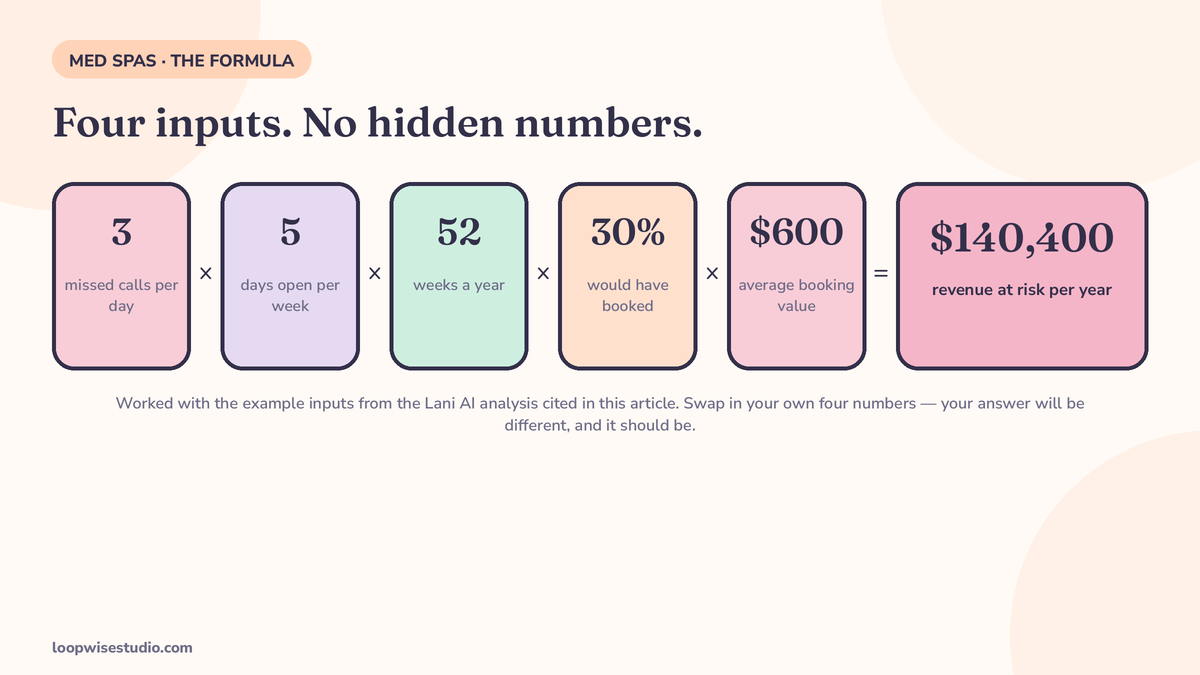
There are only four inputs. Here they are, with where each one should come from.
Missed calls per day. Not a guess. Your phone system or carrier keeps a log of unanswered calls. If you cannot get that report, the honest fallback is a week of manual counting. This is the input owners get wrong most often, usually by a lot, in both directions.
Days open per week. Yours. Five, six, or seven. This is the input the Lani AI example left out, and it swings the final figure by tens of thousands of dollars.
Call-to-booking conversion. What share of those missed callers would actually have booked if a person had answered? Lani AI used 30%. We will use 30% in the examples below so you can compare like with like, and we will flag it each time. Some of those calls would have been price shoppers who never buy anywhere, wrong numbers, suppliers, and existing clients with a quick question. Some would have been $2,000 package buyers. 30% is a working assumption, not a fact about your spa.
Average booking value. What a first booked visit is worth. Lani AI used $600. There is a third-party anchor for this one: AmSpa’s 2024 Medical Spa State of the Industry Report, cited by NetPartners, put average spend at $527 per visit, with an average of 245 patient visits per month across medical spas. We will use $527 in one example below so you can see the difference a sourced input makes.
The formula itself:
Missed calls per day × days open per week × 52 weeks × conversion rate × average booking value = revenue at risk per year
And the monthly version:
Missed calls per day × days open per week × 4.33 weeks × conversion rate × average booking value = revenue at risk per month
That is all there is. Anyone showing you a loss figure should be able to show you these four numbers. If a calculator will not show them, it is asking you to trust it instead of check it.
Do your own maths: a table you can copy
This is the calculation page in plain table form. Copy it, replace the example inputs with yours, and work down the rows. The example inputs are labelled as examples throughout. They use the Lani AI benchmarks — 3 missed calls a day, 30% conversion, a $600 average booking value — so you can see exactly what that claim is built from.
Step-by-step, using the example inputs
| Step | What you are working out | Example inputs | Example result |
|---|---|---|---|
| 1 | Missed calls per day | Count unanswered calls in your phone log for one full week, divide by days open | 3 |
| 2 | Days open per week | Your real trading days | 5 |
| 3 | Missed calls per week | Step 1 × Step 2 | 15 |
| 4 | Missed calls per year | Step 3 × 52 | 780 |
| 5 | Share who would have booked | Example benchmark: 30%, from Lani AI’s internal benchmarks as published in its March 2026 release | 30% |
| 6 | Lost bookings per year | Step 4 × Step 5 | 234 |
| 7 | Average booking value | Example: $600, Lani AI’s figure. Alternative sourced anchor: $527 average spend per visit, AmSpa 2024 | $600 |
| 8 | Revenue at risk per year | Step 6 × Step 7 | $140,400 |
| 9 | Revenue at risk per month | Step 8 ÷ 12 | $11,700 |
Read step 8 carefully. With these example inputs, the worked result is $140,400, which sits above the release’s “more than $130,000”. That gap is the point. Small changes in days open, missed calls, or booking value move the answer a lot, and a single headline number hides all of it. Your answer will be different. It should be.
Your own copy of the table
| Your input | Your number |
|---|---|
| Missed calls per day (from your phone log) | |
| Days open per week | |
| Missed calls per week (row 1 × row 2) | |
| Missed calls per year (row 3 × 52) | |
| Share who would have booked (start at 30% if you have no better figure) | |
| Lost bookings per year (row 4 × row 5) | |
| Average first-visit value in dollars | |
| Revenue at risk per year (row 6 × row 7) | |
| Revenue at risk per month (row 8 ÷ 12) |
What recovery could be worth — as scenarios, not promises
No fix recovers every missed call. Some callers have already booked elsewhere. Some never reply. So instead of one recovery claim, here are three scenarios applied to the example figure of $140,400 at risk. These are illustrations of the arithmetic, not a promise about any system, ours included.
| Scenario | Share of lost bookings recovered | Example value per year |
|---|---|---|
| Cautious | 40% | $56,160 |
| Middle | 60% | $84,240 |
| Strong | 80% | $112,320 |
Why show you three instead of one? Because one ranking calculator in this space tells owners a vendor recovers 84% of the loss, presented as a plain output with no source and no explanation of where 84% came from. That number is doing sales work, not maths. If someone gives you a single recovery figure, ask what it is based on and ask to see the range.
Three worked examples
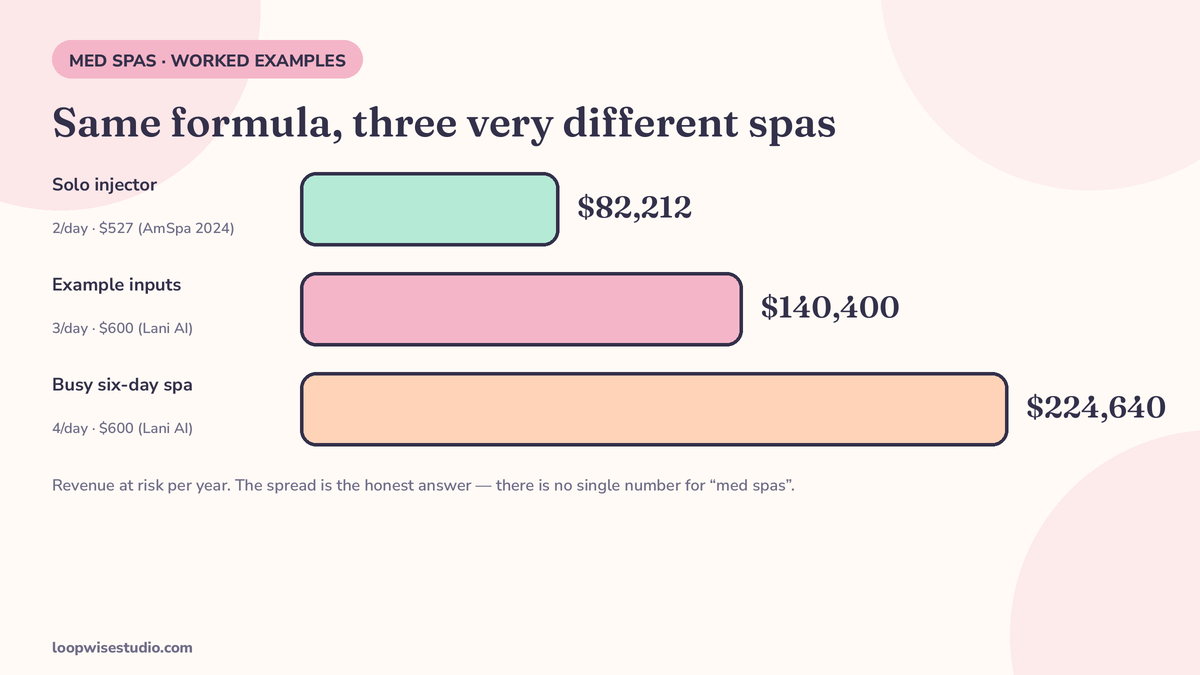
Example 1: The solo injector
One operator, renting a room or running a small studio, open five days a week, doing most treatments herself and answering the phone between clients. She misses fewer calls in total, but she misses them during her busiest, best-paid hours.
| Input | Value | Source or note |
|---|---|---|
| Missed calls per day | 2 | Example assumption — count yours |
| Days open per week | 5 | Example assumption |
| Missed calls per year | 520 | 2 × 5 × 52 |
| Conversion | 30% | Lani AI benchmark, used for comparison |
| Lost bookings per year | 156 | 520 × 30% |
| Average value | $527 | AmSpa 2024 average spend per visit |
| Revenue at risk per year | $82,212 | 156 × $527 |
That is not $130,000. It is also not small for a one-person business: roughly $6,851 a month, from two calls a day. And this example almost certainly understates her case, because a solo operator’s missed calls cluster at the exact hours she is earning most, which are also the hours new clients ring.
Example 2: The mid-sized spa, using published answering-service maths
HealthcareCallCenter, a medical answering service, published its own worked example. It assumed 25 calls a day, with 46% arriving after hours or during busy windows (a figure it attributed to call volume data across healthcare practices), giving about 11 calls a day at risk. Over 22 working days that is 242 calls a month. At 30% who would have booked, that is 72 lost bookings a month, at $500 each, or $36,000 a month in potential treatment revenue at risk.
We are showing you their numbers as they published them, in their framing. Note what they did and did not do. They were clear about every input, which is more than the press release managed. But 25 calls a day is a busy spa. AmSpa’s figure of 245 visits a month works out at roughly 11 visits a day. If your spa takes 10 or 12 calls a day rather than 25, scale this example down by half before you worry about it.
| Input | Their published value |
|---|---|
| Calls per day | 25 |
| Share at risk (after hours or busy) | 46% |
| Calls at risk per day | 11 |
| Working days per month | 22 |
| Calls at risk per month | 242 |
| Would have booked | 30% |
| Lost bookings per month | 72 |
| Value used | $500 |
| Revenue at risk per month | $36,000 |
Example 3: The busy six-day spa
Two or three treatment rooms, open six days, a front desk that is often one person covering check-ins, check-outs, and a ringing phone.
| Input | Value | Source or note |
|---|---|---|
| Missed calls per day | 4 | Example assumption |
| Days open per week | 6 | Example assumption |
| Missed calls per year | 1,248 | 4 × 6 × 52 |
| Conversion | 30% | Lani AI benchmark, used for comparison |
| Lost bookings per year | 374 | 1,248 × 30%, rounded |
| Average value | $600 | Lani AI’s booking value, deliberately, to show the top end |
| Revenue at risk per year | $224,640 | 374 × $600 |
The spread between Example 1 and Example 3 — $82,212 to $224,640 — is the honest answer to the question in this page’s title. There is no single number for “med spas”. There is a number for your spa, and it takes ten minutes to work out once you have your real missed-call count.
Why the real figure is often higher than the formula says
The formula counts one visit. Med spa clients are rarely one visit.
AmSpa’s 2024 report said 73% of medical spa patients are repeat patients. HealthcareCallCenter makes the same point in its own words: one missed call often equals one lost treatment visit worth $400 to $600, and multi-session packages commonly run $1,500 to $3,000. It also flags the case owners feel most keenly — a missed membership call, where a client ringing to pause or question a membership gets no answer and cancels a year of renewals instead.
Neurotoxin clients come back on an 8-to-12-week cycle. A caller who books Botox with the spa down the road in March is not just a lost March appointment. She is a lost May, August, and November appointment too, and she will probably take her filler and her facials there as well, because that is now her spa.
None of that is in the formula, on purpose. Lifetime value estimates can be stretched to make any number look enormous, and you should be suspicious of any page that multiplies a missed call by five years of spending without telling you. But it is worth knowing the direction of the error: a first-visit-only calculation is a floor, not a ceiling.
Why the real figure is sometimes lower
Fairness cuts the other way too, and no vendor page we found in this search says any of this.
Not every missed call is a new client. Some are existing clients who will ring again, message on Instagram, or just turn up. Some are suppliers, sales calls, and wrong numbers. If your phone log shows forty missed calls a week and ten of them are repeat attempts by the same three people, your true number is much smaller than the log suggests.
Not every missed caller books elsewhere. Some were comparing prices with no intention of booking this month. The 30% conversion assumption already allows for that. If your spa takes a lot of casual price calls, your real conversion may be lower.
Some of those bookings would have no-showed anyway. A booking is not revenue until the client is on the table. That is the other half of the leak, and it is why fixing calls without fixing attendance only does half the job. Our guide to how to reduce no shows at a med spa covers the reminder sequence, deposits, and the rescue message that protect a booking after it is made.
Voicemail callback, done properly, recovers some of this already. If your team genuinely calls every voicemail back within the hour, your loss is smaller than a spa that checks messages at the end of the day. Most spas believe they do the first and actually do the second. Check, do not assume.
Put both sections together and the honest summary is: the formula gives you an order of magnitude, not a bank statement. That is still useful. The difference between “we lose maybe a few hundred a month” and “we are putting somewhere between $80,000 and $150,000 a year at risk” is the difference between ignoring the phone and fixing it.
Want your real number instead of an example? get a free audit — tell us your phone system and we will show you how to pull a week of missed-call data, or test-call your spa at busy times and count what happens.
What each fix recovers, and what each one costs
The loss figure only earns its place if it sits next to the price of fixing it. Here are the options, with prices as published by the providers in our research. These are market prices, not a quote from us.
| Fix | What it does | Published price range | What it does not fix |
|---|---|---|---|
| Missed call text back | Texts the caller within seconds, with a booking link | Done-for-you services around $449–$499/month (FrontDesk Assist) | Calls from landlines; a booking page that does not convert |
| Callback discipline | Team calls back every missed number within a set time | Staff time only | After-hours calls; the caller who already booked elsewhere in the first five minutes |
| Human answering service | A person answers overflow and after-hours calls | $300 to $900/month (HealthcareCallCenter) | Slow web and Instagram enquiries; no-shows |
| AI voice receptionist | A robot answers, talks, and books | $297 to $997/month plus setup and per-minute charges (VoixDesk) | Clients who do not want to talk to a robot; the website |
| DIY platform build | You configure text back and follow-up in a CRM yourself | $97 to $297/month for software (NetPartners), plus roughly a week of setup including carrier registration | Your time, and keeping it maintained |
The system behind the first row is explained in full in our page on missed call text back for med spas, including the exact texts to send and the booking page those texts need behind them.
Notice something else. None of these fixes, on their own, deals with the leads who never call at all. If your med spa gets enquiries through Instagram, and those sit unanswered for hours, that is a second leak with its own cost. We wrote about how to reply to Instagram DM leads faster for a med spa separately, because the fix is different even though the cause — a busy team and a ringing phone — is the same.
How to find your real missed-call count this week
Everything above rests on one number, and you do not have to guess it.
Day 1: Ask your phone provider for the log. VoIP systems and most business line providers can produce a report of unanswered and abandoned calls by day and by hour. Ask for the last 28 days. If they cannot produce one, that itself tells you something about the setup you are running your bookings on.
Day 2: Split the log by time. Add up how many missed calls fell during treatments, how many at lunch, and how many after you closed. Owners are almost always surprised by the shape. It is rarely spread evenly, and the fix for “we miss everything after 6 pm” is different from the fix for “we miss everything at 1 pm”.
Day 3: Take out the noise. Remove your own test calls, obvious repeat attempts by the same number within a few minutes, and numbers you recognise as suppliers. Note the deduction. Honest inputs make a number you can defend to a business partner.
Day 4: Ring your own spa. Call at your busiest hour and again after closing, from a number your team does not recognise. Time how long it rings. Listen to your own voicemail greeting as a stranger would. Then ask the only question that matters: if I were ready to spend $500 today, would I leave a message here, or would I call the next spa? Write down what you actually did, not what you hope a client would do.
Day 5: Do the maths. Put your cleaned-up numbers into the table above. Then do it again with a lower conversion rate, say 20%, and see whether the conclusion changes. If the case for fixing it holds at 20%, it holds.
If you want the arithmetic done for you, the missed-call cost calculator runs the same formula in your browser — no email, no signup, and every line of the calculation is visible.
Frequently asked questions
Is the $100,000 a year figure real?
It is a real claim, published in a March 2026 press release by Lani AI and credited to that company’s own internal performance benchmarks. It is not an independent study, it publishes no methodology, and it was syndicated across several sites, which makes it look more widely supported than it is. The underlying arithmetic is plausible for a mid-sized spa. Whether it describes your spa depends on your four inputs.
What is a normal number of missed calls for a med spa?
There is no solid published benchmark we could find, and you should be wary of anyone who quotes one confidently. What does exist: one answering service states that 46% of patient calls arrive after hours or during busy windows, and one small-business calculator page states that small service businesses miss roughly 62% of incoming calls during business hours, attributed to unnamed published benchmarks. Both are vendor claims. Your own phone log for the last 28 days is worth more than either.
Should I use $600 or $527 as my average booking value?
Use your own. Pull your last fifty first-time bookings and average them. If you cannot do that today, $527 has the better pedigree: it is AmSpa’s 2024 reported average spend per visit. The $600 figure comes from the Lani AI release. The difference between them changes a yearly estimate by about 12%, which is smaller than the difference your missed-call count will make.
Does this count existing clients who call?
It should, but value them differently. An existing client who cannot get through may rebook later, so the call is not lost in the same way. But they may also be calling about a package or a membership, where HealthcareCallCenter notes a single missed call can put $1,500 to $3,000 of package value, or a year of membership renewals, in play. If you want a conservative figure, run the formula on new enquiries only and say so.
What recovery rate should I assume if I add text back?
Assume a range and demand the same from anyone selling to you. We would not plan on more than 40% in a first month, and we would treat 80% claims with suspicion unless the provider shows you the data behind them. What you can measure, from week one, is conversations started per missed call. That number is yours, it is not a benchmark, and it will tell you more than a projection.
My spa is small. Is this worth bothering with?
Example 1 above is a solo operator missing two calls a day, and the arithmetic still comes out above $80,000 a year at risk using AmSpa’s average spend. Small spas miss a bigger share of their calls, not a smaller one, because there is nobody spare to answer. The stakes per call are the same as a big spa’s. The caller’s alternatives are the same too.
The short version
A missed call at a med spa is worth somewhere between $400 and $600 in first-visit terms, and a good deal more once repeat visits and packages are counted. How many of them you lose is the difference between a nuisance and a six-figure leak, and that number is sitting in your phone log right now, not in anyone’s press release.
Show your maths. Ask anyone quoting you a figure to show theirs.
If you would rather not dig through carrier reports, get a free audit. We will count a week of missed calls at your spa, run the formula in this page with your numbers, and send you the result with the assumptions printed next to it — including the ones that make the number smaller.