How Small Clinics Compete With Big Clinic Chains Online
Big chains win online on convenience, not better care. Match them at the five moments patients compare you: search, trust, booking, contact and return visits.
A small clinic competes with big chains online by matching them on convenience, not by outspending them on ads. Patients rarely compare your clinical skill against a chain’s — they can’t judge it from a phone screen. They compare how easy you are to find, how much they trust what they see, how fast they can book, how quickly you reply, and whether you ever ask them back. Chains have systems for all five. Most independent clinics have a website and a phone number. Close those five gaps and the chain’s size stops mattering — because on a phone screen, you take up exactly as much space as they do.
Why chains win (and it isn’t the medicine)
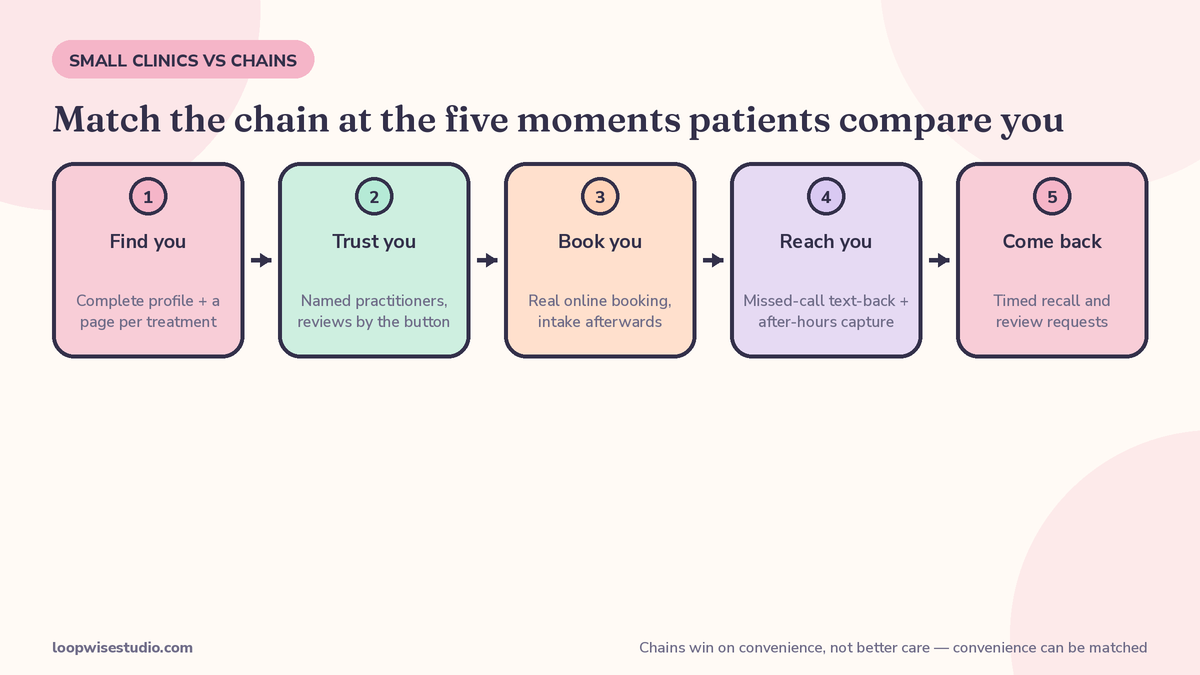
Chain clinics invest in the machinery around care: central booking, instant confirmations, reminder systems, review collection, recall campaigns. A patient choosing between you and a chain usually experiences the chain as easier, and easier wins — especially for a first visit, for someone in pain, and for anyone booking at 9pm from the sofa.
The demand side backs this up. A remote staffing firm’s guide for clinic owners (RemoteLeverage) cites figures of up to 38% of clinic calls going unanswered, and 71% of patients choosing a provider based on convenience — it attributes those numbers to LinkedIn and Accenture research, so treat the exact figures cautiously. The direction, though, matches what any clinic owner sees in their own diary: the practice that answers and books first gets the patient. The fix isn’t a bigger marketing budget. It’s matching the chain at five specific moments.
There’s a compounding effect worth understanding: every patient a chain takes from you through convenience isn’t one lost appointment — for clinics with repeat cycles (physio plans, dental check-ups, maintenance treatments), it’s a stream of future appointments and referrals too. That’s why this matters more than any single month’s diary. The reverse is also true: every patient you win back with a smoother journey tends to stay, because switching costs them the relationship they’ve built with a practitioner they know. Convenience decides the first booking; people decide the rest. Your whole job, online, is to stop losing the first booking.
Moment 1: They find you
A chain appears everywhere a patient looks: a complete Google Business Profile for every location, a page for every treatment in every town, fresh reviews flowing in. An independent clinic often has one homepage, an incomplete profile, and reviews from two years ago.
Matching them:
- Complete your Google Business Profile properly — every treatment listed as a service, current hours, real photos of the rooms and the team, the booking link in place. This is free, and for “near me” searches it matters more than your website’s homepage.
- One page per treatment, per location. Chains do this at scale with templates. You can do it better with fewer pages, because yours can be specific: the actual practitioner, the actual price range, the actual conditions you see most.
- Be where the chain isn’t. Chains are weak on specific, local, human content — the physio who treats runners, the dentist known for nervous patients. Search engines and patients both reward that specificity.
A concrete example: a chain’s page for back pain is written once and copied to forty locations with the town name swapped. Your page can name the practitioner who treats it, the sports clubs and employers nearby whose people you see, the exact first-visit process and what it costs. For the patient searching at the moment their back goes, the second page reads as a clinic; the first reads as a call centre with a postcode. Google’s local results reward the same things the patient does — relevance and real detail about one specific place.
Moment 2: They trust you
A chain buys trust with brand recognition. You have something they can’t copy: named practitioners, a real face, a local reputation. Most small clinic websites hide exactly those advantages behind stock photos and generic copy.
Matching them:
- Put the practitioners on the page — names, photos, qualifications, who they treat. Patients pick people, not logos.
- Show reviews where the booking decision happens — on the treatment page, next to the button, not buried on a testimonials page. Reviews only accumulate if you ask for them systematically; we cover the mechanics in our guide to getting Google reviews for your clinic on WhatsApp, and the same timing rules work over text.
- Publish prices or honest price ranges. Chains increasingly do. A clinic that hides every price looks expensive and generates “how much is it?” calls your front desk doesn’t have time for.
Moment 3: They book you
This is where the gap is widest. Industry guides that study chains note what patients now expect from them as standard: instant booking, text reminders, intake sorted before the visit. The independent clinic’s version is often a phone number and a contact form answered tomorrow.
Matching them:
- Real online booking with live availability — not a request form. The patient picks a slot and it’s theirs, confirmed on the spot, at midnight as easily as at noon.
- Intake after the slot is held. Send the form in the confirmation message. Chains made this standard; patients now read a long form in front of a booking as a reason to leave.
- Deposits or card details for high-value first appointments, with the policy stated plainly. Chains do this without apology, and their no-show rates show why.
One thing to get right: patients don’t resent any of this. A person in pain, booking at 9pm, wants the appointment locked in and confirmed — the confirmation message is reassurance, not admin. What they resent is uncertainty: the form that disappears into an inbox, the phone that rings out, the “we’ll call you back” that doesn’t happen. Every chain system exists to remove that uncertainty. Every item above does the same for you, at independent scale.
| Moment | What the chain does | What most small clinics do | The matching move |
|---|---|---|---|
| Find you | Full profile, a page per treatment | One homepage, stale profile | Complete profile + treatment pages |
| Trust you | Brand + review volume | Stock photos, few reviews | Named practitioners, reviews by the button |
| Book you | Live slots, instant confirm | Phone number, contact form | Real online booking, intake after |
| Reach you | Central team, instant replies | One phone, busy at peak times | Missed-call text-back + after-hours capture |
| Come back | Recall campaigns, memberships | Nothing — waits for the patient | Timed recall and review requests |
Moment 4: They reach you
A chain has a contact centre. You have a front desk that’s also checking people in, taking payments and answering the door. When the phone rings during a treatment block, nobody picks up — and that caller doesn’t leave a voicemail, they call the next clinic.
Matching them doesn’t mean hiring a call centre. It means no enquiry ever gets silence:
- Missed-call text-back. The moment a call is missed, the caller gets a text: sorry we missed you, here’s the booking link, or reply here. It takes seconds, costs little, and catches the patient while they’re still holding the phone. We explain how it works in our article on missed call text-back for med spas — the mechanics are identical for any clinic.
- An instant first reply on every channel — website form, WhatsApp, Instagram DM. An automatic reply that answers the basics and links to live slots, with a human following up. Speed matters more than polish: the clinic that replies in one minute beats the clinic that replies beautifully in three hours.
- After-hours capture. A large share of browsing and booking intent happens in the evening. Your booking page and auto-replies work those hours without anyone on shift.
Moment 5: They come back
Chains run recall like a system: reminders when a check-up is due, reactivation offers to lapsed patients, review requests after every visit. Independents rely on patients remembering — and patients forget, drift, and eventually land wherever Google sends them, which is often back to a chain.
Matching them:
- Due-date recall. Check-ups, reviews, maintenance treatments — whatever your repeat cycle is, message patients shortly before they’re due, with a booking link. One follow-up, then stop.
- Lapsed-patient reactivation. A short, human message to patients who haven’t been in 9–12 months: hope you’re well, here’s what’s new, here’s a slot. Done once or twice a year, this outperforms most advertising because these people already trust you.
- Review requests after good visits, so your reputation compounds while the chain’s marketing budget has to keep buying theirs.
How do you know it’s working? Watch four numbers monthly, all available without any new software: how many calls went unanswered and how many of those callers booked through the text-back link; how many new reviews arrived; how many bookings came from recall messages; and how full next week’s diary is compared with the same week last quarter. None of these needs to be perfect — the trend is the signal. Chains watch numbers like these at head-office level. Watching them at clinic level, where you can act the same day, is another quiet advantage of being small: there’s no committee between the number and the fix.
Where chains are actually weak
Matching the chain’s systems doesn’t mean envying everything about them. Their model has real weaknesses a small clinic can use:
- You rarely see the same person twice. Chains rotate staff across locations; continuity of care is hard for them and natural for you. Say so on your site — “you’ll see the same physio throughout your treatment” is a booking argument.
- Their contact centres don’t know the clinic. The person answering can’t squeeze in a regular, judge an urgent case properly, or answer a specific question about your practitioner. Your replies, even automated ones, can be written around your actual diary and your actual team.
- Their reviews are averaged into meaninglessness. A chain’s 4.3 stars across thousands of reviews says little about the branch near you. A strong set of recent, specific reviews naming your practitioners says a lot.
- Their systems are rigid. Central templates change slowly. You can adjust your messages, pages and offers this week, around your real diary.
The play, then, isn’t to become a small chain. It’s to take the five conveniences patients now expect, and deliver them with the personal knowledge the chain can’t match.
Where to start: a two-week order of fixes
You don’t need the chain’s budget or a six-month project. In order of impact per hour spent:
- Days 1–2: Complete the Google Business Profile — services, photos, hours, booking link. Add every treatment as a service, and check the profile looks right on a phone, because that’s where patients see it.
- Days 3–5: Switch on missed-call text-back and an instant auto-reply on your main enquiry channels. Write them in your own voice: who you are, what to do next, a booking link. Settle who checks the replies each morning.
- Week 2: Make booking genuinely live online, with intake moved after the slot is held. Test it yourself on your phone — if booking takes more than a couple of minutes or ends in “we’ll confirm shortly,” it isn’t live yet.
- Week 2: Set up the reminder sequence and your first recall list — start with patients due in the next month. Pull the list from your existing records; this is an afternoon’s work, not a project.
- Ongoing: One treatment page a week, and a review request after every completed visit. Neither needs to be perfect — consistent beats polished here.
Notice what isn’t on the list: a rebrand, an app, a new logo, an ad campaign. Those are the things clinics buy when they think competing means looking bigger. Competing, online, means being easier — and easier is mostly plumbing.
To find your own biggest gap before you start, run through our free audit checklist for a clinic website that is losing bookings — it scores each of these five moments in about fifteen minutes. And if you’d rather have someone else walk your patient journey and tell you honestly where you stand against the chains near you, get a free audit from us. That’s the whole pitch: we look, we show you the leaks, you decide what to do about them.
What about ads and directories?
Owners often ask whether they should be buying ads or listing on booking marketplaces to fight back. Both can add patients, but neither fixes a leaky journey — they pour more people into it. A marketplace listing also rents you demand you don’t own: the patient relationship, the reminders and the rebooking all stay on someone else’s platform, and the next booking can just as easily go to the competitor listed beside you. The order that works is the order in this article: fix the five moments on your own website and profiles first, so the patients you reach stay yours. Then, if you still need more volume, advertise into a journey that converts — every pound or dollar goes further when the booking path actually works.
The advantage chains can’t buy
It’s worth ending on what you have that they don’t. A chain’s system is built for consistency across fifty locations; it can’t easily do the personal thing — the practitioner who remembers a patient’s marathon, the clinic that texts a nervous patient the night before, the owner who replies herself. Build the five systems so the basics never fail, and your human advantage stops being cancelled out by a busy phone line. That’s how small clinics actually win online: chain-level reliability, independent-level care.
Want the five moments checked against your clinic, one by one? Get a free audit and we’ll do exactly that.
FAQs
Can a small clinic really outrank a chain on Google? For local searches, yes — often. Local results lean on proximity, profile completeness, reviews and page relevance, not company size. A complete profile and a specific treatment page can outrank a chain’s generic location page for the searches that bring bookings.
What’s the single highest-impact fix? For most clinics, it’s reply speed: missed-call text-back plus instant first replies on your enquiry channels. It costs the least, goes live fastest, and catches patients at the exact moment chains currently take them from you.
Do I need to advertise to compete with chains? Not to fix these five gaps — profiles, pages, booking, replies and recall are all owned channels. Ads on top of a leaky journey just pay to send people to a dead end; fix the journey first, then decide if you need more traffic.
Isn’t this just copying the chains? The systems, yes — deliberately. Instant booking, reminders and recall are table stakes now, not innovations. What you don’t copy is the impersonal delivery; your messages and pages can sound like a person, which is precisely your edge.
How much does it cost to build these systems? The profile and review habits cost nothing but time. Booking, text-back and recall automation is a build-and-setup job whose cost depends on your current tools and how much needs connecting — which is why we audit first and quote once, fixed, before starting.
We already have booking software. Does this still apply? Yes. Software alone doesn’t complete your profile, write your treatment pages, reply to missed calls or work your recall list. Most clinics we look at own the tools and are missing the layer around them.