How Much Does a Dental Website Cost in the UK?
UK dental website costs totalled honestly: build routes from £0 'free' to £10k+, plus booking, reminders and year-one running costs nobody quotes together.
A dental website in the UK costs £3,500–£9,500 on average for a professionally built site — the range published by Wise Agency, a UK dental website specialist. “Free” models charge £0 upfront but earn from monthly add-ons, and running the site afterwards costs roughly £200–£1,500 a month if you pay someone to manage it.
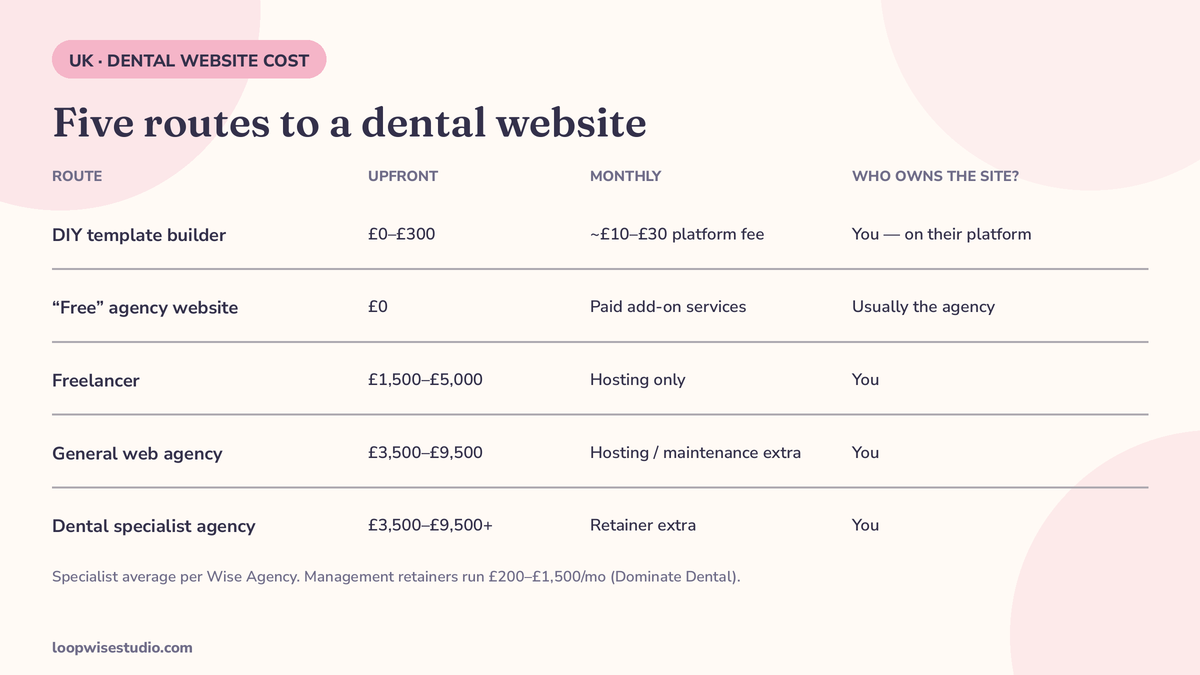
That average hides the real problem with this purchase: nobody quotes you the whole thing. One page prices the build, another prices the management, a third prices the SEO, and the booking system gets priced by a fourth company entirely. This article puts all of it in one place — what each route costs, what pushes the price up, and what a typical private practice actually pays across year one.
Every figure below comes from a named UK source, quoted in October 2026. Where a source is an agency selling the thing it’s pricing, this article says so. Check current pricing before you budget.
The five routes to a dental website — and what each one really costs
There are five ways a UK dental practice ends up with a website. They are not five prices for the same product — they differ in who owns the site, who fixes it when it breaks, and what happens when you leave.
| Route | Upfront | Monthly | Who owns the site? | The catch |
|---|---|---|---|---|
| DIY template builder | £0–£300 | ~£10–£30 platform fee | You, on their platform | Your time; generic look; booking is a bolt-on |
| “Free” agency website | £0 | Add-on services | Usually the agency | Free build, paid extras — design, photos, marketing |
| Freelancer | £1,500–£5,000 (market range) | Hosting only | You | One person; availability varies |
| General web agency | £3,500–£9,500 | Hosting/maintenance extra | You | Dental compliance knowledge varies |
| Dental specialist agency | £3,500–£9,500+ (Wise Agency’s stated average) | Retainer extra | You | Premium for GDC/CQC-aware builds |
The £3,500–£9,500 figure is Wise Agency’s published average for a UK dental practice website. It is one specialist agency’s stated average, not an industry survey — but it is the only ranking source that actually answers the build-cost question with a number, and it sits in the same band general agencies quote for professional sites of this complexity.
The “free” route deserves a straight explanation, because it is real and it is growing. Evolve Dental, for example, builds dental websites at £0 upfront and makes its money from the services around the site. That can suit a practice that needs a site now and has no capital budget. What you trade away is control: if the agency owns the design, the domain setup or the content system, leaving later means rebuilding. Ask who owns what before you sign — the checklist near the end of this article covers it.
For comparison, the broader benchmark for a website with online booking built in is covered in our guide to how much a website with online booking costs for a clinic — dental sits at the pricier end of that range, for reasons the next section explains.
What pushes the price up — the dental-specific drivers
Two practices can both ask for “a website” and get quotes £5,000 apart. The gap is almost never the homepage. It is these five things:
Treatment pages. A dental site that ranks needs a real page per treatment — implants, Invisalign, composite bonding, hygiene — each with suitability, process, risks, FAQs and clinician details. Wise Agency’s own price estimator is built around exactly this: page count and treatment depth drive its quotes. Ten proper treatment pages cost more than two, and they are also what brings enquiries in.
Online booking integration. A contact form is cheap. Live booking that talks to your practice management software — so patients book real slots, get confirmations, and the appointment lands in your diary without staff re-typing it — is an integration project, not a page. This is the single biggest price driver after page count.
GDC-compliant copywriting. Dental copy has rules: no misleading claims, no unsubstantiated superlatives, clear pricing and risk information. Writing that satisfies the GDC and still persuades is specialist work. Dominate Dental, a UK dental marketing firm, puts specialist dental web skills at £45–£85 an hour against £25–£40 an hour for a general developer — their figures, and a fair explanation of why dental quotes beat generic ones.
Photography and video. Real team photos and surgery footage convert; stock smiles do not. A half-day shoot is a line item many quotes quietly exclude.
Multiple locations and clinicians. Each location needs its own pages, Google profile alignment and booking rules. Multi-site practices should expect quotes at or above the top of the average range.
If a quote looks suspiciously cheap, it is usually one of these five that has been cut — most often treatment pages or the booking integration, which are precisely the parts that make the site earn. Wise’s own positioning makes the same point from the other side: their pages argue a dental website should be built around patient enquiries — visibility, conversion and tracking — rather than around design. You are not buying pages. You are buying the enquiries the pages produce, and the drivers above are where those enquiries come from.
Inside a specialist quote — what the estimator is actually pricing
Wise Agency’s site runs an eight-step price estimator, and its long treatment-page walk-through is unintentionally the most honest pricing document in this market — because it shows what the money buys. A treatment page that ranks and converts, in their anatomy, is not 300 words and a stock photo. It is a hero built around the enquiry, suitability cards (who this treatment is and isn’t for), a benefits-and-process section, a comparison table (their example: implants versus dentures), FAQs, the clinicians who perform it, and consultation and risk information in tabs.
Multiply that build by eight or ten treatments and you can see where a £6,000 quote goes — and what a £1,500 quote skipped. Neither Wise nor any other source in this research publishes a per-driver price (“treatment pages add £X”), so this article won’t invent one. But when one quote is a third of another, the estimator’s anatomy is the checklist to diff them against: count the treatment pages, and open each one to see which of those components actually exists.
Myth vs fact, while you’re comparing quotes:
- Myth: “A cheaper quote is the same website for less money.” Fact: In every route priced above, the gap is scope — treatment pages, booking integration, copy, photography — not margin. The cheap quote is a smaller website.
- Myth: “The build price is the cost of the website.” Fact: Management retainers alone (£200–£1,500 a month per Dominate Dental) pass the build price within the first year or two. The build is the deposit, not the cost.
- Myth: “Free means the agency is cheaper.” Fact: Free means the agency earns elsewhere — add-on services and, typically, ownership of the asset. That may suit you. Price the extras and the exit before deciding it’s cheaper.
The costs after launch that nobody puts in the quote
The build is the one-off cost. These are the ones that keep arriving:
- Hosting and domain: typically bundled into a care plan, or £10–£40 a month bought separately.
- Website management: Dominate Dental publishes basic management retainers at £200–£400 a month and comprehensive ones at £800–£1,500 a month, with London practices paying up to £2,000. Note that Dominate’s own pricing table lists Basic Care at £300–£500 — slightly different from its FAQ’s £200–£400. Either way, budget low hundreds a month if you want updates, backups and changes handled for you, and expect London and the South East to cost 20–40% more (a premium WhiteHat SEO cites in its UK dental cost benchmarking).
- SEO: WhiteHat SEO’s dental guide puts specialist dental SEO retainers at £800–£3,000 a month, citing a 2026 cost report — treat that as an agency benchmark, not a promise. A site nobody finds needs this conversation sooner or later.
- Booking software and messaging: your booking platform subscription, plus per-message costs if reminders and follow-up go out by text or WhatsApp. For the messaging layer specifically, our breakdown of how much WhatsApp automation costs a UK small business prices that slice on its own.
None of these are reasons not to build the site. They are reasons to ask for them in the quote, in writing, before you compare two agencies whose headline prices turn out to cover different things.
If you’re weighing the website against a broader salon-style build in the same market, our guide to what a salon website with online booking costs in the UK shows the same route maths in a neighbouring trade — dental runs higher, mostly on compliance and treatment-page depth.
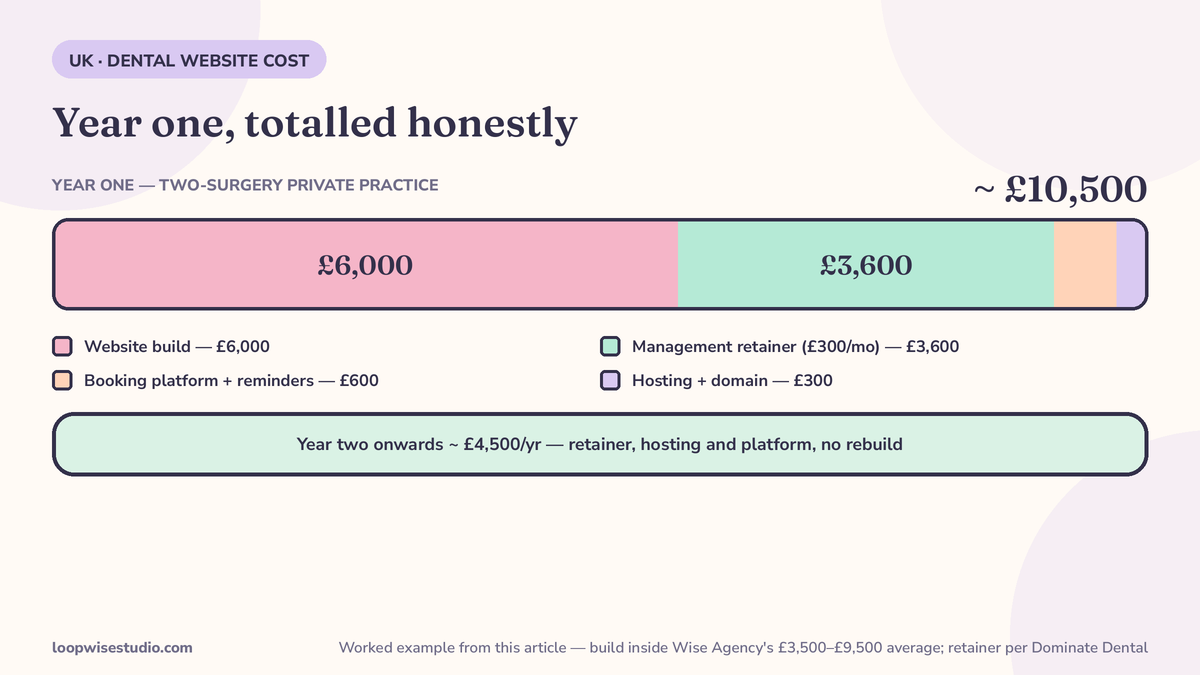
Year one, totalled — a worked example
Here is the worked example no ranking page publishes. Assumptions, stated plainly: a two-surgery private practice in Manchester, mid-range specialist build, basic management retainer, no paid SEO in year one.
| Item | Year-one cost | Source basis |
|---|---|---|
| Website build (one-off) | £6,000 | Inside Wise Agency’s £3,500–£9,500 stated average |
| Hosting + domain | £300 | Typical bundled allowance |
| Management retainer, £300/mo | £3,600 | Dominate Dental’s Basic Care band (£300–£500/mo) |
| Booking platform + reminders | £600 (allowance) | Varies by provider — get it quoted |
| Year one total | ≈ £10,500 | |
| Year two onwards | ≈ £4,500/yr | Retainer + hosting + platform, no rebuild |
This is arithmetic from the sourced figures above, not a quote — your number moves with treatment-page count, booking integration depth and whether you add SEO. But it shows the shape of the truth: the build is roughly half of year one, and the “cheap website” question is really a question about the other half.
Run the same table in London and it moves again. WhiteHat SEO’s benchmarking puts the London and South East premium at 20–40% across dental web and marketing services. Apply even the low end to the worked example and the Manchester practice’s £10,500 year one becomes roughly £12,500+ in the capital — same website, same scope, different postcode. If your quotes come from London agencies for a practice outside the South East, that premium is a legitimate thing to challenge.
Want your own version of this table, with your treatments and your current setup priced in? get a free audit and we’ll map where your enquiries are leaking before anyone talks about a rebuild.
What “free” dental websites actually trade away
The free model is not a scam, and this article is not going to pretend otherwise. Practices genuinely get a working website for £0 upfront. The trade is in three places:
- Ownership. If the design, content or platform belongs to the agency, exit means starting again. Evolve’s model earns from add-on services — which is legitimate, but it means the free site is the start of a paid relationship, not the whole product.
- The extras are the business. Photography, copywriting, marketing, extra pages — the things section two of this article says drive results — are where free models charge. Price them before you compare “free” against a £6,000 build that includes them.
- Performance claims need care. Free-model providers publish big numbers — Evolve cites 96,000+ new patient enquiries a year and £12.3m in treatment value across its sites. Those are the company’s own marketing figures, unverified, and they describe a network, not what your practice will get.
Free is a financing choice: £0 now, paid over time, with strings. Sometimes that is the right choice. Just make it with the strings visible.
How to get a fixed quote instead of a range — copy this checklist
Ranges exist because agencies quote without seeing your setup. Send every bidder the same brief and the ranges collapse into comparable fixed quotes. Copy this into your email:
DENTAL WEBSITE QUOTE BRIEF
Practice: [name], [number] surgeries, [locations]
Current site: [URL or "none"] — what we keep / what we replace
Treatment pages needed: [list each treatment]
Booking: must connect to [practice software] with live slots: yes/no
Follow-up: appointment reminders + lapsed-patient messages by
  text/WhatsApp: yes/no
Copy: GDC-compliant copywriting included? Photography included?
Ownership: we own domain, design, content and can export everything: confirm
Year-one total: build + hosting + maintenance + booking platform
  + messaging, itemised — not just the build price
Ongoing: monthly cost after launch, and what it includes
Any agency that will not itemise the year-one total is asking you to compare their build price against someone else’s full price. That comparison is how practices end up “saving” £2,000 and spending it twice later.
If you’d like a second pair of eyes on quotes you’ve already received — or on a site that’s live but not booking — get a free audit and we’ll go through the numbers with you, free, before you commit to anything.
The short version
A UK dental website costs £3,500–£9,500 to build professionally (Wise Agency’s stated average), £0 upfront on free models that earn from add-ons and ownership strings, and roughly £200–£1,500 a month to have it managed afterwards. The honest figure is a year-one total — build plus booking, reminders and running costs — and for a typical two-surgery private practice that lands around £10,000 in year one. Get every bidder to price that same total, in writing, and the decision gets much simpler.
FAQs
How much does a dental website cost in the UK in 2026?
Wise Agency, a UK dental specialist, states an average of £3,500–£9,500 for a professionally built dental practice website. Simple sites and free-agency models sit below that; multi-location practices with deep treatment pages and live booking integration sit above it. Figures checked October 2026 — confirm current pricing with any agency you approach.
Why do dental websites cost more than other small-business websites?
Three dental-specific costs: GDC-compliant copywriting (specialist rates of £45–£85/hr per Dominate Dental, versus £25–£40/hr for general developers), a full page per treatment rather than one services page, and booking that integrates with practice management software instead of a simple contact form.
Are free dental websites really free?
The build can genuinely be £0 upfront. The model earns from add-on services and ongoing relationships, and the agency may retain ownership of the design or platform — so leaving later can mean rebuilding. Ask who owns the domain, design and content before signing.
What does it cost to run a dental website each month?
If you pay for management, Dominate Dental publishes £200–£400 a month for basic care and £800–£1,500 for comprehensive cover, with London up to £2,000. Add hosting, your booking platform subscription, and per-message reminder costs. SEO, if you buy it, is benchmarked at £800–£3,000 a month by WhiteHat SEO.
Should a dental website include online booking?
If missed calls and unbooked enquiries are costing you patients, yes — and it changes the quote, because real booking means integrating with your practice software, not adding a form. A form that emails the front desk still leaves staff doing the booking work by hand.
How do I compare two dental website quotes fairly?
Give both agencies the same written brief — treatment pages, booking integration, copy, photography, ownership, and an itemised year-one total including running costs. The checklist in this article is written to copy and send. Quotes that only price the build are not comparable with quotes that price the year.