Online Booking Systems for Physio Clinics in New Zealand
What an online booking system has to handle in a NZ physio clinic: ACC45 capture, treatment-plan follow-ups, text reminders — and why one missed booking costs five sessions.
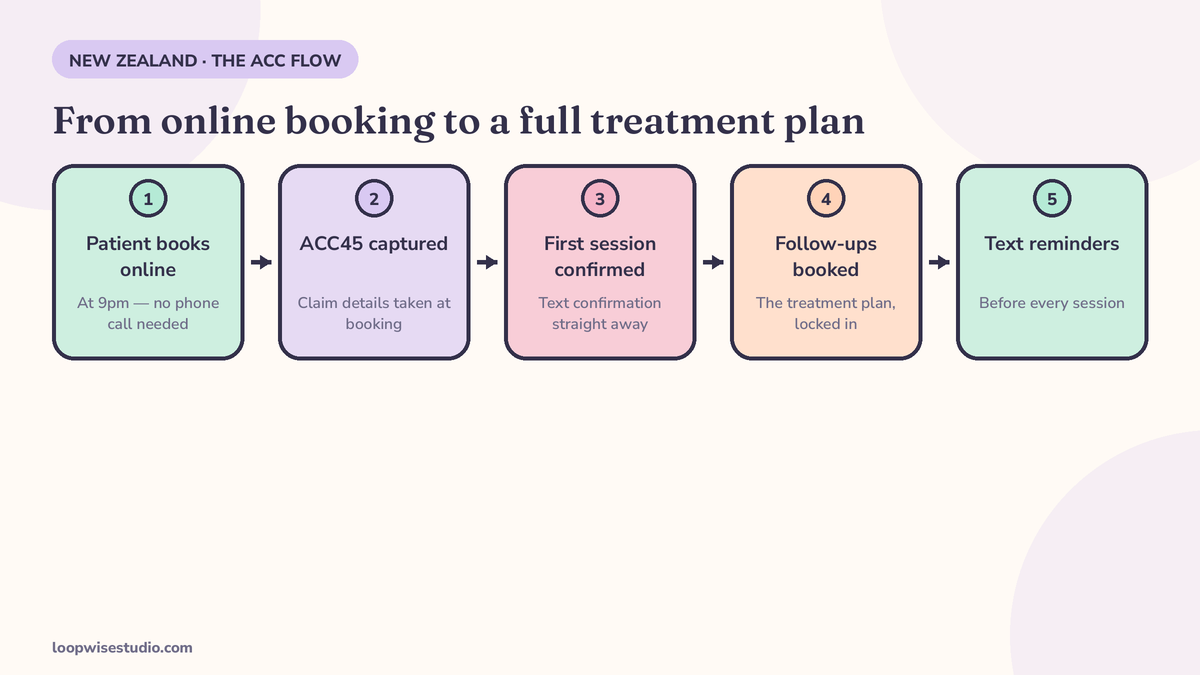
Most New Zealand physio clinics run their diary on Gensolve, Cliniko, Nookal or Zanda. The booking system question that actually decides your revenue is narrower: can a patient book at 9pm without phoning, are ACC claim details captured at the moment they book, and are the follow-up sessions locked in before they leave — because the average ACC claim runs 5.12 treatment sessions (Sapere Research Group, Physiotherapy Services Market Review for ACC & Physiotherapy New Zealand, December 2025).
Search for a booking system as a NZ physio and you’ll find directories and vendor pages. No guide. That’s odd, because physio booking in New Zealand has a wrinkle no other country’s content covers: ACC. This page covers what your booking system has to do with ACC, what to do if your current system does the diary fine but leaks bookings, and what the options cost.
It sits inside our wider guide to turning website visitors into booked appointments — this is the New Zealand physio version of that system.
What “online booking” has to handle in a physio clinic
A café takes a booking. A physio clinic takes on an episode of care. Your booking system has to handle at least four things a generic scheduler doesn’t know exist:
- ACC vs private, separated at booking. An injury claim and a private paying patient need different questions, different durations, and different paperwork. If your online booking treats them the same, your front desk is phoning every online booker to sort it out — which defeats the point.
- Initial vs follow-up appointments. Different lengths, different prices, different surcharges. Patients should only be offered the follow-up types once they’ve had an initial assessment.
- Treatment plans, not single visits. The booking that matters most is the run of follow-ups. A system that books one appointment and wishes the patient luck is leaving the episode to chance.
- The surcharge conversation. ACC pays part of the treatment cost and clinics charge patients a surcharge (as NZ clinics’ own patient information explains). Your booking flow should state it upfront, so the price isn’t a surprise at the desk.
US clinics face a version of this with plan-of-care booking — our guide to online booking websites for physical therapy clinics with text reminders covers that side. The ACC layer below is New Zealand’s alone.
The ACC45 moment — what to capture when a new injury books online
The ACC45 is the claim form a physio lodges for a new injury claim. Cloud Appointments, a Tauranga-based practice system, builds its physio pitch on exactly this: claims and Fitness For Work documentation can be created and lodged electronically inside the system, with invoices and subsidy documentation submitted directly to ACC (per the vendor’s physio clinic page).
Whether you use their system or another, your online booking intake for a new injury needs to capture, at minimum:
Copy-paste checklist — new-injury online booking intake
- Date and brief description of the injury
- Whether an ACC45 has already been lodged (and the claim number, if so)
- Employer details, if it’s a work injury
- Whether they’ve seen a GP or been referred
- Contact number that accepts text messages
- Consent to be contacted about this booking
Every field you don’t capture online becomes a phone call your team makes later. The goal isn’t a longer form — it’s the right six questions, asked once, while the patient is motivated.
Why one missed booking costs you about five sessions
Here’s the number that should shape your whole booking setup.
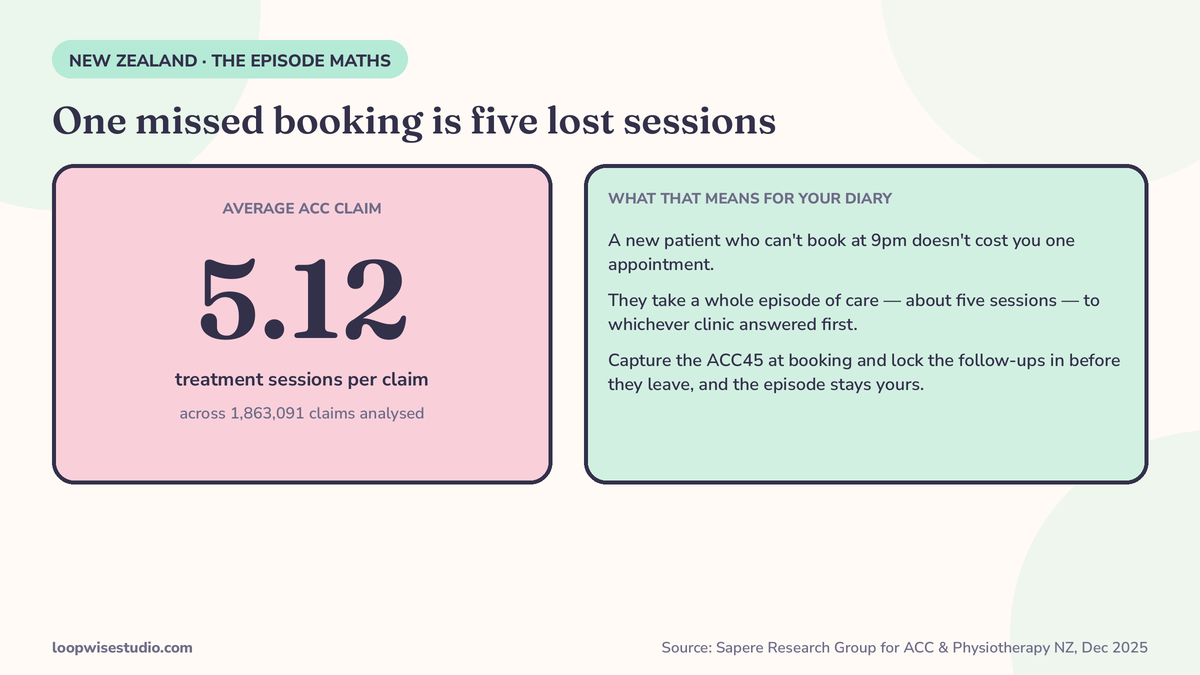
Sapere Research Group’s Physiotherapy Services Market Review, prepared for ACC and Physiotherapy New Zealand (December 2025), found the mean number of treatment sessions per ACC claim is 5.12, across 1,863,091 claims. The NZ AI-receptionist vendor WeTalk cites the same review at 5.1 sessions a claim — the two agree because they’re reading the same source.
So when a new patient rings at 6pm, gets voicemail, and books the clinic down the road instead, you haven’t lost one appointment. You’ve likely lost a five-session episode — the assessment plus the follow-ups that were never going to be booked anywhere else.
That’s the maths behind every feature in this article. After-hours online booking isn’t a convenience feature. It’s episode capture.
Reminders that fit NZ — text first, and book the next visit before they leave
Two habits do most of the work:
1. Book the follow-up before the patient leaves the clinic. The cheapest no-show prevention is a diary entry made in person, for the whole plan, at the first visit. Your booking system should make booking sessions two to five as easy at the desk as session one was online.
2. Remind by text, with a reply path. New Zealand patients live on text; WhatsApp has nothing like the reach here that it has in other markets. Your reminders should confirm, remind the day before, and let the patient reply to reschedule instead of silently not showing. If no-shows are already a problem, the UK physio experience translates closely — our guide to reducing did-not-attend appointments at a private physio clinic walks through the deposit and reminder mechanics in detail.
A simple sequence that works:
| When | Message | Job |
|---|---|---|
| At booking | Text confirmation with date, time, clinic address | Lock it in, set expectations |
| Day before | Reminder with reply-to-reschedule | Catch problems while the slot can be refilled |
| Morning of | Short reminder for early appointments | Cut the genuine forgetters |
| After a no-show | Same-day text offering the next slots | Recover the episode, not just the visit |
The NZ shortlist, honestly
If you are choosing or re-choosing the diary itself, this is the realistic field:
- Gensolve — the incumbent most NZ physio clinics already run (per WeTalk). Its strength is being the known quantity in NZ allied health; the booking experience in front of it is where most clinics feel the gap.
- Cliniko — the trans-Tasman favourite: banded pricing, every feature on every plan, and online bookings your website can hand off to. Priced and compared in detail in our Cliniko alternative guide.
- Nookal and Zanda — the other two names on every NZ shortlist. Zanda’s directory listings highlight SMS and email reminders, two-way SMS chat and telehealth; verify current NZD pricing on its NZ pages, because listings don’t state the currency.
- Cloud Appointments — the NZ-built option (Tauranga), selling the ACC integration itself: electronic ACC45 lodgement, invoices and subsidy documentation submitted directly to ACC, Healthlink secure messaging for referrals, and telehealth built in (per the vendor’s physio page). No published pricing, and its booking section is thin — the patient-facing experience is the part to test hardest in a trial.
Notice what none of them lead with: the patient’s journey from Google at 9pm to a confirmed, ACC-intake-complete booking. That’s not an accident of marketing. It’s the layer the next section is about.
Keep your system, or switch? The booking-layer option
Most NZ physio clinics run Gensolve — WeTalk’s page says so plainly, and its whole product is built around that fact. Cliniko, Nookal and Zanda cover much of the rest. Every ranking page for this search wants you to swap your whole practice system. For most clinics, that’s the wrong first move:
- Your diary is rarely the problem. Gensolve and Cliniko keep a diary perfectly well. The leaks are at the edges: no booking after hours, ACC details not captured, follow-ups not booked, reminders that don’t allow replies.
- A system swap costs months. Data migration, staff retraining, ACC invoicing quirks — you pay all of it to fix problems that mostly live outside the diary.
- The layer approach keeps what works. A booking layer means: your own website with a booking flow shaped for ACC vs private, intake captured at booking, text reminders with replies, and follow-up booking built in — handing off to the diary you already run.
If you’re genuinely outgrowing your system — reporting, multi-site, aesthetics-style features — that’s a different decision, and our Cliniko alternative guide works through it honestly, including the case for staying put.
Whichever route you take, get a free audit and we’ll map where your bookings are leaking — the phone, the website, or the follow-up gap — before you spend anything on software.
What it costs in NZD
Honest answer first: almost nobody on the NZ market publishes full pricing. Cloud Appointments publishes no price. Gensolve doesn’t put one in front of you either. Directory listings show Zanda starting at $9.50/month per practitioner, but the listings don’t state the currency — check Zanda’s NZ pricing page for the current NZD figure before relying on it.
So budget by model, not by number:
- Practice system subscription — per-practitioner, per month, with SMS reminders sometimes metered on top. Fine at two practitioners; do the maths at your planned team size.
- Booking layer on your own website — a one-off build cost plus a smaller monthly, and your existing system stays. The quote should be fixed and written, and you should own the website and domain.
Anyone who quotes you a NZ physio booking system without asking about ACC, your current diary, and your follow-up booking rate is quoting you a generic scheduler with a physio label.
Frequently asked questions
Which booking system do most NZ physio clinics use?
Gensolve is the incumbent in most New Zealand physio clinics, with Cliniko, Nookal and Zanda also common (the NZ vendor WeTalk states Gensolve is what most NZ physio clinics run, and builds its product around it). The better question is what sits in front of the diary — the online booking, intake and reminder layer patients actually touch.
Does online booking work with ACC claims?
Yes, if the intake is designed for it. Your booking flow needs to separate ACC from private appointments and capture claim details (injury date, existing ACC45/claim number, employer for work injuries) at booking. Cloud Appointments states ACC45 claims can be lodged electronically in-system with invoices submitted directly to ACC; whichever system you use, those six intake items are the minimum.
Why does one missed new patient matter so much for a physio clinic?
Because a new injury is an episode, not a visit. Sapere Research Group’s Physiotherapy Services Market Review for ACC and Physiotherapy New Zealand (December 2025) puts the average ACC claim at 5.12 treatment sessions across 1,863,091 claims. Lose the first booking and you usually lose all five sessions to another clinic.
Should I switch from Gensolve to get better online booking?
Usually not as a first step. If the diary itself works, the leaks are normally the front door — after-hours booking, ACC intake, follow-up booking and reply-able text reminders — and those can be added as a layer on your own website while your practice system stays. Switch systems when the diary itself is the problem: reporting, multi-site management, or features it simply doesn’t have.
Are text reminders or WhatsApp reminders better in New Zealand?
Text. WhatsApp is weak in New Zealand compared with markets like the UK or UAE; your patients are reachable by SMS. Use texts with a reply path so patients can reschedule instead of no-showing, and keep WhatsApp for the small number of patients who prefer it.
How much does an online booking system cost a NZ physio clinic?
Most NZ vendors don’t publish full pricing — Cloud Appointments and Gensolve both quote rather than list. Directory listings show Zanda from $9.50/month per practitioner (currency not stated on the listing — verify on Zanda’s NZ pricing page). Budget for a per-practitioner monthly subscription, possible per-message SMS charges, and, if you add a booking layer to your own website, a one-off fixed build cost.
Your diary is fine — fix the door patients walk through
The average ACC episode is five sessions long, and it is won or lost at the first booking. Patients who can’t book after hours, whose claim details nobody captured, and whose follow-ups were never locked in don’t complain — they just end up in someone else’s diary.
If you want to know which of those leaks your clinic has, get a free audit — we’ll check your booking path the way a patient at 9pm experiences it, and show you what to fix first.