Cliniko Alternatives: Honest Picks for Allied Health Clinics
Cliniko costs $45–$395/mo with every feature included. Compare Jane, Zanda, Nookal and Noterro as Cliniko alternatives — and the keep-Cliniko option nobody offers.

Cliniko costs $45–$395 a month depending on your practitioner band, with every feature included in every band. Clinics look for a Cliniko alternative mainly over reporting depth, task management, and room to grow into multi-location or aesthetics-style work — Jane and Zanda are the allied-health alternatives, Nookal is the Australian incumbent, and Pabau is the aesthetics step-up. But if your actual problem is missed calls, no-shows and patients who never rebook, no practice-software switch fixes it, because those problems live in front of the diary, not inside it.
This guide is written for Cliniko’s real heartland — Australian and New Zealand allied health — which most alternatives content ignores. It prices Cliniko honestly, concedes what Cliniko does better than its rivals (starting with its pricing model), matches each alternative to the clinics it genuinely suits, and covers the option the listicles never list: keeping Cliniko and adding the layer it’s missing.
For the wider diary-software picture, see our roundup of the best booking software for small clinic owner-operators.
What Cliniko costs in 2026 — and why its model is the fairest in this market
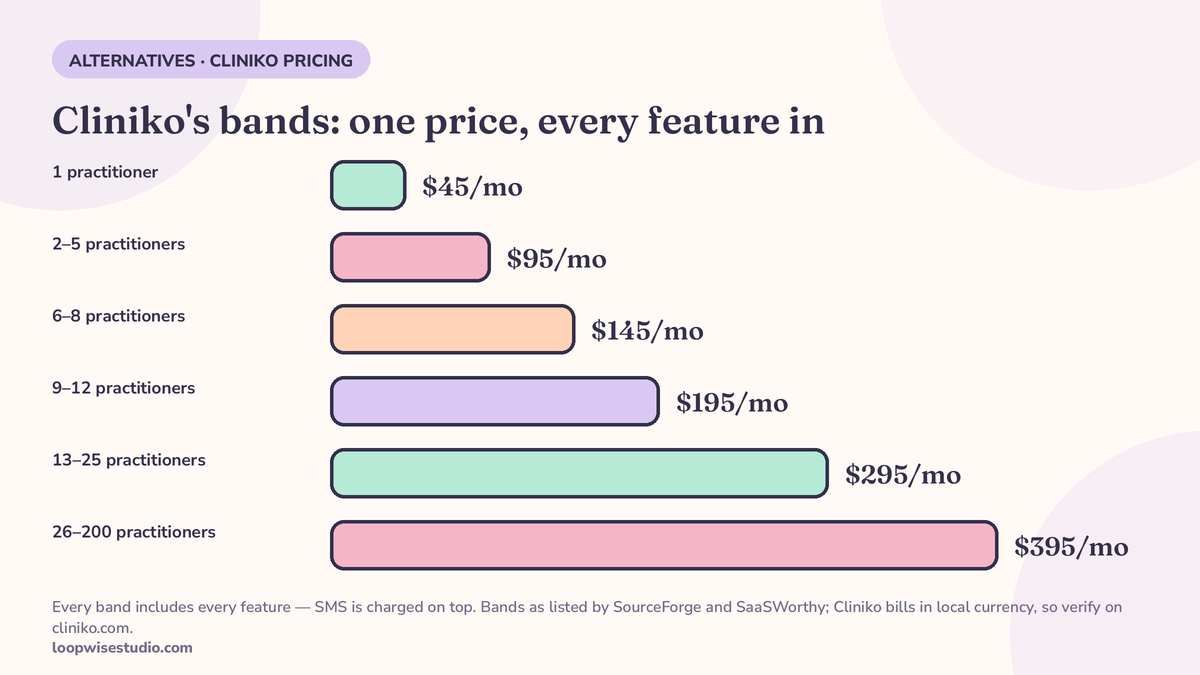
Cliniko’s published pricing, as listed by SourceForge and SaaSWorthy, is banded by practitioner count (USD as listed; Cliniko bills in local currency by region — verify the current figures on cliniko.com):
| Practitioners | Price/mo | What’s included |
|---|---|---|
| 1 | $45 | Every feature |
| 2–5 | $95 | Every feature |
| 6–8 | $145 | Every feature |
| 9–12 | $195 | Every feature |
| 13–25 | $295 | Every feature |
| 26–200 | $395 | Every feature |
Say the fair thing plainly: this is a simpler, more honest model than most rivals’. No tier gating. No add-on stack. Unlimited users, locations and file storage, and free support, on every band. SMS messages are charged separately — around US 10¢ a message, per two comparison sources (Vascue and practice-planner-reviews.uk) — which is metered, but at least it’s visible.
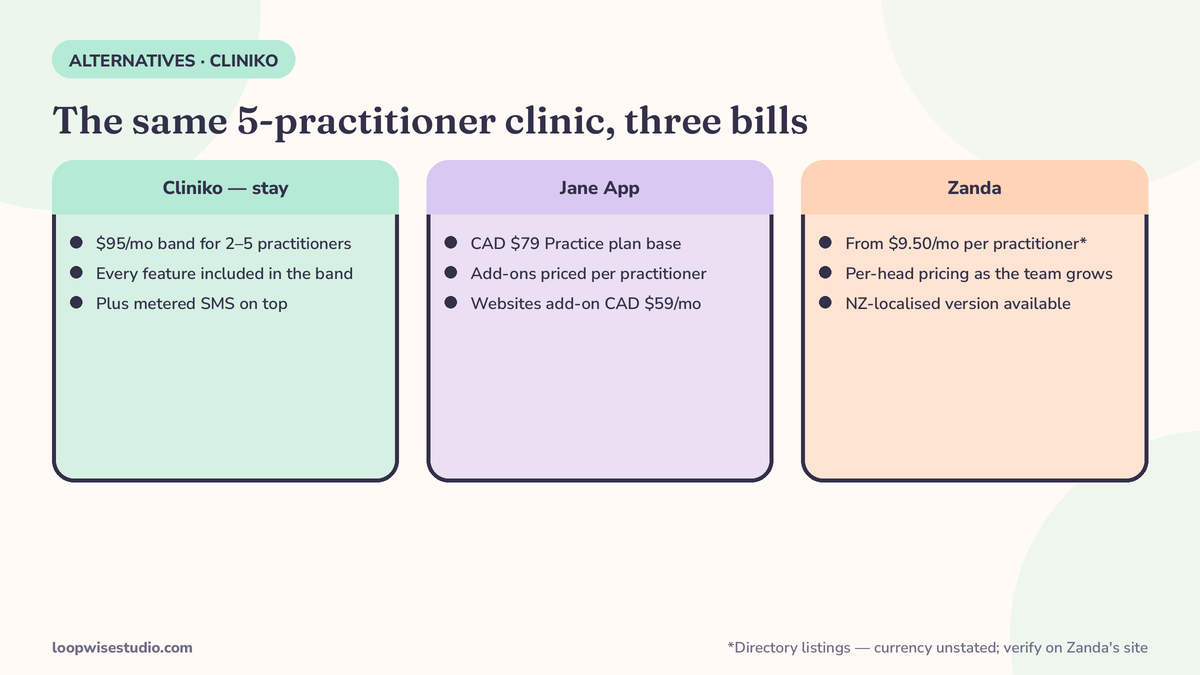
Contrast it with Jane App, Cliniko’s closest rival, where a CAD $79 headline becomes CAD $218+ for a four-practitioner clinic once scribe, billing and website add-ons land. Our Jane App alternative guide runs that maths in full. If pricing transparency is why you’re shopping, Cliniko is the benchmark, not the problem.
For a worked sense of scale, take a five-practitioner physio clinic:
Worked example — a 5-practitioner clinic’s monthly software bill
- Cliniko 2–5 band: $95/mo
- SMS reminders, say 300 messages/mo at ~10¢: ~$30/mo
- Total: ≈ $125/mo, every feature included
Hold that number against any alternative’s quote — including the per-practitioner and add-on lines they put in the footnotes.
Legit reasons to leave Cliniko — there are some
Cliniko has run since 2010 (Red Guava, Australia), serves thousands of allied health practices, and is praised even by competitors for ease of use and support. Clinics outgrow it at the edges, not the centre:
- Reporting depth. Pabau’s Cliniko review names reporting as the recurring criticism — if your decisions need serious practice analytics, Cliniko’s reports can feel thin.
- No task management. The same review flags the absence of task workflows for front-desk teams juggling recalls, referrals and follow-ups outside the diary.
- Aesthetics and multi-location depth. Pabau’s alternatives guide positions its own product here, and the underlying point stands: treatment-plan selling, before/after records and multi-site marketing are not what Cliniko was built for.
- Workflow rigidity as you grow. Zanda’s comparison page argues Cliniko’s workflows feel rigid at scale. That’s a competitor’s framing — treat it as a prompt to test your own workflows in any trial, not as settled fact.
What isn’t on this list: price games, missing basics, bad support. If your reason for leaving isn’t one of the four above, check the section after the alternatives before you commit to a migration.
The alternatives, honestly matched
| Alternative | Who it genuinely suits | Watch out for |
|---|---|---|
| Jane App (CAD $54–99/mo + add-ons) | Clinics wanting a friendlier interface and strong onboarding; CA/NZ/AU allied health and wellness | Per-practitioner fees and add-ons — the real bill is well past the headline |
| Zanda (from $9.50/mo per practitioner per directory listings — currency unstated, verify) | Allied health clinics wanting per-practitioner pricing and built-in communication tools; NZ-localised offering | Confirm NZ/AU pricing and feature parity on Zanda’s own pages |
| Nookal (A$55/practitioner/mo, per Pabau and Precision IT) | Australian clinics wanting a local incumbent with similar allied-health shape | Per-practitioner pricing grows with the team, unlike Cliniko’s bands |
| Noterro ($28.05/mo, per Noterro’s guide) | Massage, chiro and smaller practices wanting a lower-cost diary | Competitor-reported pricing; check what the plan includes |
| Pabau (per-practitioner, aesthetics-led) | Med spas and aesthetics clinics needing the full patient journey and marketing engine | Overkill — and over budget — for a straightforward physio or osteo practice |
One more honesty note. You’ll find competitor pages claiming Cliniko lacks certain security certifications. Those claims are competitor-asserted and we haven’t verified them against Cliniko’s own security documentation — neither should you repeat them. Ask Cliniko and any rival for their current compliance documents directly; Pabau’s own review notes Cliniko’s HIPAA/GDPR/PIPEDA/APP compliance framing, which is the level of care this topic deserves.
And a detail that says something about the company: Cliniko donates 2% of subscription fees to charity (per its SaaSWorthy profile). Clinics don’t leave Cliniko because it’s a bad actor. They leave because they hit an edge — or because of the next section.
Cliniko vs Jane — the head-to-head most clinics actually run
Because these two dominate allied-health shortlists, here is the honest side-by-side:
| Cliniko | Jane App | |
|---|---|---|
| Pricing model | One price per practitioner band; all features included | Lower entry (CAD $54), then per-practitioner fees + paid add-ons |
| 5-practitioner reality | $95 band + SMS (~10¢/msg) | Practice CAD $79 + seats + add-ons — past CAD $218/mo in our worked example with scribe, billing and website |
| Features gating | None — every band gets everything | Real: SMS reminders not on Balance; memberships Thrive-only; 20-appointment cap on Balance |
| Praised for | Ease of use, support, transparency (conceded by competitors) | Interface, onboarding, support (4.8/5 on GetApp per directory data in our Jane research) |
| Watch out for | Reporting depth, no task management | Cost creep as the team grows |
The pattern: Cliniko is the calmer bill as you grow; Jane is the friendlier first step when you’re small. Neither answers your phone — which is the next section.
The problems a new practice system won’t fix
Talk to clinics a year after a migration and a pattern shows up: the diary is new, the frustrations are the same.
- The phone still rings out at lunchtime, and the caller still books the clinic down the road. No PMS answers your phone.
- No-shows barely move, because the fix was never the diary — it’s deposits, a reminder sequence with an easy reschedule path, and follow-up when someone slips.
- Patients still don’t rebook at the right interval, because nothing prompts them at week six.
- Google reviews stay flat, because nobody built the automatic ask after each visit.
Every alternatives page skips this because every alternatives page is selling a migration. If these four are your real list, you don’t have a Cliniko problem — you have a front-door problem, and it follows you to whichever system you choose next. Clinics across the ditch face the identical pattern with their incumbent — our guide to online booking systems for physio clinics in New Zealand shows the same diary-vs-front-door split on Gensolve.
Keep Cliniko — add the front door it never claimed to be
Cliniko runs the diary. It was never sold as your growth engine, and judging it as one is how clinics talk themselves into a migration they didn’t need. The layer it lacks sits in front of it:
- A website built to convert — services and practitioners presented around one action, loading fast, on your own domain. (If website costs are part of your decision, our breakdown of booking website costs for a small clinic in Australia prices all three routes in AUD.)
- Missed-call text-back or WhatsApp replies — the caller who gets a text with a booking link in seconds rarely dials the next clinic.
- Reminders and rebooking sequences that plug into Cliniko’s online bookings — confirmation, day-before reminder with reschedule, and the week-six nudge that keeps treatment plans alive.
- Automatic review requests after every appointment, identical for every patient, pointed at Google.
Cliniko has online bookings and an API, so this layer connects to the diary you already trust. No migration, no retraining, no parallel run — and the four problems above actually get fixed.
If you’ve read this far and your clinic’s list is the reporting/task-management one, migrate with our blessing and the checklist below. If your list is the phone/no-show/rebooking one, get a free audit and we’ll show you what the front-door layer looks like on top of your Cliniko — before you spend a dollar on new software.
What switching actually costs beyond the subscription
Nobody in this market writes about migration reality, so here it is plainly. The subscription difference between Cliniko and any rival is the smallest number in the project. The real costs:
- Data shape. Client lists and future appointments export cleanly from most systems. What travels badly: historical notes in proprietary formats, custom intake forms you’ve refined over years, and anything stored as attachments. Assume you rebuild your forms; be pleasantly surprised by anything else.
- Cards and packages. Stored payment cards never migrate between processors — patients re-enter them. Outstanding packages, memberships and gift balances need a manual ledger and a decision about how you’ll honour them in the new system.
- Staff time. Budget for training, a parallel-run week where two diaries exist and everyone must know which one is truth, and the front-desk hours spent re-sending booking links.
- The link rot. Every old Cliniko booking link in the wild — Google profiles, referral emails, Instagram bios, your own website — points at the old system until someone redirects it. This is where migrated clinics quietly lose bookings for months.
None of this means “never switch.” It means the switch should clear a bar: the new system must fix a problem worth several weeks of disruption. Reporting depth can clear that bar. A vague feeling that the grass is greener doesn’t — and a front-door problem never does, because it packs its bags and comes with you.
If you switch — the migration checklist
Copy-paste checklist — switching away from Cliniko safely
- Export clients, future appointments and clinical records; confirm what the export does not include
- Inventory what’s tied to Cliniko: online booking links, website embeds, Google profile link, reminder templates
- Run old and new diaries in parallel for one full booking cycle
- Redirect every booking link the day you cut over — website, Google, socials, email signatures
- Message patients once, with the new booking link and a plain explanation
- Keep your Cliniko export archived — you own your records, keep them that way
Zanda offers free data migration, per its comparison page; other vendors vary. Whoever you choose, the checklist above is the difference between a switch and a leak.
Frequently asked questions
How much does Cliniko cost?
Cliniko’s published pricing is banded by practitioner count — $45/mo for 1 practitioner, $95 for 2–5, $145 for 6–8, $195 for 9–12, $295 for 13–25 and $395 for 26–200, with every feature included on every band (as listed by SourceForge and SaaSWorthy; USD as listed, regional billing applies). SMS is extra, around US 10¢ a message per comparison sources. Verify current figures on cliniko.com.
What is the closest alternative to Cliniko?
Jane App is the closest in spirit for allied health — similar audience, friendlier interface — but its per-practitioner plus add-on pricing model is the opposite of Cliniko’s one-band simplicity. Zanda is the closest AU/NZ-localised option; Nookal (A$55/practitioner/mo per Pabau and Precision IT) is the Australian incumbent alternative.
Why do clinics leave Cliniko?
The evidenced reasons are reporting depth, missing task management, and outgrowing an allied-health-shaped tool at multi-location or aesthetics scale (Pabau’s Cliniko review and alternatives guide; Zanda’s comparison page). Pricing transparency is not one of the reasons — Cliniko’s banded, all-features model is simpler than most rivals’.
Can I add online booking and reminders without leaving Cliniko?
Yes. Cliniko includes online bookings, and a front-door layer — your own converting website, missed-call text-back, reminder and rebooking sequences, review requests — can be built in front of it. Most clinics that think they need a new system actually need that layer; the diary was never their problem.
Is Jane cheaper than Cliniko?
At solo size, Jane’s CAD $54 Balance entry is competitive — but it’s capped at 20 appointments a month with email reminders only. Once a team adds practitioners, AI Scribe (CAD $15/head), insurance billing (from CAD $20) and a website (CAD $59), Jane’s bill passes CAD $218/mo, while a 2–5 practitioner Cliniko clinic sits in the $95 band plus SMS. Run your own headcount through both.
Does Cliniko work for New Zealand clinics?
Yes — Cliniko is one of the common systems in NZ allied health alongside Gensolve, Nookal and Zanda. For the NZ-specific side of booking — ACC45 capture at booking and treatment-plan follow-ups — see our NZ physio booking guide.
Keep the diary you trust — fix what it was never built to do
Cliniko is a strong diary with the fairest pricing model in its market; clinics leave it at the edges (reporting, tasks, aesthetics depth) or for front-door problems that no migration fixes. Decide which list you’re on before you spend anything.
If your list is missed calls, no-shows, silent rebooking and flat reviews, get a free audit — we’ll map the front-door layer onto your existing Cliniko setup and price it plainly, so you can compare it against any migration quote with the full bill in view.