Fresha Alternative for Salons in Saudi Arabia
Fresha alternative for Saudi salons: the global 20% new-client fee explained honestly, Arabic and WhatsApp gaps, and the own-website route with no commission.
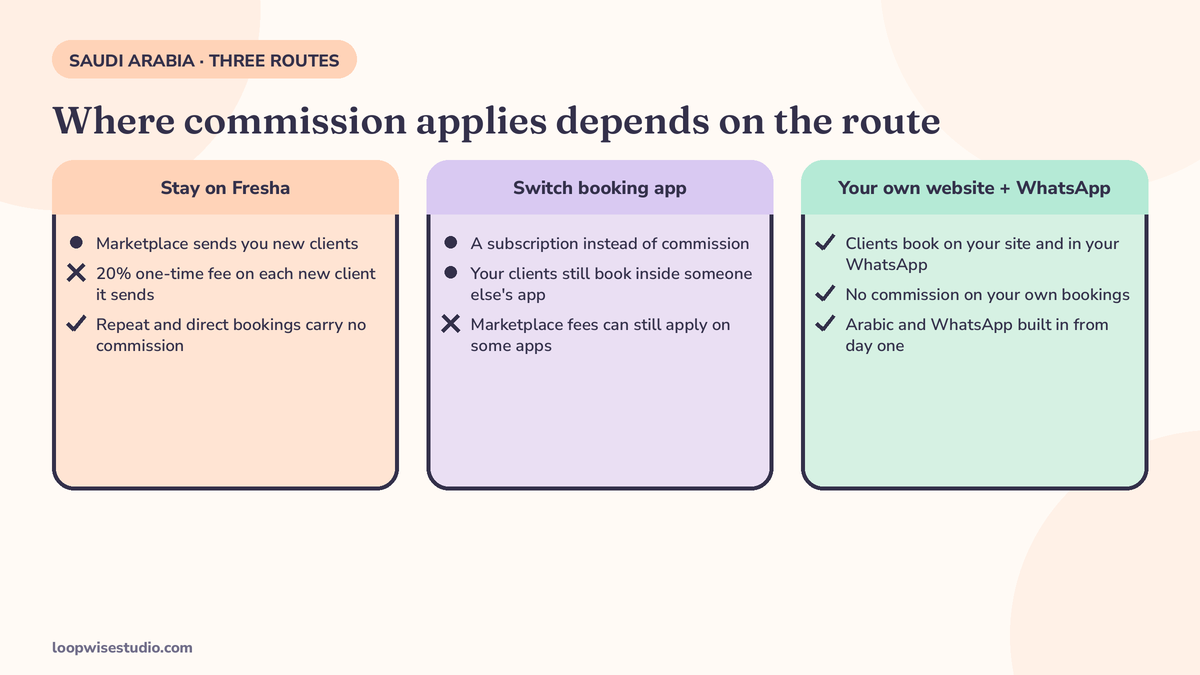
The honest short answer: Fresha does not publish Saudi-specific pricing, so judge it on its global terms, as reported by Booksy and Trafft — a one-time 20% commission (minimum $6) on every new client the marketplace sends you, plus card processing of roughly 2.2–2.8% + $0.20 per transaction. The Saudi alternative worth pricing is your own website with WhatsApp booking: no commission, Arabic-first, and clients who belong to you.
That distinction matters more in the Kingdom than almost anywhere else. Your regulars already message you on WhatsApp. They pay with mada, Tamara or Tabby. A platform built around an English-language marketplace app is solving a discovery problem you may not have — while charging you on the clients it does send, in a currency and fee model it doesn’t even publish locally.
This page goes through what Fresha actually costs on its global terms, where it fits Saudi salons and where it doesn’t, and what the alternatives look like — including the route nobody in the current search results sells: keeping the booking on your own website.
What Fresha actually charges — the global model, stated plainly
First, a warning about every other page on this topic: several ranking articles quote Fresha figures with no source at all, and none of them publishes a Saudi (SAR) price list, because Fresha doesn’t publish one either. Here is what third-party sources consistently report about the global model. Treat these as reported global terms, checked October 2026 — confirm on Fresha’s current pricing page before you sign anything.
| Charge | What sources report | Source |
|---|---|---|
| New-client marketplace commission | 20%, one-time, $6 minimum | Booksy, Trafft |
| Repeat / existing / imported clients | No commission | Trafft |
| Card processing | ~2.2–2.8% + $0.20 depending on method | Bookafy, TrustRadius, Goodcall (figures conflict slightly) |
| Subscription | Free tier ended 2025; individual plans reported from $19.95/mo | Goodcall |
| Team pricing | Reported at $14.95 per bookable member/mo | Bookafy |
| Add-ons | AI Concierge $99.95/location/mo; Client Loyalty $59.95/location/mo | Bookafy |
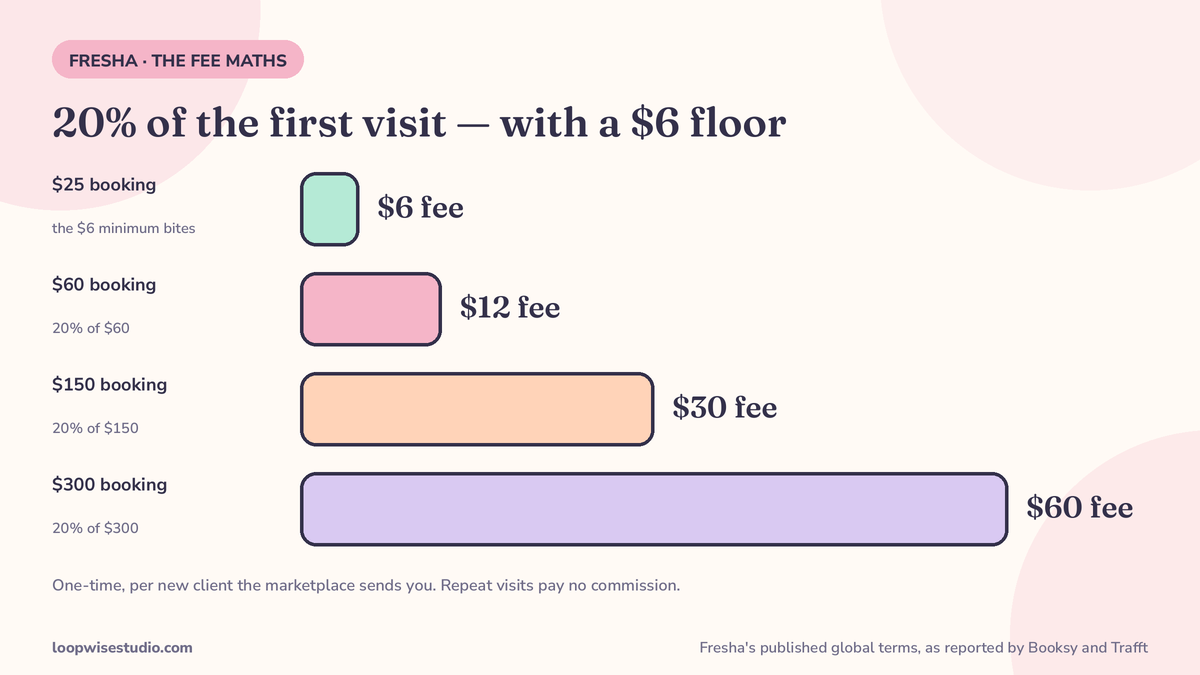
The commission maths, from Trafft’s published fee table:
- A $25 first booking → $6 fee (the minimum bites)
- A $60 first booking → $12
- A $150 first booking → $30
- A $300 first booking → $60
One more detail most salons miss, and Trafft flags it from Fresha’s own help centre: the fee can apply when a new client views your marketplace profile first and then books through your own website or social link. The client found “your” booking page — but the marketplace took its cut anyway, because it showed you to her earlier.
None of this makes Fresha bad software. It is a polished booking and POS system, and the marketplace genuinely sends new clients to salons in cities where it has consumer traffic. The question for a Saudi salon is narrower: does the marketplace send you enough new clients in Riyadh, Jeddah or Khobar to justify a fifth of every first visit — plus processing — forever? That is a question about your city and your diary, not about the software’s feature list. Our roundup of the wider field is in the best booking software for a small clinic or salon owner-operator.
The four gaps that matter in Saudi Arabia specifically
Gap 1 — WhatsApp is not the front door
In Saudi Arabia, the booking conversation already happens on WhatsApp. Fresha’s model routes clients into its app and marketplace instead. An alternative that starts from how your clients actually behave looks like WhatsApp booking for salons in Saudi Arabia: the client taps a link, picks a service and time in the chat or on your booking page, and gets confirmations and reminders in the app she already has open.
Gap 2 — Arabic is a feature, not the foundation
Gulf-focused vendors make a point of Arabic support — Salonist, the one rival actively selling across the GCC, lists multi-language support and markets to Saudi explicitly. On Fresha, Arabic is not the product’s home language, and neither is the client experience around it. If half your clients would rather read a reminder in Arabic, that is not a cosmetic detail.
Gap 3 — Local payment habits
Saudi clients split payments with Tamara and Tabby and pay by mada as a default. Marketplace platforms are built around their own card processing — which is also where the per-transaction percentage above comes from. On your own booking website, you choose the payment rails your clients already use.
Gap 4 — Data protection and your client list
Saudi Arabia’s Personal Data Protection Law (PDPL), enforced by SDAIA, puts obligations on how you collect and store client data. On a marketplace, your client list effectively lives inside someone else’s system, and — per the fee rule above — that system can charge you when those clients come back through it. On your own website, the list is yours: names, numbers, visit history, and the right to message those clients about rebooking without paying a toll.
The three real alternatives, compared fairly
| Route | What you get | What it costs | The catch |
|---|---|---|---|
| Another booking app (Salonist, Booksy, Vagaro…) | Diary, reminders, POS, some Arabic/GCC support (Salonist) | Subscription + processing; varies by vendor | Still rented: your booking lives on their system, and switching later means migrating again |
| Marketplace-first (stay on Fresha) | Discovery traffic where Fresha is strong | 20% of every new client’s first visit (global terms) + processing | You pay most exactly when marketing works; no SAR pricing published |
| Your own website + WhatsApp booking | Your domain, your list, Arabic-first, local payments, reminders and rebooking on WhatsApp | A build cost + running costs you control; no per-booking commission | You bring your own traffic — Instagram, Google, regulars — instead of renting discovery |
If Fresha’s marketplace genuinely fills your chairs with new clients every week, paying 20% of a first visit can be rational — that client may return ten times commission-free. That is the honest case for staying, and our general guide to a Fresha alternative built on WhatsApp booking makes the same point for clinics. The case collapses when most of your “new” marketplace clients would have found you anyway — through Instagram, Google Maps, or a friend’s forwarded WhatsApp number.
Worked example: what the commission does over a year
Labelled arithmetic, using the reported global terms — not a quote and not Saudi pricing, because none is published:
- Say the marketplace sends you 15 genuinely new clients a month.
- Say their first visits average the equivalent of $60.
- Commission per client: $12 (20%). Monthly: $180. Yearly: $2,160 — before card processing on every transaction, new or repeat.
Run the same sum with your own numbers before you decide. If the true figure is closer to 3 new clients a month, Fresha is cheap discovery. If it is 30, you are paying a part-time salary for clients who mostly arrive through channels you already own. When you are ready to leave a platform entirely, how to switch from Fresha to your own booking website walks through doing it without losing your regulars.
Copy this: the five questions to answer before you switch
- How many first-time clients did the marketplace actually send last month? (Count them in your diary, not the app’s dashboard summary.)
- How many of those had already seen your Instagram or Google profile first? Those are the fee-rule cases.
- What did you pay in total last quarter — commission + processing + subscription + add-ons — as one number?
- Where do your repeat bookings start: app, phone, or WhatsApp? Build the new system around the real answer.
- Can you export your full client list — names, numbers, history — today? If not, that is the first job, whichever route you choose.
What your clients actually do — and why the platform matters less than the channel
Picture the real booking journey in Riyadh. A client sees your work on Instagram at 10 p.m. She does not download a marketplace app, create an account and search for you inside it. She taps the WhatsApp link, asks if Thursday has a slot, and books in the chat.
That journey is why the “which platform?” question is smaller in Saudi Arabia than platform vendors want it to be. Discovery comes from Instagram, Google Maps and referrals. The transaction happens on WhatsApp. The platform in the middle mostly contributes the diary — and charges for the introduction when its marketplace was involved.
It also explains the pattern the research found in the current search results: the top result for this exact query is a consumer app listicle, the comparison pages are UK or Australian, and no page ranking anywhere is written for a Saudi salon owner. The market is being sold global software with global fees, in a country whose booking behaviour is unusually specific — WhatsApp-first, Arabic-first, mada-and-instalments at payment. An alternative built for that behaviour starts from the behaviour, not from a feature grid.
The switch itself, step by step
Leaving a marketplace feels risky because of the client list. Done in the right order, it is a fortnight’s background work, not a cliff edge:
- Export everything first. Client names, mobile numbers, service history, future appointments. If the export is incomplete, screenshot and rebuild before you announce anything. This list is the asset the whole switch protects.
- Build the new booking home. Your website’s booking page plus your WhatsApp number, with your full menu, prices and Arabic/English journey tested end to end.
- Move future appointments. Every booking already in the diary gets re-created in the new system and confirmed to the client by WhatsApp — which quietly teaches regulars the new route.
- Announce the new door. One WhatsApp broadcast and one Instagram post: “Booking has moved — same team, faster replies, book here.” Regulars follow instructions; they do not follow platforms.
- Run both for one cycle. Keep the marketplace listing alive through one rebooking cycle while every regular is redirected. Watch where new bookings actually start.
- Close or downgrade the marketplace once your own channel carries the diary. Keep the data export somewhere safe regardless.
Two warnings from the fee research belong here. Cards on file and stored payment details do not transfer between platforms — clients will enter them once on the new system, so pick the moment (a confirmed appointment) rather than ambushing them. And remember the profile-view fee rule during step 5: while both channels run, some “direct” bookings may still carry the marketplace fee. That overlap is the cost of a safe switch; it ends when the listing closes.
How we would set up the alternative
At Loopwise we build the third route: your own website with online booking, WhatsApp confirmations and reminders, rebooking prompts timed to the treatment, and your client list in your hands. It sits alongside WhatsApp automation for clinics in Saudi Arabia in the same cluster of systems — the channel is identical whether the appointment is a haircut or a check-up.
If you want the numbers run on your own diary first — how many new clients the marketplace really sends you and what the fee line adds up to — you can get a free audit. We will do the count with you, and if staying on Fresha is the right answer for your salon, we will say so.
When staying on Fresha is genuinely the right call
Fairness matters here, because for some salons the marketplace earns its fee:
- You are new and unknown. A salon in its first year, with no Instagram following and an empty Google profile, is buying discovery it cannot yet generate itself. Twenty percent of a first visit you would never have had is a fair trade.
- Your city has real marketplace traffic. Fresha’s consumer strength varies by city. If its app genuinely surfaces you to searching clients where you operate, the fee buys something real.
- Your repeat rate is high. The commission is one-time. A client who returns eight times dilutes that first-visit fee to almost nothing across her lifetime value.
The trap is not using Fresha. The trap is never re-running the numbers as you grow. The salon that needed discovery in year one is, by year three, often paying marketplace prices for clients who now arrive through its own reputation. Put a date in the diary — every six months, count first-time clients by source, and re-decide. Platforms count on you never doing this sum. Do the sum.
FAQs
Does Fresha charge Saudi salons in SAR?
No source we found publishes Saudi-specific or SAR pricing for Fresha. The figures in this article are Fresha’s global terms as reported by Booksy, Trafft, Bookafy and Goodcall in October 2026, in USD. Check Fresha’s current pricing page for what applies to your account.
Is the 20% commission charged on every booking?
No. Per Trafft and Booksy, it is a one-time fee on a new client’s first booking, with a $6 minimum. Returning, existing and imported clients do not trigger it. It can apply when a new client viewed your marketplace profile and then booked through your own link.
What is the strongest Saudi-specific reason to switch?
WhatsApp and ownership. Saudi salon clients already book and rearrange by WhatsApp, and local payment habits (mada, Tamara, Tabby) sit naturally on your own site. On a marketplace, both the client relationship and the rebooking channel belong to the platform.
Can I keep Fresha for discovery and run my regulars on my own system?
That hybrid is what many salons end up doing, but read the fee rule first: a new client who views your marketplace profile and then books direct may still trigger the commission. The split works best when regulars are fully moved to your own booking page and list.
Do alternatives support Arabic properly?
Some Gulf-focused vendors, Salonist among them, market Arabic and multi-language support for GCC salons. An owned website can be Arabic-first by design rather than by settings toggle — ask any vendor to show you the full client journey in Arabic, including reminders, before you buy.
What does switching actually involve?
Exporting your client list, rebuilding your service menu and prices on the new system, moving future appointments, and telling clients where to book now. Done in that order, regulars barely notice. Done backwards, you lose the list — which is why the export comes first.
Still counting what the marketplace really sends you each month? That count decides this whole page. Start with a get a free audit request and we will run it from your own diary numbers, then tell you plainly whether to stay, split, or switch.