Do I Need a Website If I Get Bookings From Instagram?
Your DMs fill the diary, so do you need a website? The honest answer, including when Instagram alone is enough — and what your bookings already rent today.
Short answer: you do not need a website instead of Instagram, and if you are fully booked with a waiting list, you may not need one yet at all. But there is a catch most owners never notice: “Instagram-only” booking already runs on a booking website. The Book Now button and the link in your bio open a booking page rented from a scheduling platform — their domain, their rules, their client list format. So the real question is not “website, yes or no?” It is whether the page your clients book on belongs to you. This article makes the strongest honest case for staying Instagram-only, answers it fairly, concedes the cases where Instagram alone genuinely is enough, and shows the small keep-both setup most salons and clinics end up with.
The strongest case for Instagram-only, stated fairly
If this is your position, you are not being naive. Here it is at full strength:
- Your clients are already there. They find you there, they watch your work there, and DMs are where bookings already happen. Moving them somewhere else adds friction to a flow that works.
- It’s free. Instagram costs nothing. A website costs money and time — design, hosting, maintenance — for something that might bring in nothing extra.
- Instagram can be the entire booking interface. Add the Book Now button, connect a scheduler, take payments, get reminders and analytics — one how-to guide for Instagram booking (AEANET) puts it plainly: Instagram bookings “can serve as a primary booking interface even if you don’t have a dedicated website”.
- Fully booked businesses gain nothing. As web agency Webloped concedes, if you are fully booked on word of mouth and turning work away, a website will not help you turn away more work. Another agency, SharpHaw, makes the same point about a fully booked barber with a waiting list of regulars.
- If you are still testing, prove demand first. A website does not validate anything. If you are not yet sure the business works, spend the money on products and practice, not pages (Webloped again — and they are right).
- Marketplace sellers are already covered. If you sell through Etsy, Amazon or a delivery app, discovery, payment and reviews are the platform’s job.
- Instagram shows up on Google now anyway. Since 10 July 2025, search engines can show public posts from professional accounts, switched on by default — so your content is findable in search without a website (as SharpHaw reports).
That is a good case. Now the honest answers, argument by argument.
Where each argument holds — and where it stops
“My clients are already there.” True for discovery — and discovery is not the whole journey. In SOCi’s 2026 Local Discovery Index, a survey of more than 1,000 US consumers reported by SharpHaw, 43% said they preview a business on social media before committing — preview, not finish. And 63% had walked away from a business that could not answer a question they needed answered. The profile makes them interested; the last questions before booking — how much, when, where, what does it involve — are where they decide. GWI research, summarised by Squarespace and reported by Webloped, puts brand discovery at an average of 5.8 channels: your client was never only ever going to look at one place.
“It’s free.” Instagram is free. The booking page it sends people to is a paid product whose free tier exists at the platform’s discretion. Even the link-in-bio tool most owners use sits on the tool’s own domain and disappears if you stop paying or the service closes (SharpHaw’s FAQ makes this point about link tools). “Free” here means “rented at £0, for now, on terms that can change”. And the audience is rented too: as Webloped notes, the algorithm decides who sees you — only a small percentage of your own followers see any given post — while sponsored posts and suggested accounts from competitors run right next to your profile. You do not own the reach either; you are borrowing it, post by post.
“Instagram can be the whole interface.” It can — but read AEANET’s own guide closely: Instagram’s built-in booking “requires integration with a supported third-party scheduling platform”. There is no Instagram diary. There is a partner platform’s booking website, reached through a button. Square’s version is the same: its page advertises booking “directly from Instagram, without needing to go to another website” — and the flow it describes opens Square’s own booking site. The booking already happens on a website. It is just not yours.
“I’m fully booked.” Conceded, in full — see the section below. This is the strongest argument on the list.
“I’m still testing.” Also conceded. A website is not a business test.
“I sell on marketplaces.” Conceded — but note that is not most salons and clinics. Treatments cannot be shipped; your “marketplace” is your local area, and your platform is a social network, not a shop.
“Instagram is on Google now.” Partly. A post answers only what its caption said on the day it was posted. Prices change, hours change, you stop offering a treatment — the old post keeps ranking with the old information (SharpHaw’s rebuttal, and it is the correct one). Search indexing of posts gives you stale fragments in Google, not a bookable result with live availability.
The four jobs Instagram cannot do for a bookings business
Strip away the ownership argument and four practical gaps remain — all of them about the moment after someone decides they want you:
- Answer questions and take the booking at 10pm without you. A booking page shows live slots, takes the deposit and confirms, while you are treating, eating or asleep. A DM waits for you — and the same SOCi figure above says most consumers have walked away from a business that could not answer. Our guide to replying to Instagram DM leads faster covers how to shrink that gap on the DM side; a bookable page removes the gap for the people who would rather just book.
- Show up in “near me” searches as a bookable result. Google Business Profile results and websites are what people compare when they search “aesthetic clinic near me”. BrightLocal’s 2026 consumer survey, reported via RedFork Marketing, found 54% of consumers visit a business’s website after reading positive reviews — the reviews live on Google, the decision gets checked on the website.
- Take deposits and send reminders automatically. No-show protection does not live in the grid; it lives in whatever booking system sits behind the button. If that system is set up under the platform’s defaults rather than your rules, you get their cancellation policy, not yours.
- Survive a lockout. In June 2025, TechCrunch reported that Instagram users had complained for weeks about a significant increase in accounts being mistakenly banned or suspended, with some appeals getting no response at all — and businesses were caught in it. Affected users had no way to reach Meta support unless they paid for a subscription. As SharpHaw puts it, when the profile is your only home online, a lockout takes the shop window and the enquiry inbox at the same time — along with every DM conversation you have ever had with a client. And bans are not the only version of this: Webloped notes that suspended, hacked or restricted accounts “are not rare”, and quotes the ownership point in a business owner’s own words from a Reddit discussion: “your friend does not own his facebook page, his instagram page or any other social media. He can lose those pages for literally any silly reason.”
Do the maths on your DM bookings before you decide
“Nobody needs a website” arguments usually skip the cost of the current system: your evenings. Count it roughly — this is arithmetic with your own numbers, not a statistic:
Enquiries per week × messages to complete one booking × about 2 minutes per message.
Say 15 enquiries a week, and each completed booking takes about 6 messages back and forth (price, dates, more dates, confirm, directions, a reminder you type by hand): 15 × 6 × 2 minutes is about 3 hours a week spent as a human booking form. We work through this model properly, with a method for counting your own threads, in our online booking vs DM bookings comparison for aesthetic clinics. If your honest count comes out at 20 minutes a week, fine — Instagram is carrying it. If it comes out at hours, you are already paying for a booking system; you are paying in evenings.
When Instagram alone genuinely is enough
Credit where it is due — the agencies on the results page concede these cases, and so do we:
- You are fully booked with a waiting list of regulars. A website will not help you turn away more work (Webloped’s line, and it is correct). Revisit when you hire, raise prices enough to thin demand, or open a second chair or room.
- You are testing an idea. Prove people will pay before you build the shopfront.
- You sell only through marketplaces. The platform is your shop, deliberately.
One thing to do even in these cases: register your business name as a domain now. Webloped puts a domain at roughly $15–25 a year. It is the cheapest insurance in this entire article — it stops anyone else taking your name, and it is there the day you need it.
If you are between the cases — busy, growing, but spending real hours in DMs — get a free audit and we will look at your current setup and tell you plainly whether a website would pay for itself in your situation, or whether you can wait.
The keep-both setup: Instagram discovers, your website books
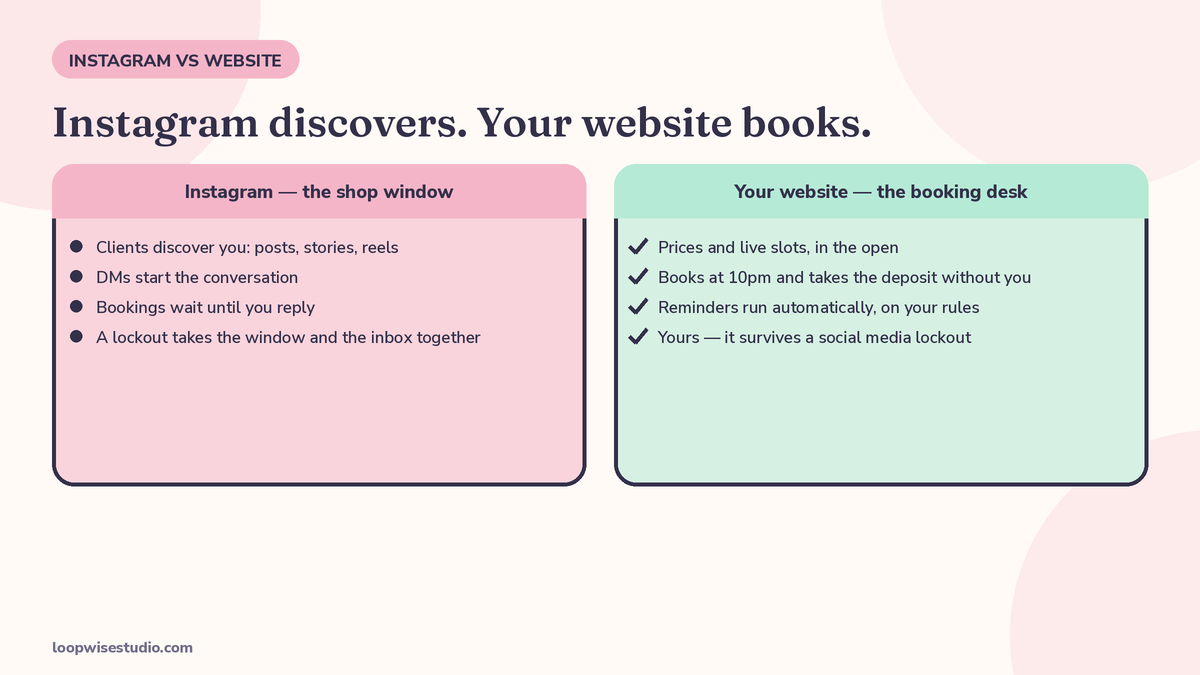
Nobody serious is suggesting you leave Instagram. The setup that works for salons and clinics splits the jobs:
Step 1 — The small website holds the deciding information. Services with real prices, who does them, before-and-afters, where you are, and live booking. Not a brochure — a decision page set.
Step 2 — Your booking page runs on your domain. Same diary your Book Now button uses today, or a booking system of your own — but the page clients land on is yours, with your deposit and cancellation rules.
Step 3 — Point everything at it. Bio link goes to your booking page, not the platform’s. Story highlights: “Prices” and “Book” lead to the matching pages.
Step 4 — Wire the DMs to it. Your first reply to a price or availability question answers the question and includes the booking link. The conversation stays personal; the diary-keeping leaves the chat.
Step 5 — Change nothing about posting. Same content, same cadence. Instagram remains the shop window — the website is simply the till and the diary behind it.
The result is the setup described in our piece on building a website that turns Instagram followers into bookings for salons: the followers were never the problem — where they land is.
The bottom line
If Instagram fills your diary today and your DM workload is small, you do not need a website yet — register the domain and get on with your week. But do not mistake the current setup for owning nothing: your clients already book on a website, a rented one, and every risk in this article sits inside that word. The day the DM hours add up, or the account wobbles, or you want Google searchers to be able to book you — that is the day the small owned site stops being optional.
Frequently asked questions
Is a link-in-bio page (Linktree and similar) enough?
As a stopgap, yes; as your home, no. It sits on the tool’s domain, it is a list of links rather than a page that answers questions and takes bookings, and it disappears if you stop paying or the service closes. Point your link-in-bio at your own booking page and it becomes a useful signpost instead of a rented front door.
Will a website steal my Instagram followers or hurt my reach?
No. The website does not compete with the profile; it catches what the profile starts. Clients still discover you, watch your work and message you on Instagram. The site only handles the part Instagram never did well: final prices, live slots, deposits and confirmations.
Instagram posts appear on Google now — doesn’t that fix search?
It helps people find a post. It does not give them a bookable result: the caption is frozen on the day it was posted, so last year’s price can be the thing ranking, and there is no live availability or booking on a post. Your Google Business Profile and website are still what a searcher compares before choosing.
I’m fully booked through DMs. Do I still need one?
Honestly, not urgently. If you are turning work away and the DM admin is small, a website solves a problem you do not have. Register the domain, and revisit the question when you hire someone, open more hours, or notice the message admin growing — those are the triggers.
What should the website include if Instagram does my marketing?
Four things: services with real prices, live online booking connected to your diary, proof (photos, reviews, credentials), and practical details — location, hours, parking, contact. Everything else is optional. Five or six pages is plenty at this size.
How much does a small website like this cost?
Less than most owners expect, and it depends on route: do-it-yourself builders run about $20–60 a month (Webloped’s figures), and a custom small site starts in the low four figures in their Canadian pricing. Either way, compare it against your honest DM-hours count above — that is the budget line it replaces. For the clinic version of the same purchase, our guide to what a clinic website with booking costs sets out the market ranges, and if you have already decided to build, how long a booking website takes to build shows where the weeks go.
Still not sure which side of the line your business sits on? get a free audit — we will look at your Instagram, your booking flow and your Google presence, and give you a straight answer, even if the answer is “keep doing what you’re doing”.