A Website That Turns Instagram Followers Into Bookings
Your salon's Instagram gets attention but not bookings? The fix is the page followers land on: services, prices, slots and a DM flow that ends in a booking.
A website that turns Instagram followers into bookings for salons is not a prettier homepage. It is one fast mobile page, built for someone arriving from your profile with a photo of what they want still in mind, that shows services and prices organised the way clients think about them, offers live slots with the stylist they came for, takes a deposit on high-value work, and confirms by message. That page — on your own domain, wired properly to your profile and your DMs — is what converts attention into a diary. Everything else in this guide is how to build and connect it.
This matters because for most salons the followers are not the problem. The content works. People save the post, visit the profile, maybe even tap the link. Then the path quietly ends: a link page with five competing buttons, a booking marketplace they have to search inside, or “DM to book” — a conversation nobody answers while you are mid-appointment. The leak is not reach. It is the last thirty seconds.
Your followers are not the problem
Salon marketing content will tell you to post more, post better, and use more Reels. Some of that is fine advice for reach. It does nothing for the person who already decided they like your work today.
Watch what actually happens to that person:
- She sees a balayage result she wants, on a Tuesday night, on the sofa.
- She visits your profile. The work is good. She wants a price and a time.
- She finds neither in under a minute. The bio sends her to a link page, the link page sends her to a booking platform’s search screen, or the caption says “DM to book.”
- She DMs. You are with a client, then closing up, then asleep. By the time anyone replies tomorrow, she has messaged the salon whose post she saved second.
Booksy’s own platform writing puts a number on the timing problem: Booksy states that of the appointments its clients book themselves, 60% are made outside working hours. That is Booksy’s figure from its own customer base, not a market study — treat it as a vendor’s view of its own data. But even at half that, the shape is hard to argue with: a booking path that depends on a human being awake and free will miss a large share of the demand your Instagram creates.
The fix is not more content. It is a destination.
What a booking website for Instagram traffic has to do
People arriving from Instagram are the least patient visitors your website will ever get, and they all arrive on a phone, usually inside Instagram’s in-app browser. Set a hard rule — booking app MyCuts states it memorably in its own guide: if it takes more than 30 seconds to go from your post to a confirmed appointment, you are losing people. Their surrounding statistics are published without sources, so treat the 30-second line as a design test rather than a measured fact — but as a test, it is a good one. Stand in your own shop, open your own profile, and time the route with one thumb.
A page that passes looks like this:
- Loads instantly, on mobile, inside Instagram. No heavy sliders, no video background, no “desktop site shrunk down.” If the first screen is not usable in two seconds, nothing below it matters.
- Opens on the booking decision, not your story. The first screen is services, prices and Book now — not a welcome message, not the salon’s history, not a newsletter signup.
- One job per visit. The page exists to turn this visit into a booking or a waitlist signup. Other pages on your site can do other jobs. This one does not get a blog sidebar, a shop, and three popups.
Anatomy of the page
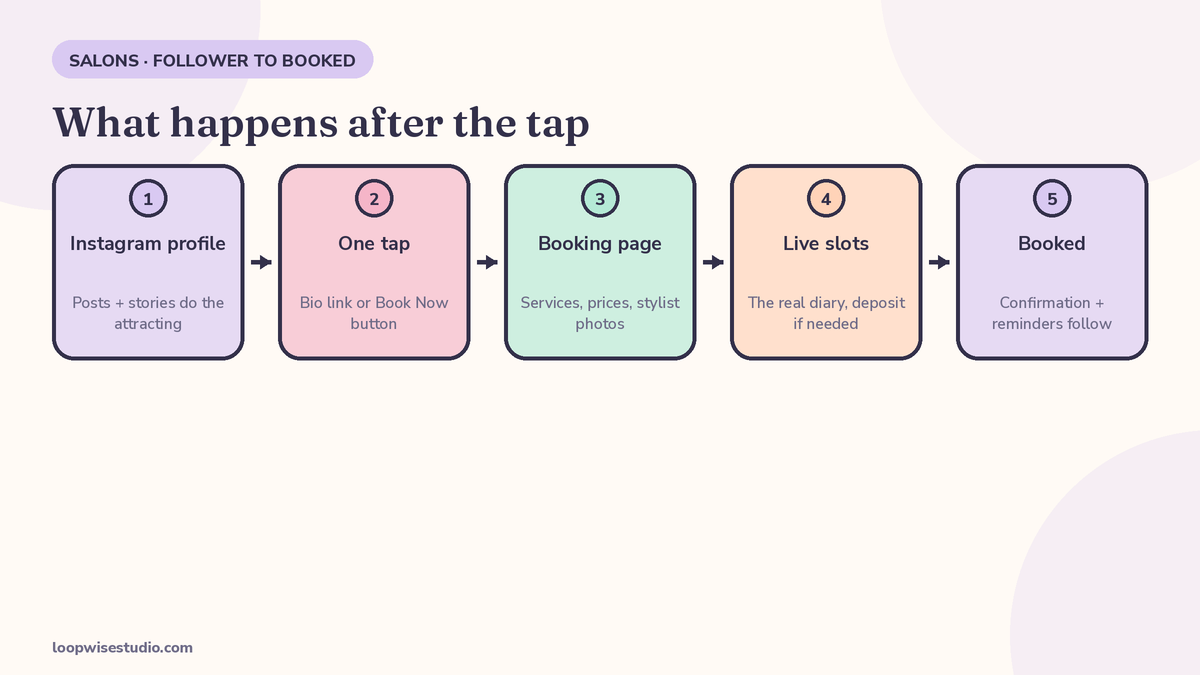
Here is the full page, section by section, in the order a follower scrolls it:
| Section | What it must contain | Why it converts |
|---|---|---|
| Header | Salon name, area, one Book button that stays visible while scrolling | The action never scrolls away |
| Service galleries | Before/after photos grouped by service — balayage, blonding, cuts, styling — not by date | She came for one result. Show her ten more of that exact result, not your whole feed in reverse |
| Service menu with prices | Every service, with a price or a clear “from” price | “DM for prices” is where followers quietly leave. Price uncertainty is friction dressed as mystery |
| Pick your stylist | Photos, names, specialties, each with their own live slots | Half of Instagram demand is person-specific — she followed the stylist’s work, not the salon’s |
| Live availability | Real slots from the real diary, including today and this week | “Request an appointment” is a promise to wait. Live slots are a booking |
| Deposit step | Card deposit for colour, extensions and other long or high-value services | Protects the diary and filters casual taps from real intent |
| Proof | Review count and a few short reviews, near the booking button, not on a separate page | The last hesitation before paying a deposit is trust. Answer it where it happens |
| Follow-up hooks | Confirmation by message, reminder sequence, review request after the visit | The booking is the middle of the loop, not the end (see below) |
Two details deserve emphasis because almost every salon page gets them wrong.
Galleries by service, not by feed. Your Instagram grid is organised by the day you posted. A client deciding on a service needs it organised by the decision: all your blonding work together, all your curly cuts together. Same photos, different order — and the second order books.
Consultation-first services get a different button. Colour correction, first-time extensions and anything that needs a patch test or a look at the hair first should book a consultation, not a full appointment. Forcing those into the normal booking flow creates the wrong bookings — wrong duration, wrong price, an awkward conversation in the chair. One honest button (“Start with a consultation”) protects the diary and the client.
Wire Instagram to it properly
A good page connected badly is the same as no page. The wiring is a handful of settings and habits:
- Use Instagram’s Book Now action button on your business profile, pointed at your booking page, instead of relying only on the bio link. The button sits where a decided follower looks first. Google has an equivalent: a booking link on your Google profile does the same job for the searcher who finds you on Maps instead of Instagram.
- Make the bio link go to the booking page itself — not a link-in-bio menu with your TikTok, your shop and a directions page in between. Every extra choice costs bookings. If you must keep other links, the booking link is the first and the largest.
- Story link stickers on every “slots this week” story. A story that says “two colour slots opened Thursday” with a sticker straight to those services’ booking section converts the urgency you just created. A story that says “DM to book” converts it into unpaid admin.
- End captions with the action, not the conversation. “Thursday 11am and 2:30 are open — link in bio books them” beats “DM me to book” every time, because one of them still works at 11pm. We make the same argument from the other side in our piece on whether you need a website if you get bookings from Instagram — the short answer is that Instagram is the shop window, not the till.
The measuring habit that keeps all of this honest: once a month, do the thumb test again from a phone that is not yours. Profiles and links get edited over time, buttons point at pages that moved, and nobody notices because the person who would notice is the client who just left.
The DM leak, and how to close it
Even with perfect wiring, DMs will keep coming — followers ask questions in the app they are already in. The problem is not that DMs exist. It is that a DM enquiry has a short life and your salon answers on a slow clock.
The pattern: a price question lands at 7:40pm. It is answered at 10am. Two other salons answered by 8pm — not because they are better, but because they had a system. The manual version of “doing Instagram well” makes this worse, not better: popular salon-marketing tactics deliberately drive more DM conversations (keyword replies, comment prompts, package invites), and every one of those conversations is a task waiting for a busy human. More reach, more unanswered messages.
Close the leak with response cover, not more effort:
- An instant first reply, day and night, that answers the common questions (prices, location, parking, how long a service takes) and always ends with the booking link. The reply’s job is to hand the follower the page — the page does the booking.
- A human takes over real conversations in the gaps of the day, from one shared inbox, picking up exactly where the automatic reply left off.
- Every DM outcome gets recorded. Price question, booked, joined the waitlist, went quiet — so follow-up is a system, not a memory.
The speed standard and the scripts for the med-spa version of this problem are in our guide to replying to Instagram DM leads faster — the mechanics transfer directly: answer in seconds automatically, in minutes personally, and never let a conversation be the only way to book.
What changes when this works: the DM stops being the booking channel and becomes the signpost. That is the difference between an Instagram presence that creates work and one that fills a diary.
If closing that leak is the part you keep not getting to — the replies, the page, the wiring — it is the exact build we do. Get a free audit and we will time your own follower-to-booking path and show you where it breaks.
After they book: the loop back to Instagram
A booking from Instagram is not the end of the path. Handled properly, it is where the next follower comes from.
The chain runs: confirmation by message the moment they book (so the appointment feels real, and the slot is defended) → reminders before the visit, with an easy reschedule tap (an early cancellation you can refill is worth far more than a no-show) → a review request after the appointment, while the result is fresh → the result itself, photographed with consent, becomes content → that post starts the loop again with the same booking path attached.
Most salons run the first half of this by hand and the second half not at all. Automating the messages is what makes the loop reliable: the review gets asked for every time, not on the days someone remembers. And the distinction between a client who booked through the system and one lost in the DMs is the distinction we draw out fully in online booking vs DM bookings for aesthetic clinics — systems remember everyone; conversations remember whoever shouted last.
Marketplace button vs your own website
The honest comparison, because both routes genuinely work:
| Marketplace booking (Booksy / Fresha buttons) | Your own booking website | |
|---|---|---|
| Setup | Fast — the button connects to your marketplace diary | A real build — page, diary, payments, messages |
| What the client sees | The platform’s page, your listing among its branding | Your salon, your prices, your work — nothing else |
| Discovery | The platform can send you clients from its marketplace | Your Instagram, Google and referrals send the clients |
| What you pay | Platform terms — a salon-software roundup (Top Salon Software) states that Fresha charges 20% commission on marketplace bookings; check each platform’s current terms directly, they change | Build cost, then low running costs — no per-booking commission to a marketplace |
| Client data | Partly the platform’s — your list may live inside their system | Yours. Emails, numbers, history and the waitlist belong to the salon |
| When you leave | Reviews, ranking and client history largely stay behind | Everything moves with your domain |
Booksy’s version of the conversion argument is real: it states that clients who book themselves make 20–30% more appointments than clients who rely on calling — again, Booksy’s own figure about its own customers. Self-booking is not in dispute. The question is whether the self-booking happens on a page you own or in an app you rent. Plenty of salons sensibly start on a marketplace. The salons that outgrow it feel the same squeeze: they do the marketing, create the demand on their own Instagram, and then pay commission and lose the client relationship at the till.
Stylists, booth renters, and more than one Instagram
In many salons the accounts do not match the business. The salon has a page, but so does every stylist — and the senior stylist’s page has three times the following of the salon’s.
The website solves this cleanly, if it is built for it: one salon booking page, with a section and live diary per stylist. Each stylist’s bio links to their own section. A follower of any chair lands in the right diary, at the right prices, under the salon’s roof. Booth renters who run fully separate businesses get separate pages and separate booking — the same structure, divided honestly instead of tangled into one account.
Do not skip this in the build. A salon page that only books “the salon” forces person-specific demand — the majority of Instagram demand — back into DMs, which is the leak you were trying to close.
How to tell if it is working
Watch five numbers, monthly. They follow the path in order, and the first one that drops is where your problem is:
- Profile visits — is the content reaching people? (Instagram’s own insights.)
- Link taps and Book button taps — is the profile converting attention into intent?
- Bookings started on the page — did the page hold them?
- Bookings completed — the gap between started and completed is friction: price surprise, account signup, a diary that shows nothing for two weeks.
- Bookings made outside working hours — your proof that the page is doing the night shift your DMs could not.
If 1 and 2 are healthy and 4 is weak, you do not have a marketing problem and no amount of posting will fix it. You have a page problem. That is the most common finding, and the cheapest of the five to fix.
What Loopwise builds
Loopwise Studio builds the whole path as one system for salons: the booking website on your own domain (service galleries, prices, stylist diaries, deposits), the Instagram wiring (button, bio, story flow), the DM and missed-message replies that hand followers to the page, and the confirmations, reminders and review requests that turn one booking into the next follower. Built for you, at a fixed price agreed before we start — not another app subscription to learn between clients.
Get a free audit — we will walk your current path from post to booked appointment, time it, and show you the exact step where your followers are dropping out. If the page is fine and the problem is elsewhere, the audit will say that instead.
Frequently asked questions
Can’t I just use a link-in-bio tool instead of a website?
For a solo stylist, a good link-in-bio portfolio page may genuinely be enough — one such tool (Outline) is built for exactly that, at a published $14/mo. The limit shows up when you have multiple stylists, deposits, a waitlist and follow-up messages to run: that is website work, and stacking separate tools for each piece usually costs more than one page that does it together.
Do prices really need to be on the page? Won’t that scare people off?
Prices on the page are the single biggest friction cut available to you. A follower who cannot find a price has three choices — DM and wait, guess, or leave — and most leave quietly. Use “from” prices where the final price depends on hair length or condition, and confirm the exact figure before the service starts. That keeps the honesty and removes the guessing.
What about clients who prefer to DM us?
They still can — the DMs stay open. The change is that the first reply arrives instantly, answers the basics, and hands them the booking link, and a human still picks up real conversations. Clients who like messaging get a faster salon, not a closed door. What they no longer have to do is wait until tomorrow to become a booking.
Will this work if our Instagram following is small?
Yes — conversion matters more, not less, at small numbers. A salon with 2,000 followers and a page that books has a better diary than a salon with 20,000 followers and a DM queue. The page also serves the traffic you get from Google and referrals, so it is not only working on Instagram visitors.
Do we lose our Booksy or Fresha clients if we move to our own page?
No — the diary is what matters, and a sensible move keeps your existing platform running while your own page takes over the Instagram and Google traffic, then migrates regulars gradually. Nobody has to rip out a working diary on a Friday. What changes is where new demand lands and who owns the relationship.
How long does it take to build?
A single-location salon page with booking, deposits and the message system is a build of weeks, not months, once your services, prices and photos are gathered. The slow part is almost never the technology — it is deciding prices and collecting good photos of your work, which you already have on your Instagram.