Booking System for UK Salons With WhatsApp Reminders
A booking system for UK salons with WhatsApp reminders from your own number: online booking, deposits, patch tests and fewer no-shows, set up for you.
A booking system for a UK salon with WhatsApp reminders is three things working as one: an online booking page that takes appointments while you are with a client, a diary that stays in step with it, and reminders that go out on WhatsApp from your salon’s own number — confirmation at booking, a reminder with Confirm or Reschedule buttons before the visit, and a follow-up if a client does not show. This page explains how that system works, what it should cost in the UK, and the parts software pages never mention: patch tests, deposits, and whose number the reminders come from.
If you have searched this before, you will have noticed the cupboard is bare. Google serves a couple of directories and product homepages, because almost nobody has written the actual guide. So here it is.
What a booking system with WhatsApp reminders actually does
Most salons do not have a booking problem. They have a gap problem: the client who decides at 9.30pm, the phone that rings mid-colour, the appointment booked three weeks ago and forgotten by the day. A proper system closes those gaps in order:
- The booking page takes the appointment properly. Service, stylist or therapist, real duration, buffer time, and the deposit or booking fee your policy asks for — taken at booking, not chased later.
- The diary updates itself. No double bookings, no copying from a DM thread into an app at the end of the day.
- The confirmation lands on WhatsApp immediately, in the chat the client already uses, from the number saved in their phone as your salon.
- The reminder sequence runs (next section), including the patch-test reminder most systems forget.
- Reschedules are self-service. A client who cannot make it taps Reschedule, picks another slot, and releases theirs in time for someone else to take it.
- A no-show is followed up politely and quickly, while a gap in today’s diary can be offered to your waiting list.
That is the whole product. Everything else — loyalty schemes, stock control, payroll — is a different purchase, and bolting it on is how salon software bills quietly grow.
The reminder sequence that protects a salon diary
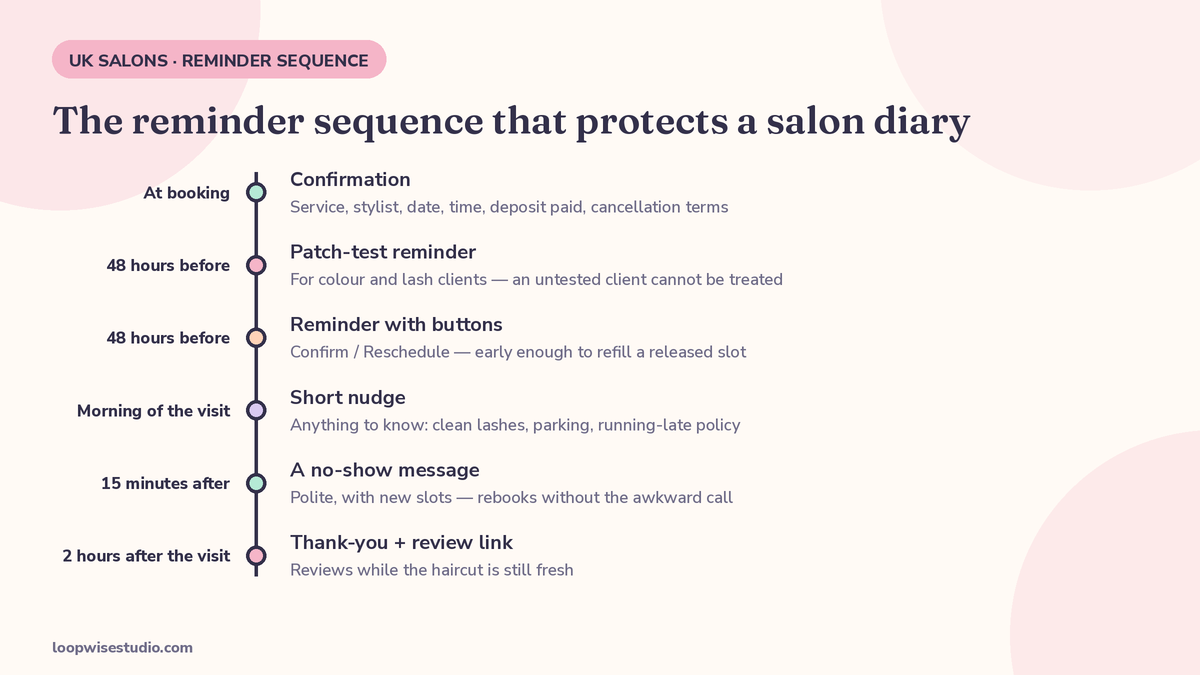
One reminder is a hope. A sequence is a system. This is the sequence we set up, with the wording style that gets replies rather than blocks.
| When | Message | Why it is there |
|---|---|---|
| At booking | Confirmation: service, stylist, date, time, deposit paid, cancellation terms in one line | The client has the facts in the chat they will actually check |
| 48 hours before, colour/lash clients | Patch-test reminder if a test is due | A client who arrives untested cannot be treated — this reminder protects the appointment itself |
| 48 hours before | Reminder with Confirm / Reschedule buttons | Early enough that a released slot can be refilled |
| Morning of the visit | Short nudge with anything to know (arrive with clean lashes, parking, running-late policy) | Catches the day’s plan changing |
| 15 minutes after a no-show | Polite message with new slots | Rebooks without the awkward phone call |
| 2 hours after the visit | Thank-you and a review link if they are happy | Reviews while the haircut is still fresh |
Templates, in normal salon English:
Confirmation
Hi Emma, you’re booked with Priya on Saturday 18 October at 11am for a cut and finish. We’ve taken your £15 booking fee, which comes off your bill on the day. Need to move it? Just reply here.
48-hour reminder
Hi Emma, looking forward to Saturday at 11am with Priya. Tap Confirm if you’re still good, or Reschedule and we’ll show you other times — no charge for moving with this much notice.
Patch-test reminder
Hi Emma, quick one before Saturday: your colour service needs a patch test at least 48 hours before. Pop in any time before Thursday and it takes two minutes at the desk — no appointment needed.
After a no-show
Hi Emma, we missed you today at 11am. Your booking fee has been kept this time, as our terms say — here are the next slots with Priya if you’d like to rebook.
Short, human, and with the terms stated before they bite, not after. If you are comparing platforms rather than systems, our Fresha alternative for clinics and salons that want WhatsApp booking works through the keep-it-or-leave-it decision in detail.
Your number or theirs?
This is the question almost nobody answers honestly, and it matters more than any feature list.
Reminders from your own WhatsApp number land in the conversation your client already has with your salon. They can reply, and the reply reaches you. The client trusts it because it is recognisably you. And if you ever change booking software, your number, your chat history, and your client relationships stay yours.
Reminders from a platform’s number or short code look like system mail, get ignored like system mail, and replies often go nowhere useful. Worse, the relationship lives inside the platform. Leave, and you leave behind the message thread your clients actually respond to — plus, on marketplace platforms, you may find the clients the marketplace introduced were never really yours to take with you.
Our view is simple: your number, your clients, your history. Any system we build runs on the salon’s own WhatsApp number for exactly that reason. The same logic applies to barbershops comparing platforms, which we cover in our Booksy alternative for barbers in the UK who want WhatsApp.
Deposits, booking fees and no-show charges, the UK way
UK salons have mostly stopped apologising for deposits. The version that works — and stays fair — has four parts:
- Take it at booking, automatically. A policy you have to enforce by phone is a policy you will stop enforcing. The system takes the booking fee or deposit as part of booking, with card payment, so no member of staff has to have the awkward conversation.
- State the terms in the confirmation, in one plain line: how much, what it comes off, and the notice needed to move without losing it. If a client is surprised by a charge, the wording failed, not the client.
- Make rescheduling easier than ghosting. Most no-shows are not malice; they are a client who knew at 9am they could not make 1pm and had no painless way to say so. A Reschedule button in the reminder saves more appointments than any charge.
- Apply the policy evenly. The system keeps the fee when the terms say so, for everyone, which removes the front-desk negotiation entirely. Even-handed is what makes it feel fair.
Card-on-file (charging only if they do not show) suits high-trust regulars; an upfront booking fee suits new clients and long appointments. Many salons run both, and the booking system should support the split without workarounds.
Midway check: if your diary loses even a couple of appointments a week to no-shows and late cancellations, get a free audit and we will work out what a reminder sequence on your own number would recover, using your real booking pattern — not a vendor’s headline percentage.
Patch tests and consultation forms: the workflow software pages skip
A colour or lash appointment without a valid patch test is an appointment you cannot legally or safely carry out. Yet booking software treats patch tests as your problem. In a joined-up system:
- The booking flow knows which services need a test, and checks the client’s test date before confirming.
- A client whose test is out of date gets the 48-hour patch-test reminder above, with a drop-in route that does not need its own booking.
- Consultation forms go out with the confirmation and come back before the visit, so contra-indications surface in good time — before the client is in the chair, not during the consultation.
It is unglamorous work. It is also the difference between software that books appointments and a system that protects them.
What it really costs a UK salon
Published UK prices, as they stand in October 2026:
| Route | Published pricing | Watch for |
|---|---|---|
| UK booking platform (BookHive) | £40/mo base plus £10 per extra staff member, as published on bookhive.uk | Check what “free to start” covers before the monthly fee applies to your team size |
| Marketplace platforms (Fresha, Booksy) | Free or low-cost to start, as compared in our research | Commission on marketplace-introduced clients, and clients you cannot take with you if you leave |
| WhatsApp-first software (Happoin) | A free-forever plan covering up to 40 appointments a month, as published on happoin.com | Tier steps once you pass the free allowance, and pricing quoted in dollars on its UK page |
| Done-for-you system (Loopwise) | Fixed price after a discovery call | Should include setup of the booking page, your number connected, and the reminder templates written for you |
Then the costs nobody puts in the headline: WhatsApp messaging on the Business Platform carries Meta conversation charges on top of any subscription; card processing applies to every deposit you take; and your own time setting up DIY software, between clients, is a real cost even if no invoice arrives. Put a year of each route side by side — subscription × 12, per-staff steps as your team grows, commission on marketplace bookings, message charges — and the “free” option is often the middle-priced one. What free never includes is someone else doing the setup.
We do not publish a salon price on this page for the same reason we criticise hidden pricing elsewhere: the honest number depends on your team size, your diary, and how much of the flow you want automated. It is quoted once, fixed, before any work starts.
Moving off Fresha or Booksy without losing your clients
The fear that keeps salons on a platform they have outgrown is losing the client list. The reality, in order:
- Your own client records are yours. Names, numbers, and visit history you collected are your data. Export them before you cancel anything, and check they include the clients who booked you directly, not just marketplace introductions.
- Marketplace clients are the platform’s audience. Clients a marketplace introduced may not be exportable, and you cannot message them as if they were your list. Plan for losing some of them; it is a real cost of leaving, and anyone who says otherwise is selling.
- Run both briefly. Keep the old platform live while the new booking page and your own number take over — your Google profile, Instagram bio, and website point to the new system, and regulars get one clear message explaining the change.
- Your reviews mostly stay put. Google reviews live on your Google profile, not inside the booking platform. They are the asset worth protecting, and they travel with you.
Salons weighing the commission side of this move should also read our comparison of a Vagaro alternative for salons without commission fees — the same “free until it isn’t” pattern shows up there too.
GDPR and PECR for salon messages
Two kinds of message leave your salon, and UK law treats them differently. This is the plain-English version; it is general information, not legal advice.
Service messages — confirmations, reminders, patch-test prompts, reschedule links for an appointment the client has made — are part of the service the client booked. They are the reason clients give you their number.
Marketing messages — a cancellation-gap offer broadcast to last month’s clients, a rebooking nudge to everyone who has not visited in six months, a new-treatment announcement — are marketing under PECR, and they need consent you can point to, gathered when the client booked or joined your list, with an opt-out in every message.
The practical rules: keep the two kinds separate in your system, honour opt-outs automatically and for good, never buy lists, and run it all on your own number under a proper data processing arrangement with whoever sets it up. Salons get into trouble by blasting offers from a booking system and calling it “reminders”. Keep the line clean and the system is an asset, not a risk.
FAQs
Do WhatsApp reminders really reduce no-shows?
A sequence — confirmation, a reminder with an easy Reschedule option, a morning nudge — gives clients a painless way to move instead of vanishing, and fills released slots early. We do not quote a percentage, because the numbers vendors publish for this are self-reported and unsourced; judge it on your own diary after a month, the way we set it up to be measured.
Will reminders come from my salon’s number?
In our builds, yes — your own WhatsApp number, so replies reach you and the history stays with your salon if you ever change software. That is the detail to check with any provider: a reminder from a platform’s number is easy to ignore and impossible to take with you.
Can the system take deposits and booking fees?
Yes. The booking page takes the deposit or booking fee by card as part of booking, states the terms in the confirmation message, and the system applies your cancellation policy evenly. Upfront fees for new clients and card-on-file for regulars can run side by side.
What happens with patch tests?
Services that need a patch test are flagged in the booking flow. A client whose test is out of date gets a reminder 48 hours before the appointment with a simple drop-in route, so nobody arrives for a colour or lash appointment they cannot safely have.
I am on Fresha or Booksy. Do I have to leave to get WhatsApp reminders?
Not always. If the platform is working for you, the first question is whether reminders can run properly from your own number alongside it. If the platform is the problem — commission on clients it introduces, or a list you cannot take with you — the move is manageable with the overlap approach above.
Your diary does not lose money on bad work. It loses it on empty chairs that were full on paper a week earlier. Get a free audit and we will look at your last month of bookings, count the gaps a reminder sequence would have caught, and tell you what the system would cost to build for your salon — as one fixed price, before you commit to anything.