Timely Alternative for New Zealand Salons With Text Reminders
Looking for a Timely alternative in NZ? Timely doesn't publish NZ-dollar plan prices — here's how to compare alternatives on text reminders, fees and ownership.

Short answer: a Timely alternative for a New Zealand salon should be judged on its text reminders first, because reminders do the no-show work. One warning before any comparison: no source anywhere publishes Timely’s NZ-dollar plan prices, so every NZD “comparison” you find is quoting Australian or US figures. Compare the reminder system, the card fees, and who owns your client list — and demand NZ pricing in writing from any vendor, including Timely.
We researched this query the way you would: search, open the top pages, look for a New Zealand comparison with New Zealand prices. Here’s what the search results actually contain — directory listings from SourceForge and Slashdot, and nothing else. No NZ editorial, no NZ review site, no NZ price table. The directories prove owners are searching; nobody has written the page. This is that page, and it starts with the fact the directories won’t tell you.
The price nobody publishes
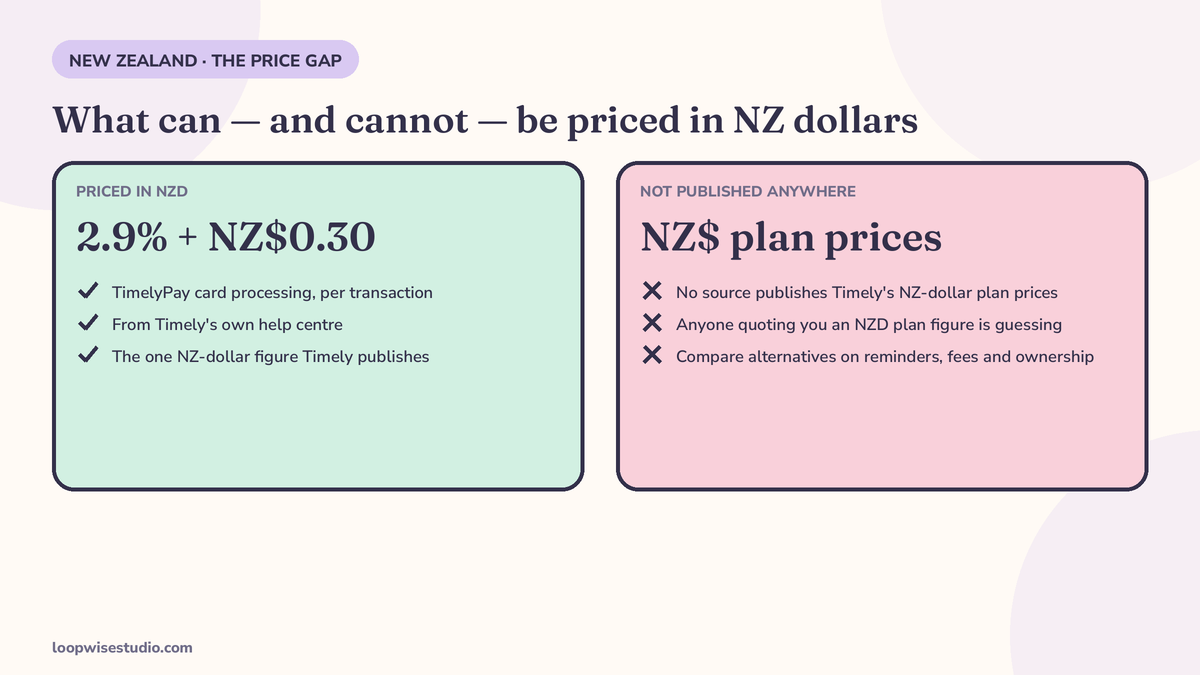
Timely’s NZ plan prices in NZ dollars do not appear in any source we could find — not on comparison sites, not on review pages, not quoted by rivals. The only NZ-dollar figure published by Timely itself that our research could verify is its card processing: TimelyPay in New Zealand runs 2.9% + NZ$0.30 per transaction, per Timely’s own help centre.
Everything else you will see is imported. Australian pages quote Australian plans — currently A$42 to A$79 per bookable staff member per month ex-GST, checked in October 2026, and our Timely alternative for Australian salons page works through those in full. US roundups quote US$26 to $47. Neither converts into what a Wellington or Christchurch salon pays: exchange rates move, GST treatment differs, and vendors price markets independently. A comparison that quietly converts A$65 into “about NZ$71” is inventing a price.
So the first rule of shopping for a Timely alternative in NZ: get the NZ price in writing, per staff member or flat, including the text allowance, before you compare anything. And know you’re not alone in the fog — Kitomba, the other name NZ salons know, publishes no pricing either, per the sources in our research. Opaque pricing is this market’s normal. Refuse to accept it anyway.
Text reminders — the feature to compare first
You searched for an alternative with text reminders, so let’s compare reminders properly. In New Zealand, text is the reminder channel: your clients’ salon relationship runs on SMS, not on an app they must install or an email they’ll open tomorrow. A reminder system earns its place on four tests:
| Test | What to check |
|---|---|
| Two-way, not send-only | Can the client reply CHANGE and actually move the appointment, or does the text just announce? A reply that lands in a staff member’s phone is not a system |
| The sequence, not the text | Confirmation at booking, reminder 24–48 hours out, a same-morning nudge for early slots, and a no-reply follow-up. One reminder is a hope; a sequence is a system |
| Metered or included | How many texts are included, per staff or flat, and what the overage costs per message. Reminder volume grows exactly when the system works |
| The rebooking tail | After the visit, does anything invite the next booking at the right interval — colour at six weeks, cut at five — or does the system go silent until the client remembers you? |
Most platforms pass the first row of their own marketing and fail the sequence test in the fine print: reminders exist, but they’re one message, send-only, metered. When you trial any alternative, send yourself the full sequence as a client. Book, get confirmed, get reminded, reply CHANGE, and see what happens. Twenty minutes of testing tells you more than any feature grid — and more than this page can, because vendors change features faster than comparison pages update.
The reminder sequence also has a second job nobody markets: it is your cancellation-refill trigger. A CHANGE reply at the 24-hour mark gives you a day to offer the slot to your waitlist by text. Our NZ healthcare clients run the same mechanics — the online booking system for physio clinics in New Zealand page specifies the reminder-and-refill flow for clinics, and salons need it for the identical reason: an empty chair found early is an empty chair filled.
What the card fees do to the comparison
Since plan prices hide, the visible NZ number — TimelyPay’s 2.9% + NZ$0.30 — deserves its moment, because processing quietly outweighs subscription differences.
Worked example, assumptions stated. A salon processing NZ$15,000 a month in card payments at an average ticket of NZ$90: that’s about 167 transactions. The percentage takes NZ$435; the per-transaction fee takes about NZ$50. Total ≈ NZ$485 a month in processing — likely more than the software subscription itself. Any alternative quoting a cheaper plan but processing half a point higher can cost you more in total. Ask every vendor two numbers: the plan price in NZD, and the all-in card rate in NZD. Compare the sum, never either figure alone.
The three routes, honestly
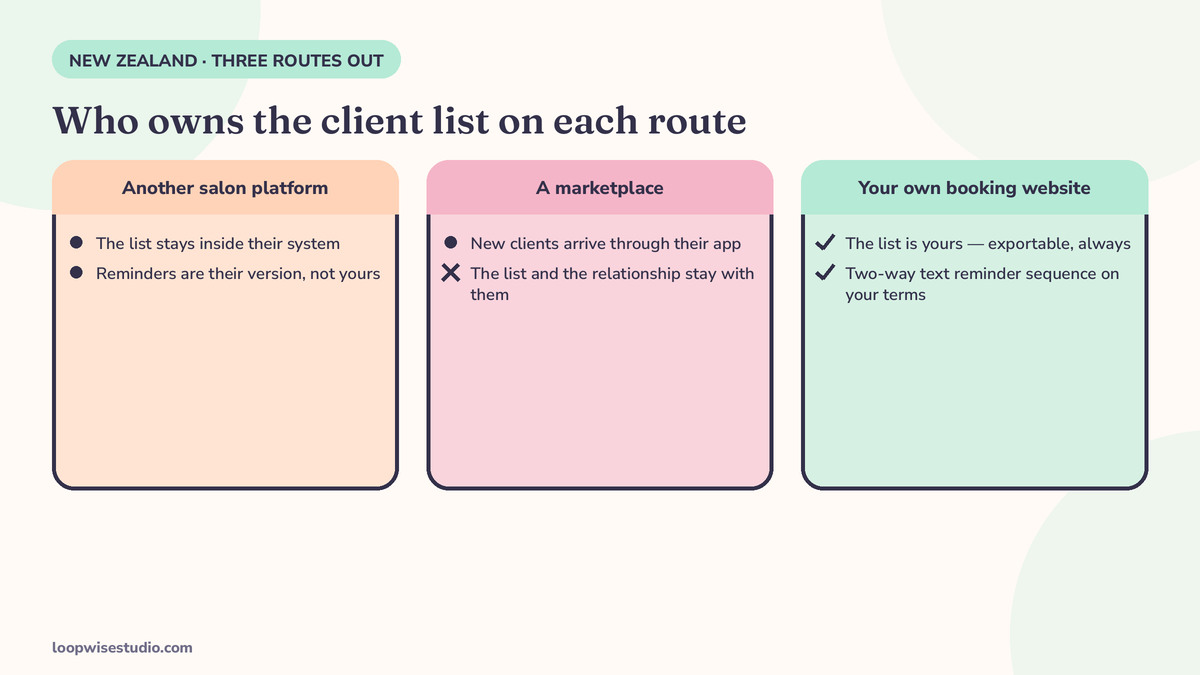
| Route | Reminder story | Ownership story |
|---|---|---|
| Another salon platform | Usually one send-only or reply-limited reminder flow, metered | You rent the diary and the booking page; the client list exports, the presence doesn’t |
| A marketplace | Reminders inside their app, to their users | Least ownership: new-client commission, regulars booking in someone else’s ecosystem |
| Your own booking website + text reminder layer | Full two-way sequence on your number, unlimited by a per-text meter you don’t control | The booking page, the number, and the list are yours; switching the diary later doesn’t move your front door |
This is the same three-route frame our pillar roundup of booking software for small owner-operated salons and clinics uses, and NZ doesn’t change the frame — it changes the evidence you can gather. With no published local pricing, the route decision rests on mechanics you can test and fees you can pin down: reminders, processing, ownership.
Platform-switchers in this region should also read the Cliniko alternative page if your salon has a clinic side — allied-health platforms are courting beauty businesses in AU/NZ, and the same pricing-opacity warning applies there.
How many reminder texts does a salon actually send? (The volume test)
Since nobody will publish you an NZ price table, your advantage is knowing your own volumes cold — vendors quote against them. Run this count from your current diary:
Worked example, assumptions stated. A three-stylist salon, five days a week, averaging eight appointments per stylist per day: about 480 appointments a month. A proper sequence — confirmation, one reminder, a same-day nudge for early slots, plus after-visit rebooking messages for roughly half of visits — lands around 3 texts per appointment: roughly 1,400 texts a month.
Now read any quote against that number. “500 texts included” is not a reminder system for this salon; it’s a third of one, and the overage rate — which the quote may not even state — decides your real bill. “Unlimited texts” needs the follow-up question: unlimited for how many staff, and what does the plan cost when you add a fourth stylist? Bring your volume to every negotiation. In a market where vendors won’t publish prices, the salon that knows its own numbers is the one that doesn’t get priced by vibes.
The front door test — the thing directories can’t compare
There is one more axis no listing site measures, and for most NZ salons it’s the deciding one: where does a new client land?
A directory can tell you which platforms have “online booking: yes.” It cannot tell you whether your Google profile’s Book button leads to a page with your name on it or a platform’s; whether the client who books becomes your contact, on your list, reachable for a rebooking text in six weeks; or whether the next salon down the road running the same platform gets shown beside you at the moment of booking.
Run the front door test on your current setup tonight: Google your salon, tap Book, and watch whose brand you land in. Then decide whether the switch you actually need is a different diary — or the same diary, finally fronted by a door you own. That is the comparison the directories were never going to make for you, and it is why this page exists.
If you switch — the NZ migration checklist
- Export the client list — names, mobile numbers, notes, packages, gift cards — before anything is cancelled. NZ clients’ mobile numbers are the asset; guard the file.
- Get every price in NZD, in writing: plan, per-staff or flat, text allowance and overage rate, card processing rate.
- Trial the reminder sequence as a client — book, confirm, remind, reply CHANGE — before signing.
- Move the next 8 weeks of appointments, open the new booking page, then close the old. No gap days.
- Text your clients once with the new booking link; update Google and Instagram the same day.
- Run both systems for a week, old one read-only, before the old subscription lapses.
- Verify gift cards and packages balance to the dollar in the new system.
Not sure whether your Timely bill is actually out of line for your size? Get a free audit — we’ll rebuild your true monthly cost from your invoice and statement, and compare routes with NZ figures where vendors will commit to them.
Who should stay on Timely
Honestly: a one- or two-chair salon whose reminders fit inside the plan, whose clients book happily, and whose owner has better uses for a weekend than migrating software. Timely is established, NZ-born software with a real support operation; “I can’t find their NZ price published” is an annoyance, not a failure of the product.
Switch when the meter bites (reminders rationed because texts cost), when chair-renters and casuals make the per-staff bill irrational, or when you realise your booking page, your reviews funnel and your client list all live inside someone else’s product and you’d like them back. Those are the triggers on every route in the table — and in NZ, they’re the only honest basis for deciding, because the price comparison the internet owes you doesn’t exist yet.
The short version
No published NZD Timely plan prices exist — treat any page quoting them as fiction, and make every vendor commit in writing. Judge alternatives on the text reminder sequence (two-way, sequenced, sensibly metered), the all-in card rate (TimelyPay NZ: 2.9% + NZ$0.30), and whether your booking page and client list end up yours.
Get a free audit and we’ll run that comparison with you — your real volumes, your real reminder counts, no converted-currency guesses.
FAQs
How much does Timely cost in New Zealand?
No source we could find publishes Timely’s NZ-dollar plan prices — not comparison sites, not review pages, not rivals. The only Timely NZ figure verified in our research is TimelyPay card processing at 2.9% + NZ$0.30 per transaction, from Timely’s own help centre. Australian plans (A$42–79 per bookable staff per month, checked October 2026) and US prices (US$26–47) circulate online, but neither is an NZ price. Ask Timely or any alternative for NZ pricing in writing.
Why do comparison sites show Timely prices that don’t match?
Because most comparison content is written for the US or Australian markets and reused. Older Australian figures (around A$30/$53/$91) still circulate after repricing, and US roundups quote US$26/$39/$47. For a New Zealand salon, all of those numbers are the wrong currency, the wrong market, or out of date — sometimes all three.
What should text reminders in an alternative actually do?
Four things: confirm instantly at booking; remind 24–48 hours before with a reply that can move the appointment; send a short same-day nudge for early appointments; and follow up after the visit at the right rebooking interval. The test is always the same — book yourself in as a client and reply CHANGE to the reminder. If nothing sensible happens, it’s a notification, not a reminder system.
Can I keep my client list if I leave Timely?
Your client data is yours and exportable. What you must do deliberately is the move itself: export names, mobile numbers, notes, packages and gift cards before cancelling; transfer future appointments; and tell clients once, by text, where to book now. Clients are lost in switches through silence — the old link dies and nobody sends the new one — not through the export.
Is WhatsApp a good reminder channel for NZ salons?
For NZ salon clients, text is the established reminder channel — it’s what this market’s booking behaviour runs on, and what the platforms here are built around. WhatsApp matters more in other markets (the UK and Gulf, for instance). An alternative sold to you on WhatsApp-first reminders for a New Zealand salon is solving another country’s problem.
When is switching not worth it?
When you’re small, your reminders fit the plan, and your clients book without friction. Migration costs a weekend and a week of double-running whatever you choose. Switch when the pricing opacity, the reminder meter, or the ownership question starts costing you bookings — not because a comparison page (including this one) made a rival look shiny.