AI Receptionist vs Human Receptionist: Clinic Costs
AI receptionist vs human receptionist for clinics: BLS-anchored salary costs, published AI pricing, answering-service maths, and the cheaper text-first fourth option.
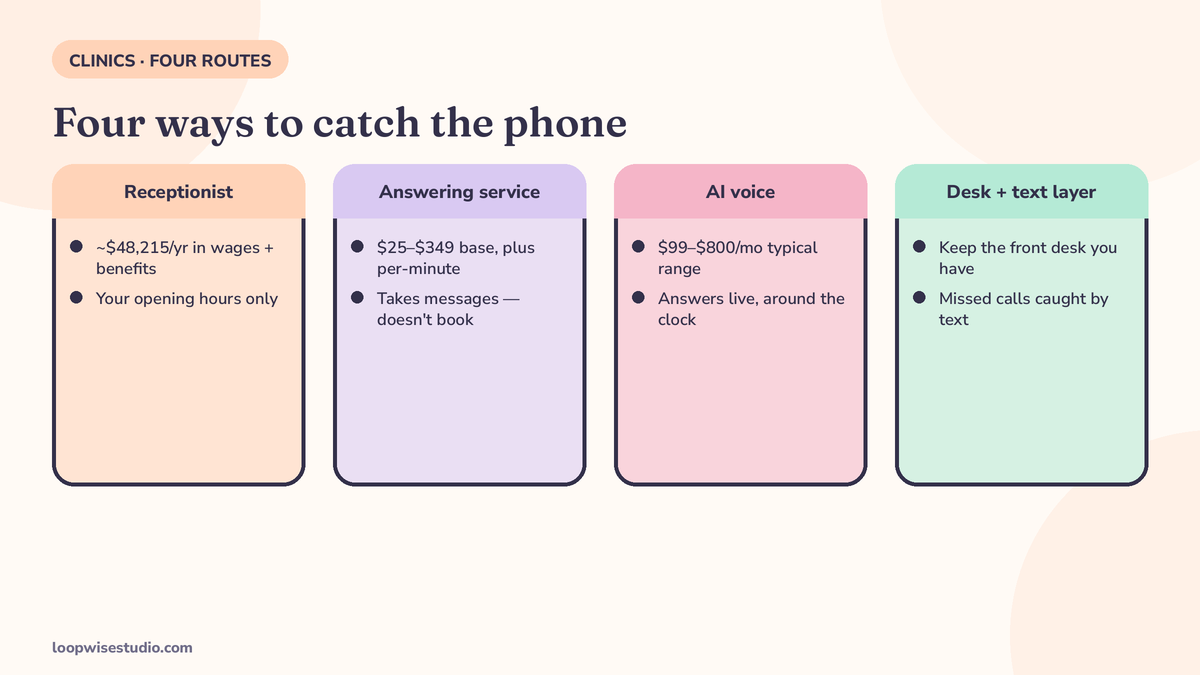
A full-time clinic receptionist costs roughly $48,000 a year in wages and benefits alone, based on the BLS median receptionist wage of $37,232 in 2024 plus employer benefits at 29.5% of wages. An AI receptionist for a small clinic typically runs $99 to $800 a month on published pricing. Most small clinics should replace neither: keep the front desk, and add a cheaper text-first layer for the calls nobody can reach.
That short answer hides the real problem with this comparison. The pages ranking for it are mostly written by companies selling AI receptionists, and their human-cost totals range from about $42,000 to over $230,000 a year for what is supposed to be the same job. Both ends are built by picking the cost stack that suits the sale.
This page rebuilds the numbers from the sources the better pages cite, keeps them in a clinic setting, and adds the two options the comparison pages leave out: a human answering service, and your existing front desk with a text layer on top. If you are weighing the wider platform question too, start with the best booking software for a small aesthetic clinic owner-operator — this article only covers the phone. If your practice runs on Cliniko and the diary itself is the question, our guide to alternatives to Cliniko covers that comparison separately.
What a clinic receptionist actually does all day
The “replace the receptionist” framing falls apart in a clinic because the receptionist is rarely phone-only.
On a normal morning, the same person checks patients in, verifies insurance, takes payments, handles forms, calls the next patient through, and answers the phone somewhere in between. An AI receptionist replaces one slice of that list: the answered call. It does not check anyone in, and it does not take a card payment across a desk.
That matters for the maths. If you compare a full salary against a $199 subscription and call the difference “savings,” you have quietly assumed the in-person work does itself. It doesn’t. So the honest comparison is not hire versus AI. It is: what does each route cost to cover the phone, and what happens to the work only a person in the building can do?
What the human actually costs, built from BLS numbers
Here is the human cost stack, using the strongest sourcing on this search result — the DeskBuddy guide from TRTC, which builds its figures from Bureau of Labor Statistics data rather than picking a salary that suits a pitch.
| Cost item | Figure | Source |
|---|---|---|
| Median receptionist wage | $37,232 a year (2024) | BLS, via TRTC |
| Employer benefits | 29.5% of wages, about $10,983 | BLS Employer Costs for Employee Compensation, via TRTC |
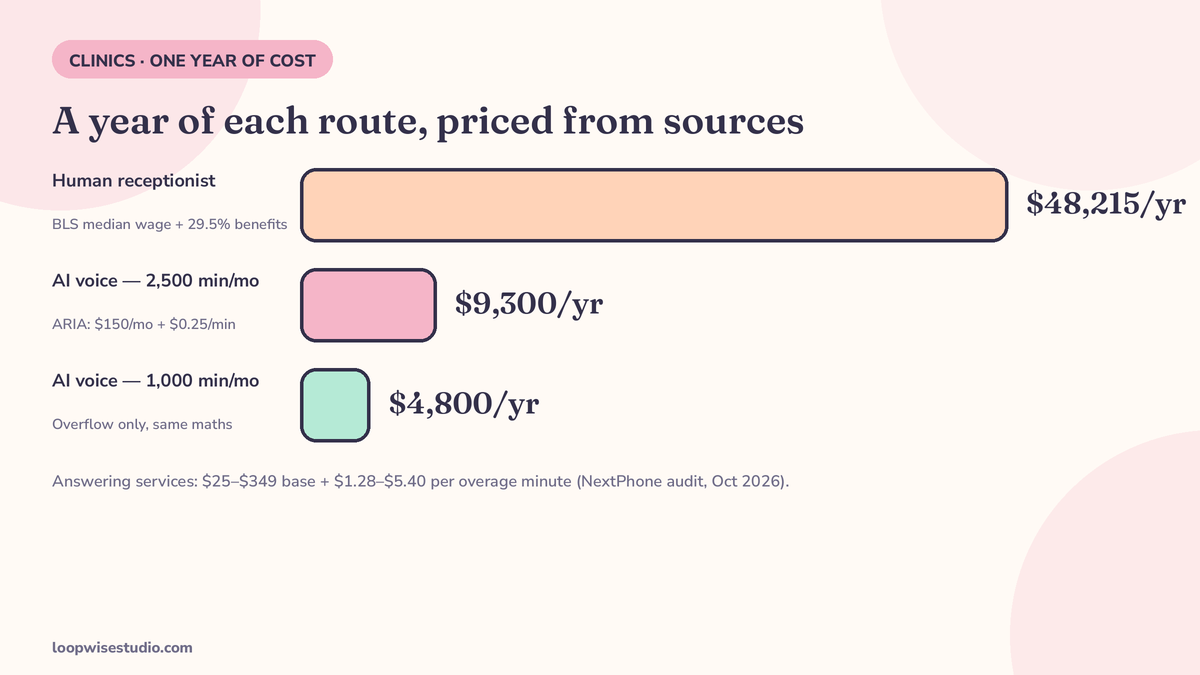
| Wages + benefits | About $48,215 a year | Arithmetic from the two BLS figures above |
| Cost to hire (recruitment, advertising, time) | About $4,700 per hire | SHRM average cost-per-hire, via CloudTalk |
| Payroll taxes, equipment, software, training | Varies by clinic | On top of the figures above |
So a fair planning number for one full-time receptionist is roughly $48,000 to $55,000 in year one, before you argue about local wages. Clinics in high-cost cities will pay more. Clinics paying above the median for an experienced medical receptionist will pay more. Indeed’s US average for a full-time receptionist, cited by CloudTalk, is about $43,783 in salary alone — which lands in the same territory once benefits are added.
Two warnings about numbers you will meet on other pages:
- The $230,000 figure. CloudTalk’s comparison tops out at $230,470 a year for a human. That total leans on Gallup’s replacement-cost estimate — replacing a leaver can cost 50% to 200% of their salary. That is a real Gallup range, but it is a turnover scenario, not a salary. It belongs in a “what if they quit” footnote, not in the headline cost of employing someone.
- The $42,000 figure. DoctorConnect, a clinic-specific vendor, works from $18 an hour to $37,440 a year and $42,000 to $45,000 loaded. The page gives no citation for the wage, but it sits close to the BLS median, so the direction is fine. Use the BLS stack above when you need a number you can defend.
The copy-paste worksheet: your clinic’s real human cost
Fill this in with your own figures before you compare anything. Five minutes, your numbers, no vendor’s.
Receptionist gross wage (year):            $________
+ Benefits at your actual rate:            $________   (BLS average: 29.5% of wages)
+ Payroll taxes:                           $________
+ Hiring cost, spread over expected stay:  $________   (SHRM average hire: ~$4,700)
+ Phone, computer, software seats:         $________
= True annual cost of the human:           $________
Hours a week this person can answer:       ________   (usually about 40)
Hours a week patients actually call:       ________   (include evenings and weekends)
That last gap — hours covered against hours patients call — is where the rest of this article lives.
What an AI receptionist actually costs a small clinic
AI receptionist pricing is published, but it comes in three different shapes, and the shape matters more than the headline.
Flat subscription tiers. CloudTalk’s 2026 comparison puts AI receptionists at $25 to $99 a month at entry level, $99 to $299 at professional level, and $300 to $899 or more at enterprise level. Those are that vendor’s market tiers, checked against vendor pricing pages — use them as a range, and check current pricing before you buy.
Per-minute pricing. DoctorConnect’s ARIA, built for medical practices, is published at $150 a month plus $0.25 a minute. Its own worked examples: at 2,500 minutes a month you pay $775 a month, which is $9,300 a year. At 5,000 minutes, $15,300 a year. That is the honest way to read per-minute pricing — your call volume decides the bill, and a busy month costs more than a quiet one.
Clinic-size ranges. OmniMD, another clinic vendor, puts AI front-desk pricing at $300 to $800 a month for a small clinic of 1 to 3 providers, and $800 to $2,500 a month for 4 to 15 providers. Treat those as a vendor’s market ranges, not an audit.
From $99 a month. s10.ai’s BRAVO, aimed at small clinics, starts at $99 a month plus usage charges. The “plus usage” is the part to price before you sign.
Put together, a realistic planning range for a small clinic is $99 to $800 a month, with the final number set by call minutes, not by the sticker. One more cost the tables skip: HIPAA and BAA scope. Vendors display compliance badges, but whether a given plan signs a BAA, and what it covers, changes what you can safely route through it. Ask in writing.
Want a second pair of eyes on your actual call volume before you price any of this? get a free audit and we will run your numbers through the same stack.
The option clinics already use: a human answering service
Most comparison pages jump straight from “hire” to “AI,” and skip the thing clinics have used for decades: a human answering service.
The pricing pattern is the same one documented in our breakdown of how much a plumbing answering service costs: a monthly base fee plus a per-minute rate for talk time beyond the included block. NextPhone’s audit of providers’ own pricing pages, checked October 5, 2026, found base fees from $25 to $349 a month and overage rates from $1.28 to $5.40 a minute, with some providers adding an after-hours premium of 1.5 to 2 times the standard rate.
For a clinic, an answering service gives you a human voice after hours who can take a message and follow an escalation script. What it usually cannot do is book into your diary, check a patient in, or verify insurance. You are paying per minute for message-taking and triage — which is the right purchase for some clinics, as long as you price it as that, and not as a receptionist.
The fourth option the comparison pages skip
Every page on this search result compares some mix of hire, AI voice, and a hybrid of the two. None of them prices the cheapest real-world setup:
Keep your front desk. Add a text-first layer for the calls they cannot reach.
- A call comes in while your receptionist is with a patient. It rings out.
- Within seconds, the caller gets a text from your clinic’s number with a booking link.
- The patient books, or replies, and the thread sits in one inbox your front desk already checks.
- After hours, the same flow runs: text, booking link, confirmation, reminder before the visit.
No robot voice answers in your clinic’s name. No per-minute meter runs while a patient describes their symptoms. The human keeps the in-person work and the judgement calls; the text layer covers the gap the worksheet above exposed — the hours and the busy moments when nobody can pick up.
This is also why the salon version of this argument exists as its own page: the AI receptionist alternative for salons and spas that is text-first, not a robot voice makes the client-preference case in full.
Side by side: cost, coverage, and what each route can actually do
| Route | Typical cost (sourced) | Coverage | Books appointments? | In-person work? |
|---|---|---|---|---|
| Hire a receptionist | About $48,000–$55,000 in year one (BLS stack) | About 40 hours a week | Yes, when free to answer | Yes — this is the point of the hire |
| Human answering service | $25–$349/mo base + $1.28–$5.40/min overage (NextPhone audit, Oct 2026) | 24/7 message-taking | Usually no — messages and escalation | No |
| AI voice receptionist | $99–$800/mo for a small clinic; per-minute plans vary (ARIA $150/mo + $0.25/min) | 24/7 live answering | Yes, if integrated with your diary | No |
| Front desk + text-first layer | Your existing salary + a booking and messaging system, no per-minute meter | 24/7 for missed and after-hours calls, by text | Yes — the booking link is the flow | Yes — your human never left |
Read the last column first. Three of the four routes do none of the in-person work at all. If your clinic’s problem is an empty chair at the front desk, only the first route solves it. If your problem is calls ringing out while the desk is busy — the far more common complaint — the fourth route solves it for the smallest new spend.
Which clinics should hire, automate, or do both
Hire when the desk itself is the gap: patients queueing to check in, payments backing up, forms piling. That is a staffing problem, and software priced per minute will not fix it.
Add AI voice when live phone answering is genuinely the product: high call volume through the day, patients who expect to book by speaking to someone, and a diary integration you have tested. Price it at your real minutes, using the ARIA maths as the template, not the entry tier.
Use an answering service when what you need after hours is a calm human taking a message and escalating the urgent few — and you have priced the per-minute bill in a busy month, not a quiet one.
Add the text layer when your receptionist is good but cannot be in two places at once, and when your patients already text, message, and book from their phones. For most one to three provider clinics, this is the first move, and for many it is the only one needed. The dental version of the same choice — voice versus text, decided by call pattern — is worked through in AI receptionist vs missed call text back for dental practices.
One worked year at a two-provider clinic, assumptions labelled
To see how the four routes land in practice, take one clinic shape and run all four through it. The clinic: two providers, one receptionist already employed, about 400 inbound calls a month (assumption — read yours off your phone report). The question is not whether to keep the human; on these numbers the desk work alone justifies the role. The question is what to add for the calls that ring out while she is busy and after closing.
- Do nothing extra. Cost: $0 new spend. The evening, weekend and busy-moment calls keep going to voicemail, where — as every vendor on this search result agrees, whatever their numbers — most callers simply hang up.
- Add an answering service. At the audited pattern of a $25 to $349 base plus $1.28 to $5.40 per overage minute (NextPhone), a few hundred after-hours minutes a month lands most small clinics in the low hundreds per month. You get messages and escalation, not bookings.
- Add AI voice. On DoctorConnect’s published ARIA maths — $150 a month plus $0.25 a minute — even a modest 1,000 minutes of overflow a month is $400 a month, $4,800 a year, for live answering that can book. Double the minutes and you double the variable part.
- Add the text layer. The existing salary doesn’t change, no per-minute meter starts, and the overflow calls get a text and a booking link instead of a voicemail box. The new spend is the booking and messaging system, priced flat.
Same clinic, same human, four very different second bills. That is the comparison the vendor pages never run — because three of the four answers don’t require replacing anyone.
The bottom line
A receptionist costs about $48,000 a year before local wages, built from BLS figures you can check. An AI receptionist costs $99 to $800 a month on published pricing, with per-minute plans decided by your call volume. An answering service costs a base fee plus a per-minute meter.
None of those numbers tells you what to do until you know which leak you have: an unstaffed desk, unanswered live calls, or calls missed while your good receptionist is busy with the patient in front of them. Price the leak you actually have.
If you want that worked out on your clinic’s real call log and wage bill, get a free audit — we will show you which route the maths supports, including when the answer is to hire and buy nothing from us.
FAQs
How much does a full-time clinic receptionist cost per year?
About $48,000 to $55,000 in the first year for a typical small clinic. The BLS median receptionist wage was $37,232 in 2024 (via TRTC’s cost guide), and BLS puts employer benefits at 29.5% of wages, which brings wages plus benefits to about $48,215 before payroll taxes, equipment, and the roughly $4,700 average cost of hiring (SHRM, via CloudTalk). Local wages can push this well higher.
How much does an AI receptionist cost for a small clinic?
Published pricing puts most small clinics between $99 and $800 a month. CloudTalk’s 2026 tiers run $25 to $99 entry, $99 to $299 professional, and $300 to $899-plus enterprise. Per-minute plans differ: DoctorConnect’s ARIA is $150 a month plus $0.25 a minute, which its own examples put at $9,300 a year for 2,500 minutes a month. Check current pricing, and price your real minutes, not the starter tier.
Is an answering service cheaper than both?
Usually cheaper than a hire, and sometimes cheaper than AI at low volume — but it is a different product. NextPhone’s October 2026 audit found base fees of $25 to $349 a month plus $1.28 to $5.40 per overage minute, with after-hours premiums of 1.5 to 2 times on some plans. Answering services take messages and escalate; most do not book into your diary or do any in-person work.
Can an AI receptionist replace our front desk?
It can replace one part of the job: answering calls and booking from them. It cannot check patients in, verify insurance at the desk, take payments in person, or handle the patient standing in front of you. In most clinics the front-desk role is mostly in-person work with phone work on top, which is why “replace” comparisons overstate the saving.
What is the text-first option, in one paragraph?
Your receptionist stays. When a call rings out — because the desk is busy, or the clinic is closed — the caller gets an automatic text from your number with a booking link, usually within seconds. They book or reply, your team sees the thread in one inbox, and reminders go out before the visit. No voice robot, no per-minute bill, and it covers evenings and weekends by default.
What should we check about HIPAA before choosing AI voice?
Ask whether the vendor signs a BAA on your plan tier, what the AI is allowed to say and record, where transcripts are stored, and how a caller reaches a human. Comparison pages treat compliance as a badge; treat it as a scope question with written answers. If a vendor will not put it in writing, that is your answer.