How Much Does a Plumbing Answering Service Cost in 2026?
How much a plumbing answering service costs in 2026: live per-minute plans, AI per-call and flat pricing, what 50 calls and a 200-call surge month actually bill, and the cheaper text-first option.
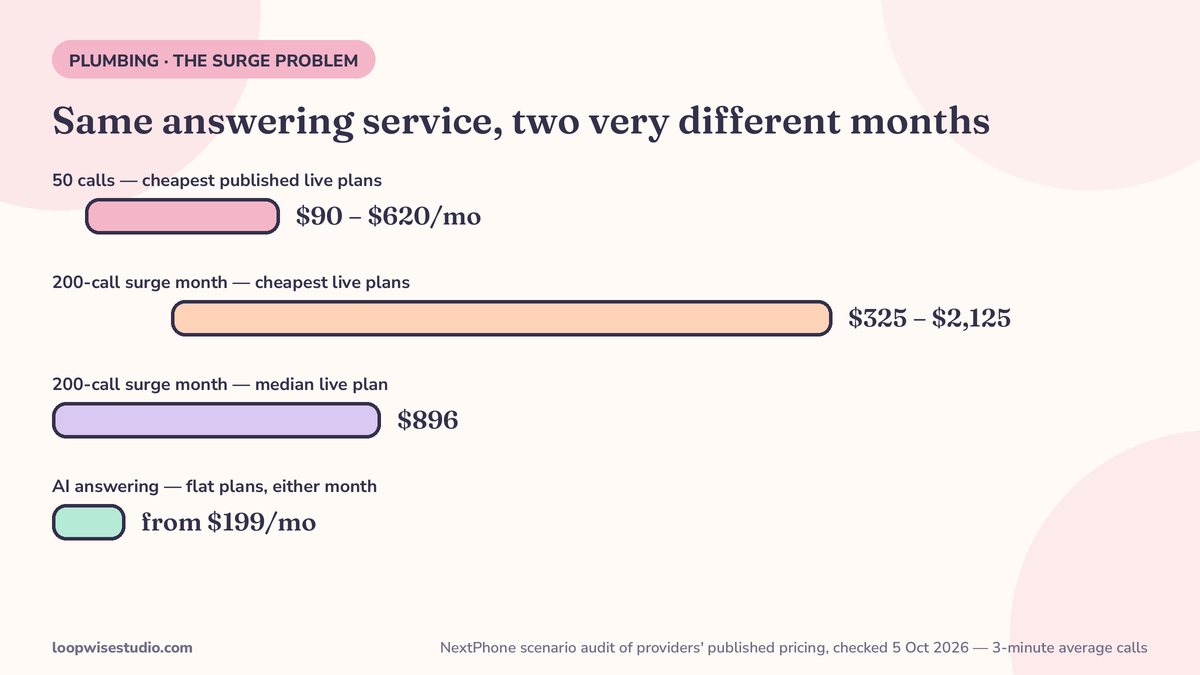
A plumbing answering service costs between roughly $90 and $620 a month for live human answering at 50 after-hours calls, billed as a $25–$349 base fee plus $1.28–$5.40 per minute of overage (NextPhone’s audit of providers’ own pricing pages, checked October 5, 2026). AI answering runs from $49 a month per-call plans to flat plans from $199; a managed, done-for-you service runs $500–$1,000 a month plus setup. In a 200-call surge month, the live per-minute bill jumps to $325–$2,125.
The rest of this page is the maths behind those numbers: how per-minute billing actually works, what each model costs at the same two call volumes, the hidden charges, and the one option — text-back instead of answering — that never appears on the price lists.
How per-minute billing actually works
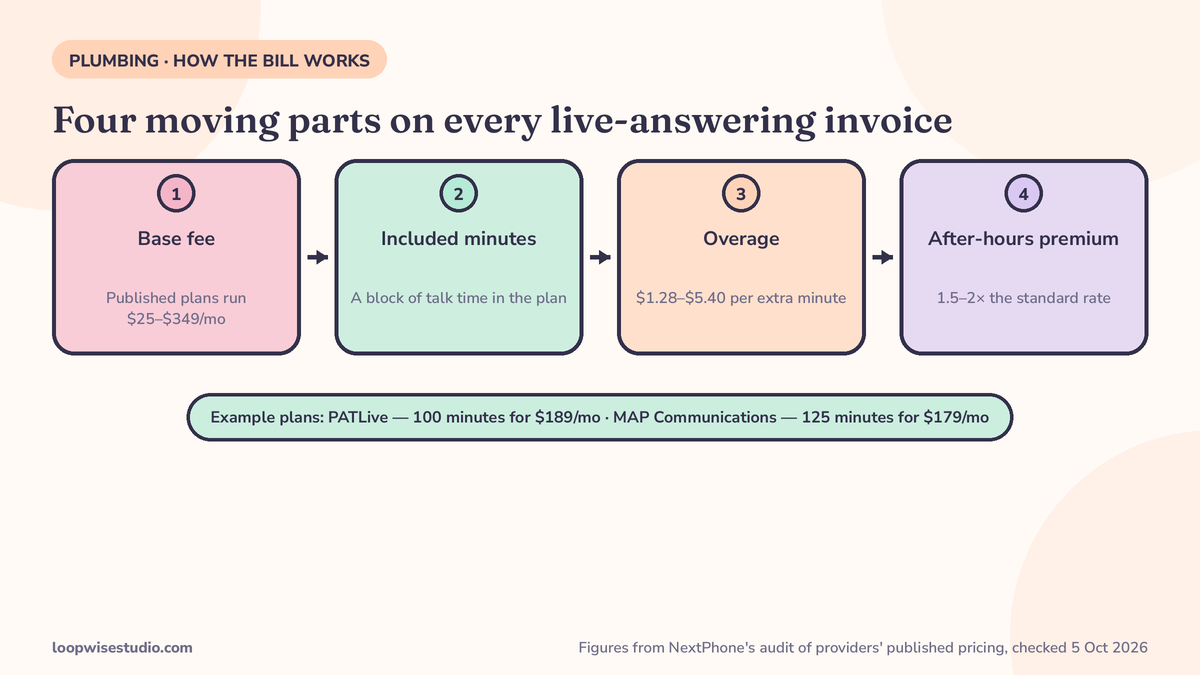
Live answering services (human operators) almost never charge a flat rate. The invoice has four moving parts:
- A base fee — the cheapest published plans start at $25–$349 a month (NextPhone’s audit).
- Included minutes — the base buys a block of talk time. PATLive’s 100-minute plan is $189 a month; MAP Communications’ 125-minute plan is $179 a month.
- Overage — every minute past the block bills at $1.28–$5.40 per additional minute, depending on the plan. PATLive charges $2.09 past its block; MAP charges $1.30. A pay-per-use plan skips the block entirely: PATLive’s is $49 a month at $2.99 a minute (all figures via NextPhone).
- An after-hours premium — some providers multiply the rate by 1.5–2× for overnight and weekend calls (NextPhone) — which, for a plumbing company, is most of the calls the service exists to take.
Two more mechanics worth knowing before you sign: minutes are typically rounded, so a 40-second call can bill as a minute; and spam and wrong numbers may bill too. Quo’s Sona is the exception that proves the rule — it explicitly does not bill calls under 15 seconds, which tells you everyone else might. Setup fees exist as well: none at PATLive, Posh, Smith.ai or Abby, while Moneypenny, AnswerConnect and AnswerFirst charge one without publishing the amount (NextPhone).
What 50 calls a month really costs, model by model
Same volume, same assumption — 50 after-hours calls a month at about 3 minutes each — priced through every model using the figures providers publish:
| Model | What 50 calls/mo costs | Source |
|---|---|---|
| Live answering, cheapest published per-minute plans | $90–$620/mo (base + overage included) | NextPhone scenario audit |
| Live answering, named plans | PATLive 100-min plan: ~$3,522/yr; MAP 125-min plan: ~$2,538/yr at this volume | NextPhone annual table |
| Live answering, category ranges | $130–$500/mo | Jobber, citing Nextiva |
| Virtual receptionist | $200–$1,600/mo | Jobber, citing VoiceCharm |
| AI answering, per-call | Smith.ai: free for 25 calls, then $3.00/call, or $150/mo for 75 calls; Quo Sona: $49/mo for 50 calls, extra calls $0.99 each | NextPhone; Quo |
| AI answering, flat | NextPhone from $199/mo unlimited; Jobber AI Receptionist $99/mo; CallJanice $249/mo flat unlimited | Providers, via research |
| Managed / done-for-you AI | $500–$1,000/mo + $1,500 one-time setup | Collman Digital Marketing’s own published pricing |
| In-house receptionist | Median wage $38,010/yr (~$54,000/yr fully loaded) — and only covers ~40 hrs/week | US Bureau of Labor Statistics, via Collman |
| Missed-call text-back (text-first) | No per-minute meter; priced as a system, not a phone bill — see the text-first section below | — |
Read the live-answering row twice. The $90 end and the $620 end are the same volume on different published plans. The plan you pick matters more than the category — and the range inside the category is where the money leaks.
What a surge month does to each bill
Plumbing call volume is not flat. A freeze week or a heat wave can quadruple it. NextPhone’s scenario at 200 after-hours calls in a month: the cheapest published live plans land at $325–$2,125 for that month, and the median published live plan bills $896.
That is the structural flaw in per-minute pricing for this trade: the bill spikes in exactly the weeks when the calls are worth the most and you can least afford to let them ring. AI flat plans (from $199/mo) and per-call AI pricing don’t spike the same way — $0.99 an extra call (Quo Sona) or $3.00 a call (Smith.ai) grows in a straight line you can predict. Jobber’s cited AI range is $100–$300 a month (via Nextiva). A managed service like Collman’s holds its flat $500–$1,000 because there is no per-minute meter at all.
One question cuts through all of it, and it’s the subject of a section below: not what the month costs, but what a booked job costs under each model.
AI answering prices: per-call, flat, and minute bundles
The AI category splits into three pricing shapes, and the shape matters more than the sticker:
- Per-call. Smith.ai’s AI Receptionist: free for the first 25 calls, then $3.00 per call, or $150 a month for 75 calls. Quo Sona: $49 a month covering 50 calls, $0.99 per additional call, sub-15-second calls not billed (all as published by the providers, via NextPhone and Quo).
- Flat. NextPhone from $199/mo unlimited; Jobber’s own AI Receptionist at $99/mo as an add-on to the platform; CallJanice at $249/mo flat with unlimited calls.
- Minute bundles. Sameday, a trades-focused option, starts at $449 a month for 500 minutes (via NextPhone) — per-minute logic wearing a flat-rate costume, with the same surge exposure once the bundle runs out.
AgentZap’s FAQ puts the AI category at $49–$199 a month flat and live human answering at $300–$1,500 by volume, sourced to “industry pricing surveys, 2025” — treat those as indicative ranges rather than audited figures, but they square with the named plans above. Unity Connect’s segmentation is the useful summary: self-serve AI runs $50–$400 a month; a managed, dispatch-integrated service runs $500–$1,500+.
The in-house comparison: the hire covers 40 hours, your leaks don’t
The benchmark every answering service is really compared against is a person. The U.S. Bureau of Labor Statistics median receptionist wage is $38,010 a year; Collman’s fully loaded estimate is roughly $54,000 once payroll costs land. NextPhone’s table uses $2,900 a month salary-only; Unity Connect puts a full-time hire at $3,000–$4,500 a month. The estimates differ; the structure doesn’t.
A hire answers during business hours, at a desk. Your missed calls happen on jobs, at lunch, and at 2 a.m. — the hours a receptionist doesn’t cover and an answering arrangement does. The comparison only makes sense if you price the hours where the leak actually is, which is why most small shops end up comparing answering models against each other rather than against a hire.
Context for why the leak matters: Invoca research, cited by NextPhone, found 27% of calls to home services businesses go unanswered. And Harvard Business Review’s “The Short Life of Online Sales Leads” research, cited by Collman, found the average business takes roughly 42 hours to respond to an inbound lead — by which time an emergency caller has long since booked someone else.
The option the price lists leave out: text-back instead of answering
Every model above pays someone — or something — to answer the phone. There is a cheaper architecture for a small shop: don’t answer the missed call at all. Text the caller back within seconds, automatically, and book the job by text.
Honest scope, because this is our own category: text-back does not answer the phone, does not talk a panicked homeowner through shutting off a water main, and does not replace a live operator for a multi-truck dispatch operation. What it does is catch the caller in the seconds after they hang up — before they dial the next company — open a two-way text conversation, and land the job in your calendar. For the one-to-five-truck shop whose missed calls are mostly “nobody could pick up,” that is the leak, and it plugs it without a per-minute meter, a surge bill, or an operator reading a script. It pairs with a proper website and booking system, the same front door that turns website visitors into booked appointments — and it produces a written record of every conversation, which no phone call does. The mechanics are in missed call text back for plumbers.
Cost per booked job: the only number that decides it
Collman is the one source in this space that names the right metric — cost per booked job — and nobody, including Collman, computes it. Here it is as labelled arithmetic (your numbers will differ; the method is the point):
Take a $500 month under two models. A mid-range live plan at 50 calls bills roughly $300–$600 (NextPhone’s scenario range). A text-back system at a flat system price has no per-call cost at all. Now apply your own booking rate: if a third of the callers you actually engage end up booked, 50 engaged callers is roughly 16 jobs either way — the difference is what each engagement cost, and whether the surge month quadrupled it. Run it with your real call count from your phone bill, not a vendor’s capture-rate claim: several ROI figures in this market are built on the seller’s own assumptions, and at least one prominent guide’s “74.1% of calls go unanswered” headline is its own call data, contradicting the Invoca 27% figure it cites elsewhere. Trust the invoice maths, not the marketing maths.
What the invoice actually looks like in a freeze week
Ranges are abstract; an invoice isn’t. Build one from published plan figures. Take MAP Communications’ 125-minute plan as NextPhone documents it: $179 a month base, $1.30 a minute past the block. A normal month at 50 calls × 3 minutes = 150 minutes: 125 included, 25 over, roughly $179 + $32.50 = $211.50. Now the freeze week version: 200 calls × 3 minutes = 600 minutes. Overage is 475 minutes at $1.30 = $617.50, for a month of roughly $796.50 — and that’s on one of the cheaper overage rates, before any after-hours premium. On PATLive’s pay-per-use structure ($49 + $2.99/min), the same 600 minutes is $49 + $1,794 = $1,843 — which is how a shop ends up inside NextPhone’s $325–$2,125 surge range without anything unusual happening except weather.
Neither of those invoices is a scam. Both are the published maths working exactly as designed. The design question is yours: do you want your busiest, most profitable week’s call coverage to be your most expensive line item, growing by the minute — or a known flat number you budgeted in October?
What the money buys: a message, or a booked job
Unity Connect’s roundup notes that the cheapest answering tiers take messages rather than book jobs, and NextPhone quotes the same frustration from a trades forum: unless the service keeps your schedule, you may lose the business anyway. Price tiers in this market are really capability tiers wearing price tags:
- Message-taking — someone answers, writes it down, you call back during business hours. Cheapest, and for an emergency caller, functionally voicemail with a human accent.
- Answering + dispatch — the service triages and wakes your on-call tech. This is where live answering earns its money for multi-crew shops.
- Answering + booking — the job lands in your Jobber or ServiceTitan calendar during the call. AI flat plans and managed services compete here; check that any service you price actually does it, in your software, before you compare its sticker to a message-taker’s.
Comparing a $130 message-taking plan against a $249 booking plan is not a $119 saving. It’s two different products. The cost-per-booked-job calculation above only works if the model you’re pricing actually books.
Questions to ask before you sign anything
The price on the page and the price on the invoice are cousins, not twins. Get written answers to these before you commit:
- How are minutes counted? Rounded up to the minute? Do ring time and hold time bill? Do spam and wrong-number calls bill — and if not, what counts as one? (Quo’s published sub-15-second exemption is the standard to ask others to match.)
- What triggers the after-hours premium, and is it 1.5× or 2×? For a plumbing company, “after hours” is not an edge case — it’s the product.
- What is the setup fee, exactly? If the provider charges one without publishing it — Moneypenny, AnswerConnect and AnswerFirst do, per NextPhone’s audit — that silence is a negotiating opening, not a fact of life.
- Does it book into my software, or take a message? In writing. If it’s a message, price it as a message service no matter what the sales page calls it.
- What happens in my biggest month? Ask them to price your surge volume — 150 or 200 calls — on their plan, in numbers. A provider who won’t run that arithmetic is telling you something.
- What’s the contract term and the exit? Per-minute plans with long terms are how a $130 quote becomes a year of $800 surge bills you can’t leave.
Five of these six questions exist because some detail of the real price isn’t on the pricing page. That’s normal in this market — Jobber’s guide has to footnote its ranges to third-party sources (Nextiva, VoiceCharm) because so few providers publish complete numbers themselves. Your job is to close those gaps before the contract, not after the first invoice.
Which model fits your shop
| Shop size | Model that usually fits | Why |
|---|---|---|
| Solo / one truck | Text-back system, or per-call AI | You miss calls because you’re under a house. A per-minute plan bills you most in your busiest weeks; a flat text-first system doesn’t |
| 2–5 trucks, office help in hours | Text-back for after-hours + overflow, or AI flat | The leak is evenings, weekends and dispatch chaos, not 9-to-5 |
| Multi-crew with dispatch | Live answering or managed AI | You need a human-grade triage and dispatch handoff, and the volume justifies the meter |
| Anyone whose surge months scare them | Anything flat | The 200-call month is the test: $325–$2,125 on live per-minute vs a flat line you already know |
Not sure which leak is costing you more — the unanswered call or the unbooked one? Get a free audit — we’ll take your actual call volume, price each model against it, and show you the per-booked-job number before you sign anything.
Frequently asked questions
How much does a plumbing answering service cost?
For live human answering, the cheapest published plans run a $25–$349 monthly base plus $1.28–$5.40 per overage minute; at 50 after-hours calls a month that totals $90–$620 (NextPhone’s audit of providers’ pricing pages, checked October 5, 2026). AI answering runs $49–$300 a month depending on per-call or flat pricing, and a managed, done-for-you service runs $500–$1,000 a month plus a $1,500 setup (Collman’s published pricing).
Why did my answering service bill triple in one month?
Per-minute billing plus a surge. Your base fee buys a fixed block of minutes; a freeze week pushes you deep into overage at up to $5.40 a minute, sometimes with a 1.5–2× after-hours premium on top. NextPhone’s scenario puts a 200-call month at $325–$2,125 on published live plans, with the median plan at $896 — versus the same shop’s normal month.
Is AI answering cheaper than a live answering service?
On the sticker, yes: per-call AI starts at $3.00 a call (Smith.ai, after 25 free calls), per-call bundles at $49 a month for 50 calls (Quo Sona), and flat AI plans from $99–$249 a month (Jobber, NextPhone, CallJanice). The trade-offs are conversation quality on unusual calls and whether the system books into your software or just takes a message — the cheapest tiers tend to take messages rather than book jobs.
Do answering services charge setup fees?
Some do. NextPhone’s audit found no setup fee at PATLive, Posh, Smith.ai or Abby, while Moneypenny, AnswerConnect and AnswerFirst charge one without publishing the amount. Managed services state theirs: Collman charges a one-time $1,500 setup on top of $500–$1,000 a month. Ask for the setup fee in writing before signing — an unpublished fee is a negotiating point, not a surprise to accept.
What’s the cheapest way to stop losing missed calls?
For a small shop, usually a missed-call text-back system: an automatic text fires seconds after an unanswered call and the job gets booked by text, with no per-minute billing and no surge pricing. It doesn’t replace a live operator for complex dispatch — but if your problem is “calls ring out while we’re on jobs,” it solves the actual problem at system pricing rather than phone-bill pricing. The comparison logic mirrors automatic review requests for plumbing companies: small automations, priced flat, beating per-use services.
Is a receptionist cheaper than an answering service?
The BLS median receptionist wage is $38,010 a year, roughly $54,000 fully loaded (via Collman) — more than most answering arrangements, and it covers about 40 hours a week at a desk. Your missed calls cluster outside those hours. A hire makes sense when you also need in-office admin; as pure call coverage, it’s the most expensive option that covers the fewest of the hours that leak.