AI Receptionist Alternative for Salons: Text-First
An AI receptionist alternative for salons and spas that never uses a robot voice: missed-call text-back, a booking link and reminders, priced against published voice AI.
If your clients would rather text than talk to a robot voice, you do not need an AI receptionist: missed-call text-back, a booking link, and text reminders cover the same missed calls for less money, and the client never has to speak to a machine. Voice AI earns its cost when call volume is high and clients expect to book by phone. Text-first wins when your bookings already start in messages — which, for most salons and spas, they do.
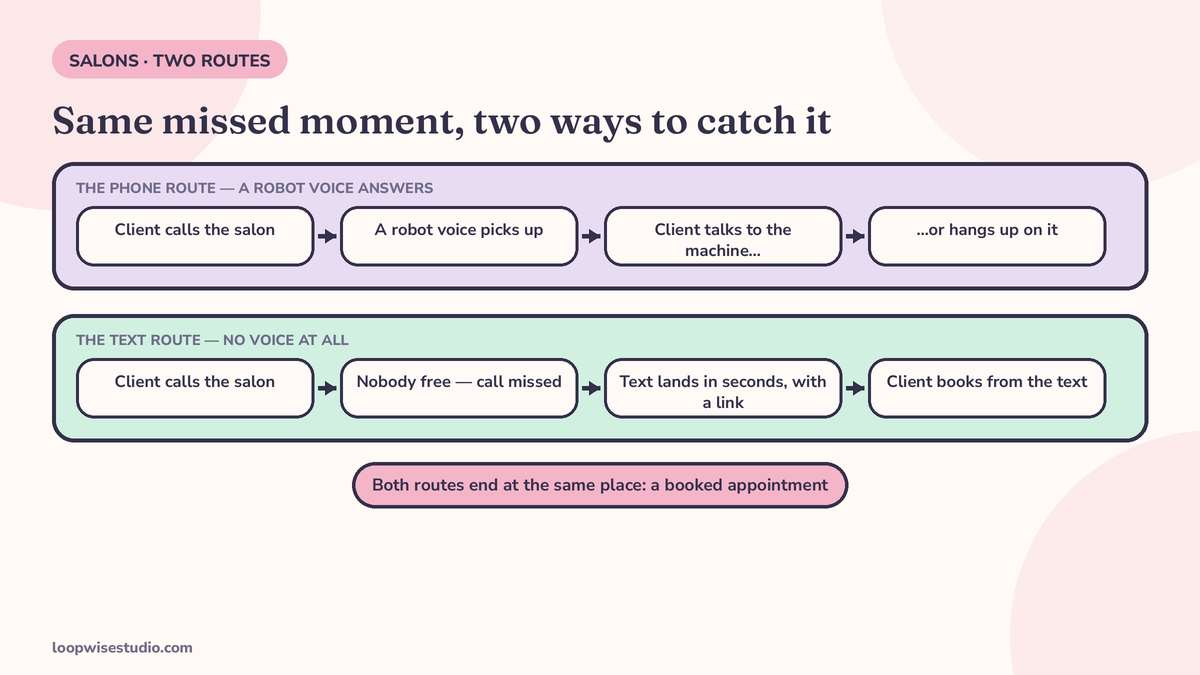
Search for an alternative to an AI receptionist and you will find roundups of AI receptionists. Every ranking page for this query compares voice tools against other voice tools. The option the searcher actually asked for — no robot voice at all — is not on any of them.
This page is that option, priced honestly against the voice tools, with the cases where voice genuinely wins stated plainly. It sits in the same family as the best booking software for a small aesthetic clinic owner-operator: own the booking route, instead of renting a voice to stand in front of someone else’s.
Why some of your clients hang up on a robot voice
Start with the number the voice roundups cite and then walk past. CloudTalk’s salon roundup reports Zenoti’s 2026 consumer survey: 55% of salon clients said they were comfortable with an AI receptionist — which means 45% were not. Among med spa regulars, 71% were comfortable.
Read that the way an owner should. In a salon, nearly half your clients would rather not book through a machine voice. The roundup uses that figure to argue for a human handoff option. It never asks the simpler question: why put a voice in the way at all, when the same client will happily tap a booking link in a text?
The same Zenoti 2026 industry data, again via CloudTalk, gives the problem its shape:
- 37% of salon and spa calls go unanswered.
- 82% of missed calls happen during business hours — not at night, but while your team has clients in chairs.
- Only 24% of missed callers leave a voicemail.
- 34% of appointment requests arrive outside business hours.
- 73% of clients said they would be more loyal to a business that made booking easier.
These are a vendor’s industry figures, reported secondhand, so treat them as direction rather than gospel. But the direction is hard to argue with: calls get missed while you are working, clients do not leave messages, and a chunk of demand lands when you are closed. None of that requires a voice to fix. It requires an instant, silent reply.
What a text-first setup actually does, step by step
Here is the whole system. No dashboard tour, no feature list — just what the client experiences.
- A call is missed. You are mid-colour, mid-massage, or closed. The phone rings out.
- A text goes out in under a minute. From your salon’s number, in your name: sorry we missed you, here is the booking link, or reply here.
- The client books or replies. The link opens your real diary — service, stylist or therapist, live times. No account, no hold music, no repeating their name to a voice that mishears it.
- Confirmation and reminders follow by text. Instant confirmation, then a reminder before the visit, with a one-tap way to move the appointment instead of ghosting it.
- After the visit, the loop closes. A thank-you text, a review request sent the same way to every client, and a rebooking nudge when their service is due again.
Every step happens in a channel your clients already use to run their lives, on the device that is already in their hand when they think of booking. And every step leaves a written thread your team can see — which matters when the missed call text back system built for med spas handles the same job in a clinic: the record is the point, not just the booking.
The copy-paste asset: the four texts that carry the whole system
Steal these. Change the name, keep the shape — short, one job each, always an exit to a human.
The missed-call text (goes out automatically, in under a minute):
Hi, it’s [Name] from [Salon] — sorry we missed your call, we’re with clients. Book here: [booking link] or reply to this text and we’ll help.
The confirmation (instant, after booking):
You’re booked: [service] with [stylist] on [day] at [time]. Need to move it? Reply MOVE and we’ll sort it — no need to call.
The reminder (day before):
Reminder: [service] tomorrow at [time] with [stylist]. Still good? Reply YES. Need a different time? Reply MOVE and pick a new one.
The rebooking nudge (when the service cycle comes round):
Hi [Name], it’s about [X weeks] since your last [service] — [stylist] has [day] at [time] open if you’d like it: [booking link]. No pressure if not.
Notice what none of these does: pretend to be a person having a conversation. The client knows it is a message. That honesty is a feature, and the dental comparison makes the same point from the other side — see AI receptionist vs missed call text back for dental practices on who the patient thinks they are talking to.
Text-first vs voice AI: the honest side-by-side
| Question | Voice AI receptionist | Text-first setup |
|---|---|---|
| What does the client meet? | A robot voice answering in your salon’s name | A text message from your number |
| What does it handle best? | Long spoken bookings, questions answered aloud | Missed calls, booking links, reminders, rebooking |
| How is it priced? | Per minute, per call, or monthly tiers — the meter runs while clients talk | Booking and messaging system pricing; no voice minutes to meter |
| Where does it fall down? | Clients who dislike robot voices; names and services misheard; cost climbs with talk time | Clients who genuinely need a spoken conversation; problems too tangled for a thread |
| Does it work after hours? | Yes, answers live | Yes, texts instantly and books into the diary |
| Can your team see what happened? | Call recordings and transcripts, in the vendor’s app | The thread, in the inbox your team already uses |
Voice AI is not a scam, and this page is not going to pretend otherwise. A busy spa with a phone-led clientele and a front desk drowning in calls may get real value from it. The argument here is narrower: for the typical salon, the missed calls are a messaging problem wearing a phone costume, and messaging fixes it for less.
What the voice tools cost, on their published prices
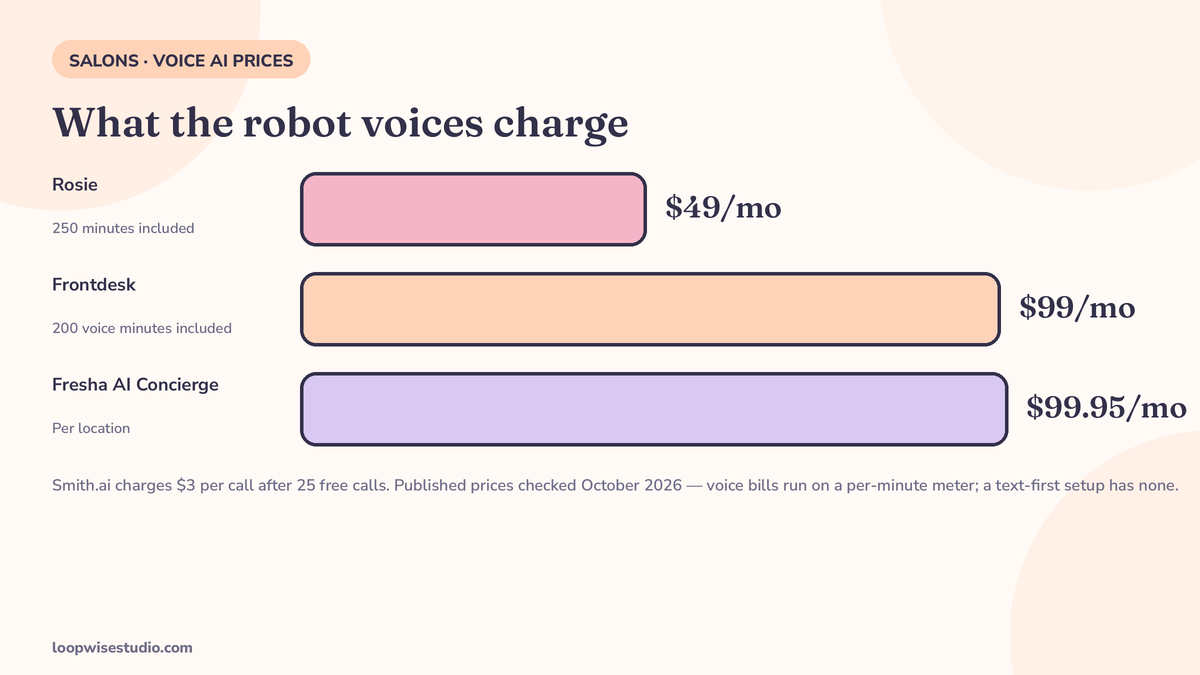
These are the prices the roundups read off vendor pricing pages, with Main Street AI’s comparison dated October 2026. Check current pricing before you buy — vendors move these often.
| Tool | Published price | The catch, as the roundups note it |
|---|---|---|
| Rosie | $49/mo for 250 minutes; $149/mo to book on your calendar | The $49 plan texts a booking link instead of booking — in other words, the cheap tier is already text-first, minus the system around it |
| Frontdesk | $99/mo ($79 on annual), 200 voice minutes | Minutes are the ceiling; talk time decides the bill |
| Trillet | $49/mo for 150 minutes, then $0.20/min | Overage maths again |
| Goodcall | From $79/mo per 100 unique callers | Priced per caller, not per call |
| Fresha AI Concierge | $99.95 per location per month, as an add-on | On top of your Fresha subscription |
| Smith.ai | 25 calls free, then $3 per call; Pro $150/mo for 75 calls | Per-call pricing suits low volume only |
| AgentZap | From $109/mo for 150 minutes, plus $499 setup and $0.85/min overage | Setup fee and overage, both |
| iVERA | $149/mo plus 2.5% of AI-generated revenue | A percentage of the bookings it makes |
| Phonely | 100 minutes free, then from $33/mo on annual (via CloudTalk) | Intro pricing; check the full tier list |
Spot the pattern the roundups document without naming: the moment a voice tool gets cheap, it stops talking and sends a text with a booking link instead. CloudTalk even warns that the booking link is “where most bookings quietly die” — about tools that send a link and nothing else. A text-first setup is that same link, with the reminders, rebooking and follow-up built around it so it doesn’t die.
If the maths still looks close for your volume, the clinic version of this comparison — AI receptionist vs human receptionist cost, built from BLS salary data — shows how to price any answering option against a real wage bill.
What a text-first setup costs
There is no per-minute meter, so there is no surprise bill in your busiest month. The costs are the system costs:
- Your booking system and diary — the one you likely already pay for.
- The messaging layer: missed-call text-back, reminders and rebooking running on your number.
- Setup: connecting the diary, writing the four texts above in your voice, and testing the flow on your own phone.
What you are not paying for: voice minutes while a client tells a long story, a percentage of the revenue your bookings generate, or a second and third subscription to make the first one useful. Loopwise builds this layer done-for-you — your website, your booking page, your number — rather than handing you another tool to configure. We do not publish a fixed price for it here, because the honest price depends on your current setup; the audit at the end of this page is where that number comes from.
Not sure whether your missed calls are a voice problem or a messaging problem? get a free audit and we will look at your call pattern and your current booking route, and tell you straight — including if voice AI is the right buy for you.
Two myths to clear before you decide
Myth: “A text is just a cheap voice call.” No — it is a different transaction. A voice call demands the client’s full attention, in the moment, often while they are at work or on a bus. A text waits politely on their screen until they are free, carries the booking link inside it, and stays there to be tapped at 9 p.m. For a considered purchase like a colour appointment or a spa day, waiting is a feature, not a downgrade.
Myth: “If we don’t answer live, we look small.” What looks small is a phone that rings out to a full voicemail box. An instant, well-written text in your salon’s name, with a live diary behind it, reads as organised — the same impression a good receptionist gives, in a quieter channel. Professional is a property of the response, not of the medium. Zenoti’s loyalty figure points the same way: 73% of clients said they would be more loyal to a business that made booking easier (2026 data, via CloudTalk). Easier, note. Not more vocal.
Which salons should still choose voice
Choose voice AI if most of these are true:
- Your bookings overwhelmingly start as phone calls, not messages, DMs or walk-ins.
- Call volume is high enough that your team loses working time to the phone every day, not just at peak.
- Your clients are phone-first — an older clientele, or a spa where a booking is a long consultation-style conversation.
- You have tested the tool with your own services and names, on your own ears, and your clients sound fine with it.
Choose text-first if your clients already DM you to book, if your missed calls cluster around busy hours and evenings, and if the idea of a robot answering in your salon’s name makes you wince. That wince is market research. Your clients will have it too — 45% of them, on Zenoti’s own survey.
The bottom line
The alternative to an AI receptionist is not a better AI receptionist. It is removing the voice from the transaction entirely: an instant text, a real booking link, reminders that let clients move instead of vanish, and a rebooking nudge when they are due.
Your missed calls get covered. Your clients never have to make small talk with a machine. And your team works from a written thread instead of a call log.
If that sounds like the shape of your salon, get a free audit — we will map your current missed-call moments and show you the text flow on your own diary before you spend anything.
FAQs
What exactly is a text-first receptionist setup?
It is not a person or a robot — it is a flow. When a call is missed, the caller gets an automatic text from your salon’s number within a minute, with a booking link and the option to reply. Confirmations, reminders and rebooking nudges follow by text. Your team can step into any thread at any point, because it is just messaging on your number.
Will clients think a bot is texting them?
They will know it is an automated message, and that is deliberate. The text does not pretend to be your receptionist having a chat; it says sorry we missed you and hands over a booking link. Clients who want a human can reply or call back, and a human picks it up. Compare that with a voice AI, which answers as if it were your salon — the pretence is the part many clients dislike.
Does text-first work for spas as well as salons?
Yes, and arguably better: spa bookings are longer, higher value, and usually planned rather than urgent — exactly the kind of decision a client makes happily from a link, at 9 p.m., without a phone call. Med spa regulars were also the most comfortable group with automation in Zenoti’s 2026 survey (71%, via CloudTalk), so the reminder and rebooking layer meets little resistance there.
What if a client actually needs to talk to someone?
They reply to the text, or they call back — and because the thread already holds their service, name and preferred time, your team starts halfway through the conversation instead of at the beginning. Text-first does not remove humans. It removes the dead air before a human gets involved.
How does this compare with Fresha’s AI Concierge or similar add-ons?
The add-on route charges per location on top of a platform subscription — Fresha’s AI Concierge is published at $99.95 per location per month — and the voice lives inside that platform’s world. A text-first layer is built around your own website, diary and number, so it survives a change of booking platform. If you are deep in one platform and happy there, the add-on is the simpler buy; if you want the asset to be yours, build the layer.
Can Loopwise set this up with the booking software I already use?
In most cases, yes — the layer sits around your diary rather than replacing it: missed-call text-back on your number, your booking link in the text, reminders out, replies into one inbox. The audit checks your current software first, and if something genuinely blocks the flow, we will tell you what the workaround or the switch would cost before you commit.