WhatsApp Appointment Reminders for Dental Clinics in Singapore
WhatsApp reminders for Singapore dental clinics: reminder vs recall sequences, per-treatment intervals, and the PDPA rules that separate service messages from marketing.
Short answer: a Singapore dental clinic needs two different WhatsApp systems, not one — appointment reminders (instant confirmation, a day-before reminder, a final touch 2 hours before) and recalls that bring patients back at treatment intervals, such as the 180-day scaling cycle and 7-day post-extraction check documented in SmartDentist’s recall engine. Under the PDPA, reminders are service messages; recalls and promotions are marketing and need express consent.
Most content ranking for this query is generic WhatsApp-API material written for other countries, plus one consumer listicle about braces. The dental-specific mechanics exist, but they are scattered across product pages. This page assembles them into one PDPA-clean system.
It sits inside the wider model in our pillar guide to WhatsApp booking systems for aesthetic clinics in Dubai and pairs with the clinic-wide version, WhatsApp booking systems for clinics in Singapore.
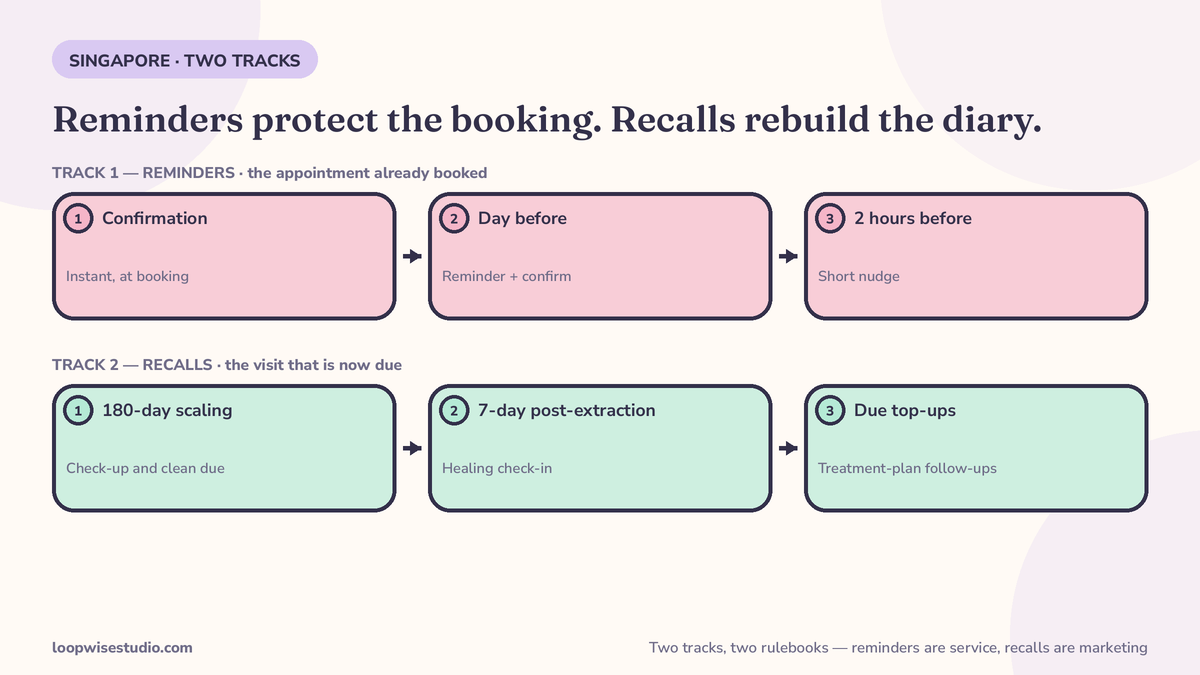
Track 1 — Reminders: protecting the appointment already booked
The reminder sequence documented by Lamanify, a platform serving dental clinics in this region, runs four touches: 3 days before, 1 day before, 6 hours before, 1 hour before. SmartDentist’s published pattern is leaner: a day-before touch, a day-after follow-up, and a reminder 2 hours before the appointment.
You don’t need both. Pick the shape that fits your booking lead times:
| Touch | When | Job |
|---|---|---|
| Confirmation | Instant, at booking | Lock it in; give reschedule route |
| Early reminder | 3 days before (long-lead bookings only) | Let plans change early, while the slot can refill |
| Main reminder | 1 day before | Confirm or reschedule by reply |
| Final reminder | 2–6 hours before | Catch the forgotten morning/lunch slots |
Two rules make reminders work. First, every reminder carries a reply-based reschedule — a patient who moves an appointment is revenue kept; one who silently doesn’t show is a dead hour. Second, reminders stay purely about the appointment. The legal reason is in the PDPA section below.
Track 2 — Recalls: the revenue most clinics never chase
Reminders protect this week’s diary. Recalls build next quarter’s. SmartDentist’s recall engine is the clearest published model in this market, built on per-treatment intervals — its examples: a 180-day cycle for scaling and polishing, and a 7-day check after an extraction. The principle generalises to your own treatment list:
- Hygiene/scaling patients → recall at the interval your dentists set (SmartDentist’s documented default: 180 days)
- Post-treatment checks → short-interval touches (their example: 7 days after extraction)
- Treatment-plan patients who consulted but never booked → a follow-up sequence of their own, separate from recalls
A recall is not a reminder, legally or practically. The patient has no appointment booked. Which brings us to the part most vendors skip.
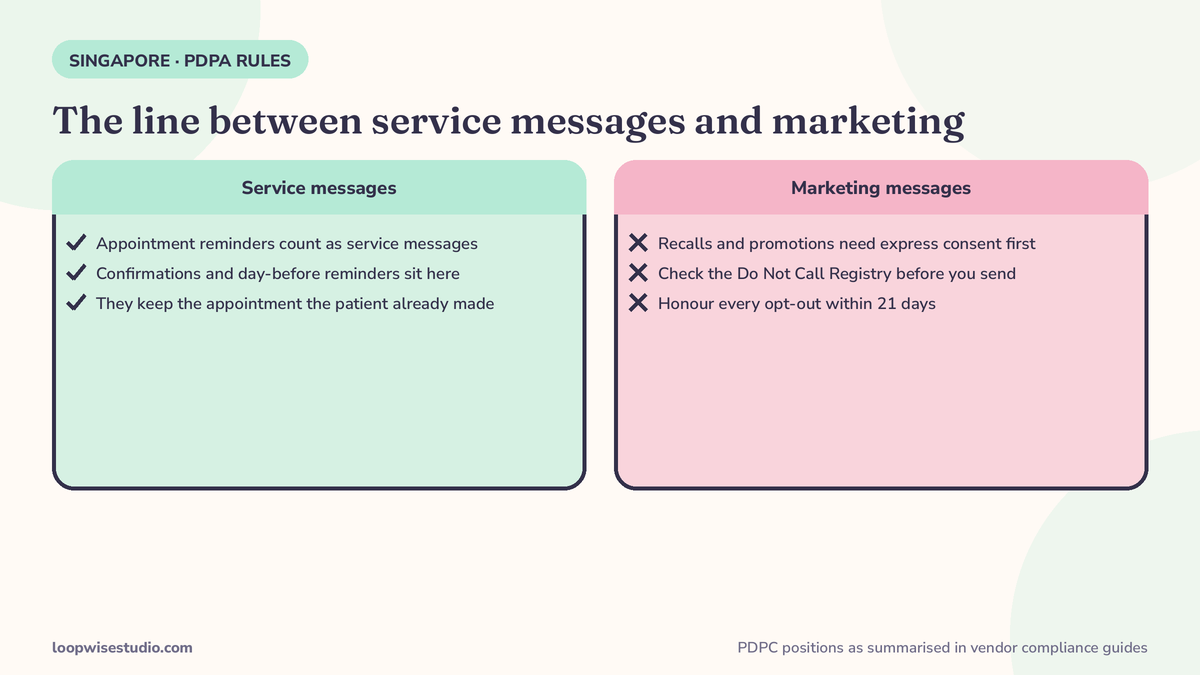
The PDPA line: reminders are service, recalls are marketing
Per the PDPC’s position as summarised in FingerBooth’s compliance guidance for Singapore businesses:
- Appointment reminders are service messages — they concern an existing booking and are transactional in nature.
- Marketing requires express consent. Sending promotional or recall-style messages needs the patient’s clear agreement. A completed transaction does not equal consent, and the PDPC is explicit that a one-off transaction does not create an ongoing relationship you can market to.
- Check the Do Not Call (DNC) Registry before sending marketing messages to Singapore numbers where you don’t hold consent.
- Honour opt-outs within 21 days — the window stated in vendor compliance summaries of the rules; build the suppression into the system so it happens automatically, not when someone remembers.
- Penalties under the PDPA can reach S$1 million, per ChatDaddy’s compliance summary — treat consent records as seriously as clinical records.
One widely shared vendor ROI table (ChatDaddy’s) claims reminder systems move no-shows from 7–10% down to 2–3%. That is vendor marketing, not a study, and we don’t present it as evidence anywhere on this page. The honest claim is smaller and true: patients forget, reminders arrive where patients actually read, and a reply-reschedule saves slots that a silent no-show burns.
Copy this: the four dental messages
Confirmation: “Hi [Name], you’re booked at [Clinic] for [treatment] on [date] at [time]. Reply R to reschedule.”
Day-before reminder: “See you tomorrow at [time], [Name]. Please arrive 10 minutes early for forms. Reply C to confirm, R to reschedule.”
2-hours-before: “Your appointment at [Clinic] is at [time] today. We’re at [address] — see you soon.”
Scaling recall (consent-based list only): “Hi [Name], it’s been about 6 months since your last scaling and polish at [Clinic]. Book your next one here: [link]. Reply STOP to end messages.”
Notice the recall carries the booking link and the opt-out. The reminders don’t need the opt-out line in the same way — they are service messages about a live booking — but they must never carry an offer. One promotional sentence turns a reminder into marketing, with marketing’s consent requirements attached.
Setting recall intervals without inventing them
The interval table is where clinics go wrong in both directions — recalling everyone at six months regardless of treatment, or never recalling at all. The only intervals we state as documented are SmartDentist’s published examples (180 days for scaling, 7 days post-extraction). Everything else belongs to your dentists, written into the system as rules:
| Recall type | Interval | Set by |
|---|---|---|
| Scaling & polish | 180 days (documented SmartDentist default) | Your dentists confirm or adjust |
| Post-extraction check | 7 days (documented SmartDentist example) | Your dentists |
| Orthodontic review | Per treatment plan | Your orthodontist |
| Implant review | Per treatment plan | Your implantologist |
| Consulted, never booked | Days, not months — while the conversation is warm | Your front desk |
The system’s job is mechanical: track the date, send at the interval, record the response, stop when told to stop. The clinical judgement stays with clinicians. Any vendor who ships “standard” medical intervals without asking your dentists is guessing with your patients.
How you know it’s working — measure slots, not messages
Vendors will report messages sent and open rates. Neither pays rent. Measure these four numbers monthly, from your own diary:
- No-show rate before vs after reminders start — your diary, your count.
- Reschedules captured — appointments moved by reply that would previously have been silent no-shows.
- Recall bookings — appointments created from the recall track, tagged as such.
- Opt-outs — a rising opt-out rate means your recall copy is reading as spam, whatever the open rate says.
If a vendor’s dashboard can’t show you the first three, the system is a messaging toy, not a booking system. And if anyone quotes you an industry no-show percentage for Singapore dental clinics, ask for the study — our research for this page found vendor marketing tables, not published data, which is why this article states none.
What to check before you buy any reminder tool
- Can it run recalls by treatment interval, or only appointment reminders? (The SmartDentist-style recall engine is the differentiator.)
- Whose WhatsApp number sends the messages — yours, or the vendor’s?
- How are consents recorded, and can you prove them per patient?
- Does it suppress opted-out patients automatically, within the 21-day requirement?
- Does it keep service and marketing lists separate by design?
- Is pricing published? In this market, often not — get it in writing.
For the non-dental version of the same sequence, and how it connects to your booking page, see WhatsApp appointment reminders for dental clinics in Dubai — the Gulf mechanics differ mainly in the consent regime.
The day-after message almost nobody sends
SmartDentist’s published pattern includes one touch most reminder systems skip entirely: a day-after follow-up. It has three jobs, none of them marketing in spirit:
- Aftercare check — after an extraction or procedure, a short “how are you feeling?” message catches complications early and is simply good care. (Clinical content belongs to your dentists; the system only schedules the touch.)
- Next-step booking — if the treatment plan has a next stage, the day-after message is the natural moment to book it, while the patient still has the context fresh.
- The honest review moment — a patient who has been checked on is the patient most likely to speak well of you. Keep this separate from the reminder stream and never condition it on the rating; ask everyone the same way, or don’t ask.
That single message turns a reminder system into a care system — and care systems are what patients stay with. It also illustrates the PDPA design principle of this whole page: the closer a message is to the patient’s actual treatment, the more clearly it is a service message. The further it drifts toward promotion, the more consent machinery it needs behind it. Build the tracks apart, and each stays simple.
How we set it up
Loopwise builds this as one system on your own website and WhatsApp number: booking, the reminder track, the recall engine set to your dentists’ intervals, and the consent split built in so a reminder can never drift into a promotion. If you want the gaps in your current setup found first, you can get a free audit.
One diary, worked through the system
Labelled illustration — a composite, not a clinic’s real data — showing how the two tracks touch one patient’s year:
- January: Patient books a scaling appointment online. Confirmation lands instantly. Day-before reminder, 2-hours-before touch. She attends.
- Day after: The follow-up message checks how she is and — because her dentist noted a filling to watch — books a review.
- July (180 days later): The recall fires to her, because she gave express consent at her January visit and it is recorded. She books from the link. The cycle that used to depend on her remembering now runs itself.
- If she had ignored July: One follow-up touch, then silence. No third chase, no offer smuggled into a “reminder.” The system respects the stop — which is exactly why patients stay on the list for the next cycle.
Multiply that one patient by the recall list sitting in your practice software, and you see why the recall track, built legally, is usually worth more than the reminder track that gets all the attention. Reminders defend the diary you have. Recalls build the diary you would otherwise be advertising to replace.
Getting the consent at the visit — the 20-second script
The entire recall track depends on one habit at reception. When a patient finishes a visit, the consent ask takes twenty seconds and must be specific — a generic “can we message you?” buried in intake forms is exactly the grey zone the PDPC position warns about. Copy this:
“We send appointment reminders on WhatsApp — those come automatically. Separately, when your next check-up or cleaning is due, we can send one message with a booking link. Is that okay? We never send offers unless you ask for them.”
Record the yes, the date, and who asked, against the patient record. That record is your proof, your suppression list’s foundation, and the reason your recall messages can be sent with confidence years later. Clinics that build this habit find their recall list grows every week without a single campaign. Clinics that don’t are stuck choosing between not recalling and recalling on shaky ground — and “shaky ground,” under a law with penalties reported up to S$1 million, is not where a dental practice wants its marketing to live.
FAQs
How many reminders should a dental clinic send?
A confirmation, a day-before reminder and a final touch 2 hours before covers most clinics. Lamanify’s documented sequence adds 3-days-before and 6-hours-before touches. More than that risks annoying patients — and risks the messages reading as marketing.
What’s the difference between a reminder and a recall?
A reminder concerns an appointment already booked — a service message under the PDPA. A recall invites a patient back at a treatment interval (180 days for scaling, per SmartDentist’s documented engine) when nothing is booked — that is marketing, and it needs express consent.
Can I send recalls to patients who visited once?
Not on the basis of that visit alone. The PDPC position, as summarised in compliance guidance, is that a one-off transaction does not create an ongoing relationship or consent for marketing. Collect express consent at the visit; then recall freely within it.
Do I need to check the Do Not Call Registry?
Yes, before marketing messages to Singapore numbers where you don’t hold express consent. Service reminders about existing appointments sit outside the marketing rules — another reason to keep the two tracks separate.
What happens if a patient opts out?
Stop marketing messages to them and honour it within 21 days under the rules as summarised in vendor compliance guides. Your system should suppress the number automatically. Service messages about a live appointment they booked are a separate matter — take advice if unsure.
Can reminders include a promotion, like 10% off whitening?
No — not in the reminder stream. That sentence makes the message marketing, requiring express consent and DNC checks for every recipient. Run promotions as separate campaigns to your consent-based list.
Your diary loses slots to forgetting, and your recall list — the cheapest bookings you own — sits untouched in most clinics. Start with a get a free audit request and we will map both tracks for your practice, consent rules included.