How to Reduce No-Shows in a Dog Grooming Salon
The UK version: WhatsApp reminders at 5 days and 24 hours, a fair deposit ladder in plain words, breed-cycle rebooking, and a waiting-list broadcast that refills gaps.
A dog grooming salon cuts no-shows with three things working together: automatic reminders (WhatsApp or text, a few days before and again 24 hours before), a deposit or card on file with a clear cancellation policy, and rebooking the next groom before the client leaves. Salons using all three keep the slot paid or filled even when a client cancels — the reminder catches the forgetful, the deposit covers the rest.
Notice what that short answer does not contain: a statistic. That is deliberate, and this guide will be upfront about it, because the no-show advice aimed at groomers is built on numbers nobody can trace. One widely-ranking vendor guide puts the average grooming no-show rate at “between 10% and 20%” and attributes it only to unnamed “industry surveys”. The same guide says text reminders cut no-shows by 30–40% — sourced to nothing. UK Pet Food counts around 15.5 million dogs in UK homes, with 41% of households owning one (industry figures reported in 2026). That is the size of your market. Your no-show rate is in your own diary, and it is the only one that should drive your decisions.
What follows is the UK version of this guide that the American ones are not: pounds not dollars, WhatsApp not just SMS, costs worked by groom type, and every policy written out in words you can copy.
What a no-show actually costs a UK grooming salon
A no-show in grooming is not like a no-show in retail. You cannot put the slot back on a shelf. A groom is one to three hours of one groomer’s hands, pre-booked, with the next dog already relying on the day running to time.
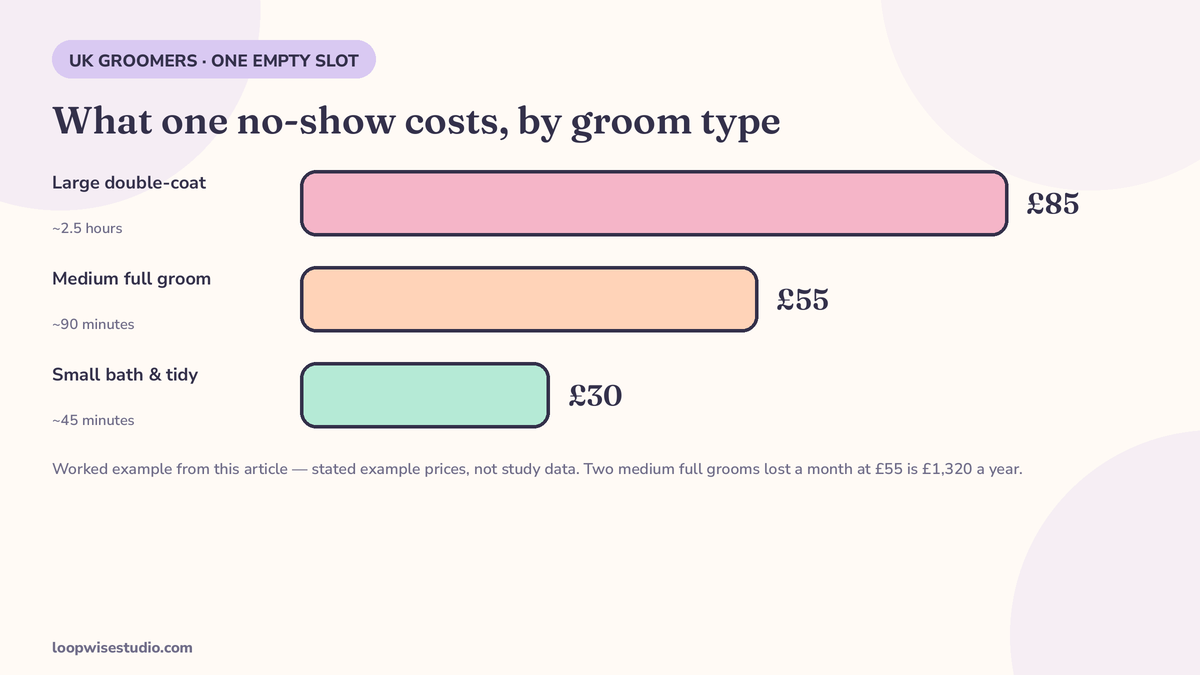
Worked example — our arithmetic, with the assumptions stated, not data from a study:
| Groom type | Slot length | Example price | What one no-show loses |
|---|---|---|---|
| Small dog, bath & tidy | ~45 min | £30 | £30, plus a gap too short to fill usefully |
| Medium dog, full groom | ~90 min | £55 | £55 — half a morning’s takings for a solo groomer |
| Large double-coat, full groom (e.g. Newfoundland) | ~2.5 hours | £85 | £85, and the rest of the day reshuffled |
Now run your own version. Count last month’s no-shows and late cancellations in your diary — most groomers who do this are surprised in the wrong direction — and multiply by your average groom price. Two medium full grooms a month at £55 is £1,320 a year. For a one-person salon, that is a month’s rent walking out of a door nobody opened.
There is a second cost nobody counts: the coat. A dog that no-shows and rebooks three weeks late arrives matted, takes longer, costs more, and sometimes cannot be done kindly in the slot available. The no-show tax is paid twice — once in the empty slot, once in the harder groom.
Fix 1 — Reminders that land: WhatsApp and text, at the right moments
Most no-shows are not malice. They are a booking made six weeks ago, in a diary the client does not own, for a dog who cannot remind anyone. Your reminder system has one job: be impossible to miss and effortless to answer.
The sequence UK grooming systems actually run is simple. GroomRules, the groomer-built platform, sends reminders 5 days and 24 hours before, by text and email; a multi-stage cadence (instant confirmation, then touches in the run-up) is the common pattern. On WhatsApp, use the same timing with copy like this:
At booking (instant):
“You’re booked in ✓ Bella’s full groom is on [day, date] at [time] with [groomer]. Need to move it? Just reply here — please give us at least 48 hours’ notice so we can offer the slot to another dog.”
5 days before:
“Not long now — Bella’s groom is [day] at [time]. Coat check: if she’s got any matting, let us know so we allow enough time. Reply YES to confirm, or tell us if you need to move.”
24 hours before:
“See you tomorrow at [time] for Bella’s groom. Reply YES to confirm. Running late or can’t make it? Reply now and we’ll sort it — no-shows leave a big gap in our day, so please don’t just not come.”
Three things to notice. Every message asks for a reply, because a confirmed appointment behaves differently from a merely announced one. The 24-hour message names the policy without sounding like a policy. And the 5-day message earns its place — it surfaces matting, holidays and “oh no, that’s the school trip” with enough time left to refill the slot.
This works because of the channel as much as the words. The reminder can only do its job if it is read, and in the UK the message a client reads is the WhatsApp. If you run WhatsApp booking for your grooming salon, reminders ride on the same thread as the booking, which is exactly where the client’s attention already is.
Fix 2 — Deposits and card on file: a fair policy, worded for you
Reminders catch the forgetful. Deposits handle everyone else. The framework below follows the structure recommended in Check-in DOG’s groomer guide — first-offence grace, a late-cancellation charge, a full fee for no-shows — rewritten for a UK salon and worded so you can paste it straight into your booking flow:
Our booking policy Life happens, and moving your appointment is free with at least 48 hours’ notice — just message us.
- First late cancellation or no-show: we’ll rebook you, no charge. Things go wrong; we get it.
- After that: cancelling inside 48 hours is charged at 50% of the groom price. Not showing up is charged at the full price.
- Charges go to the card you booked with — no invoices, no chasing. New clients and grooms over 2 hours are booked with a deposit, which comes off your bill on the day.
Why this shape works:
- The grace first-offence is deliberate. It makes the policy feel fair, which makes the rest of it enforceable. Clients accept being charged the second time by a salon that let them off the first.
- 50% for late, 100% for silent. A late cancellation at least gives you a chance to refill. Silence gives you nothing, so it costs everything.
- Card on file does the collecting. GroomRules’ worked example is a £55 groom with a £15 deposit by card and £40 on the day — proportionate, and the saved card is what turns the policy from words into money. A policy you have to invoice for by hand is a policy you will not enforce by the third time.
- Announce it at booking, not at the till. The policy belongs in the confirmation message, where agreement is easy, not in an argument in your salon doorway.
One legal-flavoured caution: these are business terms, presented as a template, not legal advice — if your salon is part of a franchise or your insurer has wording requirements, run it past them once.
Fix 3 — Book the next groom before this one ends
The cheapest no-show is the one that was never a cold booking in the first place. A dog rebooked at collection — “same again in five weeks? I’ll put you in now” — is a booking made by a happy client standing in front of you. A dog whose owner “will message you” is a booking that has to survive six weeks of forgetting.
Anchor the interval to the dog, not the calendar. The defaults one UK platform publishes (GroomRules, October 2026) are a sensible starting grid:
| Breed | Default recall interval |
|---|---|
| Cockapoo | Every 4 weeks |
| Goldendoodle | Every 4 weeks |
| Cocker Spaniel | Every 6 weeks |
| Newfoundland | Every 6 weeks |
| Labrador | Every 8 weeks |
Tuft’s recurring bookings run at 6, 8 or 12 weeks or custom — the same principle. Your own intervals may differ by coat and lifestyle; set them per dog once, and the system chases the recall so you do not have to. The script at collection takes ten seconds:
“Bella’s coat does best at five weeks — shall I book her next one now, same day and time? You’ll get a reminder the week before, and you can move it free if it clashes.”
A rebooked dog with a reminder coming is the closest thing grooming has to guaranteed revenue. It is the same regulars-on-a-cycle logic as reducing no-shows at a UK beauty salon, except your clients’ cycles are written on their coats.
Fix 4 — Self-service reschedule, so clients move instead of vanishing
Ask any groomer what the ideal bad outcome is and it is not a kept appointment — it is an early cancellation. A slot released three days ahead can be refilled. A slot released by silence cannot.
So make moving an appointment easier than ghosting it:
- Every reminder carries a move option in the same message. Reply, tap, pick a new slot. No phone call, no embarrassment, no “I’ll ring them later” that never happens.
- The reschedule flow enforces your policy automatically — free outside 48 hours, charged inside it — so the rule is the system’s, not yours personally.
- Every cancellation asks one question: why? Wrong day, price, dog unwell, forgot. A month of those answers tells you whether your problem is reminders, pricing or booking too far ahead.
The general principle travels: the reason reducing no-shows works in clinics is the same — make the honest action (move it) the easiest action. Grooming just feels it harder, because your slots are longer and your team is smaller.
Fix 5 — Refill the gap: the waiting-list WhatsApp broadcast
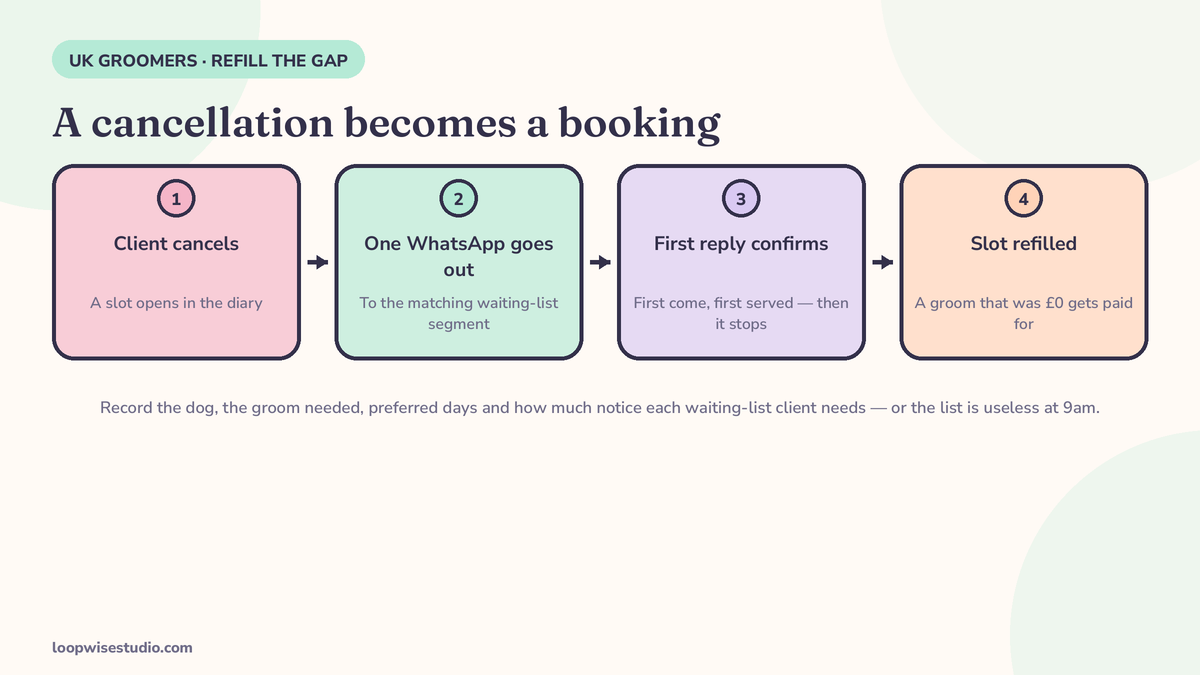
Some cancellations will land inside 24 hours whatever you do. The last line of defence is a waiting list that actually gets used — which means one that lives where you can reach it in thirty seconds.
Build the list properly. For every waiting-list client, record: the dog, the groom needed, preferred days/times, and how much notice they need. A list of names without that detail is useless at 9am with a 10am hole.
Broadcast like this (copy-paste):
“Quick one — we’ve had a cancellation tomorrow (Thursday) at 10am, suitable for a small/medium full groom. First reply gets it, 10% off the groom for the short notice. — [Salon name]”
Send it to the matching segment only (the Newfoundland owner cannot use a slot sized for a Shih Tzu), and stop at the first confirmed reply. Does the refill rate matter enough to bother? One vendor guide claims waiting lists “typically recover 40–60% of cancelled slots” — with no source given, so treat it as a claim, not a promise. Your own number after a month of doing this is the only one worth quoting. Even at the pessimistic end, a refilled slot costs you one message and pays for a groom that was otherwise £0.
If you want this wired up properly — reminders, deposits, recalls and the refill broadcast running off your own diary instead of your evenings — you can get a free audit. We will look at your no-show pattern and tell you which of the five fixes would pay back first in your salon.
The repeat no-show client: prepay-only and other last resorts
Every salon has one. Lovely person, lovely dog, three no-shows a year. Policy ladders exist for exactly this client, and using them is not a betrayal — the other clients, the ones who show up, are subsidising the empty slots.
Escalate in order:
- Deposit on every booking, whatever the groom. No exceptions, kindly explained: “The system asks for it after two missed appointments — it’s nothing personal, and it comes off your bill.”
- Prepay-only. Full price at booking. Most repeat offenders quietly fix themselves at this rung, because the money is already spent.
- Standby-only. No advance slots; they take cancellation gaps via the waiting list. Some clients genuinely cannot commit ahead, and this is the honest shape for them.
- Part ways. Rare, and usually mutual by this point.
Put the ladder in your policy from day one — “clients who miss two appointments move to deposit bookings” — so when it happens, you are following your own rules rather than inventing a punishment.
FAQ
How much notice should I ask for cancellations?
48 hours is the workable standard for grooming: long enough to stand a chance of refilling a one-to-three-hour slot, short enough that clients accept it. Charge around 50% inside the window and the full groom price for a no-show, with one first-offence grace. Whatever you choose, the numbers matter less than saying it at booking and enforcing it the same way every time.
Should I charge a deposit to regulars, or only new clients?
New clients and long grooms: yes, always. Regulars with a clean record: a card on file is usually enough — the policy, not the deposit, does the protecting. The moment a regular no-shows twice, they move to deposit bookings under your published ladder. Uniform rules, applied by the system, keep it from ever feeling personal.
Do reminders really reduce no-shows, or is that marketing?
Reminders fix one specific cause: forgetting, across a six-to-eight-week gap between booking and groom. That is a real and large cause in grooming because of the cycle length. What reminders cannot fix is the client who double-booked or lost interest — that is what deposits and rebooking-at-collection are for. Be wary of any vendor quoting you an exact percentage reduction: the ones in circulation are unattributed, including the “30–40%” figure in popular guides.
What’s the best channel for grooming reminders in the UK: WhatsApp, SMS or email?
WhatsApp first, SMS as fallback, email as the receipt. The reminder has to be seen and answered in the moment, and UK clients live on WhatsApp — it is the same thread they booked on. SMS reaches the minority not on WhatsApp. Email is where confirmations go to be filed, not read.
A client no-showed and now wants to rebook. What do I say?
Warm, brief, and with the policy attached:
“No problem at all — glad [dog] is OK. I can offer [two slots]. Because the last appointment was missed, the system will take the deposit when you book this one — it comes off the bill on the day. Shall I send the booking link?”
No lecture, no guilt trip, and the charge (if your ladder applies) is presented as the system’s rule. Most clients accept instantly, because the framing is fair.
Can I do all of this with the software I already have?
Mostly, yes — the fixes are habits and settings more than tools. Check whether your current system can send two reminders at set times, take a card at booking, run recurring bookings on per-dog intervals and message a waiting list in one go. If it cannot do one of those, that gap is your leak. A done-for-you setup exists for salons that would rather not configure it themselves — but no tool fixes a policy you do not enforce.
To recap: reminders catch the forgetful, deposits cover the rest, rebooking at collection stops the cycle leaking, and a waiting list turns the cancellations that still happen into refills. Run all five and a no-show stops being a lost morning. If you’d like the system set up around your salon, get a free audit and we will start with your diary, not a sales pitch.