WhatsApp Booking for Aesthetic Clinics in Ireland
WhatsApp booking for Irish aesthetic clinics: tap-to-chat slots, deposit links and automatic reminders instead of 11pm manual replies. Costs and GDPR covered.
WhatsApp booking for an aesthetic clinic means a client can tap from Instagram or Google straight into a WhatsApp chat, see real consultation slots, and confirm on the spot — with a deposit link and automatic reminders — instead of waiting hours for a manual reply. In Ireland, most clinics still take those messages by hand, including after hours, which is exactly where bookings leak.
The demand is already there. Astra Clinic in Dublin, for example, invites patients on its website to WhatsApp the clinic directly — and a person answers, by hand, during opening hours. The channel works. What’s missing is the system behind it: live slots, deposits and reminders that don’t depend on someone watching a phone.
How Irish aesthetic clients actually book today
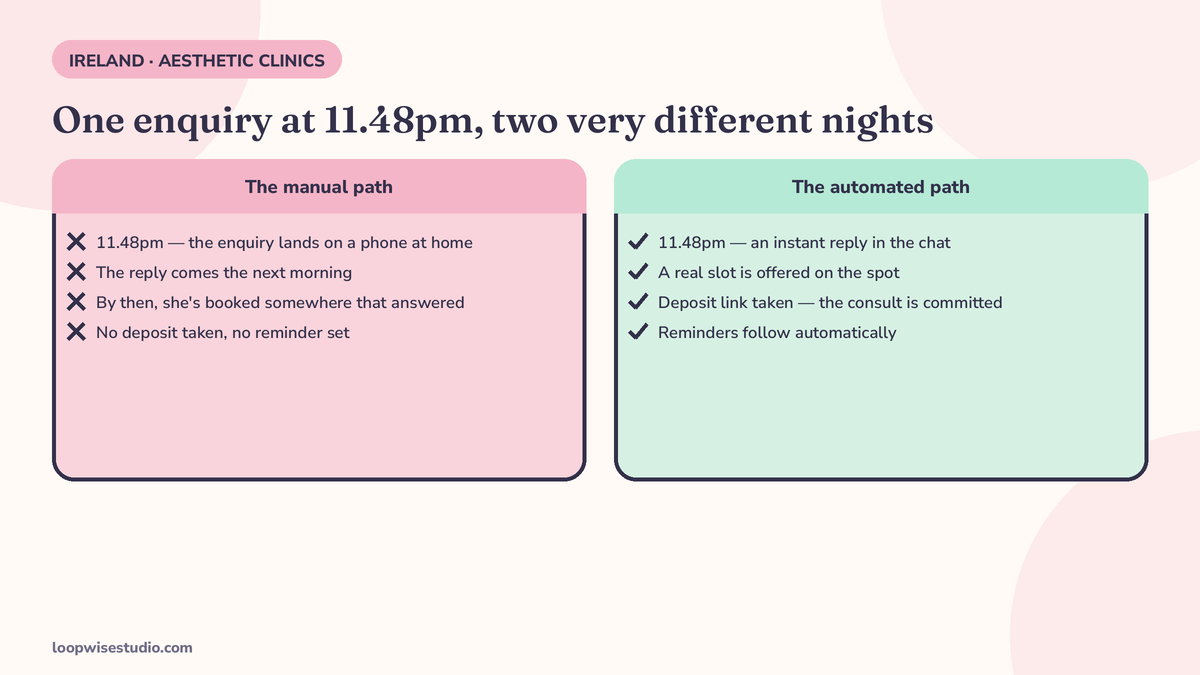
The typical evening at an Irish aesthetic clinic looks like this:
- A client sees a treatment on Instagram at 10pm and taps the WhatsApp button.
- She asks about price, downtime and the earliest appointment.
- The message sits in a phone at reception — or on the owner’s personal phone — until morning.
- By morning she has messaged two other clinics. The one that replied first, and offered her a slot instead of a conversation, gets the booking.
- If she does book and something comes up, changing the appointment means another round of messages — so she simply doesn’t show.
Nothing here is a marketing problem. The clinic’s ads, its Instagram, its location are all doing their job. The leak is mechanical: manual replies cannot cover the hours when clients actually enquire, and manual booking carries no deposit and no reminder structure.
What WhatsApp booking means here — the flow, step by step
Step 1 — tap to chat. Your Instagram profile, Google listing and website all point to one WhatsApp number — yours, on your website and under your clinic’s name, like the front door we build for WhatsApp booking for clinics in Ireland generally.
Step 2 — real slots, in the chat. The client picks a treatment and sees actual availability from your diary. No “we’ll check and get back to you.”
Step 3 — the consult is confirmed with a deposit link. For high-value consultations, a card deposit in the chat turns a casual enquiry into a commitment. More on deposits below.
Step 4 — reminders run automatically. Confirmation at booking, a reminder before the appointment, one-tap reschedule. The client who can’t make it moves the slot instead of vanishing from it.
Step 5 — a human can step in at any point. Automation handles the mechanics. The moment a conversation needs judgement — a worried client, a post-treatment concern — your team takes over in the same thread.
Loopwise builds this as an owned system: your number, your website, your diary, your client list. It’s the same model as our Dubai aesthetic clinic WhatsApp booking system, localised for Ireland — and notably, no Irish vendor currently sells it. Irish clinics ranking for this topic are offered ads retainers, Malaysian AI chatbots or salon software instead.
It starts on Instagram — the DM is the leak before the leak
Most aesthetic enquiries don’t start on WhatsApp. They start as an Instagram DM — a reply to a story, a question under a reel — and Instagram DMs are where response times go to die, because they live in an app nobody at reception is assigned to watch.
The fix is a handoff, not a second inbox to babysit: the DM gets an instant reply that answers the basic question and moves the conversation to WhatsApp with one tap, where the booking flow takes over. From that tap onward, everything is on your number, in one thread, connected to your diary. A clinic that automates WhatsApp but leaves Instagram manual has sealed the second leak and left the first one open.
What to ask any provider — before the demo, not after
- Does it run on our clinic’s own WhatsApp number, and do we keep the number if we leave?
- Are the slots it offers pulled live from our diary, or typed in by someone?
- Can it take a deposit in the chat, under our own payment account?
- Who writes the message templates, and can we see every one before they go live?
- What exactly happens when a client asks a clinical question at 11pm?
- Can we export our full client list and conversation history at any time?
- What’s the total monthly cost at our message volume — including WhatsApp’s per-message charges?
A provider who answers all seven clearly, in writing, is selling a system. A provider who answers with a demo and a discount is selling a subscription. The questions cost you nothing; ask them in this order, because the first two decide whether the rest matter.
The after-hours problem — measured in your numbers, not borrowed ones
You’ll see vendors quote dramatic statistics about after-hours enquiries and lost revenue. The ones circulating for Ireland are self-reported marketing claims — one Irish agency advertises “+€35M in patient bookings generated” on its homepage and “€30M+” elsewhere on the same site. Treat all of it as advertising, because it is.
Your own numbers are easy to get and much more useful:
- Count last month’s WhatsApp and Instagram enquiries that arrived after closing time.
- Count how many of those people ever booked.
- Compare with enquiries that arrived during hours.
That gap is your leak, priced at your own consultation and treatment values. A booking system is worth buying if it closes a worthwhile share of that gap — and you can measure whether it does, in your diary, within the first month.
Deposits for high-ticket consultations — how they change behaviour
A consultation slot at an aesthetic clinic is 30–45 minutes of a clinician’s diary. Given away free with no commitment, it’s treated as optional — by the client who booked it on a whim at midnight. A deposit changes the psychology without changing the welcome:
- The client commits when she books, not when she arrives. Card details or a deposit payment in the chat takes ten seconds.
- Rescheduling replaces vanishing. With money down, a client who can’t make it uses the reschedule link — she wants the appointment, just not at that time.
- Your policy does the enforcing. “Your deposit moves with your appointment if you reschedule more than 24 hours ahead” is a rule the system applies evenly, so staff never have to argue it case by case.
Set the deposit at a level that’s meaningful but not a barrier — many clinics use the consultation fee itself, deducted from treatment if the client proceeds. State the rule clearly in the booking chat, before payment, so there are no surprises.
Reminders and rebooking — top-ups and courses
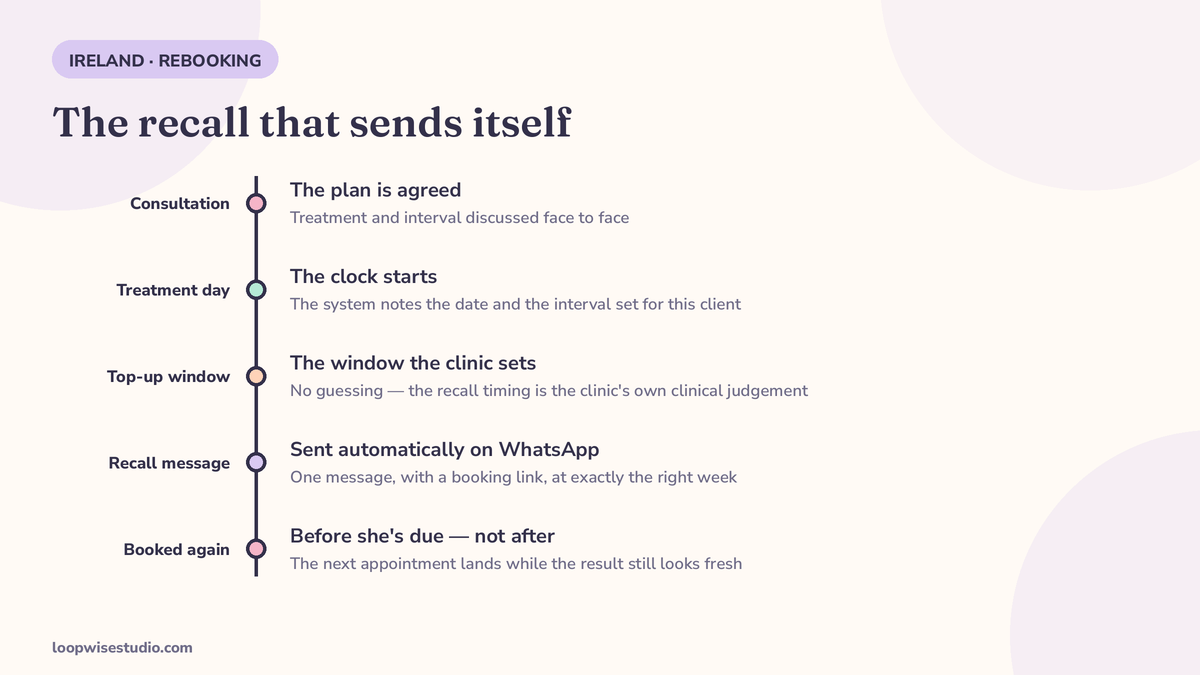
Aesthetic revenue is repeat revenue: injectable top-ups on a cycle, laser courses across months, review appointments after treatment. Each has a moment when the client is due — and that moment is in your diary, which means it can drive a message:
| Moment | Message that goes out |
|---|---|
| Consult booked | Confirmation + deposit receipt + how to reschedule |
| 24 hours before | Reminder with one-tap confirm or reschedule |
| After treatment | Aftercare pointer + review appointment offer |
| Top-up window (set by your clinician) | “You’re due for your review/top-up — here are this week’s slots” |
| Course session due | Next-session booking link, while the course is still front of mind |
The intervals are set by your clinicians, per treatment — the system never invents a medical schedule. This is the same retention engine described in our WhatsApp rebooking campaigns for aesthetic clinics, run on Irish diaries.
If your diary has gaps that your enquiry volume says shouldn’t be there, get a free audit and we’ll show you where the bookings are stopping.
The copy-paste asset — the booking conversation, written out
Steal this structure for your own clinic, manual or automated:
Client: Hi, do you have anything for anti-wrinkle consultations this week? Clinic (automatic): Hi [Name], yes — for [Clinic] in [Town], Dr [Name] has Thursday 2:30pm or Friday 11:00am. Tap one to hold it, or tell me a day that suits better. Client: Thursday works. Clinic: Done — Thursday 2:30pm is held for you. To confirm, there’s a €[X] consultation deposit here: [link] — it comes off your treatment if you go ahead. You’ll get a reminder the day before, and you can move the appointment from that message if anything changes.
Four moves: answer instantly, offer real slots, confirm with a deposit, promise the reminder. Everything else is decoration.
GDPR and consent for Irish clinics — plain English
- Booking messages are service messages. Confirmations, reminders and reschedule links for an appointment the client made are part of the service. Keep them factual.
- Marketing needs permission. Top-up reminders tied to a client’s own treatment plan are care follow-up; a broadcast promoting a new treatment offer is marketing, and needs consent captured and recorded, with a working opt-out in every message.
- Be careful with claims in automated messages. Don’t let templates promise results or lean on before-and-after imagery — the same advertising caution that applies to your social posts applies to anything the system sends.
- Data stays in your systems. Client details live in your diary/CRM; WhatsApp carries the conversation, and the client list is exportable — it’s yours.
What it costs — the honest anchors
There is no published Irish price for an owned WhatsApp booking system, because nobody lists one. The anchors that do exist, all published pricing checked in October 2026 — confirm current pricing before relying on them:
- Chat add-ons: iGlowly’s Pro plan, which adds WhatsApp to a website chat assistant, is listed at €249/month in Europe — for a chat widget layer, not a booking system with deposits.
- Agency retainers: EireDigital, the Irish medspa marketing agency, publishes packages from €499/month — an ads-led growth retainer in which booking and reminders are one component, not the product.
- Software suites: Phorest’s AI front desk “Ivy” answers enquiries and takes booking requests by WhatsApp and, according to Phorest’s own internal data, resolves up to 87% of client conversations — but it comes with the full Phorest software suite, not as a layer on the diary you already run.
An owned system is priced differently: a fixed build on your number and website, then the running costs are WhatsApp’s per-template message charges and hosting. If you want that priced for your clinic, get a free audit — the quote is fixed before any work starts.
The same enquiry follow-up engine, built for dental diaries, is covered in WhatsApp automation for dental clinics in Ireland.
FAQs
Do clients actually book through WhatsApp, or do they prefer a booking page?
They do both — which is why the system offers slots in the chat and a one-tap booking page for clients who’d rather tap through a calendar. The pattern that fails is neither: it’s the manual reply hours later.
Can the system take deposits for consultations?
Yes. The confirmation message carries a secure payment link for the deposit amount you set, and the slot is only fully confirmed once it’s paid. Your deposit and reschedule rules are written into the flow in plain language.
What happens when a client asks something clinical?
The system doesn’t answer clinical questions. It books the consultation where the question belongs, or hands the thread to your team immediately. Post-treatment concerns are handed over at once, always.
We already use salon/clinic software. Do we have to switch?
No. The booking layer connects to your existing diary where possible, or runs a live booking page alongside it. The point is to fix the enquiry-to-booking gap, not to migrate your whole practice.
Is our client data safe, and do we own it?
Your client list, conversations and number belong to your clinic. Data is held in your systems, consent and opt-outs are recorded automatically, and everything is exportable if you ever leave — that should be in writing from any provider, including us.
How is this different from an AI chatbot on our website?
A website chatbot only talks to people already on your website, and usually only in a chat window. WhatsApp booking starts where clients actually are — Instagram, Google, referrals — runs on your own number, connects to your diary, takes deposits and sends reminders. Different job, bigger surface.