WhatsApp Appointment Reminders for Dental Clinics in Dubai
The full WhatsApp reminder sequence for Dubai dental clinics: instant confirmation, 24h and 12h reminders, one-tap reschedule and no-show recovery in Arabic and English.
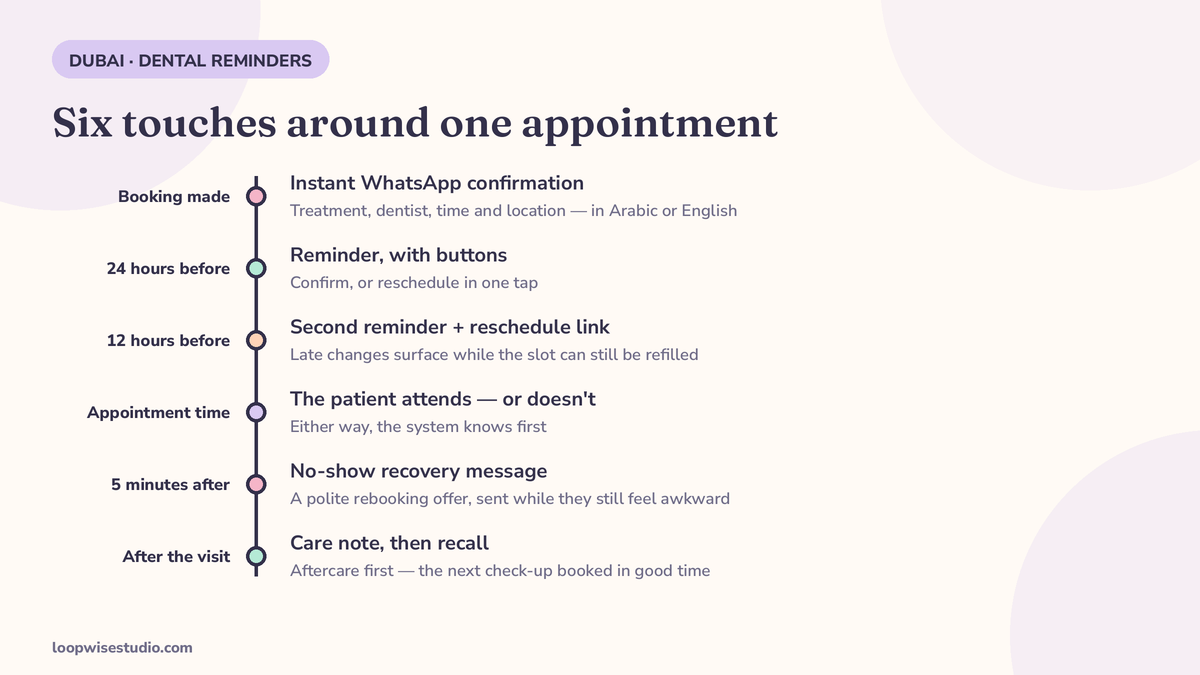
WhatsApp appointment reminders for a Dubai dental clinic work as a sequence, not a single message: an instant confirmation when the patient books, a reminder 24 hours before, another 12 hours before with a one-tap reschedule link, and — if the patient still doesn’t show — a recovery message minutes later offering new slots. Sent in Arabic or English from the clinic’s own number, they replace the front desk’s manual reminder calls.
No page in Dubai currently explains this properly. Reminders appear everywhere as a feature bullet — “automated reminders included” — with no timings, no wording and no no-reply path. This page is the missing manual: the sequence, the templates in both languages, what it costs in AED from published sources, and how to measure whether it’s working.
The four jobs a reminder system has to do
- Confirm — the patient knows the booking is real, immediately, in writing.
- Remind — at the moments when a forgotten appointment can still be saved.
- Reschedule — make moving the appointment easier than not showing up.
- Recover — when someone still misses, reopen the conversation while the intent is warm.
A system that only reminds does a quarter of the job. The sequence below does all four. It’s part of the same system as our WhatsApp booking system for aesthetic clinics in Dubai — booking and reminders are one flow, not two products.
The sequence — timings first, then the words
| When | Message | Job |
|---|---|---|
| At booking | Instant confirmation with date, time, doctor and a way to change it | Confirm |
| 24 hours before | Reminder with one-tap confirm or reschedule | Remind + reschedule |
| 12 hours before | Short reminder — the “morning of the day before” nudge for next-day appointments | Remind |
| If no reply | One follow-up, then the slot is flagged to your team while it can still be refilled | Protect the slot |
| 5 minutes after a missed slot | Recovery message offering two open slots | Recover |
The published cadence closest to this comes from Zavis, a UAE AI-receptionist vendor, whose FAQ describes a confirmation plus reminders at 24 hours and 12 hours before, each with a one-tap reschedule link, and a recovery message five minutes after a missed appointment offering two alternative slots, with follow-up until the patient rebooks or replies. We match that cadence and extend it with the no-reply path — the part that protects tomorrow’s diary, which no rival documents.
The copy-paste asset — the full template set, Arabic and English
Rivals in this market all claim bilingual reminders. None publish a single Arabic template. Here is the complete set — written to be lifted, with the placeholders your system fills from the diary.
1. Confirmation (at booking)
EN: Hi [Name], your appointment at [Clinic] is confirmed for [Day, Date] at [Time] with Dr [Name]. Reply CHANGE any time if you need a different time. AR: مرحباً [الاسم]، تم تأكيد موعدك في [العيادة] يوم [اليوم، التاريخ] الساعة [الوقت] مع الدكتور [الاسم]. رد بكلمة «تغيير» في أي وقت إذا احتجت إلى وقت آخر.
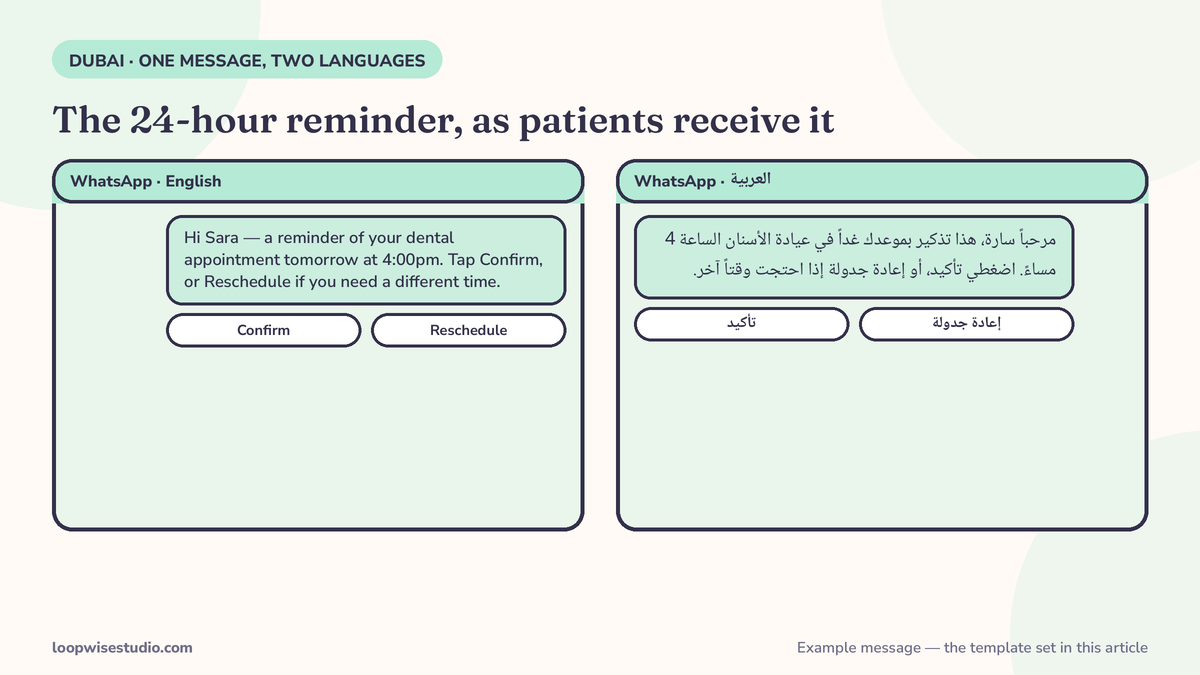
2. Reminder (24 hours before)
EN: Reminder: you’re booked at [Clinic] tomorrow, [Date] at [Time]. Reply YES to confirm, or tap here to reschedule: [link] AR: تذكير: موعدك في [العيادة] غداً [التاريخ] الساعة [الوقت]. رد بـ«نعم» للتأكيد، أو اضغط هنا لتغيير الموعد: [رابط]
3. Reminder (12 hours before)
EN: See you today at [Time], [Name] — your appointment at [Clinic] is in a few hours. Running late or can’t make it? Tap to move it, and your slot can go to another patient: [link] AR: نراك اليوم الساعة [الوقت]، [الاسم] — موعدك في [العيادة] بعد ساعات قليلة. إذا تأخرت أو لم تستطع الحضور، اضغط لتغيير الموعد حتى يستفيد مريض آخر من الوقت: [رابط]
(For a morning appointment, the 12-hour message lands the evening before — word it as “tomorrow morning” in that case. Your templates should carry both variants.)
4. No-show recovery (5 minutes after the missed slot)
EN: Hi [Name], we missed you at [Time] today. Two slots have opened up: [Option 1] and [Option 2]. Reply 1 or 2 and we’ll rebook you straight away. AR: مرحباً [الاسم]، افتقدناك اليوم الساعة [الوقت]. توفّر موعدان: [الخيار ١] و[الخيار ٢]. رد برقم ١ أو ٢ وسنعيد حجزك فوراً.
Three rules across all four: the patient’s language, chosen at booking, is used every time; every message offers a way out (reschedule, opt out) as visibly as it asks for commitment; and no clinical content ever goes into a reminder.
5. Preparation note (with the 24-hour reminder, when the treatment needs one) Some appointments need the patient to do something before they arrive — bring an insurance card or Emirates ID, arrive early for forms, follow a pre-treatment instruction your clinician has set. Attach it to the 24-hour reminder, not a separate message:
EN: One thing for tomorrow: please bring your Emirates ID and insurance card, and arrive 10 minutes early — we’ll handle the paperwork before your [Time] appointment. AR: ملاحظة لغد: يرجى إحضار الهوية الإماراتية وبطاقة التأمين، والحضور قبل الموعد بعشر دقائق — سننهي الأوراق قبل موعدك الساعة [الوقت].
What makes a patient actually reply — the wording rules
The templates above follow five rules, and they’re most of why a sequence outperforms a lone reminder call:
- One message, one action. Confirm, reschedule, or reply with a number. A message asking for two things gets neither done.
- Name the specifics. Doctor, date, time, clinic. A reminder that could be from anyone gets treated like it’s from no one.
- Short enough to read on a lock screen. If the point isn’t visible without opening the chat, it isn’t a reminder — it’s a letter.
- The reschedule path is bigger than the guilt. “Tap to move it” appears in every message. A patient who can move an appointment in five seconds rarely ghosts it instead.
- Same language, same voice, every time. The patient who booked in Arabic gets reminded in Arabic, in the same tone as the confirmation. Consistency is what makes automation feel like the clinic, not a call centre.
Three ways to get reminders in Dubai — compared honestly
| Route | How it works | Published cost anchor | The catch |
|---|---|---|---|
| Inside your PMS | Reminders are a feature of the dental practice software | Remedico lists AED 363 per doctor per month (including 1,000 free WhatsApp reminders) in its published Dubai PMS comparison, checked October 2026 — verify current pricing on their site | Reminders are metered against an allowance, and the sequence is whatever the PMS offers — usually a reminder, not a recovery flow |
| Inside an AI receptionist | A vendor’s AI handles enquiries and sends reminders as part of the package | Bertos publishes AED 2,500/month (AED 2,000 on annual billing) for its WhatsApp Assistant tier — but automated reminders only start at the Growth tier, AED 3,500/month (AED 2,800 annual), which also adds Instagram and bilingual messaging (published pricing, October 2026 — check current pricing) | You rent the whole receptionist to get the reminder sequence; one language only at the entry tier |
| A WhatsApp layer on your existing system | Booking + the full sequence (confirm, remind, reschedule, recover) built on your number and diary | Fixed build quote; running costs are WhatsApp’s per-template message charges and hosting | Needs your diary connected properly — which is the build |
None of these routes is wrong for every clinic. If your PMS already sends confirmations and one reminder, say so and measure it before buying anything. If reminders are bundled three tiers deep in a receptionist package, do that maths too — it’s the comparison nobody in this market publishes.
The same layer, built for bookings first, is what we run for dental clinics in Abu Dhabi as well.
If your front desk is still working a reminder call list every afternoon, get a free audit and we’ll cost the full sequence for your clinic.
Measuring it — your number, not a borrowed one
Here is a fact this market avoids: no published, sourced no-show rate for Dubai or UAE dental clinics exists. Vendors quote figures — Bertos, for instance, claims 67% of enquiries arrive after hours and that over 50% of patients prefer Arabic — but publishes no source for either, so this page doesn’t use them as facts, and you shouldn’t buy on them either.
Measure your own instead:
- Baseline: for the last full month, divide missed appointments by booked appointments. That’s your no-show rate.
- Run the sequence for one month. Same diary, same team — only the reminders change.
- Compare. Also track reschedules-in-chat: every patient who moves instead of vanishing is the system working, and it never appears in a no-show statistic.
Any vendor selling reminders should be comfortable being judged this way, on your diary. We are — the audit starts with your baseline, and you can get a free audit whenever you’re ready.
Dubai details rivals skip
- Send times are a setting, not an accident. Reminder windows should respect prayer times and your patients’ working patterns — including the Friday/weekend rhythm — rather than firing at fixed clock times copied from another market.
- One number, your number. Reminders from the clinic’s own WhatsApp number get read as messages from the clinic. Reminders from a platform’s shared number get read as marketing.
- Templates need approval. WhatsApp requires pre-approved templates for messages sent outside the 24-hour reply window, which is exactly where reminders live. Approval lead time belongs in the project plan; a vendor who doesn’t mention it hasn’t set this up before.
For the broader attendance problem these reminders feed into, see how to reduce no-shows at a med spa — the mechanics are the same across appointment businesses.
FAQs
How many reminders should a dental clinic send?
Three touches cover it for most appointments: an instant confirmation, a reminder 24 hours before, and one 12 hours before — each with an easy way to reschedule. More than that trains patients to ignore you; fewer leaves the evening-before change of plans with nowhere to go.
Can reminders really go out in Arabic and English?
Yes. The patient picks a language at booking and every template after that runs in it. The templates in this article are written in both languages — your system fills the name, date, time and doctor from the diary.
What happens if the patient doesn’t reply to any reminder?
The system sends one follow-up, then flags the appointment to your team while the slot can still be offered to someone else. Silence becomes information for the front desk instead of a surprise at the appointment time.
Do reminders work from our existing clinic number?
They should. Running the sequence from your own WhatsApp number — the one patients already have saved — is a requirement to set with any vendor. If a provider wants reminders sent from their number, ask why.
What does a reminder programme cost per month in Dubai?
From the published anchors in this article: reminders sit inside a PMS subscription (Remedico lists AED 363 per doctor per month with 1,000 WhatsApp reminders included) or inside an AI-receptionist package (Bertos reminders start at its AED 3,500/month tier). On an owned system, the running cost is WhatsApp’s per-template message charge at your reminder volume — small per message, and itemised. All figures checked October 2026; confirm current pricing with each vendor.
Does WhatsApp charge per reminder message?
Yes — template messages sent outside the 24-hour conversation window carry a per-message charge set by Meta for the UAE. It’s small per message, but it’s why an itemised bill matters: you should see exactly how many reminders you sent and what each cost.