WhatsApp Booking System for Dental Clinics in Abu Dhabi
A WhatsApp booking system for Abu Dhabi dental clinics: Arabic and English booking, live slots, reminders and recall on your own number. Malaffi and costs.
A WhatsApp booking system for a dental clinic in Abu Dhabi lets patients pick a language — Arabic or English — choose a doctor and a live slot, and confirm inside WhatsApp. No phone call, no app download. Most Abu Dhabi clinics already accept WhatsApp messages, but staff answer them by hand; the system is what connects that chat to the diary, the reminders and the recall list.
That distinction — manual versus system — is the whole story of this page. The channel is not new to your patients. The automation behind it is what’s missing.
How Abu Dhabi patients already book — by hand
WhatsApp booking already exists in Abu Dhabi; it’s just staffed by people. Perfect Smile Dental Centre on Hamdan Street, for example, tells patients on its own website that appointments can be booked by phone or WhatsApp, with reception helping on insurance eligibility. Patients message, reception replies when they can, someone checks the diary, someone writes back.
Multiply that by every enquiry, every day, and the failure modes are familiar:
- Messages that arrive in the evening wait until the clinic reopens.
- Two receptionists, one shared phone, no record of who promised what.
- A patient who doesn’t get a quick answer messages the next clinic on Google.
- Recalls — hygiene due dates, review appointments — depend on someone remembering to work a list.
Enterprise vendors write about this market at GCC level: workflow diagrams, hospital integrations, Abu Dhabi named in a list of cities. Nobody writes the page for an Abu Dhabi dental owner. This is that page. For the wider system it belongs to, see our WhatsApp booking system for aesthetic clinics in Dubai — the TC8 pillar this article supports.
What the system adds — live slots in the chat
A booking system turns the manual chat into a connected flow:
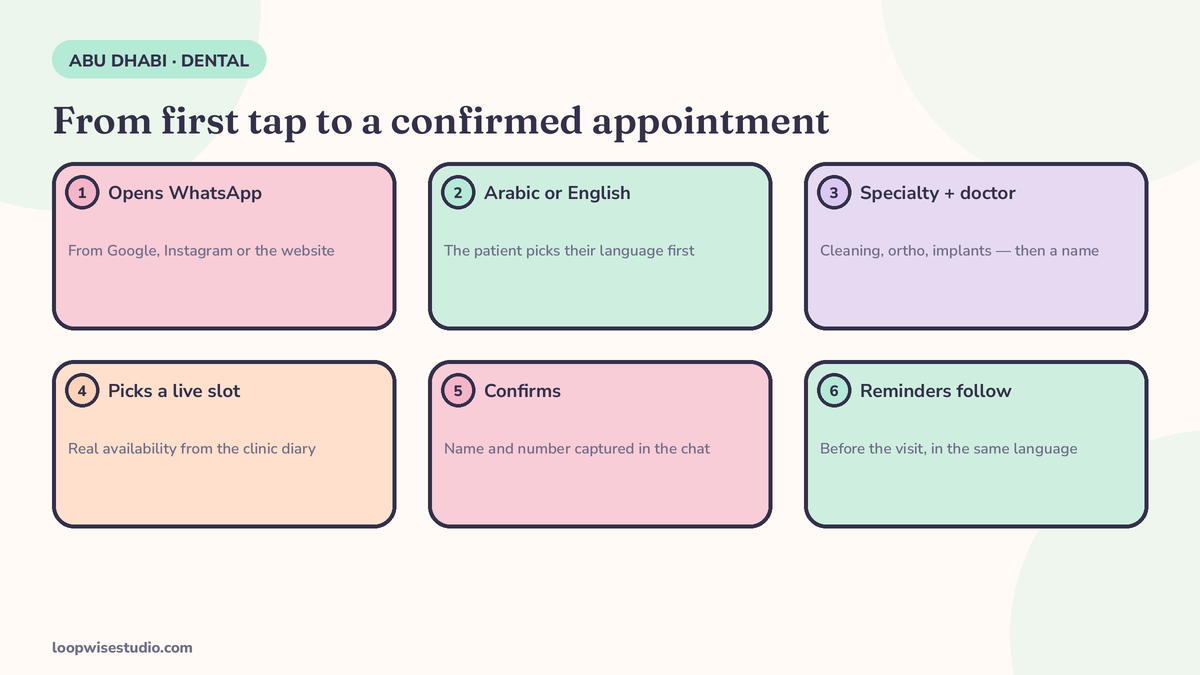
Step 1 — the patient starts on your number. From your website, your Google profile or a printed QR code in the clinic, one tap opens WhatsApp on the clinic’s own number.
Step 2 — language first. The first choice is Arabic or English. Everything after it — slots, confirmations, reminders — runs in the language the patient picked, and your team sees one thread, not two inboxes.
Step 3 — specialty, doctor, live slot. The patient picks what they need (consultation, cleaning, emergency), then a doctor, then a real opening from the diary. The slot they see is the slot that exists.
Step 4 — instant confirmation. Name, treatment, doctor, date and time, confirmed in the chat, with the appointment written into the diary at the same moment.
Step 5 — reminders and easy rescheduling. A reminder before the visit, with rescheduling inside the chat instead of a phone call. The reminder sequence itself is covered in full in WhatsApp appointment reminders for dental clinics in Dubai — the cadence transfers directly.
Step 6 — follow-up and recall. After the visit, the follow-up message. When the next hygiene visit or review falls due, the recall message. The diary drives both.
Arabic and English, properly — not a translated afterthought
Every vendor in this market claims bilingual support. None of them show it. Here’s what “properly” means in practice:
- The patient chooses. Language selection is the first step, not a setting buried in a menu — the journey anatomy UAE healthcare vendor Health Cluster documents (language → specialty → doctor → slot) gets this order right.
- Templates are written in both languages, not machine-translated on the fly. A reminder is a formal message from a medical provider. It should read like one in Arabic and in English.
- Staff see one conversation. Whichever language the patient writes in, your team works from a single thread with the full history — no screenshots forwarded between phones.
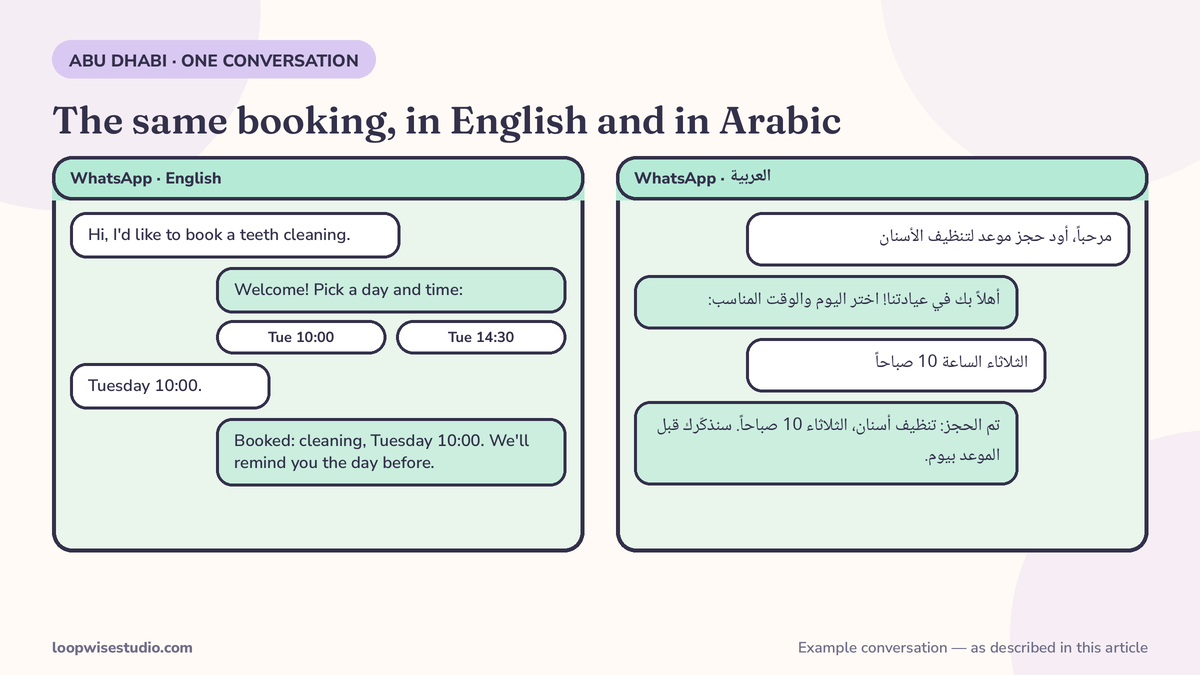
- The example below is what your patients would see. Labelled as an example, because it is one:
Patient: مرحباً، أود حجز موعد لتنظيف الأسنان. (Hello, I’d like to book a teeth cleaning appointment.) Clinic: أهلاً بك في عيادتنا. الدكتور [الاسم] متاح يوم [اليوم] الساعة [الوقت] أو [الوقت]. أيّهما يناسبك؟ (Welcome to our clinic. Dr [Name] is available on [day] at [time] or [time]. Which suits you?) Patient: الأول يناسبني. (The first one suits me.) Clinic: تم تأكيد موعدك: [اليوم، التاريخ] الساعة [الوقت] مع الدكتور [الاسم]. ستصلك رسالة تذكير قبل الموعد، ويمكنك تغييره من هذه المحادثة. (Your appointment is confirmed: [day, date] at [time] with Dr [Name]. You’ll receive a reminder before the appointment, and you can change it from this conversation.)
The dental journeys that actually matter
A general booking link treats every appointment the same. A dental clinic’s diary doesn’t work that way:
- First consultations (implants, Invisalign, cosmetic work): high-value, often researched for weeks. The win is a fast, complete answer and a slot offered in the same conversation — not a callback promise.
- Hygiene recalls: the most predictable revenue in the diary, and the easiest to automate. Due date in the system → message out → slot booked → reminder sent.
- Multi-visit treatment plans: a plan agreed in the chair unravels when visit two depends on the patient remembering to call. Booking the next visit before they leave, then reminding on WhatsApp, keeps the plan on schedule.
- Emergencies: pain doesn’t wait for opening hours. The system takes the details, offers the first emergency slot, and flags your team — the patient hears back in seconds, not at 9am.
What changes for your front desk
Automation doesn’t remove your reception team from booking; it removes the typing. Concretely:
- The phone stops being the diary’s gatekeeper. Enquiries that would have queued on hold arrive as WhatsApp threads the system has already moved forward.
- Reception works a shorter, warmer list. Instead of every message, staff see the flagged ones: the patient who asked something clinical, the booking that stalled, the emergency that needs a call.
- Nothing depends on one person’s phone. The shared inbox means any team member can pick up any conversation, with the full history in front of them — in whichever language the patient is using.
- Recalls stop being a project. Nobody sets aside a day to work a due list; the list works itself, message by message, as dates fall due.
How setup runs — the order matters
- Your number first. The system is registered on the clinic’s own WhatsApp number through the Business Platform, with your clinic name and profile. Patients message the number they already trust.
- Diary connection. Doctors, specialties, appointment lengths and working hours are mapped so the slots offered in chat are real — including which doctor does implants and which does hygiene.
- Templates approved in both languages. Booking, confirmation, reminder, reschedule and recall templates are written in Arabic and English and submitted for WhatsApp’s approval before anything goes live.
- Entry points connected. Website button, Google profile and in-clinic QR codes pointed at the number, so every path in leads to the same flow.
- Team testing, then live. Your staff run test bookings in both languages, try to break the diary logic, and only then does the system meet a real patient.
Compliance in Abu Dhabi — what WhatsApp should and shouldn’t carry
Abu Dhabi’s health information exchange is Malaffi, and the principle for any clinic system is simple: the clinical record lives in your practice system, connected where required — WhatsApp carries appointment logistics, not medical records.
In practice:
- On WhatsApp: booking, confirming, reminding, rescheduling, directions, preparation instructions for a visit.
- Not on WhatsApp: diagnoses, treatment records, clinical images, anything that belongs in the patient file.
- Consent and opt-out: service messages about a patient’s own appointment are part of care; anything promotional needs consent and a working opt-out.
Health Cluster’s dental guidance names Malaffi alongside Dubai’s NABIDH and the federal Riayati platform in exactly this context — integration and records stay with the clinical systems. A booking layer should respect that boundary by design, not by staff discipline.
If your clinic’s WhatsApp currently lives on a reception phone with no connection to the diary, get a free audit and we’ll map the booking flow for your clinic — in Arabic and English.
What it costs — the pricing models in the UAE
No vendor in this market publishes an Abu Dhabi dental price, so be wary of any article that quotes you one. What’s actually on offer, as of October 2026:
| Model | How it’s priced | What to watch |
|---|---|---|
| Enterprise platform (HIS/EMR-connected) | Custom quote, usually aimed at groups and hospitals | Dental is one module among many; timelines match IT projects, not clinic projects |
| AI receptionist per clinic | Quoted after a demo — Zavis, the closest UAE rival, publishes no pricing and quotes per clinic after a 20-minute walkthrough | Total cost stays unknown until you’re deep in a sales process |
| Owned system on your website + number | Fixed build quote, then message/hosting running costs | You own the number, the templates and the patient list — confirm that in writing |
The questions that expose any model: Is it my number or yours? Are Arabic templates included or an add-on? What does a reminder cost me per message? What happens to my patient list if I cancel?
Loopwise works on the third model — a fixed quote before work starts, which is what we’ll give you if you get a free audit.
FAQs
Do patients in Abu Dhabi really book dental appointments on WhatsApp?
Yes — they already do, manually. Clinics advertise “book by phone or WhatsApp” on their own websites today. The system doesn’t ask patients to learn anything new; it connects the chat they already send to the diary, reminders and recall list.
Does the system work in Arabic and English?
Yes. The patient picks a language first, and every message after that — booking, confirmation, reminder, recall — runs in that language from templates written in both. Your staff see one thread per patient.
Does it replace our practice management software?
No. Your PMS/EMR stays the clinical record and the diary of record. The booking system connects to it (or runs a live booking layer alongside it) and handles the patient conversation on WhatsApp.
How does this sit with Malaffi and UAE health data rules?
Clinical data stays in your clinical systems. WhatsApp carries appointment logistics only — no diagnoses, no records, no clinical images. That boundary is built into what the system is allowed to send.
What does it cost?
There is no honest published market price — enterprise platforms and AI receptionists in the UAE both quote privately. An owned system is quoted as a fixed build for your clinic once the scope (doctors, branches, languages, integrations) is known. Beware any page stating a standard AED figure for this; none exists publicly.
We have more than one branch. Can patients choose?
Yes. Location is one of the first choices in the flow, each branch keeps its own diary and slots, and reminders come from the same clinic number with the branch named in the message.
The same automation across the Saudi clinic market is covered in WhatsApp automation for clinics in Saudi Arabia.