Timely Alternative for Salons in Australia: The Real Costs Compared
Timely's current Australian pricing checked October 2026, the SMS and card fees on top, and when an Australian salon is better off with its own booking website.

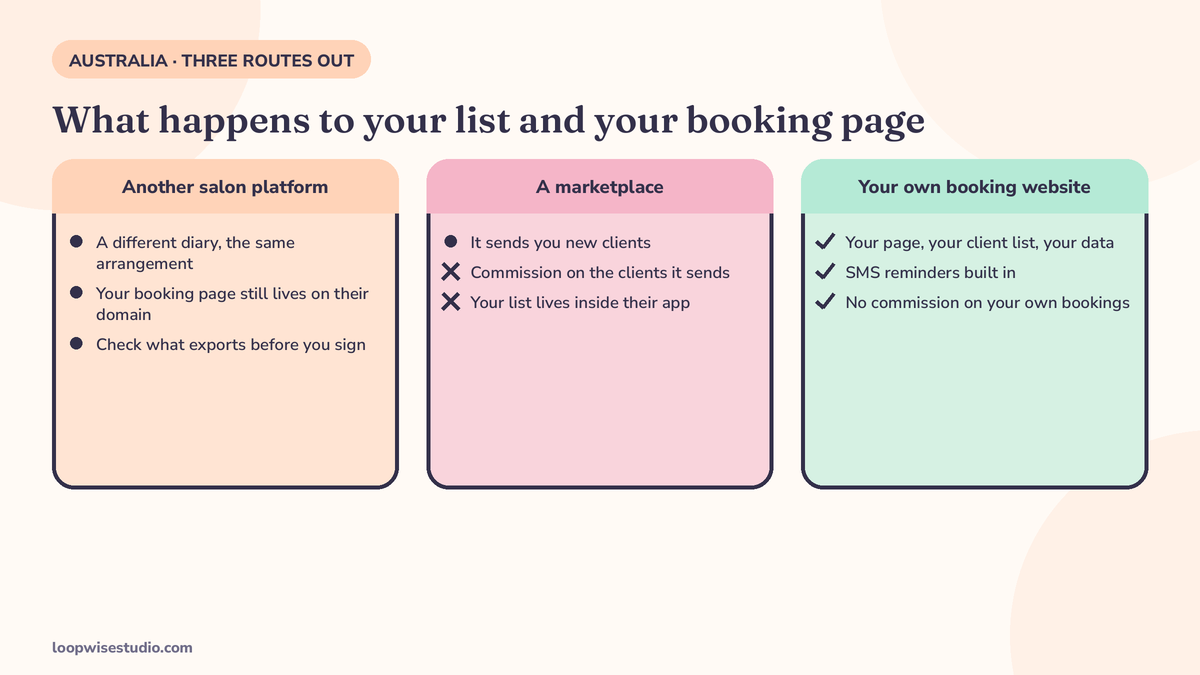
Short answer: a Timely alternative for an Australian salon is either another salon platform, a commission marketplace, or your own booking website with SMS reminders built in. Timely’s current Australian pricing, checked in October 2026, runs A$42 to A$79 per bookable staff member per month ex-GST depending on plan — before SMS overages and card fees. Which route wins depends on whether your problem is price, reminders, or owning your client list.
First, fairness. Timely is good software. It has run Australian and New Zealand salon diaries for years, its booking flow is polished, and plenty of salons leave it reluctantly. This page is not an argument that Timely is bad. It is a worksheet for the moment you start asking whether it is still the right shape for your salon — the same worksheet our pillar roundup of the best booking software for a small clinic or salon owner-operator applies to every platform on the list.
Why Australian salons start looking — the four triggers
Owners rarely switch software because of one bad week. The pattern in the comparison pages for this market is consistent:
- The per-staff bill crept up. Timely prices per bookable staff member, so every casual, every new senior, every rent-a-chair stylist adds a monthly line. The salon that was cheap at two staff is not cheap at six.
- The SMS allowance ran out mid-month. Reminders are the feature doing the no-show work, and they are metered — the plan includes a set number per staff member, then charges per message.
- The booking page isn’t yours. Your Google profile, your Instagram, your afterpay of attention — all of it points at a booking page on a platform’s terms, styled their way, inside their ecosystem.
- You want the follow-up layer, not just the diary. Rebooking nudges, lapsed-client recalls, review requests, a text-back when the phone is missed — the diary holds appointments; it doesn’t chase them.
If none of those four itch, stay. Switching costs you a weekend of pain minimum, and software you know beats software you’re learning. If two or more do, read on.
Timely’s Australian pricing — the current figures, and the mess around them
Here is where this page earns its keep, because Timely pricing online is a swamp.
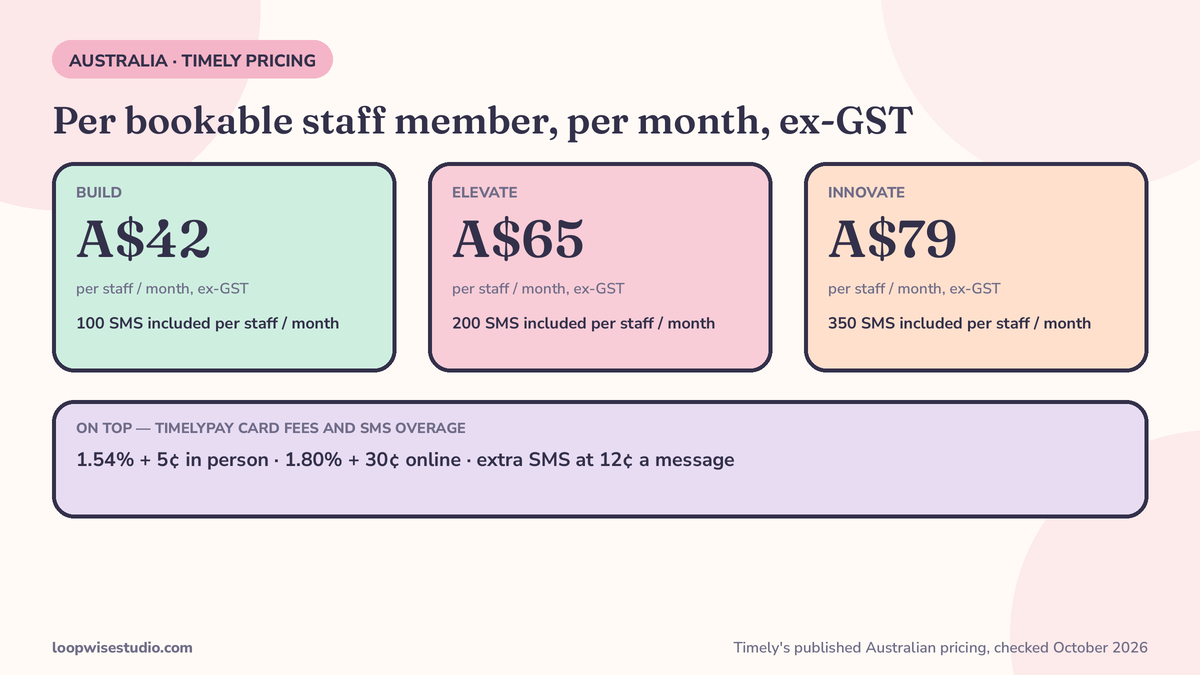
The current Australian figures — Timely’s published Australian plan pricing as checked in October 2026:
| Plan | Per bookable staff / month (ex-GST) | SMS included per staff / month |
|---|---|---|
| Build | A$42 | 100 |
| Elevate | A$65 | 200 |
| Innovate | A$79 | 350 |
On top of the plan: SMS beyond the allowance is charged at 12c per message, and card payments through TimelyPay run 1.54% + 5¢ in person and 1.80% + 30¢ online, as published. A priced comparison checked on 17 October 2026 put a three-staff salon at A$126, A$171 or A$209 a month across those plans — consistent with the per-staff rates above once plan inclusions are counted.
Now the conflicting reports, flagged rather than mixed in. You will find comparison pages — ZibaDesk’s head-to-head among them — still quoting roughly A$30 / A$53 / A$91 for Timely plans. Those are older Australian figures; the plans have been repriced since. You will also find US-written roundups (Xolapp, GetApp and Pabau repeat them) quoting US$26 / $39 / $47. Those are United States prices. Neither set is the price an Australian salon pays today, and any comparison built on them — including several ranking for this exact query — is comparing you against a ghost. Before you rely on any figure on this page, check Timely’s current pricing page; vendors reprice, and October 2026 is the date on ours.
The total-cost worksheet — run your own salon through it
The plan fee is the visible cost. The real comparison needs three more lines. Copy this worksheet and fill it with your numbers:
| Cost line | Your salon |
|---|---|
| Staff who need a bookable column × plan price | ___ staff × A$___ = A$___/mo |
| Reminder + confirmation SMS per month vs plan allowance | ___ sent, ___ included, overage ___ × 12c = A$___/mo |
| Card fees on bookings paid online/in salon | A$___ volume × ~1.5–1.8% = A$___/mo |
| Your time on setup, workarounds, duplicate tools (email tool, review tool, form tool) | ___ hrs/mo |
| True monthly total | A$___ |
Worked example, assumptions stated. A four-staff salon on Elevate: 4 × A$65 = A$260/month ex-GST. It sends about 900 reminder and confirmation texts a month (four staff, five days, roughly eleven appointments a day, two texts each); the plan includes 4 × 200 = 800, so 100 texts spill into overage at 12c = A$12. Salon takes A$6,000/month of card payments through the platform at a blended ~1.65% ≈ A$99. True total ≈ A$371/month before anyone’s time. That is the number to compare alternatives against — not A$65, and not the A$42 headline either.
Two lessons hide in that arithmetic. The per-staff model punishes growth in casuals and chair-renters, whose columns are bookable only some days. And the SMS meter punishes doing reminders properly — the exact behaviour that protects your diary is the behaviour that bills you.
The three routes out — and what each one actually changes
| Route | What changes | What doesn’t |
|---|---|---|
| Another salon platform (the lateral switch) | Price structure, interface, feature mix | You’re still renting the diary, the booking page, and the client relationship from a platform |
| A marketplace (Fresha-style) | No subscription; clients may discover you | Commission on new clients, your regulars booking inside someone else’s app, the least ownership of all |
| Your own booking website + reminder layer (Loopwise route) | The booking page lives on your domain; SMS reminders, rebooking and recalls run on your number; the client list is your asset | You still need a diary discipline — software doesn’t fix a salon that won’t set its own cancellation policy |
The lateral switch is the right answer more often than vendors admit: if Timely’s features fit and only the tier annoys you, a rival platform with flat or per-location pricing can cut the bill without changing how your clients book. Our Australian salons usually arrive asking about this route and leave asking about the third — because their actual complaint, once priced, is the SMS meter and the follow-up layer, not the diary. If the diary itself is the issue, the online booking website with text reminders for Australian salons page specifies that system directly.
The SMS registration wrinkle every Australian alternative must handle
Australia changed the SMS rules, and any reminder system you move to has to be set up inside them. Since 1 July 2026, businesses sending SMS with a branded sender ID in Australia need that sender ID registered under ACMA’s SMS Sender ID Register; unregistered IDs are replaced with the word “Unverified” and grouped into a thread flagged as a possible scam. Our research for the text message reminders for Australian dental clinics page verified this directly against ACMA’s own register guide — note the precise wording: messages are labelled and grouped, not blocked outright.
Why it matters for a Timely switch: your reminder texts are only useful if clients trust them. A reminder arriving under “Unverified,” bundled into a scam-flagged thread, does the opposite of its job. Whatever you move to — platform or own website — confirm the sender-ID registration is handled, in writing, before your first reminder goes out. It is a two-line question that most comparison pages never ask.
The chair-renter problem — where per-staff pricing hurts most
One salon shape deserves its own section, because it is where the worksheet turns fastest: the salon with rent-a-chair stylists or a casual-heavy roster.
Timely’s model charges per bookable staff member. A chair-renter who works Thursdays and Saturdays still needs a bookable column — and under a per-staff plan, that column is a full monthly line, whether it holds four appointments a week or forty. The same applies to the casual colourist you roster only for wedding season, and the apprentice whose column you open for blow-dry bookings in December. Each one is priced like a full-time senior.
Before switching, count your columns the way your roster actually works:
- Full-time staff with full books — per-staff pricing is defensible here; the column earns.
- Part-timers under three days a week — the column still costs a full line.
- Chair-renters — you may be paying a platform fee to host a business that is, legally and commercially, not yours.
- Seasonal or trial columns — priced the same as your busiest senior.
If more than a third of your bookable columns are part-time, casual or rented, a flat or per-location price structure — or your own booking site, where a column costs nothing extra — will usually beat the per-staff model on the worksheet alone. This one structural check settles more Timely comparisons than any feature list.
Five questions to ask any alternative before you sign
Software demos are choreographed. These questions are not, and the answers separate platforms from brochures:
- “Show me the reminder sequence as the client receives it.” Not the settings screen — the actual texts, in order, with timings. Then ask what a client reply does.
- “What is my all-in monthly cost at my real volumes?” Your staff count, your text count, your card volume — their numbers, in writing, including overages.
- “Who registers my SMS sender ID, and when?” In Australia this is an ACMA compliance question (covered in the next-but-one section), and “we’ll sort it out later” is the wrong answer.
- “What exactly do I export if I leave, and can I test an export today?” A vendor confident in their product lets you rehearse leaving it.
- “What happens to my booking page URL?” If your Google profile and Instagram point at an address the vendor owns, leaving costs you your front door. On your own domain, it doesn’t.
Ask Timely the same five questions about staying. Sometimes the answers are why you stay — and knowing that is worth as much as a switch.
If you switch: the migration checklist
Software switches fail in the boring places. Copy this list:
- Export your client list — names, numbers, emails, notes, outstanding packages and gift cards — before you cancel anything, and keep the export file.
- Screenshot your next 8 weeks of appointments. Exports miss things; the diary as it stands is your ground truth.
- Move future appointments first, then open the new booking page, then close the old one. Never run a gap day.
- Tell clients once, on SMS, with the new link — and pin the link on Google and Instagram the same day.
- Register your SMS sender ID (see above) before the first reminder from the new system.
- Run both systems for one full week, old diary read-only, before you let the old subscription lapse. Chair-renters and casual columns are where double-bookings breed.
- Check gift cards and packages are honoured to the dollar in the new system. This is the item that generates complaints six months later.
Timely does not lock your data in a vault — but no vendor migrates for you at the level of care your regulars expect. The checklist above is the difference between a switch clients barely notice and a switch they gossip about.
Thinking of making the move before a busy season rather than during it? Get a free audit and we’ll price your current setup — plan, SMS, card fees — against the alternatives, using your real numbers.
The honest verdict by salon size
One or two staff, reminders inside your allowance: Timely is fairly priced for you. The A$42 Build tier with 100 texts per staff is a reasonable deal, and switching costs more in pain than it saves. Spend the effort on your Google profile instead.
Three to six staff, reminders spilling into overage, chair-renters complicating the columns: this is where the worksheet turns against the per-staff model. Price the lateral switch and the own-website route side by side; this salon size is where the own-website maths most often wins, because the reminder layer stops being metered per text.
Multi-location or package-heavy: your problem is no longer the diary fee, it’s the absence of a follow-up system — recalls, package expiry, review requests. Platforms sell you modules for each. An owned system builds them in once. Compare total cost of the stack, not the diary.
New Zealand salons run the same evaluation with an extra twist — nobody publishes Timely’s NZ plan prices at all. Our companion page on a Timely alternative for New Zealand salons covers that situation directly.
When to make the switch — timing matters more than the tool
Whenever you land, land in a quiet month. Migrate mid-January, not mid-November: your team learns the new diary on forgiving days, the double-running week doesn’t collide with the Christmas book, and any client confusion surfaces when you have time to fix it. Announce the new booking link once, by text, the week you open it — and time your old subscription’s end to just after the overlap week closes, not before. Salons that switch in peak season don’t have a software problem; they have a calendar problem wearing a software costume.
The short version
Timely’s real Australian price is A$42–79 per bookable staff per month ex-GST, plus metered SMS and card fees — and half the comparison pages online are quoting old or American numbers. Run the worksheet with your own figures. If the total still makes sense, stay. If the meter and the missing follow-up layer are the problem, that’s the own-website route’s home ground.
Get a free audit — bring your last Timely invoice and we’ll do the worksheet with you, line by line.
FAQs
How much does Timely actually cost an Australian salon in 2026?
Per Timely’s published Australian pricing checked in October 2026: Build A$42, Elevate A$65, Innovate A$79 per bookable staff member per month, ex-GST. SMS allowances are 100, 200 and 350 messages per staff member per month by plan, with extra messages at 12c each. TimelyPay card fees are published at 1.54% + 5¢ in person and 1.80% + 30¢ online. Older pages quoting around A$30/$53/$91 are out of date, and US$26/$39/$47 figures are US pricing — neither applies to an Australian salon.
What is the closest like-for-like Timely alternative in Australia?
Other salon platforms will sell you a diary with online booking and SMS reminders at a different price structure — flat, per-location, or per-staff. The genuine alternative in kind, not just in vendor, is a booking website on your own domain with the reminder layer built in: same diary functions for your clients, but the booking page, the number the texts come from, and the client list belong to the salon.
Can I move my Timely client list and future appointments to a new system?
Your client data is exportable, and any competent migration moves future appointments across. The items to verify by hand are packages, gift cards, and chair-renter arrangements, which exports handle unevenly. Use the checklist in this article, run old and new side by side for a week, and keep your export file after the switch.
Why do my reminder texts matter to ACMA?
Since 1 July 2026, branded SMS sender IDs in Australia must be registered under ACMA’s SMS Sender ID Register. Unregistered IDs are replaced with “Unverified” and grouped into a thread flagged as a possible scam — which destroys the trust a reminder depends on. Any system you switch to must handle registration; confirm it before your first reminder sends.
Is it worth switching just to save on SMS overages?
Alone, usually not — 100 extra texts cost A$12. The overage matters as a symptom: it means your reminder volume has outgrown the plan tier, and the tier jump (A$23 per staff per month from Build to Elevate) is the real cost. Price the whole worksheet, not the line item.
What do I lose by leaving Timely?
A diary your team knows, Timely’s consumer-facing presence, and whatever reporting history you didn’t export. You do not lose your clients — they were never Timely’s — but you must move them deliberately: exported list, new booking link sent by SMS, Google and Instagram updated the same day. Salons lose clients in switches through silence, not through software.