SMS Reminders vs Phone Calls for Reducing Dental No-Shows
SMS reminders vs phone calls for reducing dental no shows: the study data both ways, what reminder calls cost in staff time, and the exact order that wins.
The short answer to SMS reminders vs phone calls for reducing dental no shows: use texts first, for everyone, and save phone calls for the patients and appointments where a call genuinely wins. The best dental study on the question found lower no-show rates for texted patients than for phoned ones — but a second study found something that complicates the story in a useful way: a personal call from a staff member, when it actually reaches the patient, beats every automated message. Both are true, and the system that respects both facts is the one that works: SMS beats a call attempt; a completed personal call beats a text.
This page puts the actual numbers side by side, shows what reminder calls cost a small practice in staff time, and ends with the practical rule set for which patients still get a call.
The head-to-head numbers
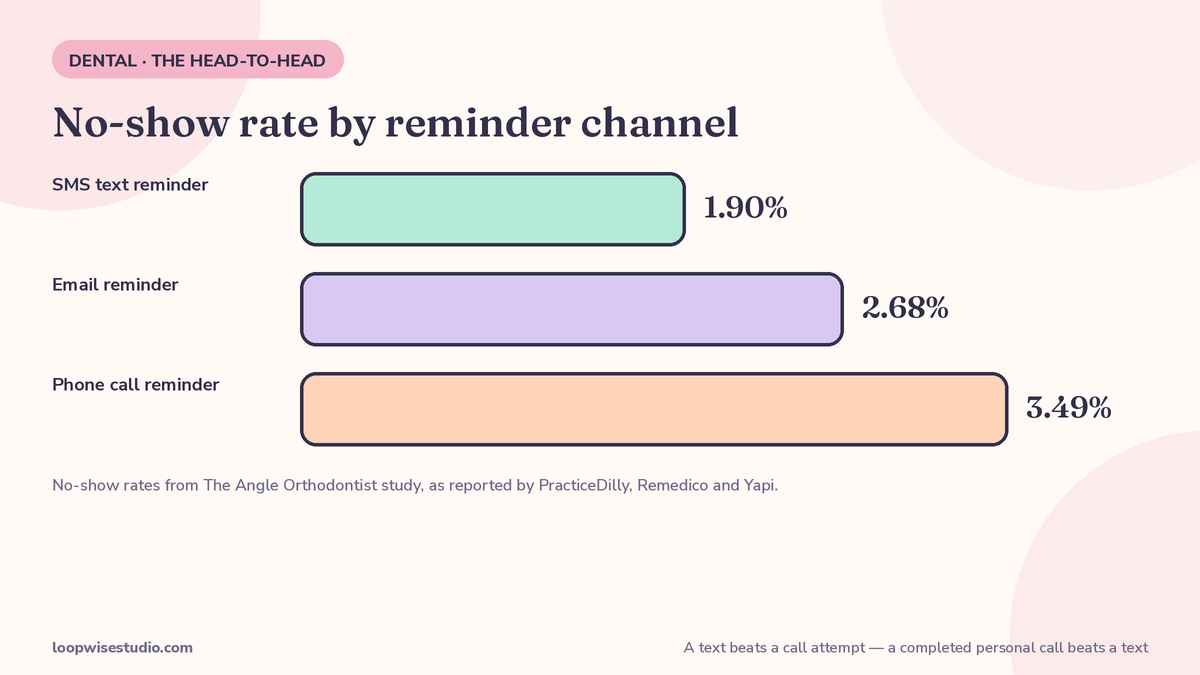
Start with the study most often quoted on this question. Research published in The Angle Orthodontist, reported by PracticeDilly, Remedico, and Yapi, compared no-show rates by reminder channel for dental patients:
| Reminder channel | No-show rate (The Angle Orthodontist, as reported) |
|---|---|
| SMS text reminder | 1.90% |
| Email reminder | 2.68% |
| Phone call reminder | 3.49% |
| No reminder at all | Attendance worsened — Yapi, reporting the same journal, notes no-show rates fell 10.3% versus the previous no-reminder period once reminders were used |
Read those numbers carefully, because they are usually quoted too proudly by texting vendors. They do not say phone calls are useless — 3.49% is a strong result in absolute terms. They say that, across a whole patient list, the text edges the call. The reasons become clear further down this page: a text is delivered whether or not anyone is free to receive it.
The surrounding evidence points the same direction on reminders generally. A meta-analysis published in BMJ Open, reported by ProSites, found patients who received text-based notifications (text and/or email) were 25% less likely to forget or not show, and that multiple notifications worked significantly better than one. And patients’ own stated preference lines up with the data: in a Hanover Research study reported by ProSites, 80% of patients said they preferred text or email reminders over calls, and a DentistryIQ national survey reported by ProSites found 55% preferred text reminders over email.
There is one more text effect worth isolating, because it changes how slots get refilled. Yapi reports a study in which only 14% of patients receiving SMS reminders cancelled or broke their appointment, compared with 31% of patients who received no reminder at all. Note the comparison — that figure is against no reminder, not against calls, and we are not going to pretend otherwise. But its lesson transfers: a texted patient who cannot come tells you, in writing, ahead of time. Remedico, citing Inshalytics, reports the mirror image of the same effect — patients who confirm their appointment are 78% more likely to attend than those who never respond. A reminder that invites a reply sorts your day into confirmed, moved, and silent, while there is still time to act on all three.
The study that disagrees — and why both studies are right
Now the counterpoint, which most texting vendors leave out of their comparisons entirely.
ProSites reports an older study from The American Journal of Medicine — Parikh et al., 2010, covering 9,835 patients (sample size as reported by Clinekt): the no-show rate was 23.1% with no reminder, dropped to 17.3% with an automated reminder, and fell further, to 13.6%, when a member of staff called the patient personally.
A personal call beat the automated message. Decisively. So which study do you believe?
Both — because they are measuring different things, and the difference is the whole answer to this keyword.
The Angle Orthodontist figures measure a reminder attempt across a population. Most call attempts do not become conversations. They are made during working hours, to people who are at work. They arrive from a number the patient does not recognize, on a phone set to silence unknown callers. They end in voicemail, which the patient may hear that evening, next week, or never. Counted across every patient on the list, the call’s average performance is dragged down by every attempt that never landed.
Parikh measures something closer to a completed contact. When a staff member actually speaks to the patient — answers the question about parking, hears the hesitation, moves the appointment on the spot — that conversation is the strongest reminder there is. Nothing in a text thread matches a good human conversation. It is just that you cannot have 25 of them a day, reliably, with a front desk that also has a waiting room in front of it.
So the honest verdict is not “texts win.” It is this: a text beats a call attempt, because it almost always lands. A completed personal call beats a text, because it almost always persuades. The winning system uses the channel that always lands as the default, and spends scarce human calling time only where persuasion is actually needed.
Why calls underperform in practice
None of this is the front desk’s fault. Reminder calls fail for structural reasons:
Timing. Reminder calls get made when the desk has a gap — mid-morning, early afternoon. That is when patients are at work, in meetings, driving, or in class: the exact hours a personal phone stays in a pocket. A text sent at 10am is read at lunch; a call at 10am is a missed call by 10:01.
Recognition. Patients answer numbers they know. A call from the office line, mid-day, competes with every spam call they have trained themselves to ignore. Even a saved contact only helps if the phone is in their hand.
One shot, no record. A call is synchronous or it is nothing. If it fails, the attempt leaves no trace the patient can act on later. A text is a written object: it sits on the lock screen, it carries the date and time, and it can carry a reply option and a booking link. The patient who sees it at 9pm can confirm or reschedule at 9pm — a call answered at 9pm is a call your office is not making.
Cadence is not repeatable. Sound reminder practice, as reported in Remedico’s review of its sources, is a sequence — roughly 72 hours before, 24 hours before, and a short note 2–4 hours before the visit. Three texts per appointment is a system. Three phone calls per appointment is a full-time job, and the second call is where goodwill starts leaking: patients who have been called twice about a cleaning stop hearing reminders and start hearing chasing.
If your practice is currently calling everyone, you do not have to guess how the split would look for your list: get a free audit and we will map your patients against the rule set in this article — who stays on calls, who moves to the text sequence — before you change anything.
What reminder calls actually cost in staff time
Vendors quote striking figures for the staff time reminder calls consume; the ones we found were not sourced well enough to repeat as fact. So here is the arithmetic instead, with every assumption stated, so you can redo it with your own numbers.
Assume a small practice confirming 20 appointments a day by phone:
| Step | Assumption | Time |
|---|---|---|
| Dial, ring, reach the patient or their voicemail, leave or finish the conversation, note the outcome | 3 minutes average per patient (quick for a voicemail, longer for a chat) | 20 patients × 3 min = 60 minutes |
| Second attempts for patients not reached (about half, in most offices’ experience) | 10 patients × 3 minutes | +30 minutes |
| Total front-desk time on reminder calls | ~90 minutes a day |
Ninety minutes a day is roughly 7.5 hours a week of your most interruptible person’s time — spent on the channel with the lower population-level result in the Angle Orthodontist data. The same 20 patients on an automated text sequence cost the desk minutes, and only for the replies that need a human. Calls are not free because the phone bill is small. They are the most expensive reminder channel you own, paid in the currency a small practice has least of.
Where does that leave the call? Exactly where Parikh says it belongs: reserved for the small number of patients where a completed conversation changes the outcome.
The system that uses both: text first, call where it wins
Here is the working rule set we set up for dental practices, built directly from the two studies above:
Everyone gets the text sequence. Confirmation at booking, then the reminder cadence — about 72 hours out, 24 hours out, and a short message a few hours before (the timings Remedico’s sources report) — each with a reply to confirm or reschedule. That sequence is the default, including for patients who will later get a call as well. The full build of that sequence, message by message, is in our guide to text message appointment reminders for small dental clinics.
A patient gets a call as well when one of these is true:
- They did not reply. Silence after two texts is the highest-value call list in your practice — a short list, every name on it a real risk, and every call a Parikh-style completed contact rather than a hopeful attempt.
- It is a new patient. First visits carry the highest uncertainty on both sides. A short human call settles questions a text thread handles badly and starts the relationship properly.
- The appointment is long or high-value. A two-hour treatment block sitting empty costs more than ten cleanings’ worth of reminder effort. Call, confirm, and take any deposit your policy requires, in person.
- They have no-showed before. Repeat no-show history is one of the strongest predictors of the next one — those patients get the personal channel early, not after the fact.
- They have told you they prefer calls. Some do, including many older patients. Preference recorded once beats a channel argument held every six months. Ask, note it, honor it.
Nobody gets called three times. If the call also fails, the slot gets a final text with a reschedule link, and the waitlist logic takes over. Persistence past that point spends goodwill you will want for the recall.
This division of labor is also what makes the front door work as one system: the patient who ignores a reminder and lets the appointment lapse is often the same patient who calls the office later and does not get through — which is why reminders pair with missed call text back service for dental practices rather than replacing it. And the reminder-plus-waitlist half of this system, with deposits and booking-gap rules alongside it, is laid out in full in our guide to how to reduce no shows at a med spa — the mechanics transfer to a dental diary unchanged.
Frequently asked questions
Are automated appointment texts legal for a dental practice?
Yes, with the basics done once: patients agree to reminders when they book (consent recorded on the intake form or booking page), every message names your clinic, STOP is honored instantly and permanently, and your number is registered for automated texting with the carriers (the A2P 10DLC process in the US) so messages are not filtered. Keep clinical detail out of texts — appointment logistics only.
What about older patients who do not text?
They get calls. This comparison is about the default channel for the list as a whole, not a rule forced on every patient. Record the preference at intake — text, call, email — and each patient is reminded the way they asked. In most practices the call list ends up short enough that those calls get done properly, which is when calls work best anyway.
How many texts before it starts to annoy people?
For one appointment, a confirmation plus two to three reminders across the final three days is the normal working range, and it matches the 72/24/2–4 hour cadence reported in the literature roundups. Annoyance comes from repetition without new information — each message should either be closer to the visit or ask for something the last one did not.
Our office calls every patient and it works. Should we stop?
If your no-show rate is already low and your desk genuinely completes those calls, you are living in the Parikh result — a completed personal call is the strongest reminder there is. The question to ask is what it costs you: run your own version of the staff-time arithmetic above. Most practices that do the math keep the calls for new patients, long appointments, and non-responders, and let texts carry the routine hygiene list.
Does WhatsApp change the answer outside the US?
The studies above are US-and-dental, where SMS is the default channel patients already read. In markets where patients live on WhatsApp — the UK, the UAE, much of Australia — the same logic applies on that channel instead: an automatic message that always lands, plus a personal call held back for the exceptions. The principle is channel-independent; the app is whatever your patients actually open. For the Australian dental specifics, including ACMA’s sender-ID registration, see our guide to text reminders for Australian dental clinics.
What single change should we make first?
Turn on reply-to-confirm texting for your hygiene list, at 72 and 24 hours, and start a non-responder call list from the replies. That one loop — text everyone, call the silent — captures most of both studies’ benefits within a week, before you change anything else.
If you would rather have the loop built than build it: get a free audit. We look at how your practice reminds patients today, tell you which patients should stay on calls, and give you one fixed price to set up the text-first, call-for-exceptions system on the software you already use.