Online Booking Website for House Cleaning Services, With Text Reminders
A booking website built for a cleaning service: instant quote by beds and baths, recurring plans that hold their cadence, and a text reminder sequence that confirms access.
A booking website for a house cleaning service lets a client price their clean in under a minute — beds, baths, extras, frequency discount — pick a real slot, and save a card, then runs a text reminder sequence whose real job is confirming access: the key, the alarm, the gate code, confirmed the day before your crew drives out. Recurring plans hold their cadence through skips and pauses instead of quietly dying.
Search this query and you will notice something odd: every result sells software. Zenbooker, Service Puffin, SimplyBook.me, ScheduleDrop — all tools a cleaning owner is expected to choose, learn, and build on herself, in the evenings, between cleans. Not one result offers to build the website. And on every one of those pages, “text reminders” is a bullet point. No timings. No copy. No sequence.
This article is the page that was missing: what the booking website itself should contain, the full reminder sequence with the actual words, and an honest build-it-yourself versus done-for-you comparison at the end.
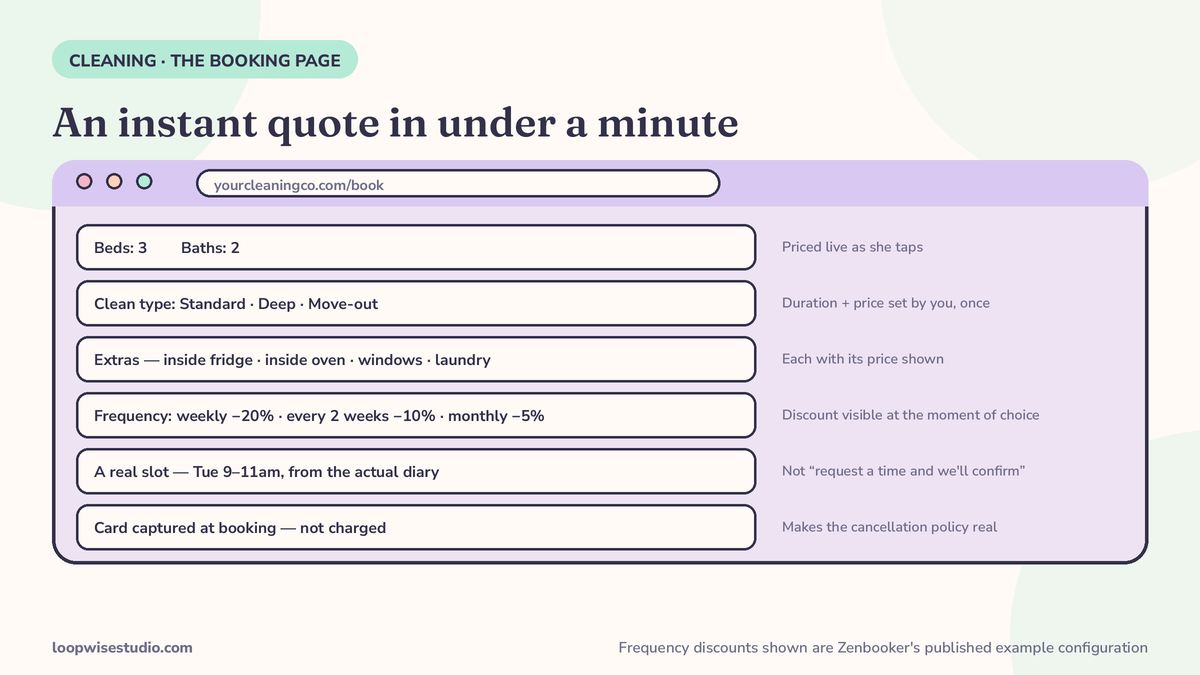
The booking page: an instant quote in under a minute
A cleaning booking page is not a contact form with a calendar bolted on. The client is pricing a visit to her home, and she will abandon any page that makes her wait for a human to quote her. The flow that converts:
- Beds and baths (and square footage if you price by it). Two selectors, priced live — the number updates as she taps.
- Clean type: standard, deep, move-in/move-out. Different durations, different prices, set by you once.
- Extras, each with its price shown: inside fridge, inside oven, interior windows, laundry, dishes. Zenbooker’s booking flow makes the point well — extras at checkout are how one-off items stop being unpaid favours.
- Frequency, with the discount visible: Zenbooker displays its frequency discounts directly in the booking flow — weekly 20% off, biweekly 10% off, monthly 5% off in its example configuration. Whether your numbers match those or not, showing the discount at the moment of choice is what turns a one-off deep clean into a standing biweekly.
- A real slot, from your actual diary — not “request a time and we’ll confirm.”
- Card captured at booking. Not charged — captured. It is what makes your cancellation policy real, and clients read it as professionalism, not suspicion.
Under a minute, start to confirmed. Every step that says “we’ll be in touch” instead loses the client who found you at 11pm — which is when a large share of cleaning bookings are made, by people finally sitting down.
Recurring cleans are the business — the website has to protect them
A cleaning company does not grow on one-off cleans; it grows on a diary of standing visits that repeat without being re-sold. So the booking system has to handle the ways recurring plans actually wobble:
- Every cadence, not just the tidy ones. Weekly and biweekly, obviously — but also every three weeks, which a meaningful slice of clients prefer and many tools handle badly, silently shifting the day until the pattern breaks.
- Skip and pause without losing the client. A client who can pause for a holiday in two taps stays a client. A client who has to phone and explain herself cancels, meaning to rebook, and mostly does not.
- The same cleaner, where you offer it. “Always Maria” is a promise clients pay for. The booking page and the reminders should both carry the cleaner’s name — it is the detail that makes the visit feel like a relationship rather than a transaction.
SimplyBook.me’s Book Soon feature points at the same truth from the other end: a prompt days after a clean, nudging the client to book the next one. The drift it fights is the subject of the lapsed-regulars section below — the website’s job is to make drifting unnecessary in the first place.
The full text reminder sequence, with the words
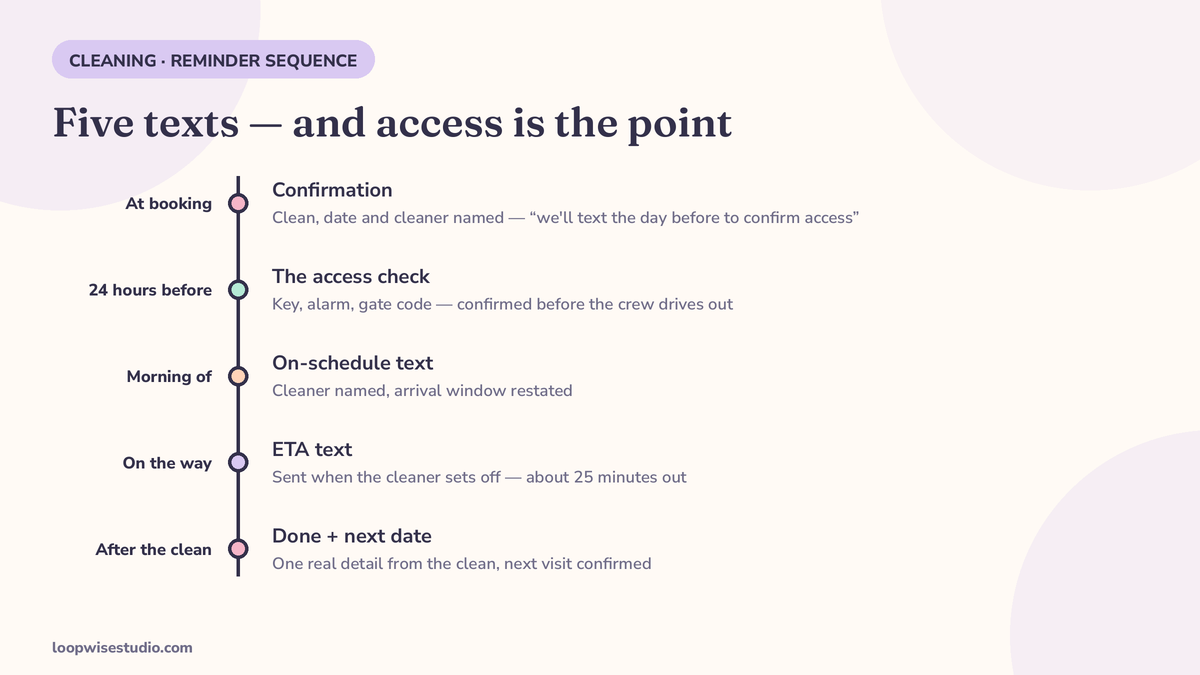
Here is the sequence no software page publishes. Timings assume a standing clean; adjust the slots, keep the order.
1. Confirmation — instantly, at booking:
Booked! Your clean with [Company] is [Tuesday 14th, 9–11am] with [Cleaner name]. We’ll text the day before to confirm access. Manage or reschedule any time here: [link]
2. The access check — 24 hours before. The most important message in this article:
Tomorrow’s clean is on, [Name] — quick access check so we’re not locked out: is the key still [under the mat / with the concierge / lockbox code 4821]? Alarm off or code ready? And is [dog’s name] in or out? Reply with anything that’s changed.
3. Morning-of:
Morning! [Cleaner name] is on schedule for [9–11am] today. We’ll text when we’re on our way.
4. On my way — when the cleaner sets off:
On my way — ETA about [25] minutes. See you soon. (Zenbooker builds this in as an en-route text when the cleaner marks themselves on the way; it is the message clients mention in reviews.)
5. After the clean — same afternoon:
All done — house is clean and locked up. [One real detail: “the fridge is done too” / “we worked around the sleeping baby”.] Your next clean is [date] — reply CHANGE if you need a different day.
Copy the set. Notice what is absent: no message exists merely to say “reminder.” Each one either confirms something, asks something, or tells the client something true.
The reminder’s real job: access, not attendance
Here is the cleaning-specific insight the whole SERP misses. In a salon, a no-show means an empty chair — the client failed to attend. In cleaning, the client does not attend anything. Your crew attends. The failure is different: the crew drives forty minutes, and the key is not where it was, the alarm is armed, the gate code changed, nobody is home.
That wasted trip costs you crew wages, fuel, and the slot another client would have paid for — and it is almost never malice. The client simply forgot the clean was that day, or forgot the cleaner needed the side gate unlatched.
So the reminder sequence in cleaning is not really about reminding. It is an access-confirmation system wearing a reminder’s clothes. The 24-hour message earns its place by asking three questions — key, alarm, pets — and the morning-of message exists so a client who realises the house is a disaster zone or the baby is ill can reschedule in two taps instead of leaving your crew at a locked door. Frame your sequence that way when you build it, and judge every message by one test: does this prevent a wasted trip or a locked-out crew?
Owners sometimes worry the access check feels like nagging. It reads the opposite way to clients — as the company that has its act together, asking once, the day before, instead of phoning from the driveway.
Two-way, or it does not count
A reminder the client cannot answer is half a system. Service Puffin — the most honest vendor in this space, a solo-built product whose founder cleans houses — states plainly on its own page that its texts are send-only: a client who replies is bounced to the owner’s personal phone. Puffin’s pricing is fair (Solo $59/mo, Crews $99/mo, Full crew $239/mo as published, reminders never billed per message), but the send-only ceiling is the gap.
ScheduleDrop, a cleaning CRM, sets the standard worth copying: two-way texting from the business number, in a shared inbox the owner and crew can both see, reminders to cleaners as well as clients. That is the bar. When a client replies “running late — key is under the blue pot, dog is friendly,” that answer has to land somewhere your crew can see it before they set off, not in a void.
If you are comparing tools or a done-for-you build, make this your first question: show me what happens when a client replies to the reminder. Everything else is features.
The reply thread also quietly becomes your business’s front door for everything else. The client who texted about the key answers your rebook message in the same thread six weeks later. The client whose clean moved for a holiday rebooks her deep clean from the same conversation. This is the same reason trades businesses are moving their missed calls into text threads — the pattern behind missed call text back for plumbers works here too: one thread, on your business number, that the customer already trusts.
If your current setup is a booking form plus a personal phone number held together by memory, you can get a free audit and we will map the gaps — quote flow, cadences, reminder sequence, the lot — before anyone talks about rebuilding it.
The trust sections a cleaning website needs
Software pages skip this entirely, because they are not websites. But your website has a job no booking form can do: persuade a stranger to hand you her house keys and alarm code. The sections that carry that weight:
- Insured and bonded, stated plainly, with the cleaner-vetting process in two honest sentences (background checks, training, who supervises).
- Key and code security: how keys are labelled (never with an address), where codes live, who can see them.
- The same-cleaner promise, if you make it — and what happens when she is ill (a named substitute, agreed in advance, or a reschedule at the client’s choice).
- Reviews where the visitor decides — on the booking page, not buried. This is where a steady review habit pays off; the same discipline covered in our guide to automatic Google review requests for plumbing companies applies to cleaning, word for word: ask everyone, by text, after the job, never gate who gets asked.
- Real pricing posture. You do not have to publish a rate card, but the instant quote must feel like the answer, not a teaser for a sales call.
A cleaning website that converts is a trust document with a booking engine attached — the reverse of how the software pages see it.
Bring back lapsed regulars
The quiet leak in every cleaning diary: the biweekly client who skipped for a holiday, skipped again for a sick kid, and by the third skip has drifted — not unhappy, just out of rhythm, slightly embarrassed, assuming she has lost her slot. Nobody on this SERP writes about her. She is cheaper to recover than any new client you will ever buy, because she already trusts you with her keys.
The rebook text — fires after two consecutive skips, or 6 weeks without a clean:
Hi [Name], it’s [Company] — we miss the house (and [dog’s name]). Your usual [Tuesday] slot is getting interest from the waitlist, but we’d rather hold it for you. Want us to restart on [date]? Reply YES and it’s back on, same as before.
Two things do the work: the slot is hers and it is at risk — both true in any business with a waitlist — and restarting takes one word. Send it once. If she says no or nothing, let her go gracefully; the relationship is worth more than a third text.
If diary gaps are a broader problem in your week, the mechanics in how salons fill cancelled appointments automatically translate directly — a waitlist text the moment a slot frees is the same system, whether the slot is a chair or a Tuesday morning clean.
Build it yourself with software vs done-for-you
An honest comparison, using published prices — check each vendor’s page before buying, as prices move:
| DIY booking software | Done-for-you booking website | |
|---|---|---|
| What you get | A booking tool on a page or subdomain | Your own website: quote flow, recurring engine, reminders, trust pages |
| Published cost signals | Agiled’s April 2026 roundup of cleaning scheduling tools lists platforms from $19–65/mo for the common options (ZenMaid $19 + per-seat fees, Jobber $39, Housecall Pro $59, Launch27 $65 annual plan, as that roundup reports); Service Puffin publishes $59–239/mo flat | Project price plus a smaller monthly; depends on pages and integrations |
| Your time | You choose it, configure cadences, write (or skip writing) the reminders, keep it updated | A few review calls; the build, the copy, and the sequence are done for you |
| Text reminders | Included, but the sequence and wording are on you; check whether replies are two-way | The full sequence written and set up, two-way from your number |
| Who it suits | Owners who enjoy systems and have the evenings to build them | Owners whose evenings are the business’s only admin department |
Neither route is a trick. Plenty of cleaning companies run well on a $59/mo tool they configured carefully. The question is whether the configuring is the best use of the only hours you have — and whether a tool page on a subdomain can do the trust work your own website does. If you would like the second route priced honestly, with your cadences and your access questions in it, get a free audit and we will look at your current booking flow before quoting anything.
The short version
A cleaning booking website earns its money three ways: an instant quote that turns 11pm visitors into booked cleans, recurring plans that survive skips and holidays, and a reminder sequence that confirms access — key, alarm, pets — before your crew leaves the yard. Build that, yourself or done-for-you, and the wasted trips and silent diary gaps mostly stop.
FAQs
What should a cleaning booking page ask for?
Beds and baths (or square footage), clean type, priced extras, frequency with the discount visible, a real time slot, and a card captured at booking. That is enough to price and confirm a clean in under a minute. Access details — key, alarm, gate code, pets — belong to the 24-hour reminder, not the booking form.
What text reminders should a cleaning service send?
Five: an instant confirmation, a 24-hour access check (key, alarm code, pets), a morning-of message, an on-my-way ETA, and a short after-clean message that confirms the next visit. The access check is the one that pays — it prevents the locked-out crew and the wasted trip.
Should reminders be two-way?
Yes. Clients reply to reminders with exactly the information your crew needs — “key’s under the blue pot,” “running late,” “skip the basement today.” Send-only systems (Service Puffin states honestly that its texts are send-only) push those replies to the owner’s personal phone or lose them. A shared two-way inbox on the business number is the standard to insist on.
How do I stop recurring clients drifting away after skips?
Make skipping easy and pausing easier — a client who can pause in two taps stays on your books. Then run one rebook text after two consecutive skips or about six weeks: their slot, their cleaner’s name, a restart date, one-word reply. One message, sent once, recovers more regulars than any discount blast.
What does cleaning booking software cost?
As a market signal: Agiled’s April 2026 roundup reports common platforms at $19–65/mo for typical tiers (with per-seat fees on some), and Service Puffin publishes flat tiers at $59, $99, and $239/mo. Verify current pricing on vendor pages — these figures move. A done-for-you website is priced as a project instead, and should be compared on your time saved and bookings gained, not on the monthly line alone.
Can the website handle move-out cleans and one-off deep cleans too?
Yes — they are just clean types with their own durations and prices in the quote flow, and they matter commercially: move-out cleans are deadline jobs (keys, inspections) that clients book urgently and pay promptly for, and a deep clean is the most common front door to a recurring plan. The frequency discount shown beside the deep-clean price is what converts one into the other.