How to Reduce DNAs at a Private Physio Clinic (UK)
Cut did-not-attend appointments with a 3-message WhatsApp reminder sequence, plan-of-care booking and a fair deposit policy. UK private-practice benchmarks.
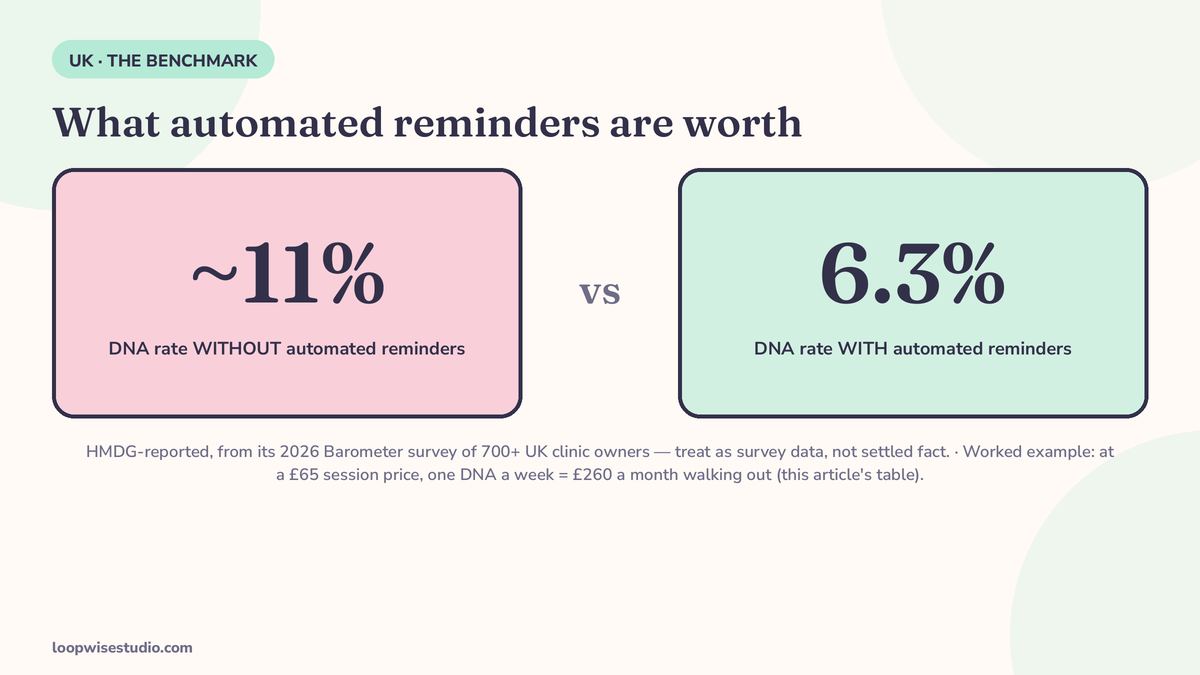
A private physio clinic cuts did-not-attend appointments by sending automated reminders — WhatsApp or SMS — with an easy reply-to-rebook route, booking the full treatment plan up front instead of one session at a time, and holding a deposit or card for new patients. HMDG’s Private Practice Barometer 2026 reports UK private-practice DNA rates of about 11% without automated reminders and 6.3% with them, though those figures are HMDG’s own survey reporting and worth checking against the current Barometer before you quote them.
Notice what that list doesn’t include: a sterner policy document. Search this problem and you’ll mostly find NHS GP practice DNA policies — escalation letters and removal-from-list warnings. A private clinic can’t remove anyone from a list, and doesn’t need to. It has levers the NHS doesn’t: deposits, plan booking, and reminders written for people who are paying. This page is the private version.
What one DNA actually costs you — do your own maths
Forget national figures; do this calculation with your own diary. Take your session price and multiply by your DNAs per week:
| Your session price | 1 DNA/week | 2 DNAs/week | 3 DNAs/week |
|---|---|---|---|
| £50 | £200/month | £400/month | £600/month |
| £65 | £260/month | £520/month | £780/month |
| £80 | £320/month | £640/month | £960/month |
That’s reader arithmetic, not a statistic — but it’s the right way to size the problem, because it uses your prices and your diary. And it understates the real loss for physio, because a DNA mid-plan isn’t just one empty slot. It’s a broken treatment plan, and broken plans don’t complete, don’t get results, and don’t refer.
Why physio DNAs happen — three causes, three fixes
They forgot. Still the largest cause, and the easiest to fix. NHS England’s list of DNA-reduction measures, published by Practice Business, found that text reminders including cancellation information can reduce DNAs by up to 10% — that’s an NHS GP setting from 2018, so treat the size of the effect cautiously, but the direction has never been in doubt.
They feel better. Unique to plan-based care: at session three the pain eases, the patient concludes they’re fixed, and session four quietly doesn’t happen. No reminder fixes a motivation problem — a mid-plan check-in does (below).
They booked too far ahead. HMDG’s Barometer reports the lowest DNA rate for appointments booked 3–7 days ahead (6.2%) — its survey data, flagged here as HMDG-reported rather than independently audited. Long gaps between booking and appointment decay. Short booking windows and a cancellation list are the structural answer.
The reminder sequence — three messages, with an exit in every one
A reminder with no easy way out produces no-shows. A reminder with a one-tap exit produces either an attended appointment or a slot you can refill. Send these on WhatsApp where the patient uses it, SMS where they don’t:
At booking — confirmation:
Hi [Name], you’re booked in at [Clinic] on [day, date] at [time] with [physio]. Need to change it? Just reply here — no charge to move with 24 hours’ notice.
48 hours before:
Hi [Name], a reminder of your physio appointment on [day] at [time]. Still good? Reply YES to confirm, or reply CHANGE and we’ll find another time.
Morning of the appointment:
Morning [Name] — see you at [time] today. If you’re stuck, reply now and we’ll rebook you while there’s still time to offer the slot to someone else.
Two design rules. Every message names the exit — replying to cancel must be easier than not turning up. And a reply is answered by a human or a booking link within the hour, not admired in an inbox. The underlying sequence is the same one in our pillar guide to reducing no-shows at a med spa; what changes in physio is what happens between appointments, which is the next section.
Book the plan, not the appointment
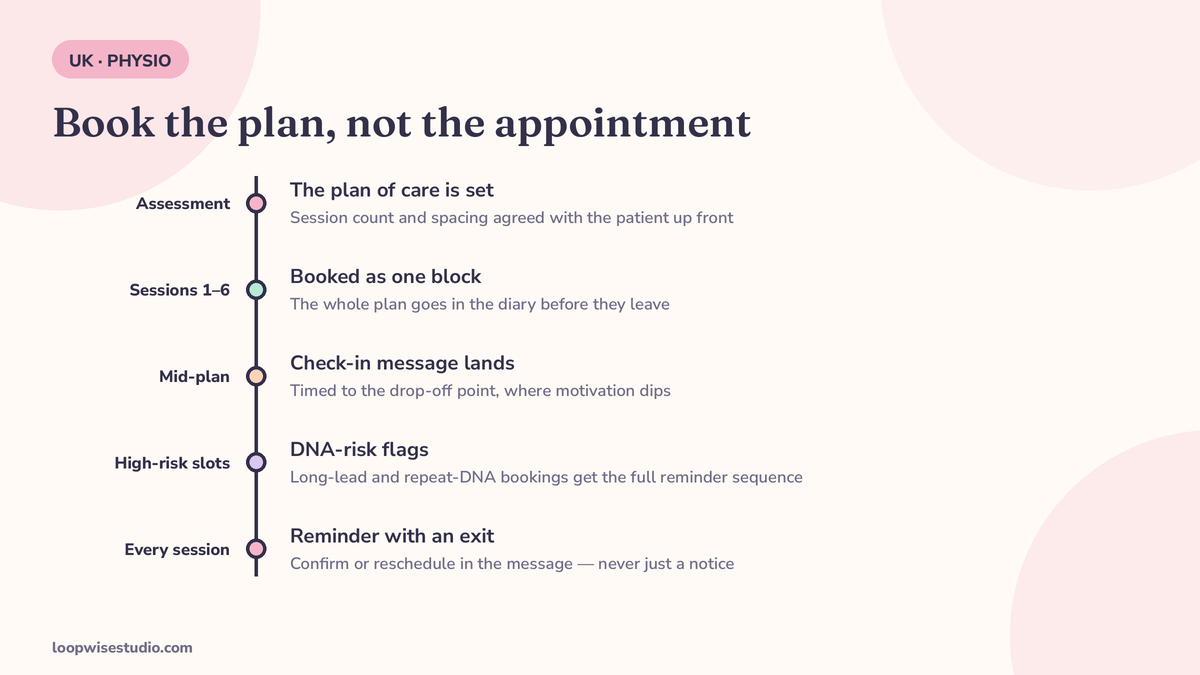
Single-appointment booking manufactures DNAs. At assessment, book the whole block — sessions one to six, same day and time where possible — and put every date in the patient’s phone before they leave.
Then defend the plan’s weak point. In most treatment plans the drop-off risk peaks when pain first eases, around the middle sessions. That’s where a check-in message earns its place:
Hi [Name], you’re halfway through your plan with [physio]. The next few sessions are where we build the strength that keeps the pain away — stopping now is the most common reason it comes back. See you [day] at [time]; reply if you need to move it.
HMDG reports a national median rebooking rate of 80% across UK private practice (again, HMDG-reported survey data). Clinics in its top bracket rebook 85–90% or more. The gap between those numbers is mostly this: whether the next appointment exists before the patient walks out.
For the booking-page side of this — visit types, plan booking, self-service rescheduling — see our guide to an online booking website for chiropractors and physio clinics. If you are outside the UK, our guide to booking systems for physio clinics applies the same layer in New Zealand.
Deposits and a fair DNA policy — the private sector’s lever
The NHS can’t charge for a missed GP appointment. You can — but how you frame it decides whether it protects your diary or costs you goodwill.
The model that works in private practice:
- Deposit or card hold for new patients and long appointments, framed as part of the session fee, not a penalty. It comes off the price when they attend.
- A written policy, stated at booking, in plain words: free to move with 24 hours’ notice; the deposit is kept inside that window.
- Waive on rebook. One real-clinic model in the market charges the full fee for a DNA but waives it if the patient rebooks and attends within 7 days. That turns a punishment into a recovery route — the patient comes back, the plan survives, and the policy still deters casual no-shows.
- Apply it consistently. A policy enforced only on patients you don’t like is worse than none.
Refill the slot — the cancellation list
A cancellation 30 hours out is only a loss if nobody fills it. Keep a short list of patients who want earlier slots — people mid-plan waiting on a sooner session are ideal — and message the list the moment a slot frees:
Hi [Name], a slot has opened at [Clinic] tomorrow at [time] — earlier than your current booking. Reply YES if you’d like it and we’ll move you.
First reply gets it; everyone else gets a brief “it’s gone, we’ll message next time” note. This is the physio version of the waitlist mechanics we cover for beauty clinics in how to reduce no-shows at a UK beauty salon — same machinery, different diary.
If your diary leaks at several points at once — DNAs, late cancellations, unbooked plans — get a free audit and we’ll map which leak is costing you most before you fix any of them.
The words that make the deposit acceptable — say them at booking
A deposit policy fails at the moment it’s first explained badly. The script matters as much as the amount. At assessment or first booking, it takes twenty seconds:
“I’ll book your sessions in as a block so you keep the same time each week. We take a deposit for the first appointment, which comes straight off your session fee when you come in. If you need to move a session, just message us with 24 hours’ notice and there’s no charge — the deposit only stays with us if an appointment is missed without notice. And if that ever happens, rebook and attend within a week and we’ll waive it.”
Every element of that script is doing a job. The deposit is framed as part of the fee, never as a fine. The free-move window is stated before the penalty. And the waiver is announced up front, so the patient hears “recoverable” rather than “confiscated” — which is why they mention it when something goes wrong instead of quietly not turning up.
Manage the booking window, not just the reminder
HMDG’s booking-window data (HMDG-reported, as flagged earlier) points at a structural fix that costs nothing: appointments booked 3–7 days ahead DNA at the lowest rate it measured, 6.2%, while same-day bookings ran at 7.7% and long-lead bookings decay further. Two habits follow:
- Don’t book session six ten weeks out and hope. Keep the plan block on a rolling horizon — confirm the next two or three sessions, keep them close, and let the block roll forward at each visit.
- Hold a same-day release. Keep one or two slots that open on the day for the cancellation list, rather than filling the diary solid a fortnight ahead and having no flex when — not if — a gap appears.
Pair this with the patient-recorded detail the NHS research supports: Practice Business’s NHS England list found that having the patient record the appointment themselves was associated with an 18% reduction in DNAs, and read-back of the details with 4% — small behavioural nudges from an NHS GP setting, so borrow the principle (the patient confirms the date in their own words or their own calendar) rather than the percentages. In a WhatsApp flow, the confirmation reply — “Reply YES to confirm” — is that nudge, built in.
The first appointment is the riskiest — give new patients the full treatment
DNA risk is not evenly spread. New patients — no relationship with the clinic, no plan yet, sometimes booked in pain that has since settled — miss at the highest rate in most private diaries. So the strict end of the system belongs at the front door:
- Deposit or card hold at first booking, explained with the script above.
- Confirmation message immediately, with the date written out in full — day, date, time — because “Tuesday” booked ten days ago is how people arrive on the wrong Tuesday.
- A “what to expect” line in the confirmation: where to park, what to wear, how long the assessment runs. Uncertainty is a quiet cause of first-visit DNAs; removing it is free.
- The 48-hour reminder with the reply-to-change route matters most here, because a new patient who can’t make it and says so is a filled slot; one who says nothing is a hole.
Existing plan patients, by contrast, usually need the lighter touch — reminders plus the mid-plan check-in — because the relationship and the block booking are already doing the work.
After a DNA happens — the follow-up message
What you send in the hour after a missed appointment decides whether you ever see the patient again. Shame closes the door; an open route back keeps the plan alive. Medesk’s no-show checklist for private practices makes the same point in process terms: a documented follow-up after every DNA, restating the policy and giving the rebook path. In message form:
Hi [Name], we missed you at [time] today — hope everything’s alright. Your treatment plan has [number] sessions left, and stopping mid-plan usually means the problem comes back. You can rebook here: [link]. Under our policy the deposit for today’s session is held, but rebook and attend within 7 days and we’ll waive it.
Send it once, the same day. If there’s no reply in a week, one final message, then stop — chasing beyond that point spends goodwill you may want later when the pain returns, as it often does.
Measure three numbers, not one
Track these separately, monthly, on a three-month rolling view — the measurement split recommended by Physitrack’s guidance for small physical therapy practices:
- DNA rate — booked, never arrived, never contacted you.
- Late-cancellation rate — cancelled inside your notice window. Different problem, different fix (policy and deposits, not reminders).
- Self-discharge rate — plan started, plan abandoned. Your “feeling better” leak lives here, and reminders alone will never fix it.
Lumping all three into one “no-show number” hides which lever to pull. HMDG’s specialty breakdown — podiatry lowest at 5.7%, chiropractic highest at 8.2% among its core MSK therapies, all HMDG-reported — is a useful sense-check for where a physio clinic should sit, not a target to quote as settled fact.
Putting it together — the order to do this in
You don’t need to rebuild your diary in a weekend. The sequence that works, in order:
- This week: turn on the three-message reminder sequence with a reply-to-change route. No policy changes, no new software decisions — just the messages.
- Next: start block-booking plans at assessment, and add the mid-plan check-in message at the session where your patients usually drift.
- Then: write the deposit policy, brief the team on the booking script, and apply it to new patients first. Existing patients keep the terms they know until their next plan starts.
- From month two: run the cancellation list, and read the three numbers — DNA, late cancellation, self-discharge — once a month.
Each step is independently worth having, and each makes the next one easier: reminders expose how many DNAs are simple forgetfulness, the policy handles what’s left, and the measurement tells you whether the split is moving.
Frequently asked questions
What is a normal DNA rate for a private physio clinic?
HMDG’s Private Practice Barometer 2026 reports about 11% without automated reminders and 6.3% with them, based on its survey of 700+ UK clinic owners. Those are HMDG’s reported figures from its own survey — useful as a benchmark, worth verifying against the current Barometer before quoting them as fact.
Should I charge for DNAs?
You can, privately — the NHS policy documents that dominate search results can’t. The fairer model is a deposit taken at booking that comes off the session fee on attendance, with a waiver if the patient rebooks and attends within a set window such as 7 days.
WhatsApp or SMS for physio reminders?
Whichever the patient actually reads and can reply to — offer both. The channel matters less than the sequence: confirmation at booking, a reminder 48 hours before with a reply-to-change route, and a morning-of message.
How do I stop mid-plan dropouts?
Book the full plan at assessment, then send a check-in message at the point pain typically eases — the middle sessions — explaining what the remaining sessions are for. Monitor self-discharge separately from DNAs so you can see whether it’s working.
Do reminders really halve DNAs?
HMDG reports roughly that gap — about 11% without automated reminders versus 6.3% with — in its 2026 Barometer survey of UK clinic owners. It’s survey-reported data, not a controlled trial, so treat it as a strong indication rather than a guarantee for your clinic.
What’s the difference between a DNA and a late cancellation?
A DNA never contacts you; a late cancellation tells you inside the notice window. Track them separately: reminders fix DNAs, deposits and policy fix late cancellations, and plan check-ins fix self-discharge.
One thing to leave behind entirely: the warning-letter ladder. It exists in NHS policies because a GP practice has no price lever and no other sanction. You have both price and relationship levers, and both work better than a letter that tells a paying patient they’re on a final warning. Save the formality for the rare repeat case the policy genuinely can’t fix.
A private physio clinic doesn’t need GP-style warning letters. It needs reminders with an exit, the whole plan booked up front, a deposit policy that’s fair enough to enforce, and three numbers watched monthly. Get a free audit and we’ll set the sequence up against your own diary.