How to Reduce No-Shows at an Orthodontic Practice
Reduce no-shows at an orthodontic practice by splitting consult no-shows from adjustment no-shows: a full reminder sequence with copy, backfill and a fair policy.

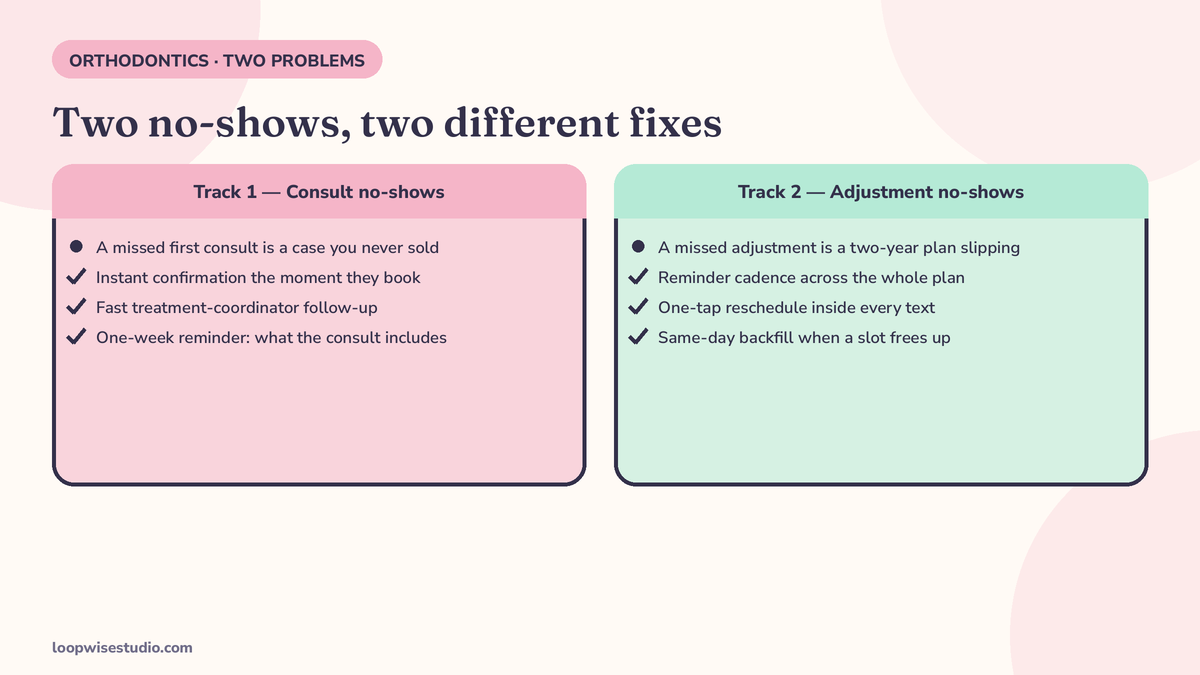
An orthodontic practice has two different no-show problems, and they need different fixes. A missed first consult is a case you never sold — fix it with instant confirmation and fast treatment-coordinator follow-up. A missed adjustment is a two-year treatment plan slipping — fix it with a reminder sequence, easy rescheduling, and same-day backfill.
Most advice on this topic treats no-shows as one problem with one cure (“send reminders”). That is also roughly all you will find if you search this question today: the pages currently ranking for it are near-identical templates repeating the same four tactics, decorated with percentages attributed to studies that are never named. We won’t repeat those numbers here, because nobody can check them. What follows is the system instead — built from the mechanics of how orthodontic diaries actually fail — plus the arithmetic to measure your own rate before and after.
First, measure yours properly
You cannot fix a rate you haven’t split. “Our no-show rate” as one number hides the two problems. Pull the last 90 days from your diary and count separately:
- Consult no-shows: booked first consultations that didn’t attend ÷ all booked first consultations.
- Adjustment/visit no-shows: booked in-treatment appointments that didn’t attend ÷ all booked in-treatment appointments.
Worked example, assumptions stated: your diary shows 80 consults booked last quarter, 14 didn’t show — a 17.5% consult no-show rate. In-treatment, 600 adjustment visits booked, 30 missed — 5%. Those two numbers need completely different responses, and the 5% is still expensive: 30 missed adjustments is 30 chairs idle and 30 treatment plans stretched by weeks. Track both monthly. Any change you make below, judge against these two rates — not against a benchmark from the internet, because for orthodontics specifically, there is no published one worth trusting.
The same discipline applies in the med spa world — our guide to reducing no-shows at a med spa uses the same measure-first approach — but orthodontics adds the consult/adjustment split and the parent factor below.
A quick diary audit before you change anything. For each of the last 90 days’ misses, mark which of these was true — you’ll usually find two causes doing most of the damage:
| Diary check | What it tells you |
|---|---|
| Booked more than 14 days ahead | The gap is the cause — shorten waits or add an early touch |
| Never replied to any reminder | Your messages aren’t landing or aren’t answerable |
| Booked by phone, no confirmation sent | The booking never felt real to the parent |
| Same families, repeatedly | A fit problem (times, transport) — handle personally, not with more automation |
| Clustered in exam weeks / holidays | Calendar collision — plan around the school year |
Track 1 — Stop consult no-shows
A consult no-show usually isn’t rudeness. It’s a booking made days ago, by a parent who was comparison-shopping, that quietly lost to school runs and work. The fixes are about momentum:
Confirm at the moment of booking. The confirmation text goes out while the parent is still on your website or just off the phone — practice name, date and time in plain words, what to bring, and a one-tap way to move it. A consult confirmed warmly within a minute feels like an arrangement; a consult confirmed by a reminder three days later feels like an obligation.
Make the wait short. The longer the gap between booking and consult date, the more chances life has to intervene. If your consult wait is over two weeks, that is a no-show cause no reminder can fix — protect some near-term consult slots, including a few after-school ones, even if it means holding them back from the general diary.
Give the consult an owner. One named person — usually your treatment coordinator — owns consult attendance. They see the day’s consult list each morning, and any consult that hasn’t confirmed by the 48-hour mark gets a personal text, not another automated one. If a consult does miss, the recovery sequence starts within the hour, while the intent is still warm: a short, kind text with two concrete alternative times. Our companion piece on missed call text back for orthodontists covers the call-side version of this — catching the enquiry before it ever becomes a shaky booking.
Reduce the unknowns. Parents no-show less when they know what the consult involves: how long it takes, that records/imaging happen then, roughly what happens about cost and payment options. Put it in the confirmation and the 48-hour message. Uncertainty is a quiet no-show driver.
Track 2 — Stop adjustment no-shows across a two-year treatment
In-treatment patients are different. They like you, they intend to come, and they still miss — because the appointment was booked six weeks ago, at the chair, in a hurry, and life since then has been loud. And the cost compounds: a missed adjustment doesn’t just idle a chair, it stretches the whole case, pushes the finish date, and eats a slot another patient needed.
- Book the next visit before they leave, and confirm it by text in the room. The patient (or parent) should leave with the next appointment already in their phone calendar — sent by text while they’re still in the chair, not on a paper card that dies in a school bag.
- Match the cadence to the visit type. A records/bonding appointment is not a wire change. Longer, higher-commitment visits get the full reminder sequence; quick checks get a lighter touch so you don’t train families to ignore you.
- Watch the drifters. A patient who has moved or missed twice is a different risk from one who never has. Flag them in your system; they get the personal-touch version — an earlier reminder and a coordinator-sent text — while reliable families get automation only.
- Mind the school calendar. Your no-show spikes are predictable: exam weeks, school holidays booked over standing appointments, the first week back in September. Plan reminder timing and overbooking caution around them, not against them.
The reminder sequence that covers both tracks
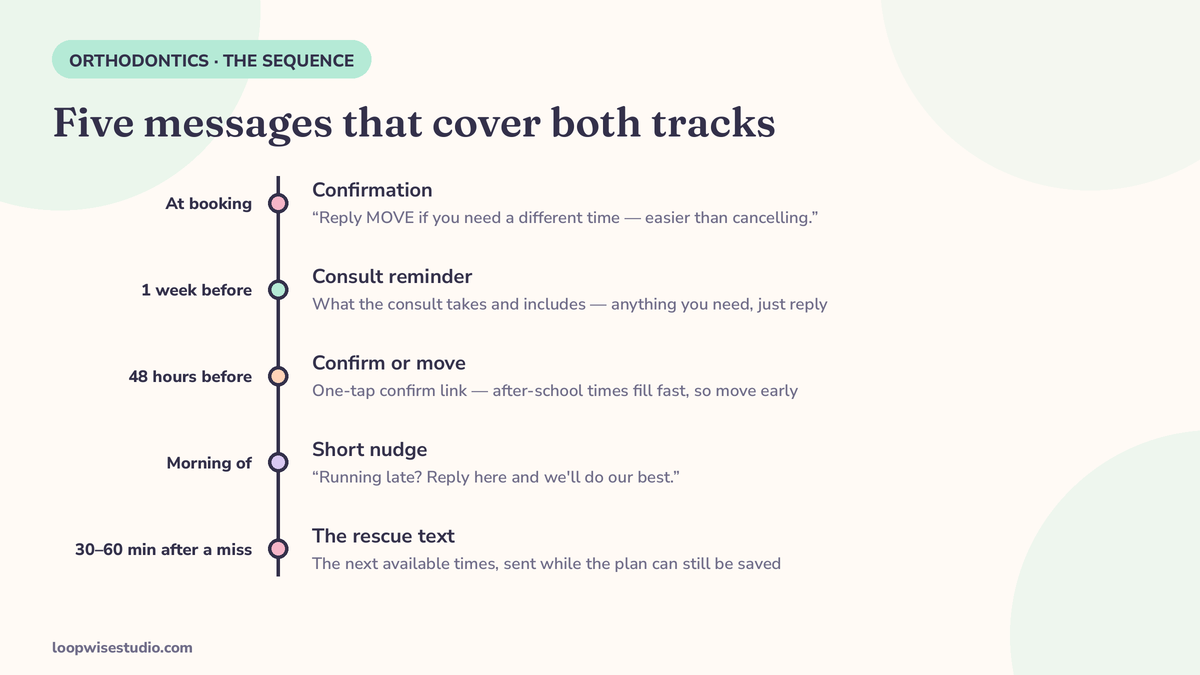
One sequence, tuned per track. Copy the wording and adjust names and links:
| When | Who gets it | Message |
|---|---|---|
| At booking | Both tracks | “You’re booked: [Patient] at [Practice] on [day, date] at [time]. Reply MOVE if you need a different time — easier than cancelling. We’ll remind you before.” |
| 1 week before | Consults mainly | “[Name], your consultation at [Practice] is on [date] at [time]. It takes about [X] minutes and includes [records/photos]. Anything you need before? Just reply here.” |
| 48 hours before | Both tracks | “Reminder: [Patient]’s appointment is [day] at [time]. Tap to confirm: [link] — or reply MOVE and pick a new time in seconds. After-school times fill fast, so move early if you need to.” |
| Morning of | Both tracks | “See you today at [time], [Name]. Running late? Reply here and we’ll do our best. Need to move? [link]” |
| 30–60 min after a miss | Both tracks | “We missed [Patient] today — no stress, things happen. Here are the next times we can do: [times/link]. Book one now and the plan stays on track.” |
Three rules make this work. Every message can be replied to, and replies reach a human. Rescheduling is always one tap — a patient who can move an appointment in ten seconds doesn’t need to ghost it. And messages to parents are addressed to parents (“[Patient]’s appointment”) — the parent is the one who drives, pays, and decides.
For most practices this sequence runs on text, because that is where parents actually read things. The wider comparison of channels is covered in our article on text reminders versus phone calls for dental no-shows — the short version: calls for the personal touches, texts for the system.
If building this sequence, the diary rules, and the backfill flow below sounds like a project your front desk doesn’t have spare hours for, that’s exactly the kind of system we set up — get a free audit and we’ll map it against your current diary first.
Make rescheduling easier than disappearing
People no-show when moving the appointment is harder than not turning up. Every step of friction — call during office hours, hold, negotiate a new time — pushes a busy parent toward the ghost. So:
- One-tap reschedule inside every reminder. The link shows real alternative times, including after-school slots, and confirms the move instantly.
- Kill the phone-only rule. If moving an appointment requires a call, a share of patients will simply not do either. Let the text thread handle it, with a human reading replies.
- Protect after-school inventory honestly. If a parent tries to move and sees only 10am Tuesday slots, they’ll cancel mentally and no-show physically. Hold a realistic slice of late-day appointments for moves.
Scheduling design: templates, buffers, and backfilling a gap
The diary itself is a no-show tool. Orthodontic template scheduling — long appointments (bonding, debonds) placed where they don’t fragment the day, adjustments clustered in the after-school rush they naturally belong to — reduces the collisions that create chaos days. Two operational rules help most:
Don’t overbook against your no-show rate. It is tempting to double-book the slots that “always” miss. Do it and both patients arrive: now you’re running 40 minutes late, which teaches every family in the waiting room that your times are approximate — and approximate times get approximate attendance. Protect the schedule instead, and backfill honestly.
Run a same-day backfill list. When an adjustment cancels in the morning, that slot has value for exactly a few hours. Keep a short list of patients who asked for earlier or after-school times, and text them the opening with a one-tap claim: “A [time] slot just opened today — want it? Reply YES and it’s yours.” The slot fills, a family’s treatment speeds up, and your chair doesn’t sit empty. This is the same refill mechanic salons use — our piece on filling cancelled appointments automatically shows the flow — with the ortho twist that your waitlist is patients already in treatment, not new enquiries.
A fair cancellation policy, in plain words
You need a policy; it needs to be said at booking, not debuted after a miss. Keep it human, especially since most of your patients are minors and the person you’re really addressing is a parent doing their best. Sample wording:
“Things come up — we get it. If you need to move an appointment, tap the link in any reminder or text us any time; moving is always free and takes seconds. All we ask is that you move rather than miss, so we can offer the time to another family. If appointments are missed repeatedly without letting us know, we may need to book future visits at quieter times of day.”
A note on failed-appointment fees: many orthodontic practices deliberately don’t charge them for children’s care, and a fee-first policy can cost more goodwill (and more Google reviews) than it recovers in chair time. If you do charge, say so plainly at booking, apply it consistently, and never let it be a surprise. What we would not recommend is the opposite extreme sometimes advised online — paying people to cancel early with discounts. It trains families to treat your diary as negotiable and muddies the simple norm you’re trying to build: move, don’t miss.
When they still don’t show: the rescue sequence
Some misses happen anyway. The hour after a missed consult is worth more than the week after. Run it as a fixed sequence:
- Within the hour: the rescue text from the table above — two concrete alternative times, no guilt.
- Next day: a personal message from the treatment coordinator by name. For consults, this is a sales conversation, not admin: answer the unasked question (usually cost or timing) and offer a virtual consult if getting in is the obstacle.
- One week later: last automated touch — a short message with the booking link and an easy out (“reply STOP and we won’t chase”). Then move them to a light-touch nurture list rather than nagging forever.
Log the reason whenever you learn it. After a quarter, your rescue notes will tell you more about your no-shows than any benchmark: school, forgot, cost worry, or booked elsewhere each points at a different fix upstream.
One last point on expectations: give the system a full quarter before judging it. No-show behaviour is habit plus diary design, and both change slowly — the first month mostly fixes the easy wins (unconfirmed consults, forgotten adjustments), the second month is where the backfill list and shorter consult waits start compounding, and by the third month your split rates are measuring the new normal rather than the transition. Practices that declare victory or defeat at week two are measuring noise.
FAQs
What is a good no-show rate for an orthodontic practice? There is no published orthodontic benchmark we’d stake a claim on — the figures quoted online for this exact question trace back to unnamed “studies” on template websites. Measure your own consult and adjustment rates separately for a month; that split baseline is the number every improvement should be judged against.
Should we charge a fee for missed appointments? Only with eyes open. Many practices choose not to for minors’ care, and a surprise fee generates complaints and bad reviews. If you charge, state it at booking, keep it modest, and apply it consistently. For most practices, easy rescheduling plus a clear policy recovers more chair time than fees do.
How many reminders is too many? The sequence above is five touches across the whole cycle including the post-miss rescue — and each one does a job (confirm, prepare, confirm again, day-of, rescue). What burns goodwill is repetition without function: three identical “reminder: you have an appointment” texts. Every message should let the parent confirm or move in one tap.
Our patients are mostly teens. Should reminders go to the teen or the parent? Both, deliberately. The parent gets the booking, 48-hour, and rescheduling messages — they control the diary and the transport. The teen can get the morning-of message if they’ve agreed to it. Sending everything to the patient alone is a common cause of “I never saw it.”
Does this work with our existing practice management software? The sequence, booking link, and backfill list sit alongside your existing system — they draw the diary data and send the messages; you don’t migrate your clinical records. During an audit we check your specific setup before quoting.
What about patients who keep missing? Escalate the human touch, not the punishment: earlier personal contact, a conversation about times that actually work for the family, and — if it continues — booking them into quieter slots as your policy states. Chronic misses are usually a scheduling-fit problem wearing a behaviour costume.
Split the rate, run the sequence, make moving easier than missing. If you want the sequence, the booking links and the backfill list built into your diary properly, get a free audit — we’ll start from your last 90 days of no-show data and quote the whole system as one fixed price.