WhatsApp Appointment Reminders for Clinics in Qatar
WhatsApp appointment reminders for clinics in Qatar: the confirmation, 24h and 2h messages that cut no-shows — with Arabic and English templates to copy.
A WhatsApp appointment reminder system for a clinic in Qatar sends three automatic messages per booking — an instant confirmation, a reminder 24 hours before, and one 2 hours before — in Arabic or English, with tap-to-confirm and tap-to-reschedule buttons. Patients move appointments in the chat instead of silently not showing up, and reception stops making reminder calls.
This is not a new channel your patients need to learn. Hamad Medical Corporation — Qatar’s public hospital provider — runs its own WhatsApp appointment centre, listed on its official FAQ page, for appointment requests and status updates. If the country’s biggest provider answers patients on WhatsApp, a private clinic in Doha, Lusail or Al Wakrah still relying on phone calls and a paper diary is working harder than it needs to.
What follows is the reminder system itself: the exact messages, the rules that keep them welcome, what happens when a patient cancels, and what it costs. The templates are written in Arabic and English — copy them as they are.
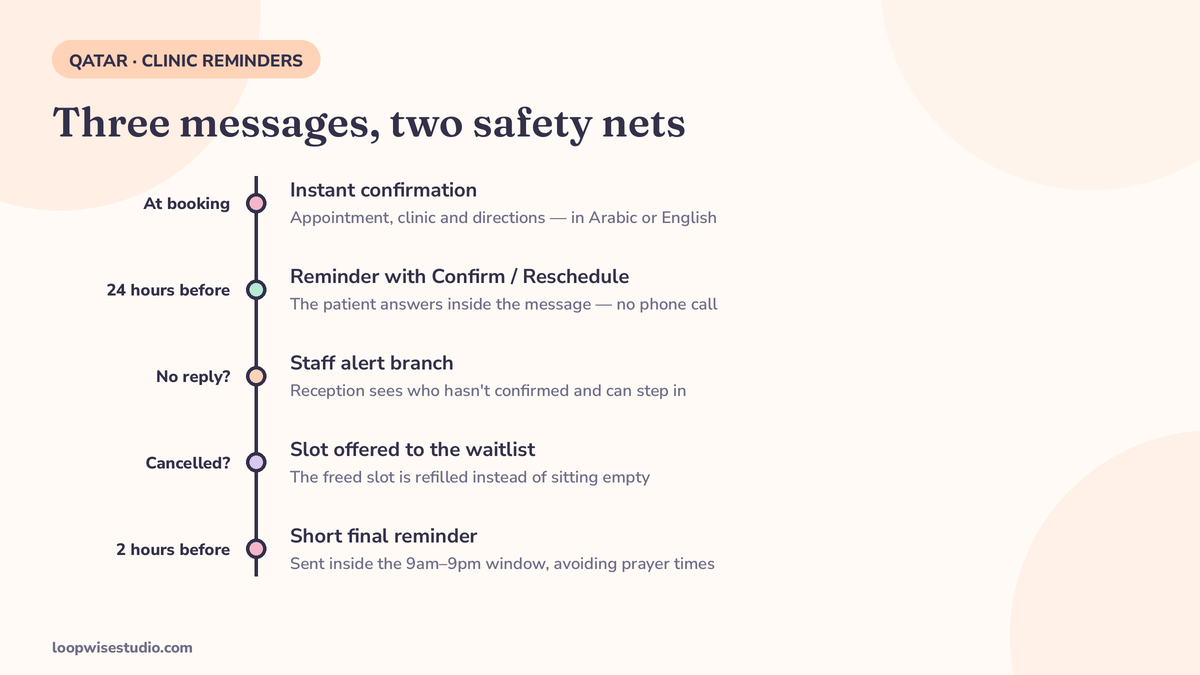
How clinics in Qatar book today — and where patients fall off
Most small private clinics in Qatar run some mix of the same three things: a phone line that rings during working hours, an SMS reminder if the booking software sends one, and walk-ins. Each one leaks patients in a different place.
The phone only works when someone answers it. A patient who calls at 8pm to book or move an appointment gets nothing, and by morning she has booked somewhere else — or simply not rebooked at all.
SMS gets read, eventually, but it is a dead end. There is no button to tap, no easy way to say “move me to Thursday.” Moving the appointment means another phone call, which brings back the first problem.
The walk-in never enters any system at all. No number captured properly, no reminder possible, no way to fill the slot if she cancels.
WhatsApp fixes the shape of the problem rather than one piece of it: the booking, the confirmation, the reminder and the reschedule all happen in one thread the patient already has open. Clinics in Dubai run the full version of this — booking plus reminders on one number — in our guide to WhatsApp booking systems for aesthetic clinics in Dubai. This article is about the reminder half, which is where the no-show savings actually live.
The three messages that do the work
A reminder system is not “we send a WhatsApp before the appointment.” It is a fixed sequence, and the sequence matters because each message has a different job. HalaFlow, a clinic messaging platform, publishes exactly this cadence — confirmation, 24 hours before, 2 hours before — and it is the cadence we build around.
Message 1 — the instant confirmation (job: lock it in, share the map)
Sent the second the booking is made. It confirms the details, and it carries the location link — MedicOlize’s published clinic message pack makes a point of this: new patients ask for the location more than anything else, so it goes in message one, every time.
English:
Hello {name}, your appointment at {clinic} with Dr {doctor} is confirmed for {date} at {time}. Location: {map link}. To change it, reply CHANGE. To cancel, reply CANCEL.
Arabic:
مرحباً {name}، تم تأكيد موعدك في {clinic} مع الدكتور {doctor} بتاريخ {date} الساعة {time}. الموقع: {map link}. لتغيير الموعد رد بكلمة «تغيير»، وللإلغاء رد بكلمة «إلغاء».
Message 2 — 24 hours before (job: get a yes, or an early release)
This is the money message. A patient who cannot come almost always knows the day before. Given a button, most will reschedule — which hands you a full working day to refill the slot. Without the button, you find out when the chair is already empty.
English:
Reminder: your appointment at {clinic} is tomorrow, {date} at {time}. Tap Confirm if you are coming, or Reschedule to pick a new time.
Arabic:
تذكير: موعدك في {clinic} غداً {date} الساعة {time}. اضغط «تأكيد» إذا كنت قادماً، أو «إعادة جدولة» لاختيار وقت جديد.
Message 3 — 2 hours before (job: catch the day-of drift)
Short, practical, and the last chance to catch traffic, parking and “I completely forgot it was today.”
English:
See you soon — your appointment at {clinic} is today at {time}. Running late? Reply here and we will do our best to hold your slot.
Arabic:
نراك قريباً — موعدك في {clinic} اليوم الساعة {time}. إذا تأخرت، رد على هذه الرسالة وسنبذل قصارى جهدنا للاحتفاظ بموعدك.
Three messages. No more. A reminder system that messages more than this stops being a service and starts being noise — which brings us to the rules.
The rules that keep reminders welcome, not spam
Clinics handle reminders badly in a predictable way: they work, so the clinic starts adding things — an offer here, a “we miss you” there — until patients mute the number. MedicOlize’s published message pack for clinics sets out operating rules that are worth copying exactly:
- Cap the volume. No more than 3 messages a month to a patient who is not in active treatment. Reminders for a booked appointment are expected; marketing on top needs the patient to have agreed to it.
- Nothing clinical in the message. No results, no diagnoses, no medicine names. A reminder says when and where — never what was found.
- Respect the clock. Send between 9am and 9pm, and avoid prayer times. A 2-hour reminder for a 1pm appointment is fine; a promotional message at Maghrib is not.
- Reply the same working day. Automation sends the reminders, but when a patient writes back with a real question, a person answers it that day. The thread has to feel staffed, or patients stop using it.
- The map link goes in every first confirmation. It is the detail new patients ask for most.
Follow those five rules and the reminder thread stays what it should be: a service patients are glad exists.
If you would rather have the whole sequence — templates, timings, reschedule handling — set up on your clinic’s number for you, get a free audit and we will map it against how your clinic books today.
The staff side: alerts your reception team actually sees
Patients are only half the system. The other half is what your team sees — and it is the part most reminder tools skip.
HalaFlow’s clinic page lists a staff-side reminder set alongside the patient messages: an alert when a new booking lands, a heads-up before an upcoming patient, a flag when a schedule changes, and a daily digest. Build the same four into your clinic’s routine and the diary stops depending on whoever happens to glance at it:
- New booking alert — the moment an after-hours booking lands, reception knows it exists before the morning rush.
- Today’s unconfirmed list — one short digest of the patients who never replied to their 24-hour reminder. Those are the only reminder calls your team still makes.
- Schedule-change flag — when a doctor’s session moves, the affected patients are messaged from the same thread, not re-phoned one by one.
The point is not more notifications. It is that the diary becomes something the whole front desk can see, instead of something one receptionist carries in her head.
When a patient cancels or goes quiet — refilling the slot
A reminder system earns its keep twice: once when it prevents the no-show, and again when it cannot.
When a patient taps Reschedule or Cancel at the 24-hour mark, the slot opens with a day to spare. The system offers it to your waitlist — patients who asked for an earlier appointment — by WhatsApp, first reply takes it. That is a chair filled that a phone-based clinic would have written off.
When a patient does not reply to the 24-hour message at all, the system flags her to reception in the morning digest. One personal call to the unconfirmed names on today’s list is a five-minute job. Calling the whole list was the old system; calling only the silent ones is the new one.
And when someone cancels inside the chat, the conversation does not end with “okay, cancelled.” It ends with a new date offered on the spot — the same thread, while the intention is still warm. A cancelled appointment that gets rebooked in the same conversation is not a lost patient; it is a moved one. Clinics in the UAE work the same refill logic — see how UAE clinics reduce no-shows with WhatsApp for the no-show side of the system.
Do the maths on your own diary
No Qatar study hands you a trustworthy no-show percentage — vendor pages quote big reduction figures without publishing data behind them, so ignore those and count your own. It takes one week of diary honesty:
- Count the appointments booked last week. Call it A.
- Count how many ended as no-shows or cancellations too late to refill. Call it B.
- Put your own value on an average slot — what that consultation or session is worth to the clinic. Call it C.
B × C is what empty chairs cost you last week. As a worked illustration with assumed numbers — not statistics: a clinic booking 150 appointments a week that loses 10 of them, with an average slot worth 250 QAR, is leaving 2,500 QAR of diary value empty every week, roughly 10,000 QAR a month. Replace every figure with your own; the shape of the sum is the point. Against that number, a reminder system is not a marketing expense. It is chair insurance.
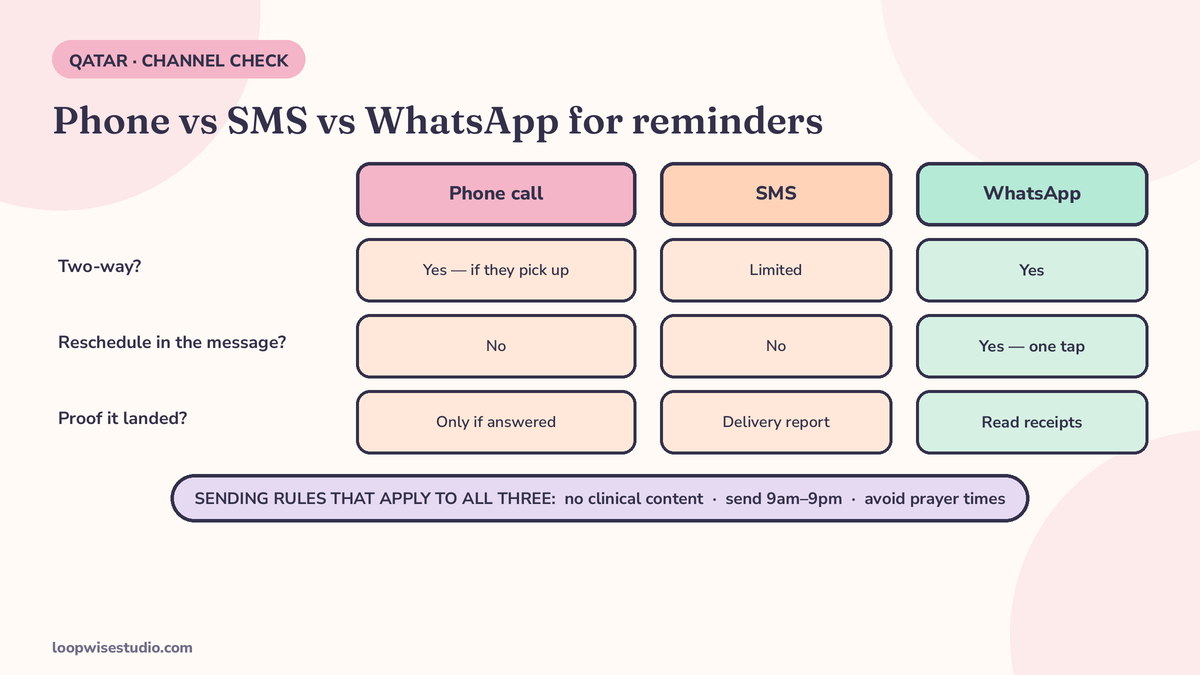
WhatsApp reminders vs SMS vs phone calls
| Phone calls | SMS | ||
|---|---|---|---|
| Patient can confirm in the message | No — needs a person on both ends | Rarely; reply handling is clumsy | Yes — buttons in the message |
| Reschedule inside the same channel | Only if someone answers | No | Yes |
| Location/map link | No | Text link only | Yes, tappable |
| Arabic + English in one thread | Depends who picks up | Possible, rarely set up | Standard |
| When it works | Working hours, staff available | Any time, one-way | Any time, two-way |
| Cost basis | Receptionist time | Per message | Per delivered template message |
The honest summary: SMS is fine as a fallback for the few patients not on WhatsApp. Phone calls still matter for the unconfirmed few. But as the main system, only WhatsApp carries the whole job — remind, confirm, reschedule, refill — in one place.
Clinics across the border run the identical sequence on the same rails; our guide to WhatsApp automation for clinics in Saudi Arabia shows the cost side worked out in SAR, message by message.
What it costs a small clinic in Qatar
There are three cost layers, and any provider quote should separate them:
- Meta’s per-message charge. WhatsApp template messages sent through the official platform are billed per delivered message, at a rate that depends on the message category (appointment reminders are “utility” messages — the cheap category) and the patient’s country. Meta publishes the rate card per country; check the current Qatar rate on Meta’s published pricing page before signing anything, because no honest figure can be quoted without it.
- The platform or provider fee. Software that connects your number, holds the templates and runs the sequences charges monthly. This is where quotes vary most, and where “per conversation” bundles hide the real volume maths.
- Setup. Connecting your existing clinic number, getting templates approved, and wiring the sequence to your diary. One-off, and it should be quoted as one-off.
Questions worth asking any provider: Is the reminder sequence capped, or do I pay per message without limit? Do replies land in an inbox my reception team can actually use? What happens to my number and my templates if I leave? A clinic that asks those three questions will not get a nasty surprise in month two.
How Loopwise sets it up
Loopwise Studio builds the reminder system on your clinic’s existing number and diary — you do not change how you book, and your patients do not download anything.
The build is: your confirmation, 24-hour and 2-hour templates written and approved in Arabic and English; the reschedule and cancel flows wired so replies land with your reception team; the waitlist refill for freed slots; and the morning digest of unconfirmed patients. Then we test it against your real appointment list before it goes live.
We turn missed calls and website visitors into booked appointments — reminders are the half of that system that protects the appointments you already won. If you want it running on your number, get a free audit and we will show you exactly what your reminder sequence would look like.
FAQs
How many reminder messages should a clinic send?
Three: an instant confirmation, one 24 hours before, and one 2 hours before. That cadence gives the patient a full day to reschedule and a same-day nudge, without training her to ignore your number. MedicOlize’s clinic message pack caps messages at 3 a month for patients not in active treatment — reminders for a booked visit are expected, extra marketing is where the cap bites.
Do the reminders work in Arabic and English?
Yes. The patient gets messages in her preferred language, chosen at booking. Qatar’s patient base is heavily expatriate, so the same system usually runs Arabic and English side by side, from the same templates.
What if a patient is not on WhatsApp?
The reminder falls back to SMS for that patient. In practice the share is small, but the system should never leave a booked patient with no reminder at all because of the channel.
Can patients reschedule inside WhatsApp?
Yes — that is the point of the 24-hour message. The patient taps Reschedule, picks a new time from your real availability, and the diary updates. No phone call, no front-desk tag.
Is it allowed to send medical information by WhatsApp reminder?
No. Keep reminders to logistics: clinic, doctor, date, time, location. Results, diagnoses and medicine details never go in a reminder message — that is a rule in MedicOlize’s published clinic message pack, and it is the right one.
How long does setup take?
The work is the templates, the number connection and the diary wiring — days of build, not months, once your message templates are approved by Meta. The bigger variable is your current booking setup: a clinic on basic software or a paper diary needs the booking capture tidied first, which the audit will flag.