How to Stop Clients Dropping Out of Laser Packages
Laser clients buy the course, attend twice, then drift. Book session two before they leave and show the sessions-left balance in every message.

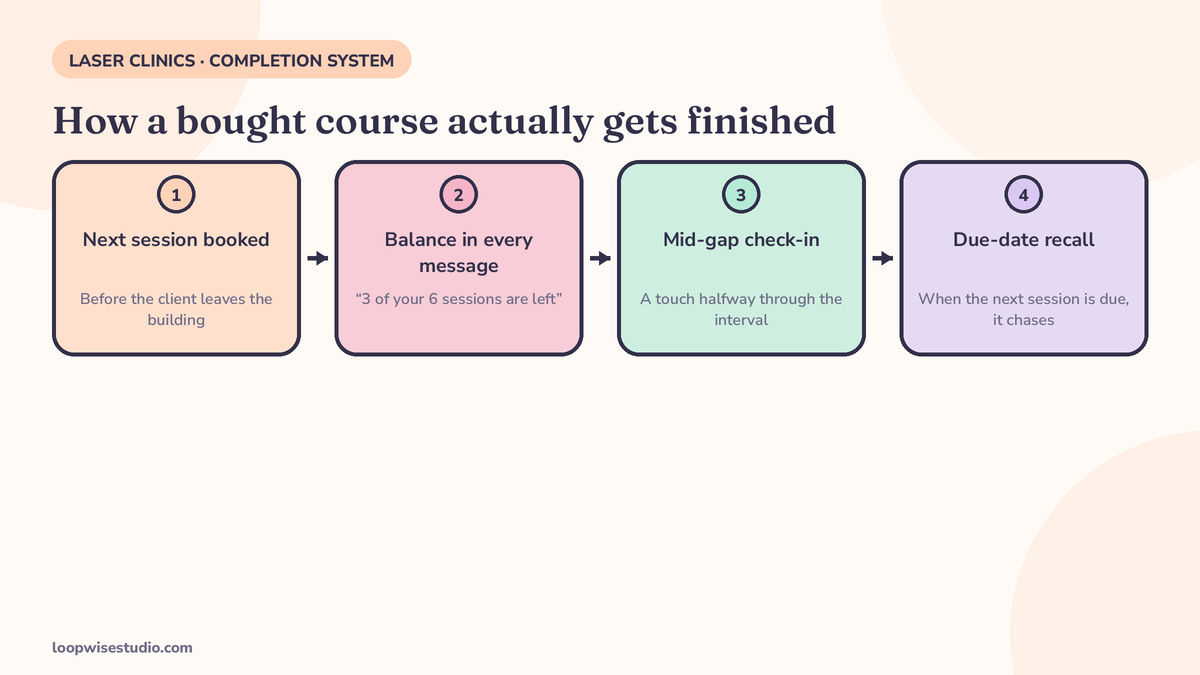
Clients drop out of laser packages when the next session is not booked before they leave, and nothing after that reminds them what they have already paid for. Book session two at checkout, show the sessions-left balance in every reminder, and recall them on the due date your clinic sets — and most of the drift never happens.
Notice what is not in that answer: discounts, loyalty points, pep talks. Package dropout is not a motivation problem. It is a logistics problem wearing a motivation costume, and it is fixed by a system, not by trying harder to keep clients excited about hair removal.
This page covers the pattern, how to measure it in your own clinic (no industry statistic exists — anyone who quotes you one is making it up), and the five-part system that keeps a course moving to completion.
The pattern — buy the course, attend twice, vanish
A laser growth agency, Grow A Salon, describes the pattern its clinic clients keep hitting: the client buys a course of six to eight sessions, attends the first two, then no-shows the third — and the course quietly dies from there. If you run laser, you do not need that citation checked. You have a drawer, literal or digital, of half-finished courses to prove it.
The mechanics are boring, which is why they get missed:
- Session one is exciting. It is booked in the consultation buzz, the result of session two is visible, the client is engaged.
- Session three is where life gets in the way. It was booked vaguely (“we’ll sort it next time”), or not booked at all. A holiday, a busy month, a tan she was told to keep out of the sun — any small friction pushes it out.
- Once the gap stretches past the interval your clinic set, restarting feels like starting over. The client does not ring to quit. She just stops, and the prepaid remainder sits there making nobody happy — she feels faintly guilty about it, and your clinic holds money it has not earned by delivering treatment.
By the time anyone notices, she has not been in for months and a “just checking in!” message lands like a debt collector. The fix has to happen early, while the course is still alive — which is why every part of the system below happens either at a session or on a schedule, never on someone’s hunch that a client has gone quiet.
Measure your own dropout first — because nobody else’s number counts
Here is an honesty point the software world will not give you: no published source quantifies laser package dropout. We looked. The articles ranking for this exact problem are generic retention listicles with loyalty-programme advice and not a single clinic measurement between them. If a vendor quotes you an industry dropout rate, ask for the study. There isn’t one.
So measure yours. It takes twenty minutes and one export:
The completion audit (copy this worksheet):
- Pick a cohort: every client who bought a course in a fixed window — say, 9 to 12 months ago, so every course has had time to finish.
- For each course, count sessions sold and sessions delivered.
- Completion rate = sessions delivered ÷ sessions sold.
- Prepaid value still undelivered = the price of the undelivered sessions, at what clients actually paid.
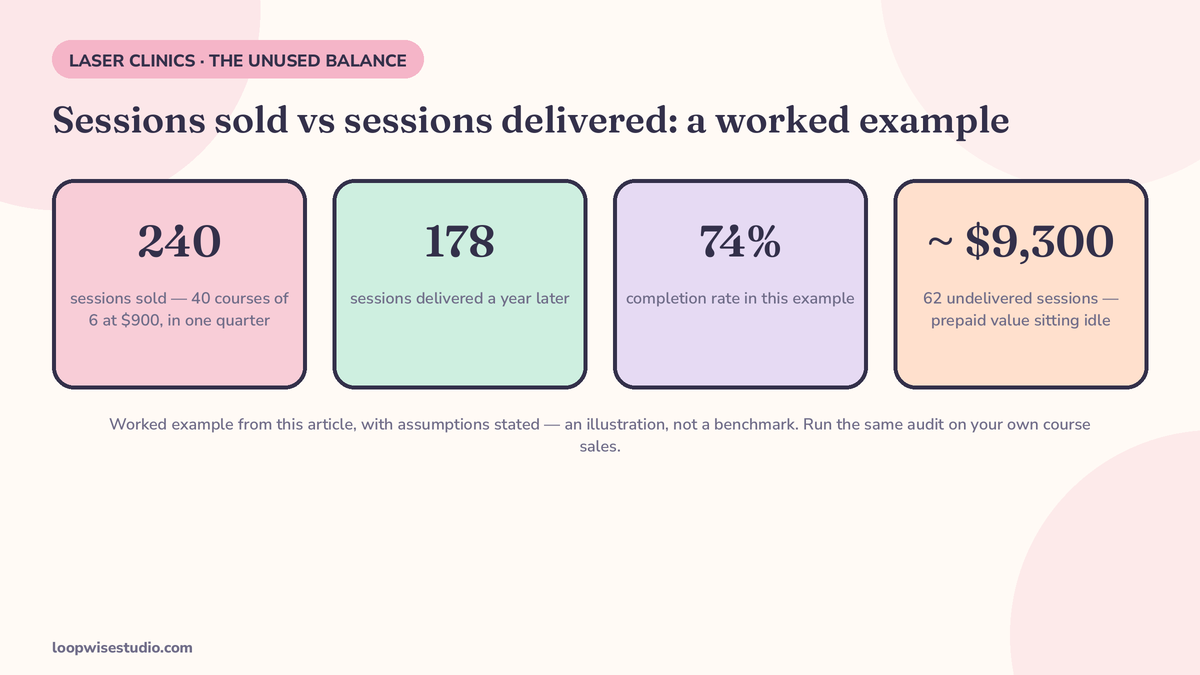
Worked example, with the assumptions stated so you can replace them with your own numbers: a clinic sells 40 courses of 6 sessions at $900 a course in a quarter — 240 sessions sold. A year later, 178 sessions have been delivered: a 74% completion rate, and 62 undelivered sessions worth about $9,300 of prepaid treatment sitting idle. Those numbers are an illustration, not a benchmark — but every clinic that runs this audit finds its own version of the same gap, and the gap is almost always bigger than the owner guessed.
That undelivered balance is not profit. It is a liability wearing a nice outfit: refunds get requested at the worst moments, chargebacks arrive with fees, and every one of those 62 sessions represents a client whose result — and whose before-and-after story, referral and top-up purchase — never happened.
Fix 1 — the next session is booked before she leaves the building
The single highest-value moment in a course is the two minutes after a session ends. She is in the building, diary in hand, course alive. Book the next session then — at the interval your clinicians have set — every time, as a rule, not when the desk remembers.
“Shall I put your next one in for [date]? Same time usually works — and you’ll get a reminder with a link if you ever need to move it.”
If she will not commit to a date, book a provisional one anyway and tell her plainly that it is provisional and movable in one tap. A movable appointment in the diary outperforms a promise to “book later” by an embarrassing margin — because later, she has to initiate, remember, and ring during your opening hours, and mostly she does not. This is the same checkout habit that drives injectable rebooking in how to remind Botox patients to rebook at 3 months — book it while they are standing there, and let automation handle everyone who slips through.
Fix 2 — every message shows the balance: “3 of your 6 sessions are left”
A client forgets she has paid for sessions. Not because she is careless — because the course left her attention the day the payment cleared. Every automated message in the course should carry the balance, in plain words:
Hi [First name], your next laser session is due around [date] — you have 3 of your 6 sessions left. Book here: [link]
That one line changes the psychology completely. The message is no longer “come and spend time at our clinic.” It is “you own something here; come and use it.” People abandon subscriptions they forget about. They do not abandon balances they can see.
For the balance to appear in messages automatically, it has to live in the booking system — which is why session-balance tracking sits at the top of the checklist in online booking system for laser hair removal clinics. If your current system cannot show sessions bought, used and left on the client record, no reminder sequence you write will fix dropout, because every message will be missing its strongest line.
Fix 3 — the mid-gap check-in and the due-date recall
Between sessions there is a gap set by your clinic’s protocol. Halfway through that gap, silence is normal — but it is also where drift starts. The two-touch safety net:
| Touch | When | What it says |
|---|---|---|
| Mid-gap check-in | Halfway between sessions | One light message: how the skin settled, a prep reminder for next time, balance shown. No booking pressure — it keeps the thread warm |
| Due-date recall | On the due date, if no session is booked | The direct ask, with the balance in the first line and a booking link |
One caution on the gap itself: published sources disagree about typical session spacing — you will find courses described as running every four to six weeks in one place and on longer regrowth cycles in another. Do not copy either number into your system. Your clinicians set the interval per treatment area and client; the automation simply runs the check-in halfway to whatever date that produces, and the recall on it. The machinery is interval-agnostic. The clinical call stays clinical.
The three warning signs a client is about to quit
Dropout is visible before it happens, if someone — or something — is watching for these:
- The gap has passed the due date with nothing booked. The most obvious sign, and the one most clinics miss because no report lists “courses overdue.” Your system should surface it weekly.
- Two reschedules in a row. One reschedule is life. Two is a pattern: the appointment no longer fits her life as it stands, and a third attempt at the same slot will fail too. This is the moment for a human message offering different times — early mornings, Saturdays, whatever your diary can flex to.
- The due-date recall went unanswered. She saw the strongest message you have — her own money, stated plainly — and did not act. That is no longer an automation problem. It is a phone call, from a person, once.
Miss all three and the next contact she gets is the win-back below — which works, but at half the rate of catching her at sign one.
The win-back that leads with what she already paid
When a course has been dormant past its due date, the message that works is not “we miss you” and it is not an offer. It is her balance, treated as the valuable thing it is:
Hi [First name], it’s [Clinic]. You still have [X] sessions left on your laser course, worth [value] of the [total] you paid — they’re yours whenever you’re ready, and booking takes 20 seconds: [link]. If you’d rather talk it through, just reply here.
And the honest counterpart, which almost no clinic sends and every clinic should: if your course terms include an expiry date, she hears about it well before it arrives — “your course runs until [date]” — stated as information, not a threat. A client who loses prepaid sessions without warning does not just leave. She leaves a review about it. Fairness and diary-filling point the same way here, as they usually do.
If dormant courses are a number you would rather not say out loud, you are the normal case, not the exception. When Loopwise builds a clinic’s booking system, the balance tracking, the check-in/recall pair and the overdue-course list are part of the build — the diary watches the courses so your team does not have to. get a free audit and bring your completion numbers; we will show you what the system would catch.
What does not work — the listicle advice, tested against the pattern
The generic retention advice ranking for this problem is not wrong, exactly. It is just aimed at a different problem:
- Loyalty points and rewards — she has already paid you. Points do not compete with a prepaid balance she cannot see.
- More education content — she knows how laser works. She attended twice. Knowledge was never the gap; a date in the diary was.
- Generic follow-up emails — an inbox newsletter does not carry her balance, her due date, or a booking link that knows who she is. The messages that work are personal because they are generated from her record, not because someone wrote “Hi [First name]” at the top.
Dropout is a systems failure with a systems fix. The wider med spa version of the same truth sits in how to reduce no-shows at a med spa — different leak, same moral: the clinics that fix it fix the follow-through, not the client.
The front-desk routine — fifteen minutes a week that runs the whole system
Automation handles the messages. What it cannot do is notice the human situations — and for that, the system needs one small human habit bolted onto it: a weekly fifteen-minute review of the overdue-course list, owned by one named person.
The list is short by design. It shows every active course where the due date has passed with nothing booked, sorted by sessions left, biggest balance first. Fifteen minutes, three actions:
- Send nothing new to the top of the list — call them. The clients with the most prepaid value sitting idle get a person, not a fourth automated message. Two minutes each: “You have four sessions left with us — can we find a time that works?” Most say yes to a human who makes it easy.
- Check the two-reschedule clients. Anyone who has moved twice gets offered genuinely different times — a different daypart, a Saturday — instead of a third attempt at the slot that keeps failing.
- Clear the finished and the gone. Courses completed get their top-up recall set. Clients who have told you they cannot continue get closed fairly, per your policy, the same week — not left on the list to be chased by a system that does not know.
That is the entire routine. No meeting, no report-writing, no spreadsheet archaeology — the booking system produces the list, and the fifteen minutes is spent talking to clients instead of hunting for them. Clinics skip this step because “keeping an eye on courses” used to mean an afternoon with the diary. At fifteen minutes, it is cheaper than the coffee run — and it is the difference between a reminder system and a completion system.
The short version
Laser clients do not quit courses — courses go quiet around them. Book the next session before she leaves, put the sessions-left balance in every message, check in mid-gap, recall on the due date, and call the human being yourself when the warning signs stack up. Measure your own completion rate first, because no honest industry number exists.
Want the balance tracking and recalls built into your booking system rather than run from a spreadsheet? get a free audit — we will map your course journey and show you where it leaks.
FAQs
Why do clients drop out of laser hair removal packages?
Almost never because of the treatment. They drop out because the next session was not booked before they left, the gap stretched past the due date, and nothing reminded them of the sessions they had already paid for. Life fills the space where the appointment should have been. The pattern agencies describe — buy six to eight sessions, attend two, miss the third, drift — is a scheduling failure, not a satisfaction failure.
Is there an industry dropout rate I can compare my clinic against?
No honest one. We researched this topic thoroughly and no published source quantifies laser package dropout — the pages that rank for it offer generic retention advice with no clinic data. Run the completion audit on your own courses (sessions delivered ÷ sessions sold, for a cohort old enough to have finished) and compare yourself against yourself, quarter over quarter.
Should I offer a discount to win back a client with unused sessions?
Lead with the balance, not a discount. She already owns the sessions — the win-back that works states what is left and what it is worth, with a one-tap booking link. Discounting a service she has already paid for teaches her nothing except that your prices are negotiable, and it does not fix the reason she drifted.
How long should a laser course stay valid?
That is your clinic’s commercial and clinical call — but whatever expiry you set, the system must warn clients well before it, more than once, with the balance stated. A client who discovers expired prepaid sessions after the fact is a refund dispute and a bad review. A client warned at 60 and 30 days either books (diary filled) or accepts the terms knowingly.
What if a client genuinely cannot continue the course?
Life changes — pregnancy, medication, moving away. Have a written, fair answer ready (pause, transfer, or refund terms per your policy) and make it easy to invoke by replying to any message. Clients treated decently on the way out come back for other treatments and send their friends. Clients trapped by silence do neither.
Does booking every session in advance actually help?
Yes — it is the strongest single fix. A client whose course is in the diary at your clinic’s interval has to actively cancel to drift; a client with nothing booked has to actively rebook to stay. Dropout lives in that difference. Book session two before she leaves session one, provisionally if needed, and let the balance reminders and due-date recall protect the rest.