How to Get More Google Reviews for a UK Aesthetic Clinic
Ask every client, automatically, when results show — on WhatsApp, with a direct link. The Google, DMCC Act and ASA/CAP POM rules a UK clinic must follow.

An aesthetic clinic gets more Google reviews by asking every client, automatically, a few days after treatment — by WhatsApp or text, with a direct review link — with no incentive offered and no filtering of who gets asked. Reviews carry roughly a fifth of Google’s local ranking weight (BrightLocal’s local ranking factors, via ResoClinx), and recent reviews count for more than a one-off batch.
That is the whole system. Everything below is timing, wording, and the three sets of rules that decide whether a UK clinic’s review campaign is an asset or a liability — including the one almost nobody in aesthetics talks about: the advertising rules for prescription-only medicines.
Why reviews move the map listing
When someone searches for a clinic near them, Google ranks the map results on relevance, distance and prominence. In BrightLocal’s local ranking factors survey, as reported by ResoClinx’s clinic SEO guide, reviews account for about 20% of the local pack weighting — second only to the Google Business Profile itself at 32%.
Two details matter more than the headline. First, recency: BrightLocal’s consumer research, again via ResoClinx, found 27% of people expect to see reviews from the last two weeks. A clinic that collected forty reviews in one push last spring looks staler than a clinic adding three a week. Second, volume follows from the same research: around 81% of consumers use Google to read local reviews. Your next client is reading them. The question is whether new ones keep arriving.
This is why review generation belongs in the same system as your reminders and rebooking, not in a occasional front-desk effort. Our pillar guide to getting Google reviews on WhatsApp for clinics covers the channel mechanics; this page is the UK aesthetic-clinic version, with the compliance layer the general guides skip.
The rules before the system — three of them
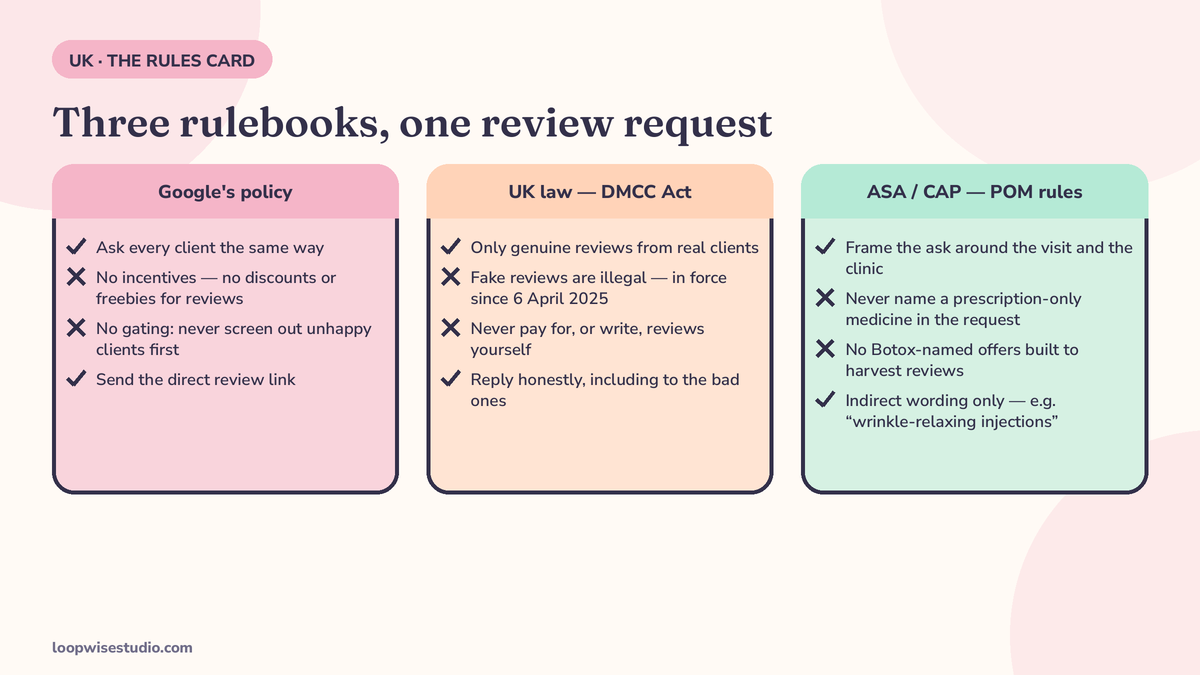
Google’s own policy
Google’s rules, summarised plainly by Mumbles Studio’s UK guide to getting reviews legally:
- No incentives — no money, discounts, freebies or prize-draw entries in exchange for a review. Google treats this as fake engagement.
- No review gating — you must not ask only the clients you expect to be happy, filter out unhappy ones, or steer negative experiences away from Google.
- No pressuring clients to review while they’re on your premises, no staff targets for review numbers, and never review your own clinic or have staff, friends or family do it.
Asking every genuine client to share their experience is explicitly fine. The ask is allowed; the filtering and the bribes are not.
UK law — fake reviews are illegal
Since 6 April 2025, the Digital Markets, Competition and Consumers Act 2024 has made fake reviews illegal in the UK. A business must not write or commission fake reviews, hide the fact that a review was incentivised, or present reviews misleadingly — for example by suppressing negative ones. The CMA enforces the Act, and fines can be significant.
This is why the “buy Google reviews” offers that show up in search results are not a grey area. They are a legal risk sitting on top of a Google policy breach, and no seller can contract you out of either.
The ASA/CAP trap specific to aesthetic clinics
This is the rule set no other reviews guide mentions, and it is the one most likely to catch a clinic out.
CAP Code rule 12.12 states: “Prescription-only medicines or prescription-only medical treatments may not be advertised to the public.” Botulinum toxin products — Botox®, Vistabel, Dysport, and the generic name botulinum toxin — are prescription-only medicines. The ASA’s position, from its own guidance on POMs and the Code, is that in non-broadcast media virtually any reference to a POM amounts to promoting it, and therefore breaches rule 12.12. The rule applies in all media, including websites and social media.
What that means in practice, per the ASA’s guidance and enforcement work:
- Naming it is enough. Brand name or generic name — both breach.
- Indirect wording still breaches. “Wrinkle-relaxing injections” counts, as do juxtapositions like “anti-wrinkle injections and dermal fillers” that imply the POM. The ASA has issued an Enforcement Notice specifically on botulinum toxin advertising.
- Before-and-after outcome images for a POM treatment are an efficacy claim — promotion. (Separately, before/after photos need the client’s written permission for that use.)
- Offers are advertising. A “£50 off Botox this month” post is exactly what the ASA’s monitoring looks for.
- The law underneath is the Human Medicines Regulations 2012, regulation 284(1): publishing an advertisement likely to lead to the use of a prescription-only medicine is an offence. In August 2024, a practitioner was fined by Lisburn Magistrates’ Court for unlawful online adverts promoting Botox®.
What you can promote, per the ASA: the consultation — “a consultation for the treatment of lines and wrinkles” — provided it doesn’t directly or indirectly advertise the POM. Where POM injectables sit alongside other injected treatments, they may be advertised collectively, for example as “injected fillers”, without naming or implying the POM.
Now connect it to reviews. A review request is a marketing communication. Build a review drive on a Botox-named offer, or post on social media naming Botox and asking for reviews, and the review campaign itself becomes a rule 12.12 breach. Frame every review request around the visit and the clinic — never around the POM by name or nickname.
The system — ask everyone, automatically, when results show
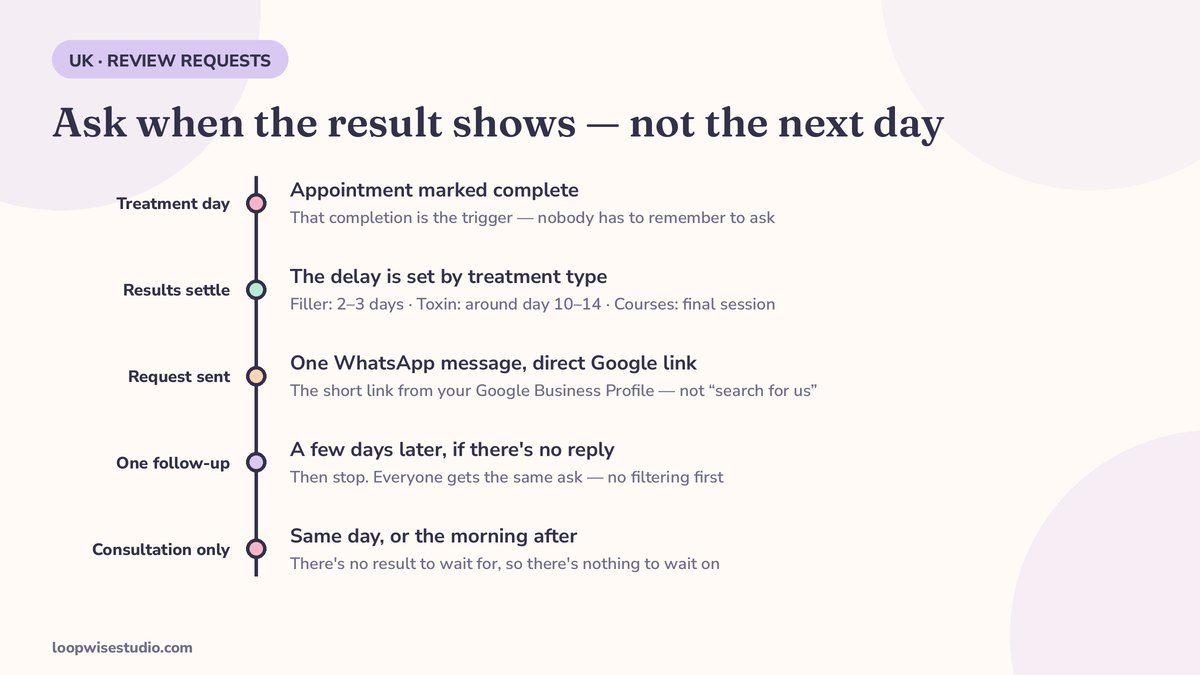
Most advice says “ask a day or two after the appointment.” For aesthetics, that’s often the wrong moment: the client can’t review a result they can’t see yet. Time the ask to when the outcome is visible.
| Treatment type | When to send the request |
|---|---|
| Consultation only | Same day, or the morning after |
| Filler and other immediately visible results | 2–3 days after |
| Toxin treatments (results settle over ~2 weeks) | Around day 10–14 |
| Skin treatment courses | At the end of the course, or the final session |
The mechanics are simple:
- Trigger: the appointment is marked complete in your booking system.
- Delay: set per treatment type, from the table above.
- Send: one WhatsApp or text message with the direct Google review link — the short link from your Google Business Profile, not a “search for us” instruction.
- One follow-up only, a few days later, if there’s no response. Then stop.
- Everyone gets the same ask. No satisfaction check first, no branching. The moment you route unhappy clients elsewhere, you’re gating.
The same automation layer that sends your appointment reminders can run this — it’s one more timed message in the sequence, which is why clinics that fix their WhatsApp appointment reminders for UK clinics usually fix their review flow at the same time.
The exact messages — copy these
Visit-framed, clinic-named, no POM names, no incentives, no star-rating language:
Hi [Name], thanks for visiting [Clinic] this week. If you have a minute, we’d really value a Google review — it helps other people in [town] find us. Here’s the link: [link]. Thank you.
The follow-up, once only:
Hi [Name], just a quick nudge on the review link from earlier in the week — no pressure at all if it’s not for you. Thanks again for coming in. [link]
Two wording rules. Say “a review”, never “a five-star review” — asking for a rating is steering. And say “honest” if you like, but never attach anything to it: no discount, no entry into a draw, no free product at the next visit.
What never to do — and what each risks
- Buying reviews. Illegal under the DMCC Act since April 2025, against Google policy, and detectable. Risk: CMA enforcement and profile-level penalties from Google.
- Offering anything in exchange. A discount or freebie for a review is an incentive — “fake engagement” in Google’s terms, and incentivised reviews must not be hidden under UK law.
- Gating. Asking only clients you believe are happy, or sending unhappy ones to a private form instead, is the single most common breach in this industry — and it’s still a breach even when a software vendor sells it as a feature.
- Building the campaign on a POM. “Leave us a review about your Botox” names a prescription-only medicine in advertising. Frame the ask around the visit, always.
- Staff or family reviews. Fake engagement under Google policy, fake reviews under UK law.
Replying to reviews without breaching anything
Reply to every review, good and bad, briefly and without discussing treatment details in public — confidentiality applies to your reply, not just your records. Thank positive reviewers by name. For a negative review: acknowledge, don’t argue, don’t confirm or deny what treatment anyone had, and move the conversation offline with a phone number. A calm reply to a two-star review does more for the next reader than the review does damage.
One more UK-specific point: never let a reply or a follow-up message become POM promotion either. “Glad your Botox worked so well!” in a public reply names the product in an efficacy context — the same rule 12.12 problem, in your own words.
Getting the link and the profile right first
The message only works if the plumbing behind it does. Three one-off jobs come before any automation:
Get your short review link. In your Google Business Profile, use the “ask for reviews” option to generate your direct review link. That link — not your Maps listing, not a QR code to your homepage — is what goes in every message. Every extra tap between the message and the review form loses reviewers.
Complete the profile the reviews sit on. BrightLocal’s figures, via ResoClinx, credit the Business Profile itself with 32% of local pack weighting — more than reviews. Businesses with complete profiles are, in Google’s own figures as reported through the same chain, 2.7 times more likely to be considered reputable and 70% more likely to attract a visit. A review system feeding an unfinished profile is half a system. The booking side of that same profile matters just as much: add a booking link to your Google profile so the searcher your reviews convinced can book without leaving Google.
Check your categories. ResoClinx’s guide cites a BrightLocal category study in which clinics using four additional Business Profile categories averaged a map position of 5.9, against 7.6 with none. Choose categories for the treatments you actually offer — and remember the POM rule applies to how you describe services in public-facing fields too.
How many reviews should a clinic aim for?
There is no magic number, and any guide that gives you one is inventing it. What the research supports is a rate, not a total: because 27% of consumers expect reviews from the last two weeks (BrightLocal, via ResoClinx), the target is a steady trickle that never fully stops — a few new reviews a week for a busy clinic, rather than fifty in a launch month and none after.
That rate falls out of the system naturally. If every completed appointment generates one request, your review velocity simply tracks your diary, which is exactly what a prospective client reading the profile expects to see: a clinic that is busy now, reviewed by people who attended recently. A sudden spike followed by silence reads, correctly, as a campaign.
The in-clinic backup — a QR card, used carefully
Automation should carry the system, but a small physical prompt still earns its place. Mumbles Studio’s UK guide lists getting your review link or QR code as step one for any business, and a card at reception or in the treatment room — “Been in recently? Tell Google how we did” with the QR code — catches the clients who ignore messages.
Two guardrails keep it legal. First, the card is self-serve: staff must not pressure clients to review while they’re on the premises, and nobody stands over a phone while it’s done. Second, the card carries the same wording rules as the messages — a review of the visit, no POM names, no offer attached. A QR card that says “£10 off your next treatment when you leave a review” breaks both Google’s incentive rule and, on a POM treatment, the CAP rules at once.
Put the reviews to work once you have them
A review’s job doesn’t end on Google. The recent ones are also conversion material: prospective clients reading your treatment pages are deciding whether to trust you with their face, and a steady stream of current, specific reviews is the strongest evidence you can show them. Surface a rotating selection on your website — with the reviewer’s words quoted exactly, never edited into something shinier — and let the recency do the persuading. What you must not do is cherry-pick in a way that misleads: UK law covers presenting reviews misleadingly, so a page showing only five-star extracts while the profile average is 3.8 is a problem, not a tactic. Quote fairly, show the overall rating alongside, and link through to the full profile.
How we set this up
The build is small: connect the review request to your booking system’s completed-appointment trigger, set the delay per treatment type, load the templates, and confirm the wording passes the three rule sets above. Clinics usually pair it with the wider review-automation approach used for automatic Google review requests for hair salons by text — same machinery, different timing and wording.
If you want the rules checked against your current review requests before you send another one, get a free audit — we’ll review your ask, your timing and your wording against Google policy, the DMCC Act and the CAP rules.
Frequently asked questions
Can I offer clients a discount for leaving a review?
No. An incentive — discount, freebie, prize draw — breaches Google’s policy on fake engagement, and UK law since 6 April 2025 treats hidden incentivised reviews as a fake-review offence. Ask plainly, offer nothing.
Is it gating if I only ask clients who seemed happy?
Yes. Selectively soliciting reviews from clients you expect to be positive is review gating under Google’s policy, regardless of how informal the selection is. The compliant system asks everyone the same question.
When should I ask after a toxin treatment?
When the result is visible — around day 10 to 14, since results settle over roughly two weeks. Asking the day after invites a review of an outcome the client hasn’t seen yet.
Can I mention Botox in the review request?
No. Under CAP rule 12.12, prescription-only medicines may not be advertised to the public, and the ASA treats virtually any reference — including indirect phrases like “wrinkle-relaxing injections” — as promotion. Frame the request around the visit and the clinic.
How many follow-ups can I send?
One. A single polite nudge is reasonable; repeated chasing pressures the client, which Google’s policy also prohibits. After one follow-up, the system stops.
Do reviews really affect my map ranking?
Yes. BrightLocal’s local ranking factors put reviews at about 20% of the local pack weighting, and its consumer research found 27% of people expect reviews from the last two weeks — which is why a steady trickle beats an occasional batch.
One last discipline: keep a simple log of requests sent and reviews received, by treatment type. Within a quarter it shows you which timings work — whether the day-10 toxin ask outperforms day 14, whether course-end requests beat mid-course ones — and it proves the system asks everyone, which is your evidence of compliance if a competitor ever complains to Google or the ASA.
Reviews are the cheapest ranking asset a clinic owns, and the easiest one to get wrong. Ask everyone, ask when results show, keep the wording inside the rules — then let the system run. Get a free audit if you’d like us to set it up and check the wording for you.