Med Spa Franchise: More Bookings at One Location
A med spa franchise playbook for one location: the booking levers you control, the ones HQ owns, and the front-desk systems that fill your diary.
A med spa franchise owner gets more bookings at one location by working the levers the franchise agreement leaves open: the location’s Google profile and reviews, book-before-they-leave rebooking at the front desk, after-hours enquiry capture, and waitlist fills. Website changes, pricing, and brand campaigns stay with HQ.
Almost every med spa booking guide on the internet is written for an independent owner. Rebuild your website. Change your prices. Pick better software. As a franchisee, you signed an agreement that hands most of those decisions to the franchisor. Prospyr’s franchising guide puts it plainly: under franchising, the franchisor dictates key aspects like marketing plans, customer service standards, and even the digital systems you use to manage patient information.
That doesn’t leave you powerless. It leaves you with a specific, shorter list of levers — and most franchisees never work that list properly. DK Law Group’s med spa ownership guide describes the standard franchise package as a set service menu and pricing model, centralized marketing support, and standardized branding and compliance protocols, in exchange for your franchise fees and ongoing royalties. Inside that package, the local relationships are yours. As one franchise-owner explainer (Colors On Parade) puts it: a franchise can provide a brand, systems, services and support, but it cannot build every local relationship for you.
This playbook sorts every booking tactic by who controls it, then works your column hard.
The control map: yours, HQ sign-off, not yours
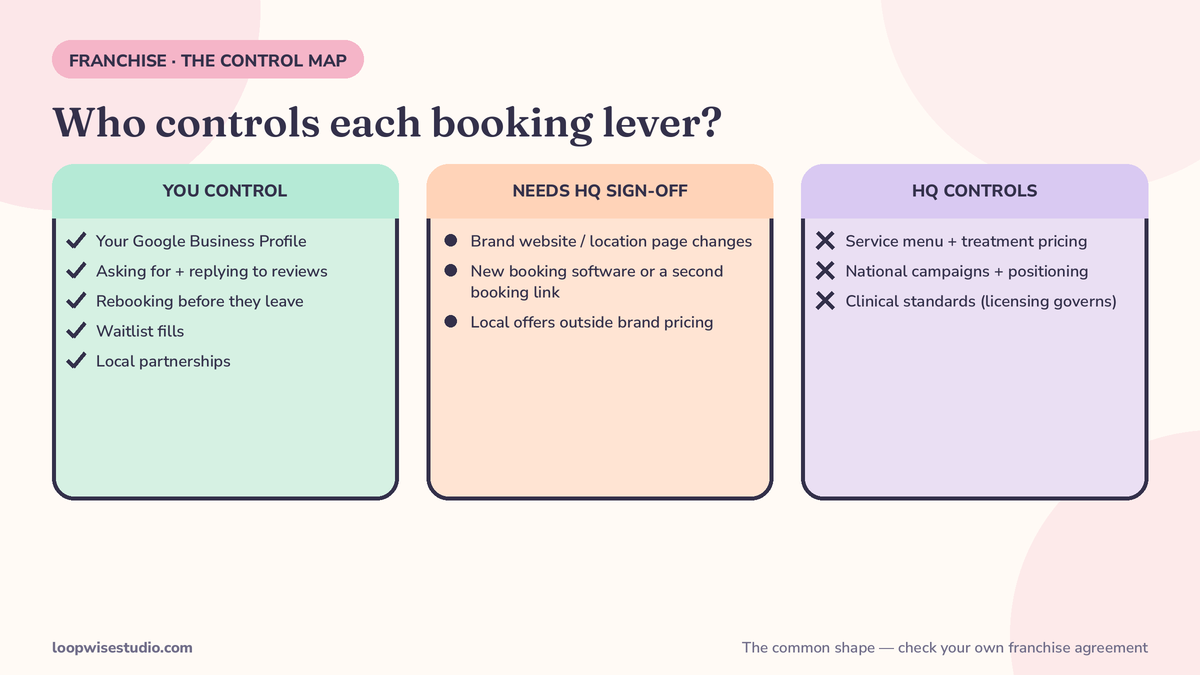
Agreements differ, so check yours before acting on any row. But the split below is the common shape, based on what franchisors typically reserve and what franchisees typically run day to day.
| Booking lever | Who controls it |
|---|---|
| Your location’s Google Business Profile (photos, Q&A, services list) | Yours |
| Asking for and replying to Google reviews | Yours |
| Book-before-they-leave rebooking at the front desk | Yours |
| Waitlist fills when a slot opens | Yours |
| After-hours enquiry capture on the approved booking stack | Yours (within the approved system) |
| Local partnerships (gyms, salons, employers) | Yours, inside brand guidelines |
| Selling HQ’s membership programme harder locally | Yours |
| Changes to the brand website or your location page | Needs HQ sign-off |
| New booking software or a second booking link | Needs HQ sign-off |
| Local offers or discounts outside brand pricing | Needs HQ sign-off |
| Service menu and treatment pricing | Not yours |
| National campaigns and brand positioning | Not yours |
| Clinical standards beyond licensing rules | Not yours (licensing governs) |
One line in that table deserves a note. Brand standards can cover your location, décor, equipment and uniforms, but a franchisor cannot impose standards on the medical professional’s practice of medicine beyond licensing standards — clinical quality control runs through state and federal licensing, not the brand manual (ABA Forum on Franchising paper, via Lathrop GPM). Your booking playbook lives in the operations column, not the clinical one.
Your Google listing is the website you actually control
HQ owns the brand website. But the page a local searcher actually lands on is usually your location’s Google Business Profile — and in most franchise systems, the location manages its own profile day to day: photos, opening hours, the services list, Q&A, and review replies.
Work it like a booking page, because that’s what it is:
- Photos that look like your rooms, not the brand library. Fresh photos of your actual treatment rooms, your actual team, your actual front desk. Searchers are choosing between you and the independent med spa two miles away; stock brand imagery makes you look identical to the franchise location in the next town.
- The services list, complete and priced the way HQ publishes it. An incomplete services list sends people to call — and calls that land after hours often go nowhere (more on that below).
- The booking link pointing at your location’s diary. If the brand system lets each location carry its own booking link, make sure yours is live and correct. A generic link to the brand homepage leaks the exact people who were ready to book. If the link is missing altogether, how to add a Google Business Profile booking link walks through the ten-minute fix, including the preferred-link setting.
- Review replies, from a named person, within a day or two. The reply is read by the next searcher, not the reviewer.
Reviews: the rules are not optional
Ask every patient, the same way, with no incentives and no filtering of unhappy patients toward a private form. Google’s review policy prohibits fake engagement and incentivized reviews, and the FTC’s Consumer Reviews Rule backs that up — Prospyr’s med spa playbook cites both primary sources and treats them as hard lines, and so should you. A simple, compliant setup: an automatic text or email after the visit asking every patient for a Google review, sent identically to everyone. That’s the same discipline described in our guide to automatic Google review requests for med spas — the franchise version is identical, just pointed at your location’s profile.
Book the next visit before they leave the building
The highest-conversion booking channel you own outright is the thirty seconds at checkout. No software change, no HQ approval, no ad spend. Most med spa treatments run on an interval — the next session is a clinical recommendation, not a sales pitch — which makes rebooking at the front desk a service, not a push.
Make it a system, not a hope:
- The clinician names the interval out loud. “We’ll see you in four weeks” in the treatment room carries more weight than any reminder text.
- The front desk books it before payment finishes. Not “call us when you’re ready” — an actual appointment, in the diary, with the patient’s name on it.
- The confirmation goes out automatically. Whatever the approved stack sends, check it actually fires for your location. A booked appointment with no confirmation is a future no-show.
- Track your rebooking rate weekly. Appointments booked at checkout divided by appointments completed. If it’s under half, the problem is the desk script, not demand.
The desk script itself can be one sentence: “Dr. Lee wants you back in four weeks — I have Tuesday the 12th at 10 or Thursday the 14th at 2. Which suits you better?” Two options, both real, no open-ended “when would you like?” This is the same discipline that drives down no-shows everywhere — our guide to reducing no-shows at a med spa covers the reminder sequence that protects the appointments you book this way.
If your front desk needs help making this stick, that’s exactly what a booking audit looks at first. get a free audit and we’ll map which of these levers your location is leaving unused.
After-hours enquiries at your location: capture, don’t hope
Your location’s phone rings when your location is closed. The brand’s national marketing doesn’t answer it. What happens to a 7:40 pm enquiry about booking a consultation at your unit is a local problem with a local fix — inside the approved stack.
Start by finding out what currently happens. Call your own location after hours and try to book. Then check three things:
- Does the approved booking system take the booking online, at that hour, for your location specifically? Prospyr’s 2026 comparison of 18 med spa platforms found 13 document online booking as included (Prospyr’s own comparison — and Prospyr is one of the 18, so read it as a vendor’s count). Included in the platform doesn’t mean switched on for your unit, or configured with your diary.
- Is there a missed-call text-back on the approved setup? An automatic text to anyone whose call you miss — “Sorry we missed you, book here” with your location’s booking link — is the single highest-yield after-hours fix, and it’s the system we break down in missed call text back for med spas. If the brand stack doesn’t offer it, that’s an HQ conversation (see the one-page case below), not a reason to install something unapproved.
- Who reads the morning enquiry list? A captured enquiry nobody follows up by 9 am is a booking for the med spa down the road. Assign it by name.
Fill your own off-peak without breaking brand pricing rules
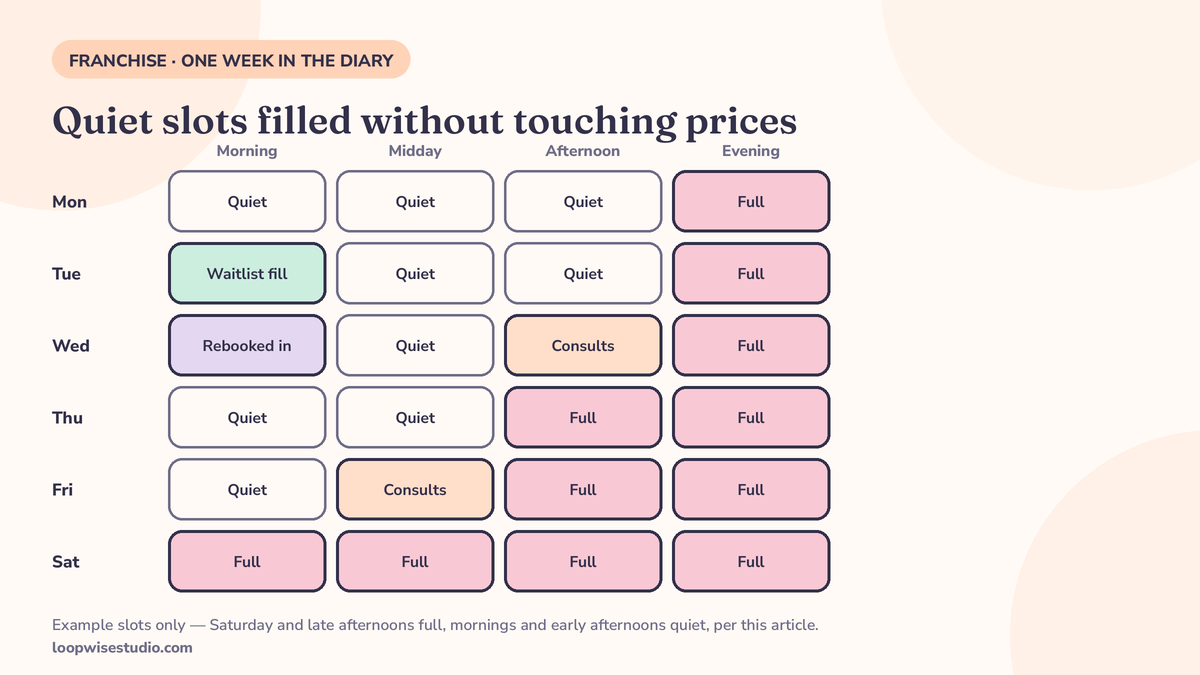
You can’t discount outside brand pricing. You probably can fill quiet slots — with timing, not price.
Your diary has a shape: Saturday and late afternoons full, Tuesday mornings empty. The levers that respect menu pricing:
- A waitlist that actually gets used. When a prime slot cancels, the first names on your waitlist get a text with a deadline to claim it. Waitlist discipline is pure front-desk behaviour — nobody at HQ can do it for you, and nobody can stop you.
- Move flexible patients into the gaps. Membership and package patients with standing intervals often don’t care which morning they come. Ask them. “Your next session falls in a busy week — I can do Tuesday at 10 and you’ll have the place to yourself” moves demand without touching price.
- Off-peak is when you book the consultations. Consults convert on the brand’s reputation, and they fill the chairs that would otherwise sit idle — then the treatments they book land in your prime slots.
What you cannot do is invent a Tuesday offer. If the gaps are costing you real money, quantify them (empty chair-hours per week, at menu prices) and take the number to HQ as a proposal for an approved local promotion. Franchisors respond to unit economics better than complaints.
Local partnerships: your territory advantage
The one channel HQ structurally cannot run for you is relationships within your territory. MedSpaProEvent’s single-location playbook makes the same point: a weak or saturated location is offset through local partnerships and community presence.
Inside brand guidelines, the working list is short:
- Gyms and fitness studios near you — their members already spend on how they look and feel.
- Salons and barbers who don’t offer your treatments — referral both ways.
- Local employers — a lunchtime talk or a staff-wellness introduction costs nothing and puts your location in front of people who live inside your territory.
- Nearby franchise units — cross-refer where a patient moves or asks for a location nearer work. Territory rules cut both ways; the unit that refers out gets referred to.
Keep every partnership inside the brand’s rules on claims and creative. If a partner wants to post about you, the approved assets exist for a reason.
If HQ runs a membership programme, out-sell every other unit locally
You probably can’t design a membership. Zenoti’s 2026 Beauty and Wellness Benchmark Report (Medspa Edition) — Zenoti’s own benchmark data — reports med spa membership sales grew 13% year over year in 2025, and that medspas with membership programmes were growing revenue at four times the rate of those without. Whether or not your brand’s numbers match its benchmark, the direction is clear: members book more predictably than walk-ins.
The franchisee’s playbook is not designing the programme. It’s enrolling harder than the unit in the next town:
- Offer enrolment at checkout, every time, with the maths done for the patient. “Your next three sessions are already in the diary — the membership makes each one cheaper. Here’s the difference.” One sentence, real numbers from the brand’s own pricing.
- Member-only local touches HQ allows: early access to your location’s new device or treatment slots, member appointment windows in your quiet dayparts — filling your gaps with your most loyal patients.
- Watch your members’ booking gaps. A member who stops booking is a phone call from your front desk, not a brand email campaign.
The one-page case: how to ask HQ for the fixes you can’t make
Some of your booking leaks genuinely sit in HQ’s column — the location page converts badly, there’s no text-back on the approved stack, the booking flow buries your diary. Franchisees who get movement write it as a one-page business case, not a gripe. Copy this structure:
Subject: Booking fixes for [location] — approval request
The leak, in numbers: Last month this location received [X] after-hours calls. [Y] of them left no message and booked nowhere. Our Google profile generated [Z] direction/call actions; our booking link appears on [profile/page] but not on [profile/page].
What I’m asking for: (1) missed-call text-back switched on for this location inside the approved platform; (2) our location-page booking link replaced with the direct diary link; (3) permission to run the brand-approved review-request text locally.
What it costs HQ: nothing beyond approval — setup and running sit with this location.
What I’ll report back: rebooking rate, after-hours bookings captured, and review volume, monthly, for one quarter.
Two things make this work. First, the numbers come from your own location — franchisors approve unit-level evidence. Second, you ask for approval inside the approved stack, which keeps brand and compliance teams calm. And check the market context you’re operating in: the same Zenoti benchmark reports med spa location counts growing 18% in 2025 while new guest visits declined 11% on a same-store basis — more units chasing fewer new guests is exactly why the local levers matter.
Your territory is a boundary — and a moat
One more constraint the independent-owner guides never mention: your territory. You generally can’t market into the neighbouring unit’s patch, and you shouldn’t want to — the franchisee two towns over is running the same brand, and poaching their patients buys you a complaint to HQ, not a business.
But a territory cuts the other way too. Inside your patch, you are the brand. Every local search, every partnership, every member enrolment in that area is yours to win or lose, and no other unit can take it from you. The single-location disadvantage the generic guides worry about — one diary, one postcode, no chain-wide cushion — is also a focus advantage: you know exactly which streets, gyms and employers your patients come from, because there’s only one front door they can walk through.
Practically, that means your marketing map is small and finishable. List the twenty businesses nearest you whose customers match your patient profile. You can realistically build a relationship with all twenty this quarter. An independent med spa with a city-wide ad budget can’t say that, and HQ’s national campaign never will.
What to measure at one location
Four numbers, monthly, on one page:
| Measure | What it tells you |
|---|---|
| Diary utilisation by daypart | Where your empty chair-hours actually are |
| Rebooking rate at checkout | Whether the front-desk system is working |
| After-hours enquiries captured vs lost | Whether the evening leak is plugged |
| New Google reviews per month | Whether your local presence is compounding |
Everything on that list is inside your control column. If a number won’t move, it points at the specific lever — or at the specific item for your next HQ conversation.
You don’t control the brand, the menu, or the national campaigns. You control whether your location’s diary is full. Work the local levers — Google profile, rebooking, after-hours capture, waitlist, partnerships — and document the rest as a case for HQ. get a free audit and we’ll sort your location’s booking fixes into the same three columns.
FAQs
Can a med spa franchisee change their own website?
Usually not the brand website — it’s HQ’s. Your location page content, your Google Business Profile, and your local booking links are often locally manageable. Check your franchise agreement: agreements differ, and the agreement, not this article, decides.
What booking levers does a franchisee actually control?
The front-desk ones: book-before-they-leave rebooking, waitlist fills, review generation at location level, local partnerships, and how after-hours enquiries at your location are captured on the approved stack. Pricing, menu, software choice and national campaigns are typically the franchisor’s.
Can I add missed-call text-back if HQ’s platform doesn’t have it?
Not unilaterally — new software usually needs HQ sign-off. The route that works is a one-page case with your location’s own numbers: after-hours calls received, how many booked nowhere, and the fix requested inside the approved platform where possible.
Is it against the rules to ask my patients for Google reviews?
No — asking is fine. What’s prohibited is incentivizing reviews, filtering out unhappy patients, or posting fake ones (Google’s review policy and the FTC Consumer Reviews Rule). Ask every patient, identically, with no reward attached.
Can I run my own discounts to fill quiet days?
Only if your agreement allows local promotions — most franchise pricing is set centrally. The pricing-safe alternatives are waitlist fills, moving flexible patients into off-peak slots, and booking consultations into the gaps. If you want a local offer, take the empty-chair maths to HQ as a proposal.
Should I promote the brand’s membership programme if I didn’t design it?
Yes — it’s your highest-value local sales job. You can’t change its terms, but enrolment at checkout, member booking-gap follow-up, and filling your off-peak with members are all local behaviours that decide how much of the programme’s value your unit captures.