WhatsApp Automation for Clinics in Saudi Arabia
WhatsApp automation for clinics in Saudi Arabia: booking, reminders, recalls and follow-ups in Arabic and English — with Meta's real SAR message costs worked out.
WhatsApp automation for a clinic in Saudi Arabia means patients book, confirm, reschedule and get reminded inside WhatsApp — in Arabic and English — instead of phoning reception. The system sends an instant confirmation plus reminders before the visit, runs on the official WhatsApp Business API, and collects patient opt-in first, as Saudi Arabia’s PDPL requires.
Your patients already run their lives on WhatsApp. The family group, the school run, the delivery driver — and, whether your clinic is set up for it or not, your reception. Most small clinics in Riyadh, Jeddah and the Eastern Province already take bookings on a receptionist’s personal WhatsApp, in between phone calls, from memory. Automation is not a new channel. It is that same conversation, organised: a real booking flow, a diary behind it, and reminders that send themselves.
This article covers the four jobs the system does, the exact messages in Arabic and English, the compliance rules in plain language, and — because nobody else publishing on this topic does it — what the messages actually cost in riyals.
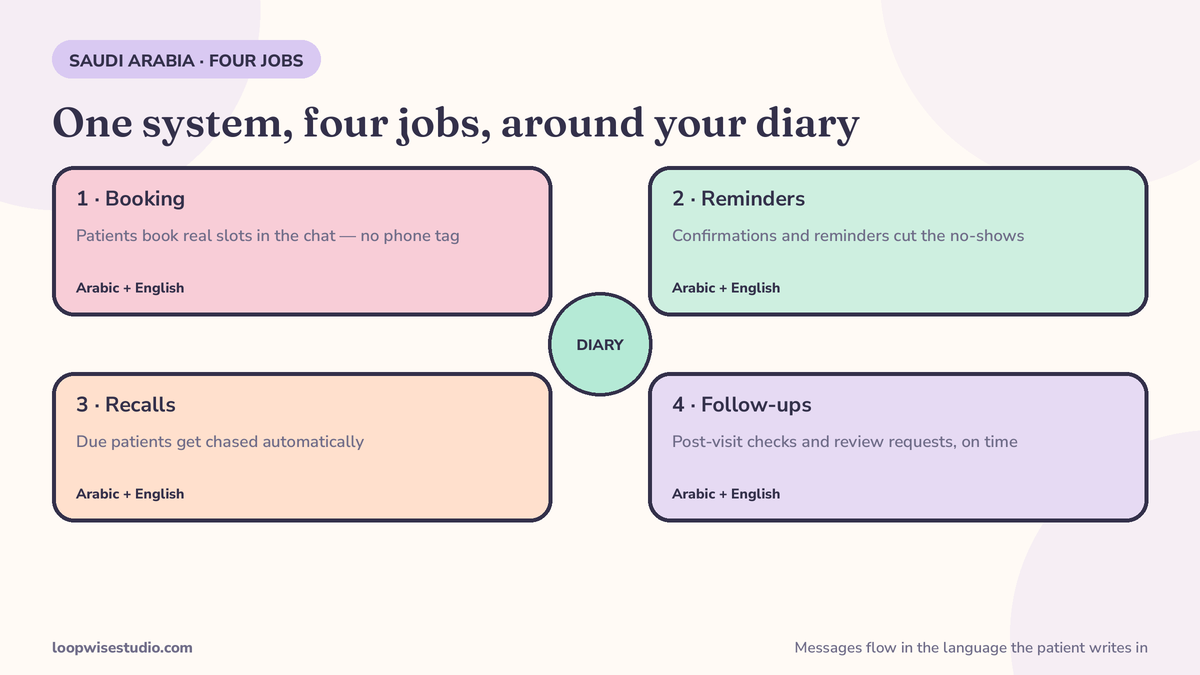
The four jobs: booking, reminders, recalls, follow-ups
Most content about WhatsApp for Saudi clinics sells hospital software: HIS integration, EMR connections, enterprise platforms. A private clinic with two to ten doctors does not need most of that. It needs four jobs done reliably.
Booking. A patient messages the clinic number, picks a doctor or service and a live slot, and leaves with a confirmed appointment — at 10pm as easily as at 10am. No app to download, no portal password.
Reminders. Confirmation instantly, then reminders before the visit, with confirm and reschedule buttons. This is the job that protects the diary.
Recalls. The appointments that never get booked because nobody chases them: the six-month dental check, the vaccination due date, the annual review. A recall message at the right interval books visits your clinic has already earned.
Follow-ups. After the visit: aftercare instructions as documents (never results in the message itself — see the compliance section), a satisfaction check, and the next appointment offered while the patient is still engaged.
Each job is simple. The system is what happens when all four run on one number, attached to one diary. It is the same architecture clinics use in Dubai — our guide to WhatsApp booking for aesthetic clinics in Dubai shows the booking half in full.
Recalls in detail: the appointments nobody chases
Reminders protect appointments that exist. Recalls create the ones that should exist and quietly don’t. GMCS’s enterprise guide to the WhatsApp Business API in Saudi Arabia catalogues the clinic reminder family beyond the appointment itself — follow-up visits, vaccination reminders, refill reminders and annual checkups — and for a small clinic, that list is where the easy revenue sits.
Set a recall rule wherever medicine already sets the interval. The dental patient who had a check-up in Muharram is due again in Rajab; the system messages her in the week she is due, with a Book button, instead of the clinic discovering her again eighteen months later. The chronic-care patient whose follow-up was “come back in three months” gets that message at three months, not whenever she happens to remember. Parents get the vaccination-due message for a child before the date, not after it.
Two disciplines keep recalls welcome. First, they only go to patients who opted in — a recall is closer to marketing than a reminder is, and the PDPL consent you captured at intake is what makes it legitimate. Second, one recall message, then one follow-up a week or two later if there is no reply, then stop. A recall that nags monthly becomes the reason a patient blocks your number — and then she never gets her real reminders either.
The appointment messages, written out
Automation lives or dies on copy. These are the core templates — formal Arabic (the right register for medical messages; warmth belongs in the greeting, not in slang) with English alongside.
Confirmation — sent instantly at booking:
Hello {name}, your appointment at {clinic} with Dr {doctor} is confirmed for {date} at {time}. Location: {map link}. Reply CHANGE to reschedule, CANCEL to cancel.
مرحباً {name}، تم تأكيد موعدك في {clinic} مع الدكتور {doctor} بتاريخ {date} الساعة {time}. الموقع: {map link}. لتغيير الموعد رد بكلمة «تغيير»، وللإلغاء رد بكلمة «إلغاء».
Reminder — 24 hours before, with buttons:
Reminder: your appointment at {clinic} is tomorrow at {time}. Tap Confirm if you are coming, or Reschedule to choose a new time.
تذكير: موعدك في {clinic} غداً الساعة {time}. اضغط «تأكيد» إذا كنت قادماً، أو «إعادة جدولة» لاختيار وقت جديد.
Recall — when the next check is due:
Hello {name}, it’s time for your next check-up at {clinic}. Tap Book to choose a time, or reply and we’ll help you pick one.
مرحباً {name}، حان وقت فحصك الدوري في {clinic}. اضغط «حجز» لاختيار الموعد المناسب، أو رد على هذه الرسالة وسنساعدك في الاختيار.
Two Arabic details separate a system that sounds Saudi from one that sounds translated. First, register: patient-facing medical messages use Modern Standard Arabic; the Saudi dialect warmth that platforms advertise belongs in replies from your team, not in clinical templates. Second, timing: ChatDaddy’s Saudi guide stresses prayer-time and Hijri-date awareness in scheduling, and it is right — reminders should be sent in daytime hours, and a recall that lands by the Hijri calendar will match how many patients actually think about annual checks.
Compliance in plain English: PDPL, opt-in, and what never goes in a message
Saudi Arabia’s Personal Data Protection Law (PDPL) is the rulebook here, and Watily’s Saudi API guide sets out the operating requirement clearly: get the patient’s opt-in before you message them for anything beyond the appointment they booked, and keep that consent on record.
The practical rules:
- Opt-in at reception or at booking. One line — on the intake form or in the first chat — where the patient agrees to appointment messages on WhatsApp. No opt-in, no marketing messages, ever.
- Appointment messages are expected; promotions are not automatic. A confirmation or reminder relates to a booking the patient made. A broadcast offering a discount is marketing: different consent, and a different price (see the cost section).
- Nothing clinical in the message. No diagnoses, no results, no medicine details. A reminder carries clinic, doctor, date, time, location — logistics only.
- New numbers start small. Watily, citing Meta’s documentation, notes a new business number starts at a limit of 250 unique customers per 24 hours for business-initiated messages, rising as the number builds a sending record. A small clinic will not hit it; a polyclinic planning a launch broadcast should know it exists.
- NPHIES is not this. NPHIES is Saudi Arabia’s national health insurance exchange — it governs insurance claims data between clinics and insurers. Vendor pages name-check it constantly, but your WhatsApp reminder system neither integrates with it nor needs to. Do not let anyone sell you an “NPHIES integration” as part of appointment messaging.
If you would rather have the templates, opt-in capture and reminder flows set up compliant from day one, get a free audit and we will walk through your clinic’s current setup.
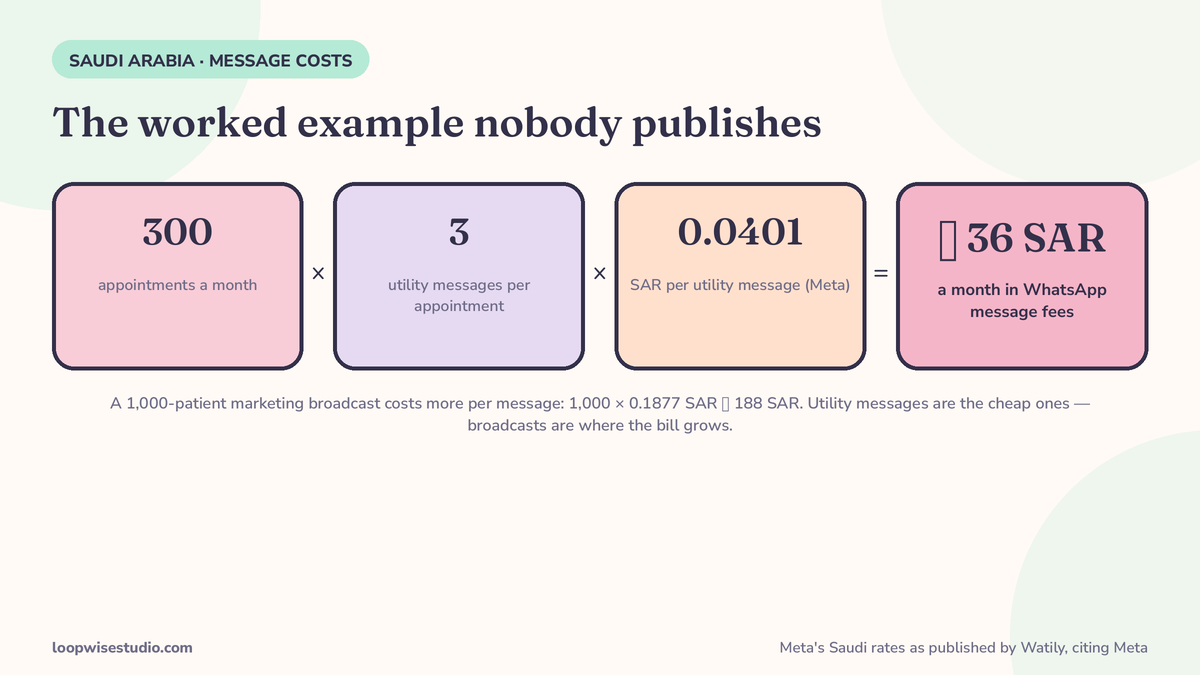
What it actually costs in SAR — the worked example nobody publishes
WhatsApp charges per delivered template message, and the price depends on the category. Watily’s guide to the WhatsApp Business API in Saudi Arabia, citing Meta’s own pricing documentation (rate card effective 1 July 2026), publishes the Saudi rates:
| Message category | What it covers | Meta rate (SAR per message) |
|---|---|---|
| Utility | Confirmations, reminders, appointment updates | 0.0401 |
| Authentication | One-time codes | 0.0401 |
| Marketing | Offers, promotions, win-back broadcasts | 0.1877 |
| Service | Replies inside a conversation the patient started | Free for the first 1,000 per number per month, then the utility rate from 1 October 2026, per Watily |
Now the arithmetic for a typical small clinic:
- 300 appointments a month, each getting a confirmation, a 24-hour reminder and a 2-hour reminder = 900 utility messages.
- 900 × 0.0401 SAR = about 36 SAR a month in Meta message fees for the entire reminder system.
Read that again, because it reframes every vendor conversation you will have: the messages themselves cost less than a team lunch. What you actually pay for is the platform on top — the software that connects your number, holds your templates and runs the diary. ChatDaddy’s published comparison table lists platform plans at $49 a month (WATI, Interakt), $99 (Respond.io) and $119 (ChatDaddy itself) — those are ChatDaddy’s own characterisations of its rivals’ pricing, so check each vendor’s current page. And reminders are the cheap category: one marketing broadcast to 1,000 patients costs 1,000 × 0.1877 = about 188 SAR, which is why the system earns its money on utility messages and treats broadcasts as an occasional, deliberate spend.
The no-show maths belongs on top of that: Techvention reported a 38% drop in no-shows and a 52% faster follow-up cycle — disclosed by Techvention as results from its own 2024 pilot across five Saudi polyclinics, so treat it as one vendor’s small pilot, not an industry benchmark. Your own clinic’s numbers will be your numbers; the cost side, at least, is now arithmetic instead of guesswork.
Clinics in Qatar run the same reminder cadence — see WhatsApp appointment reminders for clinics in Qatar for the message-by-message version — and UAE clinics work the same refill logic described in how UAE clinics reduce no-shows with WhatsApp.
What changes at the front desk on day one
Less than your team fears, and in the places they feel most. The phone still rings — some patients will always call — but it stops being the only door. The booking conversation that used to interrupt a receptionist mid-task now arrives as a chat she answers between tasks. The reminder calls that used to eat the first hour of the morning simply do not exist anymore; in their place is a short list of the patients who never confirmed, which is a ten-minute job with a coffee, not a morning.
What the team gains is the thread. Every booking, change and question about a patient sits in one searchable conversation on the clinic’s number, visible to whoever is on shift — not scattered across a personal phone, a paper diary and memory. Clinics usually report that this, not any percentage, is the change they would not give back.
Moving off the receptionist’s personal phone
Most Saudi clinics do not start from zero — they start from a senior receptionist’s personal WhatsApp, where two years of patient conversations live. That is a business risk hiding as a convenience: when she leaves, the clinic’s booking history, patient relationships and reminder habit leave with her.
The move is gentler than clinics fear. A clinic-owned number (a landline number can be connected to the WhatsApp Business API, or a dedicated mobile number) becomes the official channel. The website, Google profile, Instagram bio and in-clinic signage point to it. The personal number keeps working during the handover, with an away-style reply pointing patients to the new one. Within a month or two, patients message the clinic, not the person — and when any team member is away, the shared inbox means the conversation continues without her phone.
What does not move: the old personal chats. They stay on her device, which is exactly the point — patient data belongs to the clinic, on clinic systems, under clinic control. Starting the official history clean is a compliance feature, not a loss.
Questions to ask any provider before you sign
Watily’s guide ends with a provider checklist, and the instinct is right — interrogate the offer before the invoice. The five questions that matter most for a clinic:
- Which number do the messages come from — mine, and does it stay mine if I leave?
- Show me the per-message rates by category, and a worked monthly estimate at my appointment volume. (You now know the utility maths from the cost section — compare their answer against it.)
- Where does patient data live, and how is PDPL opt-in captured and stored?
- Who writes and approves my Arabic templates, and what happens when Meta rejects one?
- When a patient replies with a real problem, what exactly happens — and who answers it?
A provider who answers all five plainly is selling a system. A provider who answers with percentages is selling a pitch.
Do you need HIS or EMR integration? An honest answer
Probably not yet — and this is where clinics overspend. Integration matters when the WhatsApp system must read and write the same live record your doctors use, across departments. A small clinic whose diary is the source of truth needs the booking system connected to the diary, not a six-figure integration project.
Ask one question: where do appointments actually live in your clinic today? If the answer is one diary (paper, a spreadsheet, or basic software), the automation sits on that. If the answer is an EMR your doctors genuinely run the day from, the booking layer should connect to it — a smaller job than the enterprise pages imply. Buy integration when your workflow needs it, not when a vendor’s template page lists it.
How Loopwise sets it up
Loopwise Studio builds the system on your clinic’s own number and website: the booking flow, the Arabic and English templates approved and loaded, opt-in capture wired into reception and booking, reminders and recalls running against your diary, and replies landing in an inbox your team actually checks.
You keep the diary you have. Your patients keep the WhatsApp they have. What changes is that the conversation stops depending on who is holding the phone.
We turn missed calls and website visitors into booked appointments — and then the reminders make sure those appointments happen. The same build serves your other locations and verticals; our guide to WhatsApp booking for salons in Saudi Arabia covers the salon version. To see the system mapped onto your clinic, get a free audit.
FAQs
Is WhatsApp automation legal for clinics in Saudi Arabia?
Yes, on the official WhatsApp Business API, with patient opt-in collected and recorded as the PDPL requires. Appointment confirmations and reminders are service messages tied to a booking; promotional broadcasts need explicit consent. Keep all clinical content — results, diagnoses, medicines — out of messages entirely.
How much do the messages cost per month?
At Meta’s published Saudi utility rate of 0.0401 SAR per message (per Watily, citing Meta’s rate card effective 1 July 2026), a clinic sending three messages per appointment across 300 appointments pays about 36 SAR a month in message fees. Platform software is charged separately by whichever provider you use — check current pricing before signing.
Do messages have to be in Arabic?
They should be offered in Arabic and English, and the patient chooses. Formal Arabic (MSA) is the right register for medical templates; your team’s human replies can be warmer and more dialectal. A system that forces English on Arabic-speaking patients will simply get ignored by them.
Can the system handle recalls, not just reminders?
Yes — recalls are the fourth job in this article. Six-month dental checks, vaccinations and annual reviews are triggered by date rules against your patient list, with a Book button in the message. Recalls only go to patients who opted in.
Does it replace our clinic software or EMR?
No. It sits on your number and connects to the diary you actually use. Full HIS/EMR integration is an enterprise project most small clinics do not need for appointment messaging, whatever vendor pages suggest.
What happens when a patient replies with a real question?
The thread hands over to your team in a shared inbox — automation handles the routine 90%: booking, confirming, rescheduling. Anything clinical, urgent or unusual goes to a person the same working day.