Treatwell Alternative for UK Salons: 3 Routes Compared
Looking for a Treatwell alternative? Compare another marketplace, flat-fee software and your own booking system on commission, cost and who owns your clients.

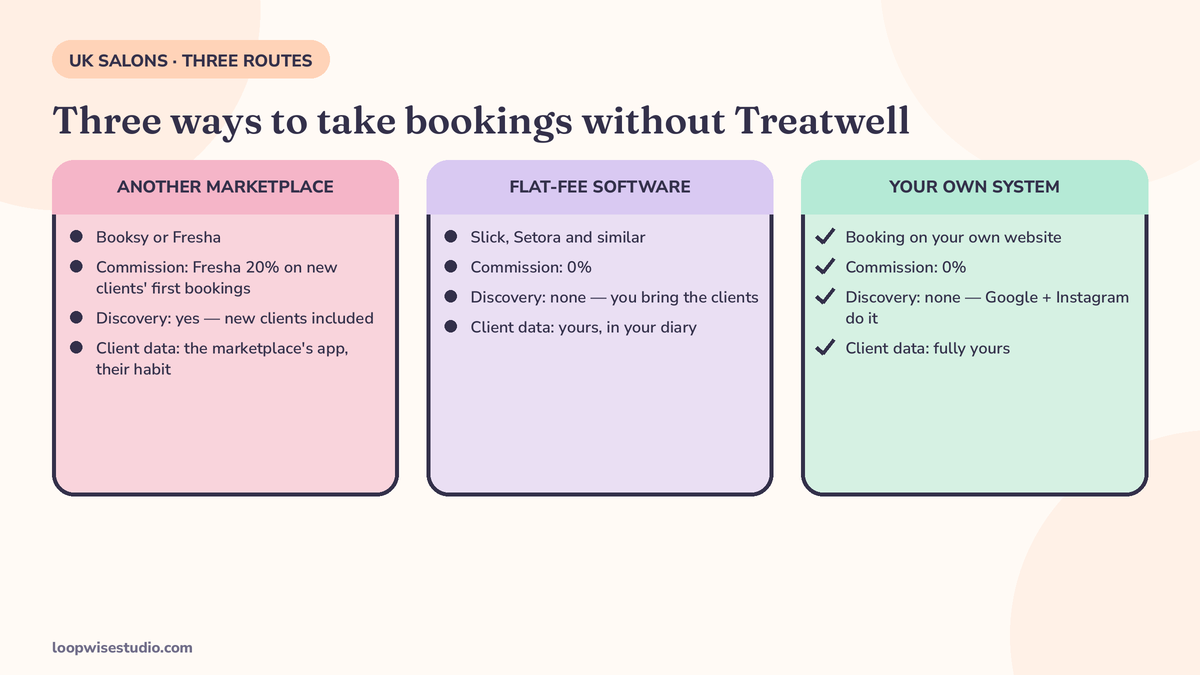
A Treatwell alternative is any way of taking bookings without Treatwell’s 35% commission on a new client’s first booking. The three routes: another marketplace (Booksy or Fresha), flat-fee salon software (Slick’s plans start at £22 a month), or a booking system on your own website. Most established salons do best with a hybrid — Treatwell for discovery, regulars on direct booking.
Treatwell is good at one thing: putting new clients in front of you. That’s worth paying for when you’re new or quiet. It gets expensive when your diary is mostly regulars who found you once, years ago, and keep arriving through a channel that still treats some of them as billable. Before you switch anywhere, work out what Treatwell actually does for your salon — because the right alternative depends entirely on the answer.
First, the 4 questions that decide it
Answer these honestly and the route usually picks itself.
- What share of your diary is regulars? Pull last month’s appointments. If 70% or more are people who’ve visited before, Treatwell’s discovery engine is doing less for you than you think — and repeat bookings are 0% commission on Treatwell anyway, so the cost sits in your new-client flow.
- Do you still need discovery? A salon in its first year, or one that’s just lost a stylist’s following, genuinely needs a marketplace’s footfall. An established salon with a waiting list doesn’t.
- Do you rent chairs? Chair renters and freelancers need their own columns, their own clients and split payments. That’s a different requirement from a single-team salon, and it rules some routes in or out.
- Who owns your client list right now? Treatwell’s own pricing FAQ is clear that your data remains your salon’s property, even after you cancel. But your marketplace profile and its reviews belong to the app and stay there. If your reviews and your rebooking habit live inside Treatwell, leaving costs more than the commission saves — until you’ve rebuilt both outside it.
Route 1: another marketplace — Booksy or Fresha
The simplest move, and the one the marketplaces themselves push: swap where clients find and book you.
What changes: the commission structure. Booksy publishes its UK starting price as £40 + VAT a month, with no standard new-client fee and an optional Boost at 30% if you want extra promotion (Booksy’s own comparison page, dated June 2026 — check current pricing). Fresha charges 20% once on a new marketplace client’s first completed appointment, with a £4 minimum, plus VAT, and a subscription of £9.95 per team member a month (figures from Fresha’s pricing page and help centre, via Resoclinx’s October 2026 read).
What doesn’t change: your clients still book inside someone else’s app, under someone else’s brand, next to your competitors. Your reviews live on their platform. And you’ll notice both routes still contain a paid-discovery lever (Boost, marketplace fees) — the meter didn’t disappear, it just got cheaper or optional.
One Fresha nuance worth knowing before you treat it as the cheap exit: per Resoclinx’s read of Fresha’s pricing page and help centre, the 20% fee can apply even when the client ends up booking on your own website, if they viewed your Fresha marketplace profile first. Clients already on your list are exempt. In other words, “cheaper commission” and “no commission” are different decisions — read the fee trigger, not just the percentage.
Choose this route if discovery is still your main need and you mainly want the mandatory 35% gone.
Route 2: flat-fee salon software — no commission, no discovery either
Tools like Slick replace the diary and the booking page, charge a flat monthly fee, and take no commission on anyone.
Slick’s published UK pricing starts at £22 a month for its Essential plan (+£14 per additional column), £37 for Advanced (+£21), and £250 for Supercharged (Slick’s compare page — check current pricing). Its comparison with Treatwell leans on exactly the things marketplaces charge around: SMS reminders included rather than metered, two-way texting, patch-test prompts, and split commissions for chair renters. It also offers to import your client list from Treatwell free.
The honest trade: flat-fee software brings you nobody. Every client who books through it found you somewhere else — Google, Instagram, word of mouth. If your problem is an empty diary, software alone doesn’t fix it. If your problem is paying commission on a full one, it fixes it completely.
One owner testimonial on Slick’s page is worth hearing because it names the real pain: “I’d pay 42% commission and the client would go to another salon for another offer and never return” — the 42% being the 35% commission with VAT loaded, from a salon owner whose clients the marketplace could re-sell to competitors. That’s the discovery model’s other side: the marketplace owns the relationship it created.
Route 3: your own booking system, on your own website
The third route skips both software rental and marketplaces: a booking system that lives on your own website, under your own name, with the client list in your hands.
Fusion Creative is a UK example of the done-for-you version — it builds salons their own branded booking app at £249 setup plus £99 a month on a 12-month minimum (its published pricing — check current terms). Its pitch is the sharpest version of this route: chains push their own apps because direct clients rebook more and cost nothing per booking.
What you gain: no commission on anyone, ever; the booking page is yours; reminders and follow-up can run on WhatsApp — the channel UK salons actually live on — rather than inside an app your clients had to download; and when a client rebooks, they rebook with you, not with a marketplace that also lists the salon across the road.
What it costs you: discovery. Your website doesn’t have Treatwell’s traffic. This route pays when your regulars, your Google presence and your Instagram already generate demand — which is most established salons, and is exactly why the hybrid below exists.
The three routes, compared side by side
| Another marketplace (Booksy/Fresha) | Flat-fee software (e.g. Slick) | Your own booking system | |
|---|---|---|---|
| New-client commission | Booksy £0 standard (Boost 30% optional); Fresha 20% once, £4 min | £0 | £0 |
| Monthly cost | Booksy £40 + VAT; Fresha £9.95 per team member | From £22/mo (published) | Varies; e.g. £99/mo + £249 setup (Fusion, published) |
| Brings you new clients? | Yes — its main job | No | No |
| Who owns the client relationship | The marketplace | You, inside their software | You |
| Reviews live on | Their platform | Your Google profile (if you build it) | Your Google profile |
| WhatsApp reminders/booking | Limited or add-on | Varies by tool | Yes — built around it |
| Effort to switch | Low–medium (imports offered) | Low (imports offered) | Medium — or done for you |
Prices as published by each vendor, checked October 2026 — confirm current pricing before you decide anything.
One more line to check on any route: the metered extras. Commission is the visible charge, but reminders are where small print lives — Slick’s own comparison table presents Treatwell’s SMS reminders as charged per message (0.07p per SMS, as Slick presents it), while Slick bundles unlimited SMS into its plans. Whether or not that specific figure survives your own check, the principle holds on every route: ask what confirmations, reminders and marketing messages cost per send, at your diary’s volume, before the monthly headline price persuades you. A busy salon sends thousands of messages a year; per-message pricing is a second subscription in disguise.
The fuller numbers behind Treatwell’s own charges — including the monthly fee Treatwell doesn’t publish and the 365-day rule — are in our explainer on how much Treatwell charges salons.
The hybrid most salons should actually run
Here’s the sequencing almost nobody sells you, because it involves keeping Treatwell: marketplace for discovery, direct for regulars.
- Keep Treatwell live. Let it do the one job it’s good at — first visits.
- Every client who rebooks gets your own booking link for next time. Repeats on Treatwell are 0% commission anyway, so you’re not dodging a fee today; you’re making sure that client is yours if you ever leave, and that they book you directly instead of browsing the app.
- Build your Google reviews in parallel, so your reputation doesn’t live solely inside Treatwell.
- When your direct channel carries most rebookings, the Treatwell bill shrinks to new-client commission only — and leaving entirely becomes a choice, not a leap.
When you’re ready to move people across properly, the step-by-step is in our guide to moving clients from Treatwell to your own booking system. And if you’re weighing Fresha as the destination rather than a waypoint, our Fresha alternative with WhatsApp booking covers that route honestly too.
If you’d rather have the whole thing assessed against your own diary before you touch anything, get a free audit and we’ll tell you which route your numbers point to.
What a year costs on each route: a worked example
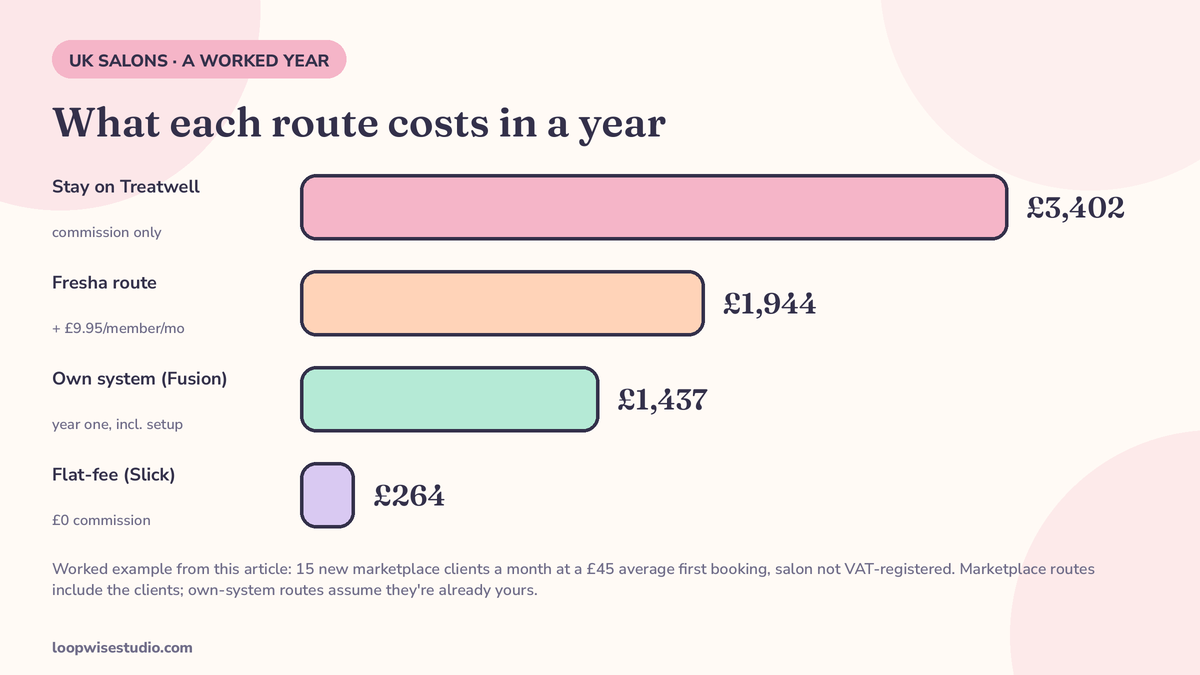
Assumptions, stated so you can swap in your own: 15 new marketplace clients a month, average first booking £45, the salon is not VAT-registered, and marketplace bookings are prepaid online.
Staying on Treatwell (new-client commission only): each new client costs £45 × 35% = £15.75 commission, + 20% VAT = £18.90. Fifteen a month is £283.50 — £3,402 a year, before Treatwell’s monthly software fee (which it doesn’t publish) and the 2.5% + VAT prepayment fee on those bookings.
Fresha route: 20% of £45 = £9 + VAT = £10.80 per new client → £162 a month, £1,944 a year, plus £9.95 per team member per month.
Flat-fee software route: Slick Essential at £22 a month is £264 a year, with £0 commission — but it brings no new clients, so the comparison only holds if your demand survives without marketplace discovery.
Your own system: Fusion’s published £99 a month + £249 setup is £1,437 in year one, £0 commission, no discovery included.
Read the table the right way round: the marketplace routes look expensive per year because they include the clients. The own-system routes look cheap because they assume the clients are already yours. The honest question is how many of those 15 monthly new clients you’d get anyway through Google and Instagram.
Replacing the discovery Treatwell gives you
Both non-marketplace routes raise the same objection: “But Treatwell sends me clients. Who sends them if I leave?” Fair question — and it has a real answer, because discovery isn’t one channel, it’s a stack:
- Google. A complete Business Profile with recent photos, your services listed, and a steady flow of reviews is where most local salon discovery actually starts. Unlike marketplace reviews, Google reviews are yours permanently.
- Instagram. Your portfolio already lives there. The fix is mechanical: a booking link in the bio that lands on your own page, not an app-store download.
- Your own client list. This is the one owners underrate. Research cited by Harvard Business Review puts the cost of acquiring a new customer at 5 to 25 times the cost of retaining one (as cited in Resoclinx’s UK fees guide). A lapsed-client win-back message to your own list costs pennies per person — and every client it returns books direct, at 0% commission, instead of re-triggering Treatwell’s 365-day rule through the app.
None of that matches a marketplace’s raw footfall in month one. All of it compounds, none of it charges 35% for the introduction, and none of it can be switched off by a platform changing its terms. The salons that leave Treatwell successfully build this stack before they go — which is why the hybrid, again, is the sequence that works.
Myth: Leaving Treatwell means losing every client it ever sent you. Fact: Your client data is your salon’s property — Treatwell’s own FAQ says so, even after you cancel. What you lose is the profile and its reviews. The clients are movable, if you move them deliberately.
Which alternative fits your salon
- Solo operator or chair renter: your clients are your column, and your income depends on them staying yours. Flat-fee software with chair-renter split support (Slick’s published feature set is aimed here) or your own simple booking page. Discovery marketplaces matter least to you — your clients follow you, not the salon’s name above the door.
- Multi-chair salon, established, mostly regulars: the hybrid, moving toward your own system. Your commission bill is mostly a tax on a diary you already fill.
- New salon or quiet diary: stay on a marketplace for now — Treatwell or the cheaper-commission routes — and build your direct channel and Google reviews from day one, so the exit is ready when the diary fills.
- Barbershop: walk-ins and regulars dominate; a flat-fee or own-system route with strong reminder and no-show tools usually beats marketplace commission. Our Booksy alternative for UK barbershops covers the barber-specific version of this decision.
Whichever route you pick, don’t let the switch itself be the project. The project is owning the rebooking. get a free audit if you want the route chosen with your real numbers rather than a vendor’s.
FAQs
What is the best Treatwell alternative for a UK salon?
There isn’t one best — it depends on what Treatwell does for you. If you need its new-client flow, another marketplace (Booksy or Fresha) cuts the commission. If your diary is mostly regulars, flat-fee software or your own booking system removes commission entirely, and a hybrid — Treatwell for discovery, direct booking for regulars — suits most established salons.
How much does Treatwell charge compared with the alternatives?
Treatwell takes 35% commission plus VAT on a new marketplace client’s first booking — an effective 42% if you’re not VAT-registered — and 0% on repeats. Fresha takes 20% once (minimum £4) plus a per-team-member subscription. Flat-fee software like Slick starts at £22 a month published, with no commission. Treatwell doesn’t publish its own monthly fee.
Do I have to leave Treatwell completely?
No. The hybrid is the most common sensible answer: keep Treatwell for discovery, move regulars to your own booking link for rebooks, and build Google reviews in parallel. Leaving entirely only makes sense once your direct channel carries most of your diary.
Will I lose my Treatwell reviews if I switch?
Your reviews stay on your Treatwell profile — they don’t move to Google or to another system. That’s why the play is to build Google review volume while you’re still on Treatwell and still seeing those clients, not after you’ve left.
Can another marketplace or software import my Treatwell clients?
Generally yes for contact data and appointments — Slick and Booksy both advertise free client import from Treatwell, and Treatwell’s own FAQ confirms the data remains your salon’s property. One hard limit, from Vagaro’s import documentation: cards on file never transfer, and customer data can’t currently be transferred out of Treatwell Pro (the app version) into Vagaro — check your export route before you commit.
What about WhatsApp? None of these seem to offer it properly
Right — it’s the missing axis in most comparisons. Marketplaces message inside their own apps; salon software is mostly SMS and email. A booking system on your own website can run confirmations, reminders and rebooking on WhatsApp, which is where UK salon clients already talk to their salon.