How to Reduce Tattoo No-Shows and Cancellations: A System
How to reduce tattoo appointment no shows with deposits, a 4-step reminder sequence, a policy clients read, and a waitlist that refills the chair. Copy included.
To reduce tattoo no-shows, studios combine four things: a deposit collected at booking (commonly $50–$100 flat for small work, 25–40% of the estimate for larger pieces), a multi-step text reminder sequence (at booking, 48–72 hours before, and day-of), a written cancellation policy with one free reschedule at 48 hours’ notice, and a waitlist that refills cancelled slots. Multiple reminders beat one — a study published in BMC Health Services Research found that clients who received several reminders missed significantly fewer appointments than clients who received just one.
Most no-show advice for studios stops at the first two items on that list. Deposits and a reminder. But a deposit does not refill an empty chair, and a reminder does nothing for the client who booked eight weeks ago and has quietly gone off the idea. This guide builds the whole system — prevent, protect, refill, recover — with the message copy and the maths included, because the copy and the maths are what the other pages leave out.
What a no-show actually costs a tattoo studio — do your own maths
An empty chair is not an inconvenience. It is the most expensive hour in your week, because tattoo time cannot be stored, discounted at the last minute, or sold twice.
Do the count with your own numbers. Here is the arithmetic, with the assumptions stated so you can swap in yours:
- One artist, average session length 2 hours, at $150 an hour — a $300 booking.
- That artist no-shows twice a month. Not a disaster month. A normal one.
- 2 × $300 = $600 a month, $7,200 a year, from one chair, at a rate most artists would call “pretty good.”
Now the version nobody puts in writing: the booth renter. If you rent your chair, the rent is due whether the client shows or not. A no-show does not reduce your costs by a cent — it converts a booked day into a day you paid to sit in an empty studio, on top of the lost session money. For an independent artist, one ghosted Saturday session can be the difference between rent covered and rent chased.
You will see bigger numbers quoted elsewhere — vendor guides commonly claim studios lose thousands a month, and some of those worked examples use three artists and higher rates. The direction is right; the point of doing it with your own diary is that your number is the one that tells you how much system is worth building.
Why tattoo clients ghost — it’s different here, and each cause has a different fix
A tattoo no-show is rarely a dental no-show. The psychology is specific to this trade, and naming the cause matters because each cause is answered by a different part of the system.
Anxiety. Custom work is permanent and it hurts. A client who was brave in the consultation gets less brave in week six. Silence feels easier than saying “I’m scared.” — answered by the check-in message and the design checkpoint (Parts 2 and 5).
Price shock, delayed. They agreed to the estimate when the design was exciting. By the week of the session, the number is just a number. — answered by the deposit (they already have money in it) and the reminder that reconnects them to the design, not just the date.
The long lead time. Good artists book out weeks or months. Life moves: jobs change, money changes, the idea fades. A booking made in March is a stranger’s promise by May. — answered by the mid-lead check-in and an easy reschedule path before the gap becomes a ghost.
Plain forgetting. Real, and the smallest cause — but the only one a single reminder fixes.
Avoiding the conversation. They want to cancel but do not want to say it to a person, so they say nothing at all. — answered by giving them a way out that is not a phone call: reply to a text, tap to reschedule. Every system below includes an exit that does not require courage.
Part 1 — Deposits that fit the work: skin in the game, sized to the session
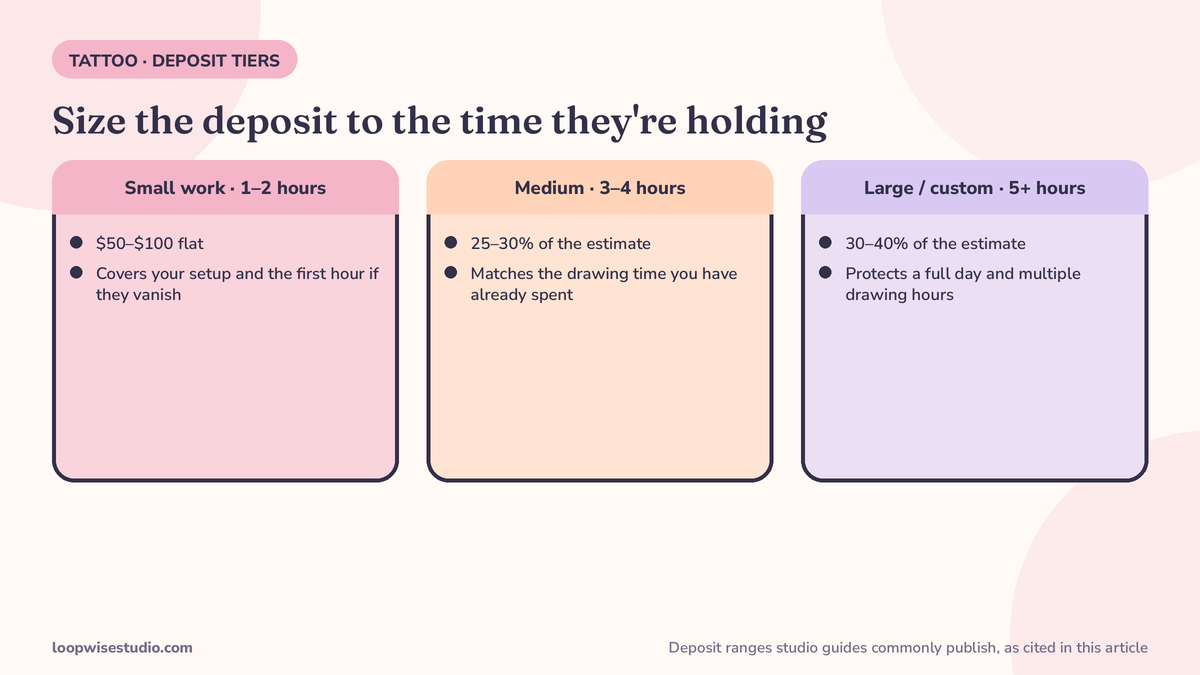
A deposit is not a punishment. It is the client putting money where their booking is, which changes the booking from an intention into a commitment. The ranges below are the ones studio guides consistently describe as common practice — Tattoo Studio Pro’s studio guide and Bookedin’s policy playbook land on the same tiers:
| Session type | Common deposit | Why this size |
|---|---|---|
| Small work, 1–2 hours | $50–$100 flat | Covers your setup and the first hour if they vanish |
| Medium work, 3–4 hours | 25–30% of the estimate | Matches the drawing time you have already spent |
| Large / custom, 5+ hours | 30–40% of the estimate | Protects a full day and multiple drawing hours |
| Known repeat offenders | Full prepayment | Earned, not default — see the ladder in Part 4’s follow-up |
Rules that make deposits work instead of just existing:
- Collect it at booking, in the booking flow. A deposit you “arrange later” is a deposit half your clients never pay. If your booking happens on your own website, the deposit is a step in the flow, not a follow-up chore — that flow is the subject of our page on the tattoo studio website with online booking and deposit payment.
- The client acknowledges the terms before paying. One checkbox: deposit amount, what it covers, the reschedule rule. That acknowledgment is also your protection if a payment is ever disputed — keep the timestamped record.
- Consultations count too. This is the leak almost no guide covers. A ghosted consult kills a whole custom project before it starts — the drawing, the sessions, all of it. Studios handle it two ways: a small consult deposit that comes off the tattoo price, or a free consult with a card held on file. Either beats a consult that costs the client nothing to abandon.
- One free reschedule, stated up front. Generosity on the first move makes the strictness on the second one enforceable. More on that in the policy.
Part 2 — The reminder sequence: four touches, each with a job
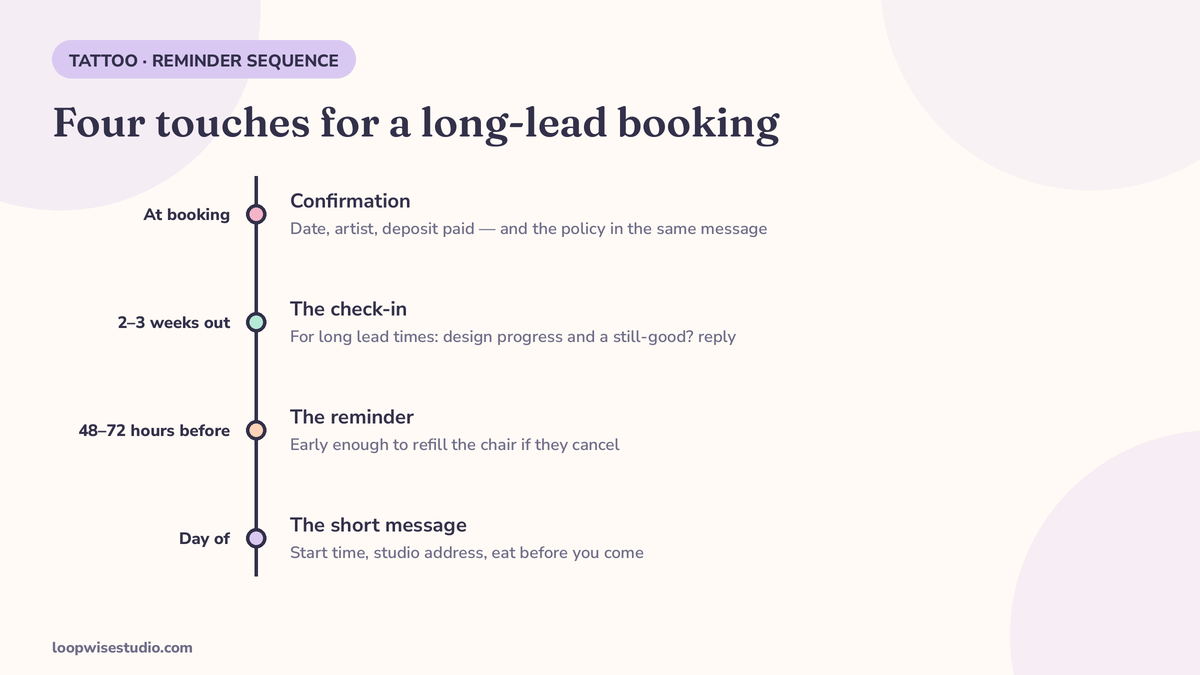
One reminder is a nudge. A sequence is a system. The BMC Health Services Research finding — several reminders, significantly fewer missed appointments than one — is the evidence; here is the sequence that puts it to work for a trade where bookings are made weeks ahead.
| When | Job of the message | Channel |
|---|---|---|
| At booking | Confirm + restate deposit and policy while motivation is highest | Text + email |
| 2–3 weeks out (long leads only) | Reconnect them to the design; catch fading intent while the slot can still be refilled | Text |
| 48–72 hours before | The decision point: confirm, or reschedule while refilling is still possible | Text |
| Day of, 1–4 hours before | Logistics: address, parking, eat first, bring ID | Text |
The copy — adapt it, don’t paraphrase it into mush:
Booking confirmation:
You’re booked in with [Artist] on [date] at [time] for your [piece]. Your deposit of [$X] is in and comes off the final price. Need to move it? One free reschedule with 48+ hours’ notice — just reply here.
The long-lead check-in (the message no other system sends):
Hi [Name], checking in on your [piece] — [Artist] is finalising the design this week. Still happy with the direction? Reply YES and we’ll lock it in, or tell us what you’d tweak.
The 48–72 hour reminder (with the easy exit built in):
Reminder: your session with [Artist] is [day] at [time]. Reply C to confirm. If something’s come up, reply R and we’ll move you — please don’t just not show, your deposit covers one free move.
Day-of:
Today’s the day — [time] at [Studio, address]. Eat something proper before, bring your ID, and give yourself time to park. Running late? Text us here.
One hygiene note, because it decides whether any of this works: you will see “98% of texts are opened” quoted in vendor guides, attributed loosely to Gartner. We could not verify that figure at the source, so this guide does not build on it. What you can verify is your own diary — send the sequence for a month and count.
If you’d rather the deposits, the sequence, and the refill below were wired up for your studio instead of assembled by hand, get a free audit and we’ll show you the flow on your own diary first.
Part 3 — A cancellation policy clients actually read (and you actually enforce)
Policies fail in two directions: written like a legal threat, so clients ignore them; or never enforced, so they are fiction. The working version is short, human, and identical for everyone.
Copy-ready policy:
Your deposit holds your slot and covers your artist’s drawing time. You can move your appointment once, free, with at least 48 hours’ notice. Inside 48 hours, or if you don’t show, the deposit is forfeited and a new one is needed to rebook. Running 15 minutes late? Message us — after that we may need to reschedule so the next client isn’t rushed.
Three things in that wording are deliberate. It says what the deposit is for (drawing time is real work clients forget exists). It makes the free move generous and visible. And it gives lateness a number — the 10–15 minute grace window studio guides commonly use — instead of leaving it to a doorstep negotiation.
Then the hard part: enforce it at the same level for the regular of five years as for the first-timer. Bookedin’s policy playbook makes this point well — the studios that struggle are the ones where enforcement depends on who is asking. A policy with exceptions for people you like is not a policy; it is a mood.
Part 4 — Refill the chair: the half of the system everyone skips
Prevention will never be perfect. The studios that lose the least are not the ones with the fewest cancellations — they are the ones whose cancelled slots get sold again. That takes two mechanisms working together.
Make cancelling early the path of least resistance. Every reminder above carries a reschedule reply. A client who replies R at the 72-hour mark has not cost you a slot — they have given you three days to sell it. A client with no easy exit ghosts at the last minute instead. Your reminder sequence is secretly a refill system: its job is to surface the cancellation while there is still time.
Run a ranked waitlist, not a hopeful list. When a slot opens:
- Text the waitlist in order — people waiting on that artist and that session length first.
- Give the first reply a short window (30–60 minutes) to confirm and pay a deposit, then move to the next name.
- The slot is only filled when the deposit lands. “Interested” is not booked.
The text:
A slot just opened with [Artist]: [day, time] — about [X] hours. You’re first on the list. Want it? Reply YES in the next 45 minutes and we’ll send the deposit link to lock it in.
The same refill mechanics apply across appointment trades — the salon version is covered in our guide to how cancelled appointments get filled automatically — but tattoo needs the artist-and-length matching that generic systems skip.
When they ghost anyway — the 24-hour follow-up and the repeat-offender ladder
It will still happen. What you do in the next 24 hours decides whether that client is lost, recovered, or quietly costing you again next quarter.
The follow-up message (send it the next day, firm and human):
Hi [Name], you missed your session yesterday at [time]. As per the policy you agreed to, the deposit is forfeited. If something serious came up, tell us — we’d rather rebook you than lose you. A new deposit is needed to hold a new slot.
Bookedin publishes a similar no-show note, and the tone is the point: no shaming, no grovelling, the rule restated and the door left open.
The ladder for repeat offenders:
- First ghost: policy applied, new deposit to rebook.
- Second ghost: full prepayment before any session is booked.
- Third: phone-only booking or a polite decline. Your chair time is finite; some clients are expensive at any price.
Log every no-show against the client record. Memory lies; the data tells you who has earned which rung.
And one recovery the ladders miss: the client who ghosted three months ago and is not a repeat offender, just embarrassed. A single message at the 2–3 month mark recovers a surprising share of them:
Hi [Name], no hard feelings about [month] — life happens. [Artist] has a couple of slots in [month] if you still want the piece. New deposit holds it, same as before.
Embarrassment, not malice, is what keeps them away; the message that removes the embarrassment has to come from you. Studios that send it treat a ghost as a paused client. Studios that don’t, lose them to the shop across town that never knew.
Measure it — the two numbers that tell you if the system is working
Systems you cannot measure decay into habits. Two numbers, counted monthly per artist, tell you the truth:
Your no-show rate. No-shows divided by booked sessions. Count it before you change anything, then monthly after. This is also the honest replacement for the industry figures floating around vendor pages — you will see ranges like “8–20%” quoted for tattoo studios with no source attached, and reduction claims of “40–60%” repeated from page to page, also unsourced. Your diary is a better source than any of them.
Your refill rate. Of the slots that cancelled with more than 24 hours’ notice, how many were rebooked? This is the number nobody tracks, and it is where the waitlist earns its keep — a studio can hold a stubborn no-show rate and still lose very little money if the refill rate is high.
Track the causes alongside, the way other appointment trades have learned to. Our guide to how to reduce no-shows at a med spa is built on the same split — measure first, then fix the cause that is actually costing you — because a forgetting problem and an anxiety problem look identical in an empty diary and nowhere else.
The commitment extras — forms and design checkpoints before the day
Deposits are a money commitment. These are attention commitments, and they fight the anxiety-ghosting that money does not touch:
- Consent and intake forms completed before the session, not on the couch. A client who has filled in their details, health notes, and ID check has mentally arrived. Send the form with the 72-hour reminder.
- A design checkpoint. For custom work, a deadline: reference images in by a set date, design preview acknowledged before the session. Each checkpoint is a small yes that makes the big yes — showing up — easier.
- Reference-image deadlines double as a filter. A client who cannot send three reference photos in six weeks was never going to sit for six hours. Better to learn it at the checkpoint than at an empty chair.
Frequently asked questions
How much deposit should I charge for a tattoo appointment? The ranges studio guides describe as common practice: $50–$100 flat for small work of 1–2 hours, 25–30% of the estimate for medium pieces, and 30–40% for large custom work. Size it to the time the client is holding — the deposit should hurt a little to lose, and cover your drawing time if they vanish.
How many reminders should a tattoo studio send? Four touches for a typical booking: a confirmation at booking, a check-in two to three weeks out when the lead time is long, a reminder 48–72 hours before, and a day-of message. The evidence points the same way — the BMC Health Services Research study found clients who received multiple reminders missed significantly fewer appointments than those who received one.
Should consultations require a deposit too? A ghosted consultation kills an entire custom project, so it deserves protection. Studios commonly use either a small consult deposit that comes off the final price, or a free consult with a card held on file. What does not work is a consult that costs the client nothing to abandon.
What do I do about chargebacks on deposits? Keep the paper trail: the client’s acknowledgment of the deposit terms at booking, the reminder history, and the no-show record. Bookedin’s policy guidance stresses documenting the policy agreement before the appointment — a deposit the client agreed to in writing, for a slot you held, is a very different dispute from a charge that appeared from nowhere.
A regular no-showed for the first time. Do I really keep their deposit? Apply the policy the same way for everyone, and use the follow-up message’s open door for the human part — if something serious happened, you can choose to rebook them, but they still need a new deposit to hold a slot. The moment enforcement depends on who is asking, the policy stops working for everyone else.
Does this system work for walk-in shops? Partly. Walk-ins have no booking to protect, but the booked half of most shops — the custom and multi-session work — is where the expensive empty hours live. Run the full system on booked work, and let the waitlist text double as your call-out when a chair frees up mid-day.
Deposits stop the casual booking. The sequence stops the forgetting and the fading. The policy makes both enforceable without an argument. And the waitlist means the cancellations that happen anyway stop being lost days. No single piece does the job — the four together are the system.
If setting it up inside your current booking flow sounds like a second job, get a free audit and we’ll map exactly how it would run in your studio — deposits, sequence, and refill — before you change a thing.