Barbershop Walk-Ins vs Online Booking: How to Run Both
Run walk-ins and online booking in one UK barbershop: sell quiet windows online, protect peak hours, keep the queue fair and charge deposits only where they fit.
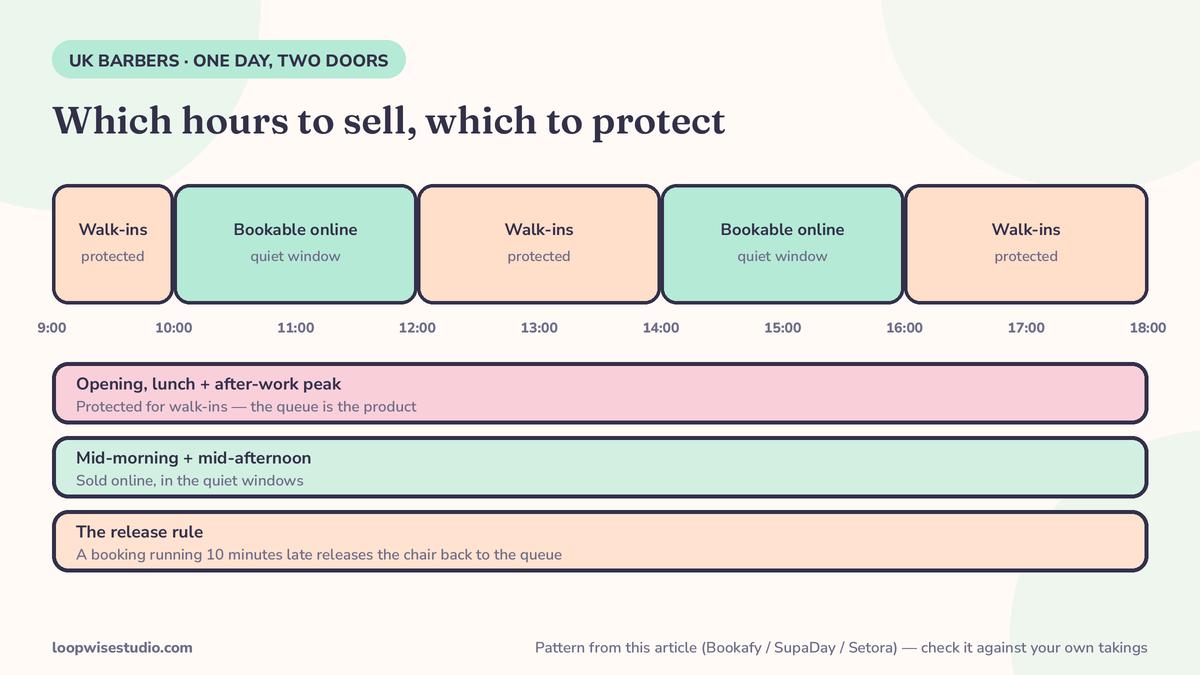
Run both by selling only part of the day online: open your quiet hours — mid-morning, mid-afternoon — for booking, protect opening, the after-work run and Saturday for walk-ins, and run both through one diary so a booked slot and the queue never fight over the same chair. Deposits apply to online bookings from strangers, never to regulars in the queue.
Most barbers don’t resist online booking because they’re behind the times. They resist it because they’ve seen the appointment-only version: Saturday regulars turned away because the diary filled up with strangers three days earlier, the queue — the whole social engine of the shop — replaced by a waiting room of people staring at phones.
That version is a choice, not a consequence. As the US booking platform Bookafy puts it, the first question is not which software. It is how much of your day you are willing to sell in advance. This guide is the hybrid answer, written for UK shops: the window model, the queue rules, the deposit rules, and the chair-renter setup.
The three ways a barbershop can run
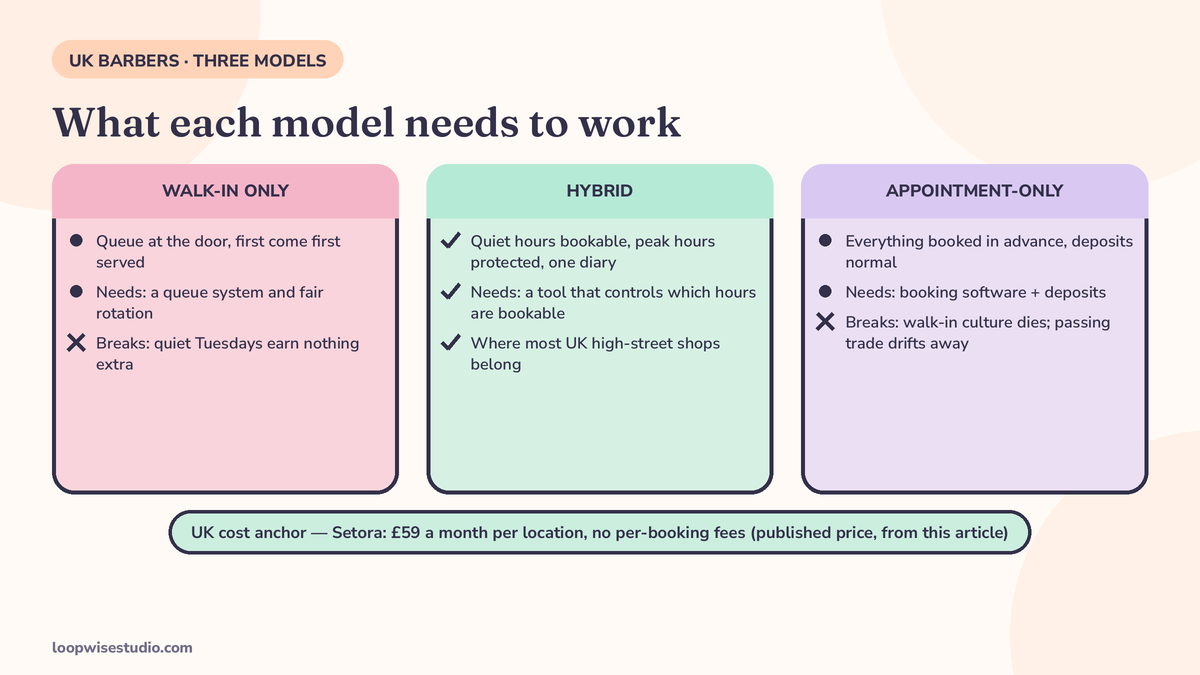
| Model | How it works | What it needs | Where it breaks |
|---|---|---|---|
| Walk-in only | Queue at the door, first come first served | A queue system and fair rotation | Quiet Tuesdays earn nothing extra; no cover when you’re shut — the client who would book at 9pm goes elsewhere |
| Hybrid | Quiet hours bookable online, peak hours protected for walk-ins, one diary | A booking tool that lets you control which hours are bookable | Needs the rules below, or the two sides collide |
| Appointment-only | Everything booked in advance, deposits normal | Booking software + deposits | Walk-in culture dies; passing trade and regulars who “just pop in” drift to the shop down the road |
Bookafy’s own model table makes the same split. Most UK high-street shops belong in the middle row — busy enough at peak to protect the queue, quiet enough midweek to sell some hours in advance.
How to know which you are: if your Saturday has a queue by 10am but your Tuesday chairs sit empty for hours, you’re a hybrid shop whether you’ve set it up or not. The only question is whether those empty Tuesday hours are being sold.
The bookable window: which hours to sell online
The rule, in Bookafy’s sharpest formulation: if you’re hybrid, open a window — publish your quiet hours for booking and keep the rush for walk-ins.
A typical UK shop week, using the demand pattern described by SupaDay (Monday–Wednesday slow, Thursday–Friday building, Saturday packed — an illustrative pattern, so check it against your own takings):
| Day | Bookable online | Protected for walk-ins |
|---|---|---|
| Mon–Wed | Mid-morning and mid-afternoon windows (e.g. 10–12, 2–4) | Opening hour, lunchtime, after-work run |
| Thu–Fri | Mid-morning window only | Lunchtime onwards gets busy — protect it as it builds |
| Saturday | Nothing, or a handful of early slots | The whole day: the queue is the product |
Setora, the UK booking platform, describes the same model from the setup side: hold slots back for walk-ins — the first or last hour of the day — or, in a multi-barber shop, keep a dedicated walk-in chair. It also sets the expectation owners need: patterns settle in two to three weeks. The first week’s diary will look odd. Judge it in week three, not day three.
Two refinements most guides skip:
- Bookable windows are per barber, not per shop. Your senior’s Tuesday may be booked out on regulars while your junior’s is empty. Open the windows chair by chair.
- Windows can move with the season. December needs fewer bookable slots — the queue does the work. January needs more. Review the windows monthly, like you review your prices.
One diary, two doors: when a booking meets the queue
The collision every barber fears: a booked client walks in at 2pm for her slot, and three walk-ins are already waiting, watching her go straight to the chair.
Handled badly, that’s a grievance. Handled openly, it’s advertising — the queue just watched proof that booking works. The rules that make it fair:
- One diary, visible to the whole shop. Booked slots appear in the same diary or queue view as walk-ins. If the booking lives in an app nobody checks, collisions are guaranteed.
- The booked slot is a real time, not a queue-jump. The client booked 2pm, so she sits at 2pm — not when she arrives early, and the queue is told her time when she walks in: “She’s the 2 o’clock booking — you’re after the gent in the blue coat.”
- The late-arrival release rule. If a booked client is more than 10 minutes late, the slot releases to the queue and she joins the back of it (or rebooks). Say it at booking, in the confirmation message, and enforce it evenly — including for regulars. This one rule protects the queue from the diary, and it’s the rule no ranking guide currently teaches.
- Waiting times told honestly. When a walk-in asks “how long?”, the answer counts the booked slots in the window, not just the bodies in chairs.
Keeping the queue fair: rotation and turns
Online booking doesn’t end the oldest fairness problem in the shop: whose chair is next. SupaDay’s blog is the one source that takes it seriously, describing turn tracking — half turns for quick jobs like line-ups, full turns for full services — so rotation stays honest and no barber feels the good chairs eat first.
The hybrid version of the rule:
- A booked appointment counts as that barber’s turn taken. No double-dipping: you don’t take the 2pm booking and stay top of the walk-in rotation at 2pm.
- A named-barber request (“only if Dan’s free”) waits for Dan, outside the rotation. A next-available walk-in takes whoever the rotation says.
- Half/full turns still apply on the walk-in side: a five-minute tidy-up shouldn’t cost a barber the next full cut in the queue’s eyes, and the team should agree the split before Saturday, not during it.
Write the rotation down where the team can see it. Fairness arguments happen when the rule lives in one person’s head.
Deposits without insulting your regulars
Deposits have exactly one job in a hybrid shop: stopping strangers from booking your quiet windows and not showing. They are not a tax on loyalty.
The published practice, from Setora’s UK guide: a £5 or £10 deposit at the time of booking, applied to first-timers or premium services. Bookafy’s version of the principle is the cleanest statement of it: deposits on online bookings; regulars and walk-ins pay in the chair.
Applied properly:
- Online booking, first time at your shop → £5–£10 deposit.
- Online booking, named regular → no deposit. She’s never no-showed you in six years; charging her one buys you nothing.
- Walk-ins → never. The queue is pay-in-chair, full stop.
- Peak slots, if you ever open any → deposit regardless of who’s booking, because a Saturday no-show is the most expensive empty chair you own.
A no-show on a booked slot isn’t just the lost cut — it’s a walk-in you could have seated. Which is why the deposit conversation belongs to the booking side of the shop only, and the release rule above handles the rest.
If no-shows are your bigger problem generally — across the salon side too — the deposit and reminder design in our UK beauty salon no-show guide goes deeper.
Chair renters: separate lists, separate money, one shop diary
Rent-a-chair is standard in UK barbering, and it’s where generic booking tools fall over. Bookafy’s structure is the right one: each barber has their own calendar and their own payment setup — deposits land with the barber, not the shop — because the renter’s clients are the renter’s business.
What to insist on, whichever tool you use:
- Each chair renter’s clients, list and money stay separate — their regulars are theirs if they ever move on.
- The shop still gets one shared view of the day, so the queue and the release rule work across chairs.
- Per-barber bookable windows: a renter who only works three days sets their own windows, not the shop’s.
Pricing model matters here. Per-user pricing multiplies across renters; per-location pricing (Setora publishes £59/month per location, with no per-booking fees or marketplace commissions) keeps the shop’s cost flat whoever sits in the chairs. Run both numbers against your chair count before you choose — and compare whatever you find against the wider field in our roundup of booking systems for UK salons and barbershops.
Getting clients onto it: the announcement sequence
Setora’s guide contains the only real client-migration copy in the UK SERP — a WhatsApp broadcast announcing the booking link — and it’s the right channel. Build the sequence around it:
The broadcast (copy-ready):
“Afternoon all — [Shop name] now takes bookings for quieter times. Midweek mornings and afternoons are bookable here: [link]. Walk-ins work exactly as always — Saturdays, evenings, no change. Booking just means your chair’s waiting when you are.”
Then, in order:
- Instagram bio and Google profile: add the booking link (Google’s “Book Online” button) with the same line — book the quiet times, walk in as always.
- In-shop signage at the till and the mirror: one sentence, not a poster of features.
- The in-chair line, said once to every regular for a month: “Next time, if you want, book the Tuesday slot online and skip the wait — or just walk in like always. Up to you.”
- First-month expectations: Setora’s honest framing — expect a trickle in week one, not a flood. The regulars convert slowly and stay converted.
What not to do: announce it as “we’re going appointment-only.” Half your queue will hear “you’re not welcome to just turn up” — and some of them will believe it permanently.
What it should cost — and the commission trap
Setora’s published price is the cleanest UK anchor: £59/month per location, with no per-booking fees or marketplace commissions. Setora also notes that some platforms charge up to 20% commission on new clients sourced through their marketplace — unnamed platforms, but the structure is the thing to check in any quote: a cheap subscription plus commission on your bookings is not cheap.
Modelled over a year, the flat route is £708 per location at Setora’s published price — simple arithmetic, and exactly the kind of total to hold against any rival quote, especially one quoted per user across four or five chairs, where the “cheaper” monthly figure quietly overtakes it. If your current tool is a marketplace app rather than a diary, our Square Appointments alternative for barbershops works through the same no-show and commission maths from that side.
Checks before you sign anything:
- Is the price per location, per user, or per booking? Model it on your real chair count.
- Any commission on bookings — including “new client” fees on people who found you through the platform once?
- Can you control which hours are bookable? A tool that only sells all-day booking can’t run the window model.
- Do reminders come with it (Setora’s setup uses a 24-hour and a morning-of reminder), and can clients book from a WhatsApp link?
If the pitch is mostly about replacing the queue, it’s the wrong tool. The right tool sells your empty chairs and leaves your Saturday alone — the same thinking behind our Booksy alternative for UK barbers, which weighs marketplace booking against owning the diary yourself.
Rather have the hybrid set up for you — windows, diary, deposits, announcement messages — than configure it between cuts? Get a free audit and we’ll map your week and show you which hours to sell.
To recap: sell the quiet windows, protect the peak, run one diary with a 10-minute release rule, keep the rotation honest, and put deposits only where strangers book online. Walk-ins built your shop. This model just makes Tuesday pay like Saturday does.
Ready to see your own week mapped? Get a free audit — we’ll mark the windows worth selling and the hours to protect, for your shop’s actual diary.
FAQs
Can I still take walk-ins if I use online booking?
Yes — that’s the whole point of the hybrid model. You choose which hours are bookable (typically mid-morning and mid-afternoon on quieter weekdays) and the rest of the day stays walk-in only. Setora’s UK guide describes holding back the first or last hour, or a dedicated chair, for walk-ins; Bookafy calls the same thing the bookable window. Nothing about online booking forces you to sell Saturday.
Won’t my regulars hate booking online?
Some won’t use it, and they don’t have to — walk-ins stay exactly as they are. The clients who convert are the ones who hate waiting: parents on a schedule, workers on a lunch break. Setora’s guidance is to expect a trickle in the first weeks, with patterns settling in two to three weeks. Offer the link, never push it.
Should I charge deposits for bookings?
Small ones, in the right place: Setora’s UK guide puts it at £5–£10, applied to first-timers or premium services. Bookafy’s rule is the cleanest — deposits on online bookings, regulars and walk-ins pay in the chair. A deposit exists to stop a stranger no-showing a slot a walk-in could have taken, not to charge your loyal clients for loyalty.
What happens when a booked client clashes with the queue?
The booking wins its slot — she booked 2pm, she sits at 2pm — and the queue gets told honestly (“you’re after the 2 o’clock booking”). The safeguard runs the other way: if she’s more than 10 minutes late, the slot releases to the queue and she rejoins it or rebooks. One diary both sides can see is what stops it becoming an argument.
How much does barbershop booking software cost in the UK?
Setora publishes £59/month per location with no per-booking fees or marketplace commissions — a useful benchmark. Watch the structures that hide the real price: per-user pricing multiplies with every chair renter, and some platforms charge commission (Setora notes up to 20%) on marketplace-sourced clients. Compare the year-one total on your chair count, not the headline month.
Can chair renters use the same booking system?
Yes, if it’s built for it: each renter needs their own calendar, client list and payment setup inside one shared shop view — Bookafy describes exactly this structure, with deposits going to the barber. Avoid tools that merge everyone’s clients into one shop list; a renter’s regulars belong to the renter.