After-Hours Answering & Booking for Vet Clinics — No Answering Service
After-hours cover for veterinary clinics without an answering service: instant text-back for routine calls, red-flag wording for emergencies, and one clean morning summary.
You don’t need an answering service to cover after hours. Most after-hours calls are routine — bookings, refills, reschedules — and instant text-back plus an online booking page handles them, while emergencies get red-flag wording that sends the caller straight to the emergency hospital or on-call vet. Answering services cost $200–$800 a month and still can’t book or triage (PupPilot).
Honesty first, because PupPilot states it and nobody else does: no one has published a verifiable figure for what share of veterinary calls arrive after hours. Anyone quoting you one is guessing. What is known is what those calls are made of — and the mix is why the answering service is the wrong tool for most of them.
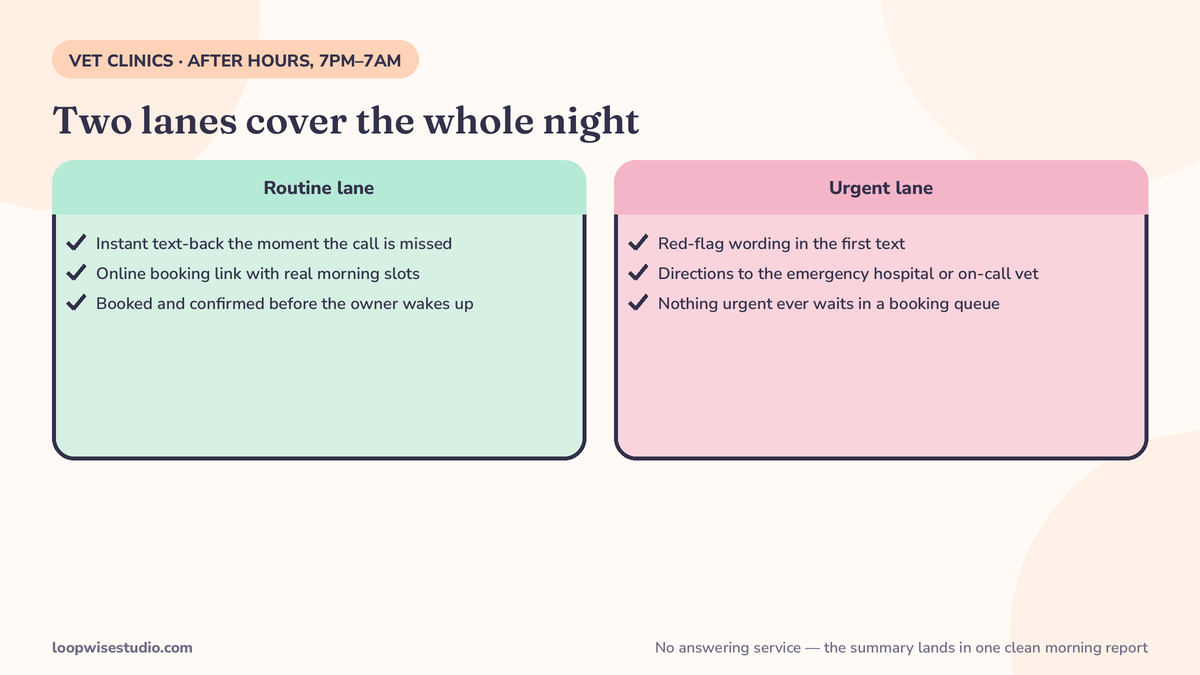
What actually calls after hours: two lanes, nothing in between
| Lane | The call | What the caller actually needs |
|---|---|---|
| Routine | “Can I book his booster this week?” / “We’re out of her tablets” / “I need to move Thursday” / “What time do you open?” | A booking, a logged request, or an answer — self-serve, in one minute |
| Urgent | Toxin ingestion, bloat (GDV), blocked bladder, trauma, breathing trouble, seizures, a pet in labour in distress, snake bite, heat stroke | To be sent to emergency care now — not a booking link, not a message in a queue |
AgentZap’s hour-by-hour breakdown of an after-hours night makes the point from inside the industry: of seven example calls, five are routine. The routine lane is most of your night. The urgent lane is the part that matters most. A system that treats them as one queue fails both — the refill request waits behind nothing, and the dog who ate chocolate waits behind a message-taking process.
That confusion is structural in voicemail: as PupPilot puts it, a message from someone whose dog ate chocolate two hours ago sits in the same queue as a refill request. Everything about the setup below exists to keep those two lanes separated from the first second.
Why answering services disappoint vet clinics
To be fair to them first: a traditional answering service gives you a real human voice at 11pm, and for some clinics that alone is worth paying for. But know what the $200–$800 a month (PupPilot’s published market range) buys, because PupPilot’s comparison is blunt about the limits:
- Operators are not veterinary professionals and follow a script.
- They cannot access your PIMS or patient records, so they can’t check a history or a medication.
- They cannot schedule appointments — every call still becomes a callback your team owes in the morning.
- They cannot triage on anything the caller says; urgent and routine land in the same message pile, just transcribed by a person instead of a phone.
And the morning-after cost is real even when the service works: PupPilot describes one practice facing 23 voicemails — roughly 45 minutes of listening, transcribing and routing — to start the day. An answering service turns phone calls into that same pile, at $200–$800 a month for the transcription.
Meanwhile callers are not patient with queues of any kind. The 2025 secret-shopper study of 5,053 US practices published in JAVMA, cited by PupPilot, found 8.2% of callers abandoned after more than five minutes on hold — at night, with a sick pet, that patience is shorter, and the next call they make is to another clinic.
The text-first system: three pieces, no robot voice
Piece 1 — instant text-back. The moment an after-hours call goes unanswered, the caller gets a text. Not in the morning — now, while they’re still holding the phone. This is the same missed call text back system that catches your daytime overflow, with the after-hours wording in place.
Piece 2 — a live booking page. The routine lane ends in real slots, bookable at 11pm, confirmed instantly, sitting in tomorrow’s diary. The caller who wanted a booster has one. No message, no callback, no slot given away to the clinic that does answer at night.
Piece 3 — emergency signposting written by you. For the urgent lane, the text leads with the instruction, in your clinic’s words: which emergency hospital, which number, when to use your on-call vet instead. It is reviewed by your vets and updated when your ER arrangements change.
The after-hours text (copy-paste):
Thanks for calling [Clinic Name] — we’re closed right now. If your pet needs urgent help — trouble breathing, collapse, a swollen stomach, can’t urinate, ate something poisonous, badly injured or fitting — call [ER hospital] on [number] now, or our on-call vet on [number]. For everything else: book an appointment here [booking link], or reply to this text and we’ll pick it up when we open at [time].
The order is deliberate and non-negotiable: emergency first, booking second. A routine caller loses two seconds reading the urgent line. An urgent caller loses nothing.
The red-flag list: what automation must never handle
Some AI answering products market themselves on giving first-aid guidance over the phone. Take the opposite position, and say so on your website: automate the routine, escalate the urgent, advise nothing. Even PawAnswer, an AI front-desk vendor, markets its safety line the same way — it never gives medical advice and flags every potential emergency for escalation.
Your red-flag wording should cover, at minimum: breathing difficulty, collapse or unresponsiveness, suspected poisoning, a swollen or hard abdomen, straining to urinate with nothing produced, seizures, major trauma or bleeding, difficulty giving birth, and heat stroke signs in hot weather. The text never asks follow-up questions about symptoms, never reassures, and never offers a “monitor it overnight” suggestion. It sends them to a human or an emergency hospital, immediately. If a caller replies to the text describing any of these, your morning team’s rule is simple: that reply is the first one answered, by phone.
The morning after: one summary, zero voicemail archaeology
The routine lane produces a diary, not a pile. Your team opens to:
- Bookings already made overnight, sitting in the diary with confirmations sent.
- Text replies that need a human — refills to prepare, questions to answer — in one inbox, in time order, red-flag replies pinned first.
- A count of after-hours calls by lane, so you can watch the real shape of your nights.
Compare the starting position this replaces — and the reason clinics drift into losing bookings after hours without noticing: nobody ever counted what the night was asking for, so the night kept its secrets.
Want to know how many routine bookings your clinic is currently handing to voicemail? get a free audit and we’ll count a fortnight of your after-hours calls with you.
A night, hour by hour: the two lanes doing their jobs
- 6:40pm — A client rings about tomorrow’s dental drop-off time. Text-back fires in seconds: drop-off details plus the fasting reminder, and a link in case they need to move it. Handled. No human involved, correctly — there is nothing clinical in the question.
- 8:15pm — An owner books a booster for Saturday from the sofa, through the booking link in the after-hours text. It lands in the diary confirmed. Under voicemail, this is a message someone transcribes at 8am — if the owner bothered to leave one.
- 10:50pm — A dog has eaten a chocolate bar. The caller rings, gets no answer, and within seconds has the emergency instruction on their phone screen: the ER hospital’s name and number, in the text itself. They call the ER. The text didn’t triage, advise or reassure — it pointed, instantly, which is precisely its job.
- 1:30am — A refill request comes in by reply text. It sits in the inbox, timestamped, ready to be the second item handled when the clinic opens — not buried as voicemail number nine.
- 5:45am — A cat owner whose pet was restless overnight replies asking to be seen today. The morning team sees it pinned at the top of the inbox and phones before the diary fills — a sick visit captured because the reply was visible, not excavated.
Nothing in that night required a voice, human or artificial. It required speed for the urgent, completion for the routine, and visibility in the morning.
Before you launch: the team and partner checklist
- Agree the wording with your vets. The red-flag list, the ER name and number, and the on-call threshold are clinical decisions. Automation publishes them; it doesn’t write them.
- Tell your emergency hospital. Your ER partner should know your out-of-hours message names them — and you should confirm the number routes correctly at 3am, not just at 3pm.
- Brief the morning rota. Whoever opens owns the overnight inbox until it’s cleared. The 5:45am reply gets a call before 9am, every day, or clients learn the text lane is a suggestion box.
- Test as a client, monthly. Ring the clinic after close from a mobile you don’t usually use. Time the text. Tap the link. If anything has drifted — a changed ER number, a broken page — you want to find it before a worried owner does.
- Review the lane counts monthly. If urgent replies are being answered late, that’s a rota problem. If routine bookings climb, that’s your evidence the night was always full of demand you couldn’t see.
The recorded message still matters — write it like part of the system
Text-back does not abolish your voicemail greeting; it demotes it to the backup lane for landlines and non-texters. Most clinics’ greetings were recorded once, years ago, and sound like it. Yours should say the same things the text says, in the same order:
“Thanks for calling [Clinic Name]. We’re closed now and open again at [time]. If your pet needs urgent help — trouble breathing, collapse, a swollen stomach, straining to urinate, suspected poisoning, a serious injury or a seizure — call [ER hospital] on [number] now. For appointments and everything else, we’ll text you a booking link in a moment if you’re calling from a mobile — or leave a message and we’ll call you back when we open.”
Sixty seconds of recording, and every lane a caller can take now leads somewhere deliberate: the ER by voice, the booking page by text, or a message that a human will actually work through in lane order. It also keeps you honest about the one setup trap from the daytime system: if a pre-voicemail announcement stops callers reaching voicemail, some text-back triggers never fire — which is why the greeting itself should announce the text, and why your monthly test call matters.
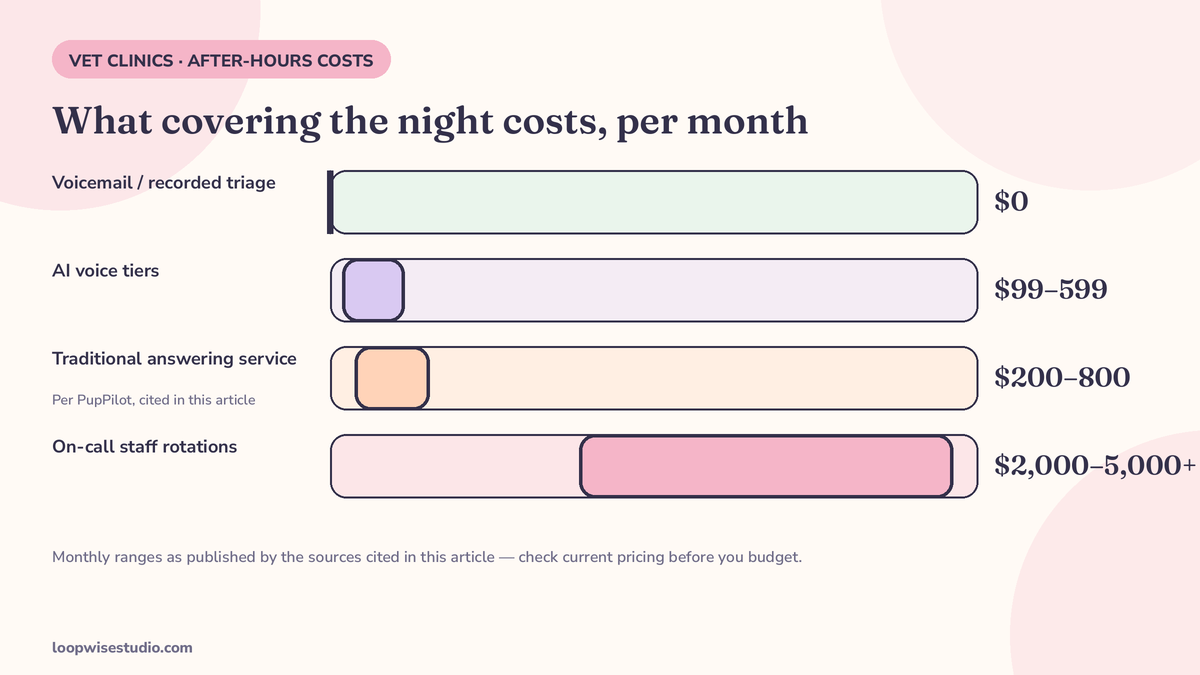
The cost comparison, with sources attached
| Option | Monthly cost | Books real appointments? | Handles urgent lane safely? |
|---|---|---|---|
| Voicemail | $0 (PupPilot) | No | No — one mixed queue |
| Recorded triage message | $0 (PupPilot) | No | Partly — signposts, but nothing is captured |
| Text-first system (text-back + booking page) | Texting/booking tooling — check current pricing | Yes, instantly, 24/7 | Yes — red-flag wording routes to ER/on-call, advises nothing |
| Traditional answering service | $200–$800 (PupPilot’s market range) | No — messages only, no PIMS access | No triage; routes messages |
| AI voice receptionist | AgentZap publishes $109/mo flat; PawAnswer lists $99–$599 tiers (vendor prices — verify on their sites) | Yes, into supported systems | Protocols vary by vendor; check the safety posture carefully |
| On-call staff rotation | $2,000–$5,000+ (PupPilot) | Yes, by phone | Yes — a human, at burnout prices |
Notice the gap in the middle of that table. The jump from “free and useless” to “human and expensive” is where most clinics sit, paying answering-service money for message-taking. The text-first row is the missing middle: routine demand handled completely, urgent demand signposted instantly, at tooling prices rather than staffing prices. And the diary it fills connects straight into the systems that protect those bookings — the reminder sequences in how to reduce no-shows at a veterinary clinic start working on an 11pm booking exactly as they do on one made at the desk.
Count your own after-hours demand before you buy anything
Two weeks, three numbers, no new software:
- Voicemails each morning. Count them before they’re played. That’s your nightly message pile.
- Missed/unanswered calls in your phone log between close and open. Most phone systems already store this; ask your provider if you can’t see it.
- Minutes spent on morning callbacks. Time it for one week. That’s the staff cost of the current system, on top of any answering-service bill.
Sort the calls you find into the two lanes. Expect the audit to surprise you in one specific way: the calls are usually not spread evenly across the night. They bunch in the first two hours after close — people getting home from work, noticing the limp, remembering the tablets — and again in the hour before you open. That bunching is good news. It means a system that responds instantly, without waking anyone, covers the busiest part of your night at the moment it happens, instead of a rota built for a 3am problem you may barely have.
If most of your nights are routine — and for most general practices they are — a text-first system covers the bulk of your demand. If your nights are genuinely emergency-heavy, the honest answer is a human triage service or a tighter ER partnership, and no text system should pretend otherwise. Clinics in other markets run the same audit — compare online booking for veterinary clinics in Australia for how the after-hours pattern shows up there.
Frequently asked questions
Will clients accept a text instead of a person at night?
For routine needs, most prefer it: a booked booster at 11pm beats a promise of a callback at 9am. The clients who need a person are the urgent lane — and the system doesn’t offer them a text conversation, it sends them to an emergency hospital or your on-call vet immediately.
What if a caller doesn’t have a mobile phone?
The recorded triage message on your phone line still plays and carries the same emergency numbers. Text-back adds a lane; it doesn’t remove the voice path for landlines or clients who can’t text.
Can the system book into our existing diary?
Yes — the booking page shows live slots and writes confirmed appointments into the diary your team works from in the morning, alongside the PIMS you already run. That’s the core difference from an answering service: PupPilot’s comparison notes answering services have no PIMS access and cannot schedule at all.
Is it safe to automate anything for emergencies?
The automation never advises, diagnoses or reassures. It does one thing: put the emergency instruction and the right phone number in front of the caller in the first seconds, instead of after a voicemail greeting. The clinical decision stays with the ER or on-call vet, exactly as it does today.
How much does the text-first setup cost compared to an answering service?
The sourced comparison: answering services run $200–$800/month (PupPilot) and on-call rotations $2,000–$5,000+/month, while a text-first setup is texting and booking tooling on top of your existing phones — priced per provider, so check current pricing. AI voice sits between the two, with vendor tiers published from $99/mo.
What happens on weekends and holidays?
The same system, unchanged — which is the point. The 48-hour weekend gap and holiday stretches are where voicemail piles grow largest, and routine demand doesn’t take holidays. Text-back and the booking page run the same on Christmas night as on a Tuesday.
The short version
After-hours calls are two lanes: routine demand a text and a booking page can finish on the spot, and emergencies that need a number and an instruction, not a queue. Cover both, advise nothing, and start the morning with a diary instead of a voicemail pile.
If you want both lanes set up on your clinic’s existing phones, get a free audit and we’ll map your current nights first.