US Med Spa Booking Report 2026: 606 Med Spas Audited — 91% Have No Instant Response
We audited 606 med spas across 18 US metros in October 2026. 71% offer online booking, but 91% have no chat or text widget, 63% have booking with no instant response, and only 8% have the full stack.
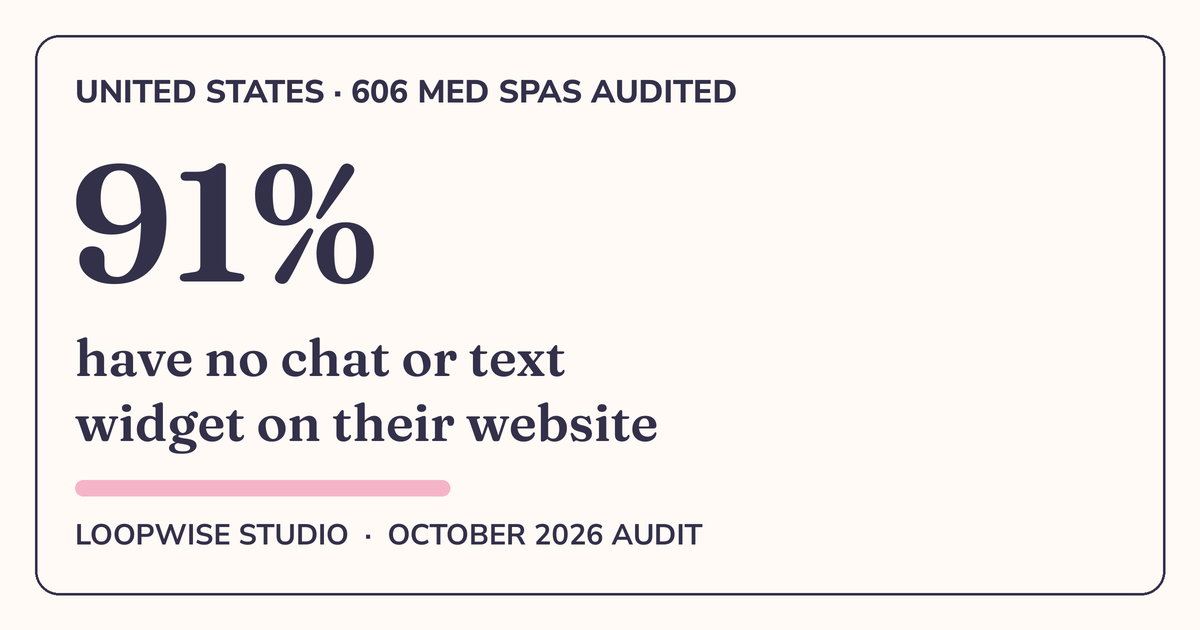
Short answer: In October 2026 we audited 606 med spas across 18 US metropolitan areas. Most of the industry has solved booking: 71% of med spa websites offer it. Almost none have solved response: 91% have no live chat or text widget, 63% take bookings but offer no instant way to ask a question, and only 46 websites (8%) combine online booking, an instant-response channel, and a working site. The American med spa industry’s problem is not the booking button. It is everything that happens before and after it.
The US med spa market is the most mature in the world. The median spa in this audit has 158 Google reviews, and two-thirds have more than 100. Patients find these businesses. What this report measures is what the patient finds when they arrive — and how much of the journey still depends on a phone call during business hours.
Key findings
| Finding | Websites | Share of 596 websites |
|---|---|---|
| Offers online booking | 421 | 71% |
| No online booking of any kind | 175 | 29% |
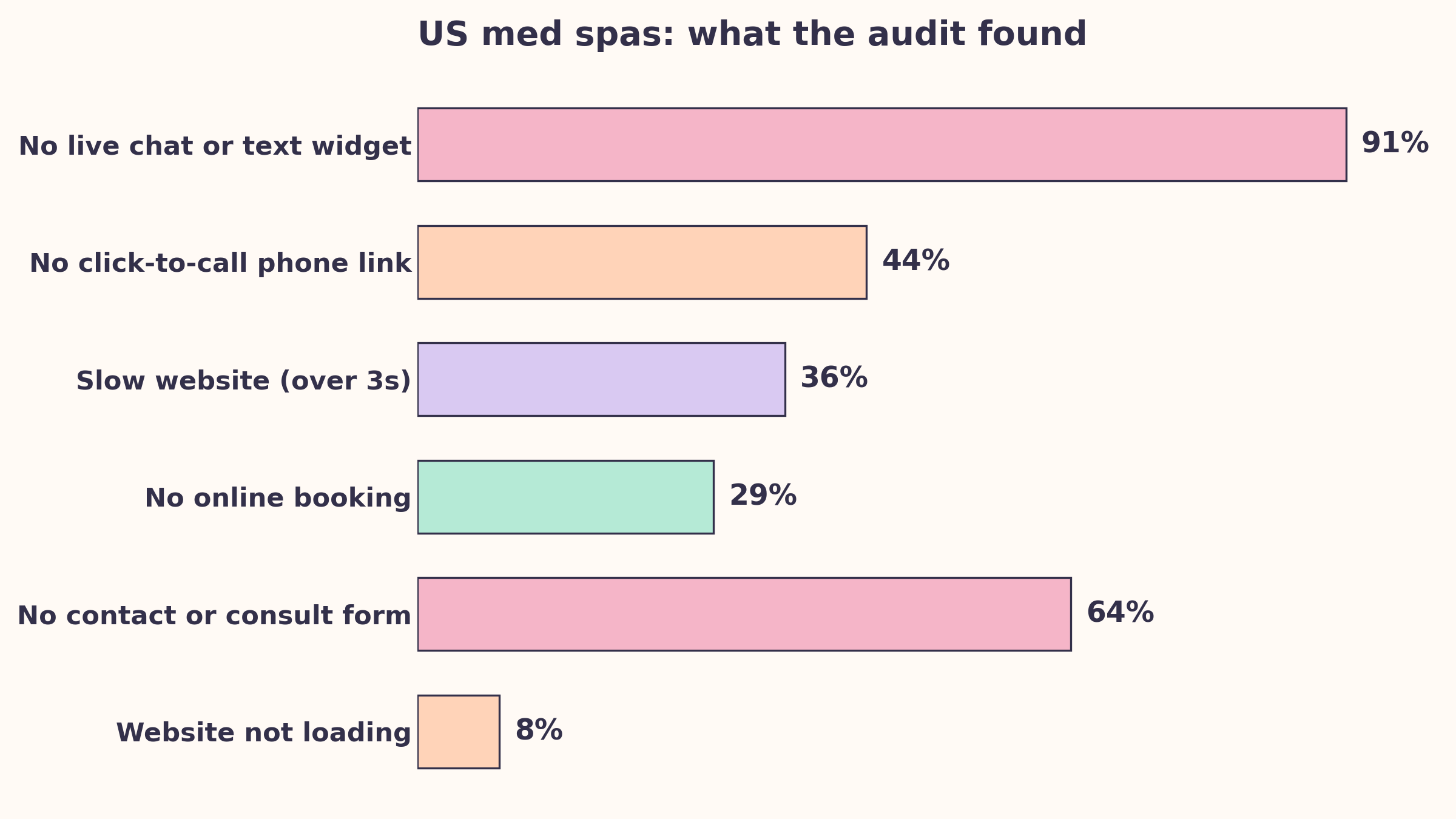
| No live chat or text widget | 542 | 91% |
| Has booking, but no chat/text widget | 375 | 63% |
| No contact or consultation form | 383 | 64% |
| No click-to-call phone link | 264 | 44% |
| Slow homepage (over 3 seconds) | 213 | 36% |
| Website not loading at audit | 46 | 8% |
| Serves site over plain HTTP (no HTTPS redirect) | 17 | 3% |
| Full stack: booking + instant response + working site | 46 | 8% |
Of the 606 med spas audited, 596 (98%) have a website and 10 have none. Percentages in this report are of websites unless stated otherwise.
The funnel: 606 spas become 46 complete ones
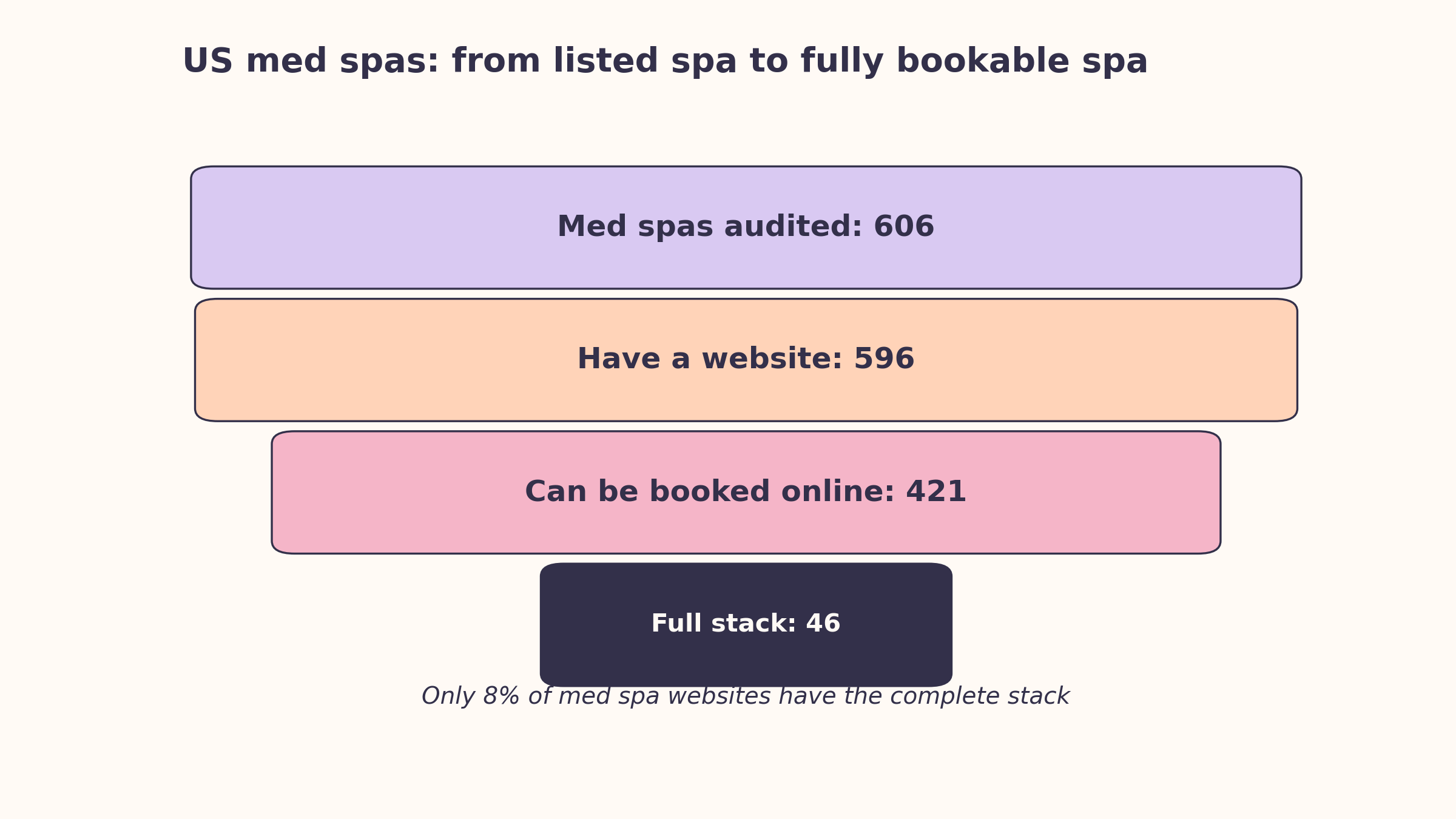
Read the funnel from the bottom. A patient who wants to (1) find a spa, (2) book a real appointment online, and (3) get an instant answer to a quick question — price, parking, “is this right for me?” — can complete that journey at 46 of 596 websites. Every other spa breaks the journey somewhere and pushes the patient back to a phone call, a form with no promised reply time, or a competitor.
Finding 1: booking is mostly solved — 29% is still 175 spas
71% of med spa websites offer online booking, a completely different picture from developing markets (in our Pakistan audit, 23–46% could be booked online). US spas have bought the software. Zenoti alone powers 60 of the platform bookings we detected, followed by Boulevard (30), Square (29), Vagaro (24), and Mangomint (11).
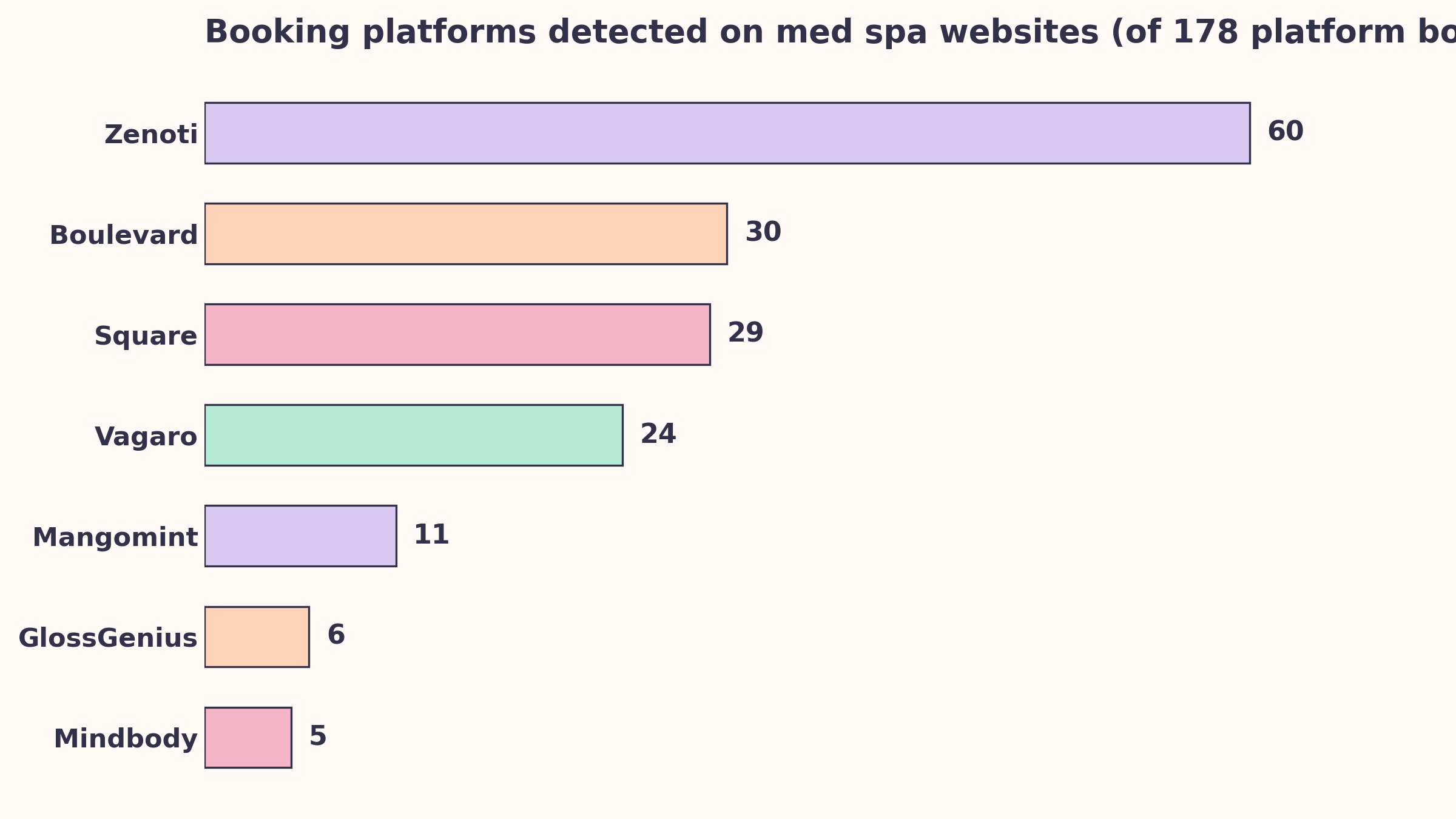
But 175 spas — 29% — still offer no online booking at all. These are not invisible businesses; many carry hundreds of reviews. Their entire conversion path is “call us.” Every patient who finds them at 9 pm, or from a quiet office where they cannot make a call, is a patient deferred — and deferred patients comparison-shop.
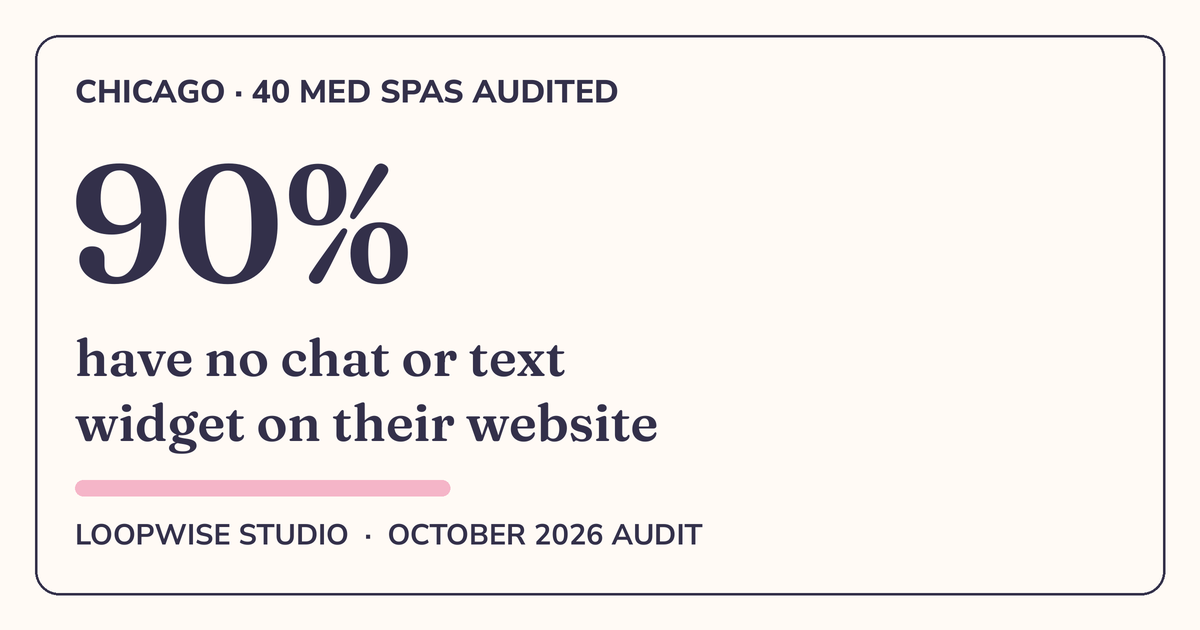
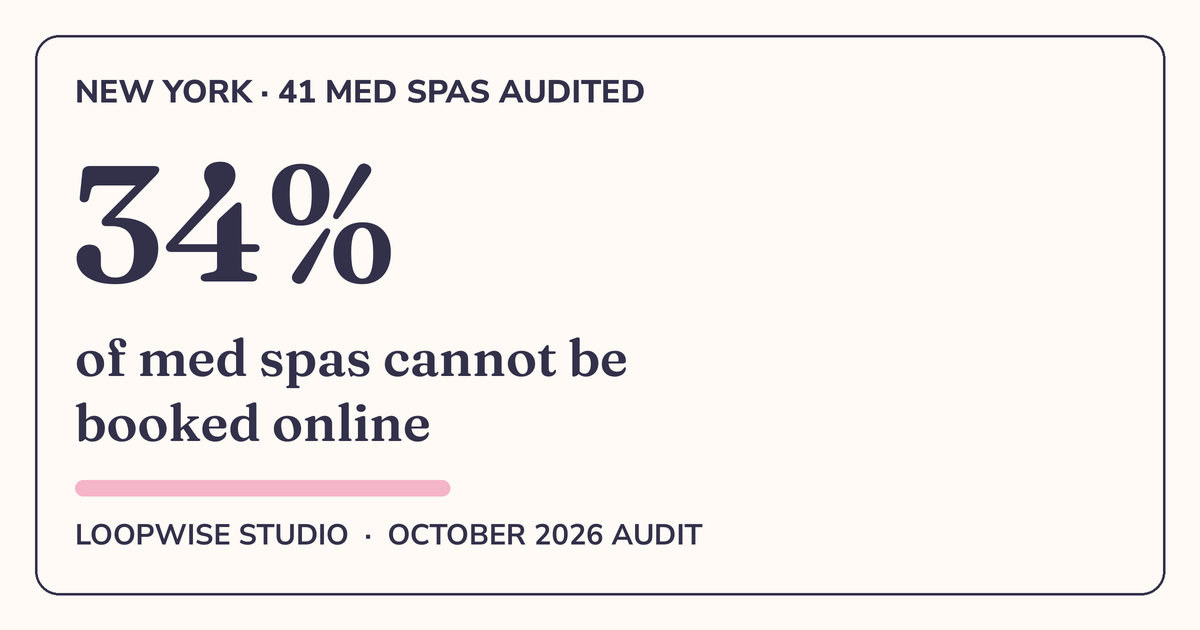
City reports in this series: New York (34% with no online booking), Chicago (28%), and Miami (36%).
Finding 2: the response gap is the industry’s real leak — 91%
Only 54 of 596 websites (9%) have a live chat or text widget of any kind. The other 91% offer a patient exactly three options: book blind, fill in a form (only 36% even have one), or call.
This matters because a large share of med spa enquiries are not bookings yet — they are questions. Is this treatment right for my skin type? How much downtime? What does it cost? A patient with a question will not book blind, and a form that promises a reply “within 1–2 business days” is where high-intent enquiries go to cool off. The spas have automated the transaction and left the conversation manual — and the conversation is where the transaction is decided.
The combined stat is the sharpest in this report: 375 websites (63%) have online booking but no instant-response channel. They paid for booking software and stopped one step short.
Finding 3: the basics are unfinished at scale
- 44% have no click-to-call phone link on their homepage. On mobile — where most of these patients are browsing — the phone number is text to be copied, not a tap. This is a one-line fix that nearly half the industry has not made.
- 36% of homepages took over 3 seconds to load in our check, and 60 (10%) took over 5. Med spa homepages are image-heavy by design; the cost of that design is paid in bounced mobile visitors.
- 46 websites (8%) did not load at all at audit time.
- 17 websites (3%) still serve over plain HTTP without redirecting to HTTPS — the browser’s “not secure” warning, on a medical business’s front door.
Finding 4: only 8% run the full stack
46 websites combine all three: working site, online booking, instant response. They are spread across chains and independents, expensive markets and mid-sized ones. Nothing about the full stack is exotic or expensive relative to what these businesses already spend on booking software and websites. It is simply finished. In a market where the median competitor has a median of 158 reviews and the same treatments at similar prices, the finished stack is one of the few differences a patient can actually feel before they ever walk in.
If you run a med spa and want to know where yours stands, the free audit on our homepage runs the same checks used in this report.
What this means, in one paragraph
US med spas do not have a discovery problem (reviews prove demand), and most no longer have a booking problem. They have a response-speed problem: questions answered in hours instead of seconds, missed calls with no automatic text back, forms with no reply promise. The fix is not more software categories — it is connecting what they already have. Our guide to missed call text back for med spas covers the highest-impact piece: the text that goes out automatically in the first seconds after a call is missed.
How this research was done
- Sample: med spas and aesthetic clinics listed on Google Maps in 18 US metropolitan areas (New York, Los Angeles, Chicago, Houston, Phoenix, Dallas, Miami, Atlanta, Denver, Seattle, Las Vegas, San Diego, Austin, Boston, Orlando, Nashville, Charlotte, Salt Lake City), found with “med spa,” “medical spa,” and “aesthetic clinic” searches in October 2026 — 606 businesses after de-duplication by listing ID. This is a large sample of listed med spas in major metros, not a census of every med spa in the United States.
- Dates: listings collected 22–23 October 2026; every website checked on 23 October 2026.
- How booking was detected: a website counts as offering online booking if its homepage links to a recognized booking platform (we check for 23, including Zenoti, Boulevard, Square, Vagaro, Mangomint, Fresha, Mindbody, Acuity, GlossGenius, Booksy) or contains a booking page or “book/schedule an appointment” path. A phone number, a contact form, or a chat widget by itself does not count.
- How chat was detected: presence of a known live-chat or web-text widget vendor (Intercom, Podium, Birdeye, Weave, Drift, HubSpot, Zendesk, and similar) in the homepage code.
- Speed: one timed fetch of the homepage from a remote server. This is indicative, not a lab benchmark — treat “over 3 seconds” as “slow enough to check,” not a PageSpeed score.
- Verification: a random sample of flagged websites was re-checked manually in a browser, including spas flagged as having no booking, and the flags held. Financing widgets (e.g. Cherry), review platforms, and directories were deliberately excluded from the booking count.
- Limitations: checks are homepage-based; a booking path that exists only deep in a site, with no homepage link or platform trace, could be missed, which would make the 29% no-booking figure slightly pessimistic. Equally, a booking link that leads to a broken or abandoned flow still counts as booking here, which cuts the other way. If you run a spa in this audit and believe a finding is wrong, contact us and we will re-check and correct it.
- Data availability: the full statistics table behind this report is published with it as a downloadable CSV. Journalists and researchers may use any figure with a citation and a link.
How to cite this report
Loopwise Studio (2026). US Med Spa Online Booking Report 2026. Audit of 606 med spas across 18 US metropolitan areas, October 2026. loopwisestudio.com
Frequently asked questions
What percentage of US med spas offer online booking? 71% of med spa websites in this audit (421 of 596), representing 69% of all 606 med spas audited.
What is the most common booking platform for med spas? Zenoti, detected on 60 websites, followed by Boulevard (30), Square (29), Vagaro (24), and Mangomint (11). 178 spas book through a recognized platform; the rest use their own booking pages.
What is the biggest gap the audit found? Instant response. 91% of med spa websites have no live chat or text widget, and 63% combine online booking with no instant way to ask a question.
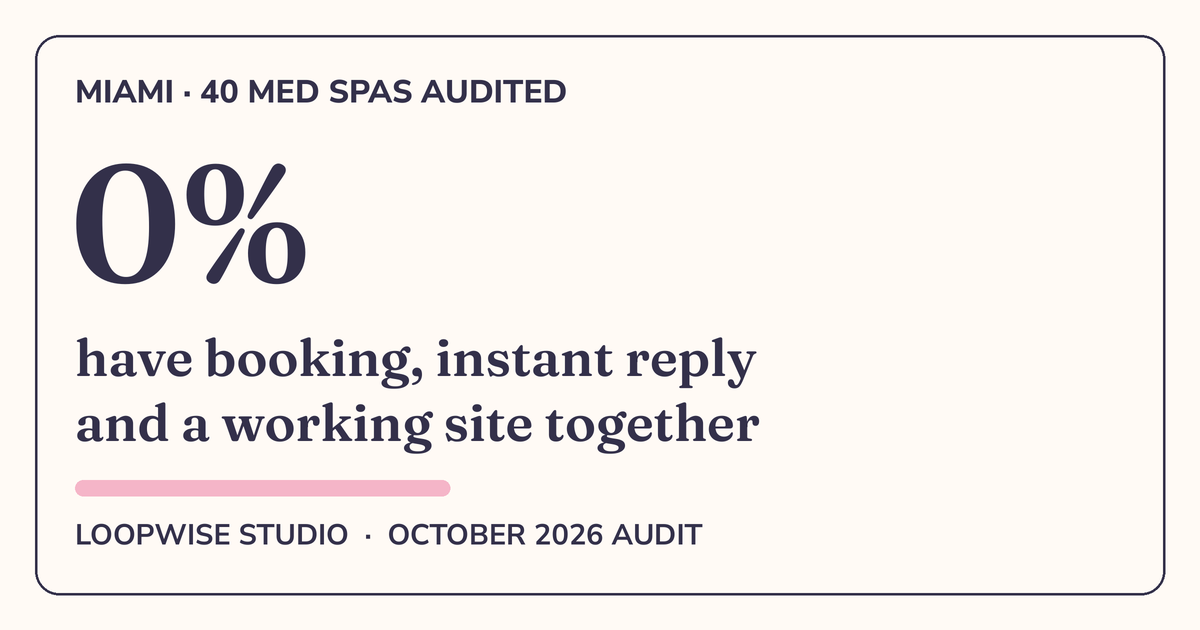
Which city had the weakest results? Miami: 36% of its med spas offer no online booking, 95% have no chat or text widget, and not one of its 39 websites had the full booking-plus-response stack. Orlando had the weakest website hygiene (21% of sites not loading, 50% slow).
Is this a survey of med spa owners? No. It is an audit of public information — the spas’ own listings and websites — checked business by business in October 2026.
Can I get my spa’s individual results? Yes. The free audit on our homepage covers the same checks for your spa, or contact us and we will send your spa’s row from the audit data.