Online Booking for Australian Clinics, With Reminders
Online booking for clinics in Australia with WhatsApp reminders: what AU practices actually use, the SMS reality, where WhatsApp fits, recalls and setup costs.
An online booking system for a clinic in Australia is a setup that lets patients book from your website at any hour into your real diary, then confirms, reminds and — when life gets in the way — lets them reschedule without phoning reception. If you found this page by searching for WhatsApp reminders specifically, here is the honest answer up front: in Australian healthcare, reminders run mainly on SMS and app push notifications, and for most GP clinics that is exactly right. WhatsApp reminders earn their place in specific parts of the market — aesthetic and beauty clinics, and practices whose patients already live on WhatsApp. This page explains what Australian clinics actually use, where each reminder channel fits, what a booking system has to do beyond taking bookings, and how the setup works if you would rather have it done for you than assembled from a software directory.
That honesty matters, because the search results for this exact topic will not give it to you. They are directory pages — long lists of software licences with feature grids — and not one of them explains how an Australian clinic’s bookings, reminders and recalls actually fit together. So let us start with the real landscape.
What Australian clinics actually use
The Australian clinic software market has a shape of its own, and any booking setup has to respect it.
GP and medical practices overwhelmingly run on a practice management system — Best Practice or MedicalDirector are the common names — with a patient-facing booking layer on top. Two platforms dominate that layer: HotDoc and HealthEngine. Patients find the practice, book into the live diary, and get managed through those systems. As the Australian automation agency High10 describes the stack: GP clinics pair Best Practice or MedicalDirector with HotDoc or HealthEngine, while allied health tends to run on Cliniko, Nookal, Halaxy or Power Diary.
Allied health and smaller clinics — physio, podiatry, psychology, dental and aesthetic practices — often run lighter: the diary inside their practice software, a booking page on their website, and varying degrees of reminder automation switched on, half-configured, or never touched since install.
That last clause is where most of the waste sits. As High10 puts the automation work in this market: a large part of it is switching on properly what the clinic already pays for, and connecting it to the waitlist. The software is rarely the problem. The configuration is.
The honest bit: reminders in Australia run on SMS and push
Here is what the market leader actually does, in its own words. HotDoc’s support documentation describes its reminder ladder: the patient gets a push notification first, and “if the patient does not confirm or cancel via this method after two hours, we will send an SMS message to follow up.” Patients without the HotDoc app get the SMS as the standard channel. WhatsApp does not appear in that ladder at all. HealthEngine’s recalls work the same way: secure SMS with a link.
There are good reasons for this. SMS reaches every phone without an app or an account. Push works for patients who have the booking app. Both are what Australian patients expect from their GP, dentist and physio.
So where does WhatsApp genuinely fit in Australia?
| Clinic type | Channel that usually fits | Why |
|---|---|---|
| GP / medical practice | Push, then SMS (the HotDoc pattern) | Established platforms, every patient reachable |
| Dental, physio, allied health | SMS first | Broad patient base, SMS is the expected channel |
| Aesthetic and beauty clinics | WhatsApp often fits well | Patients already enquire, send photos and book through chat; the relationship lives there |
| Clinics serving WhatsApp-first communities | WhatsApp for those patients | Migrant and expat communities in Australian cities run their daily lives on WhatsApp — meeting them on it is simply meeting them where they are |
The point is not WhatsApp everywhere. The point is a booking system whose reminders run on the channel each clinic’s patients actually answer — and a setup honest enough to tell you which one that is before you pay for anything. Some vendor listings do include WhatsApp among their reminder channels: EasyWeek’s listing on Capterra Australia, for example, describes automated reminders by “SMS, email, WhatsApp, and push notifications.” A feature line in a directory, though, is not a strategy for your clinic. Channel choice is.
What a booking system must actually do
Booking is the easy half. These are the jobs that decide whether the system earns its keep, and the ones directories never explain:
- A 24/7 booking page on your own website. Patients book into real availability — practitioners, rooms, appointment types and durations — not a request form someone processes in the morning. After-hours bookings are not a bonus feature; evenings are when patients do their admin.
- Instant confirmation. Written, findable, with the details and the route to reschedule. A booking that lives only in your diary is a booking the patient can forget exists.
- Reminders that can be answered. Confirm or reschedule from inside the reminder, on whichever channel it was sent.
- Easy rescheduling into real slots. The freed slot goes back on sale immediately — which connects directly to the next job.
- Waitlist refill. When a slot frees up, the system offers it to waiting patients automatically, while it is still worth filling.
- Recalls — the Australian workflow covered in its own section below, and the one most clinics still run by hand.
- A front desk that can see everything. Bookings, reminders sent, replies received, recalls due — one place, so reception is managing exceptions instead of being the system.
If a platform cannot do the diary-connected parts of that list — real availability, real rescheduling, real recalls — it is a web form with good marketing. The reminder comparison with the UK market is instructive here: British clinics face the same list, on a WhatsApp-first default — our guide to WhatsApp appointment reminders for clinics in the UK shows the same system built on the other channel.
The reminder flow, channel by channel
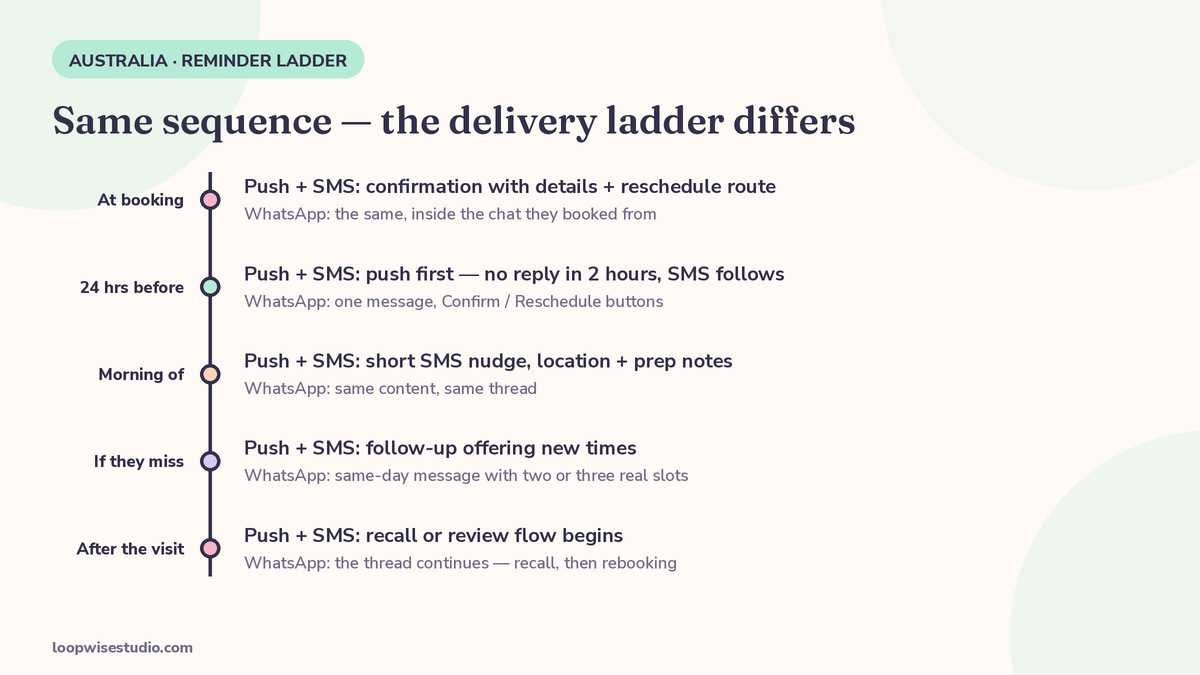
Whatever the channel, the sequence is the same. What changes is the delivery ladder:
| Moment | Push + SMS pattern (mainstream AU) | WhatsApp pattern (where it fits) |
|---|---|---|
| At booking | Confirmation message with details + reschedule route | Same, inside the chat thread the patient booked from |
| 24 hours before | Push notification; if no confirm/cancel within two hours, SMS follows (HotDoc’s stated ladder) | One message with Confirm / Reschedule buttons |
| Morning of | Short SMS nudge with location and prep notes | Same content, same thread |
| If they miss | Follow-up offering new times | Same-day message offering two or three real slots |
| After the visit | Recall or review flow begins (below) | Same thread continues — recall, then rebooking when due |
Two design rules apply on every channel. First, the reminder is a conversation, not a broadcast: a reply reaches a human or a proper flow, the same working day. Second, rescheduling must be easier than not showing up — offer actual slots, never “please call us to rebook.”
Recalls: the workflow directories never explain
In Australian practice, a recall is a clinical follow-up a patient is due for — a review, a test result conversation, a recurring check — and practices are expected to run a proper system for them, not rely on patients remembering.
HealthEngine’s recalls documentation shows what the workflow demands: the recall goes out by secure SMS with a link, and the patient completes a three-point identity check before they see anything — because a recall can carry clinical sensitivity that a normal reminder does not. It also records what manual recalls cost a practice: around $500 per month in postage, envelopes and wages, in HealthEngine’s own figures, for the letter-based process many clinics still run.
A booking system that takes recalls seriously handles them as their own flow, not as extra reminders:
- Due-date sequences. When a recall falls due, the patient is contacted; if there is no response, the system follows up on a defined schedule rather than a staff member’s memory.
- Identity check before content. The message opens the conversation; anything sensitive sits behind verification, exactly as the established platforms do it.
- Book from the message. The recall ends in a booked appointment, not in a phone queue — the patient picks a real slot from the same flow.
- A recall list the practice can see. Who is due, who has been contacted, who has booked, who is overdue. If it is not visible, it is not a system.
This is also where channel honesty matters again: recalls belong on the secure, expected channel — SMS with a verified link is the Australian norm — while WhatsApp serves the clinics and communities where it is genuinely the patient’s home channel. For allied health practices, the same booking and recall machinery applies with a lighter diary, which is the territory of our guide to an online booking website for chiropractors and physio clinics.
If your clinic’s reminders and recalls currently depend on reception remembering, there is a quieter way to run them. Get a free audit — we will look at your current booking page, reminder setup and recall process, and show you precisely where patients fall out of each one.
Software versus done-for-you setup
The directories assume you want to choose a licence and configure it yourself. Some owners do. But look at what “setting it up” actually contains:
- Diary rules: appointment types, durations, practitioner schedules, buffers, rooms
- Templates written in the clinic’s voice, for every touch in the flow above
- Reminder timings per appointment type, and the push-to-SMS or WhatsApp ladder configured
- Recall lists built, sequences set, identity-checked links tested
- Waitlist rules, so freed slots are offered in the right order
- Staff shown the one screen that matters, and what to do when a patient replies
None of that is difficult. All of it is somebody’s week — and in most clinics it is nobody’s week, which is why so many practices pay for systems whose best features were never switched on. A done-for-you setup means the licences are chosen to fit your existing practice software where possible, configured end to end, and tested with real bookings before anyone calls it finished. You keep your PMS. You keep your number. What changes is that the system starts doing the jobs in this article.
The follow-on flows matter as much as the booking itself. Once a visit completes on this system, the same thread can carry the review request — covered step by step in how to get Google reviews on WhatsApp for a clinic — and, where the channel fits, the rebooking prompt when the next visit falls due.
What it costs, in shape
Honest shape rather than invented figures: expect three lines. A one-off setup (diary rules, templates, recall lists, testing) — priced as a fixed job once your current stack is known. The software licences themselves, which in this market range from the established platforms’ own plans to lighter tools for smaller clinics; a directory will show you per-month figures, and they are usually the smallest part of the real cost. And optional ongoing care, if you want someone else watching the recall lists and reminder performance.
What we will not do is quote you a number before seeing what you already run. Half the value in this market is configuring what you have; the other half is not paying twice for it.
Frequently asked questions
Do Australian clinics really use WhatsApp for reminders?
A minority, and in specific places. Mainstream GP reminders run on push notifications and SMS through HotDoc and HealthEngine — that is the market norm and it works. WhatsApp fits aesthetic and beauty clinics, and clinics whose patients come from WhatsApp-first communities. Any provider who tells you WhatsApp is the standard channel for Australian clinics is selling, not informing.
We already use HotDoc or HealthEngine. Do we need to switch?
Usually not. The common gap is not the platform, it is configuration: reminder timings, template wording, waitlist switched on, recalls systematised. A proper setup starts with what you have and only changes a licence when something you need genuinely is not in it.
What is a recall, and why does it need its own flow?
A recall is a clinical follow-up a patient is due for, as distinct from a reminder for an appointment already booked. It needs its own flow because it starts from a due date, not a booking; it can touch on sensitive matters, so identity checks come before content; and it only ends when the patient is booked in. Treating recalls as extra reminders is how patients quietly fall through.
Can patients reschedule from a reminder, or do they still phone us?
From the reminder. Confirm and reschedule are actions inside the message, against your real availability, on whichever channel the reminder used. If rescheduling requires a phone call, patients who cannot face the call will keep simply not arriving.
Does online booking work with our practice management system?
For the common Australian stacks — Best Practice, MedicalDirector, and the allied-health platforms such as Cliniko and Halaxy — booking layers and reminder flows are designed to sit with them. The audit stage exists precisely to confirm what your stack supports before anything is promised.
How long does setup take?
Once your diary rules and templates are agreed, the build is a matter of weeks, not months, and runs alongside your normal clinic days — patients keep booking the old way until the new flow is tested and live. The recall list clean-up is usually the longest single task, because it involves your real patient data.
A booking system that fits the country it is in
Australia does not need another software licence, and it does not need WhatsApp forced into clinics where SMS is the right answer. It needs booking systems that are set up completely: live diary, answerable reminders on the channel your patients use, recalls that run themselves, and a waitlist that refills the gaps.
If that is the state you want your front desk in, get a free audit — we will review your current booking page and reminder setup, tell you honestly which channel fits your patients, and show you what the finished system would look like on your existing software.