Missed Call Text Back for HVAC Companies: The Surge-Day Fix
On the first heat-wave day every HVAC phone rings at once. Missed call text back texts each caller in under 60 seconds, triages the emergency, and books the job.
Missed call text back automatically texts an HVAC caller within 60 seconds of a missed call, asks what is wrong, and either books the job or escalates the emergency to your on-call tech. For HVAC companies its main job is surge capacity: on the first heat-wave day, when every phone rings at once and your lines jam, the text holds callers a callback list never reaches in time.
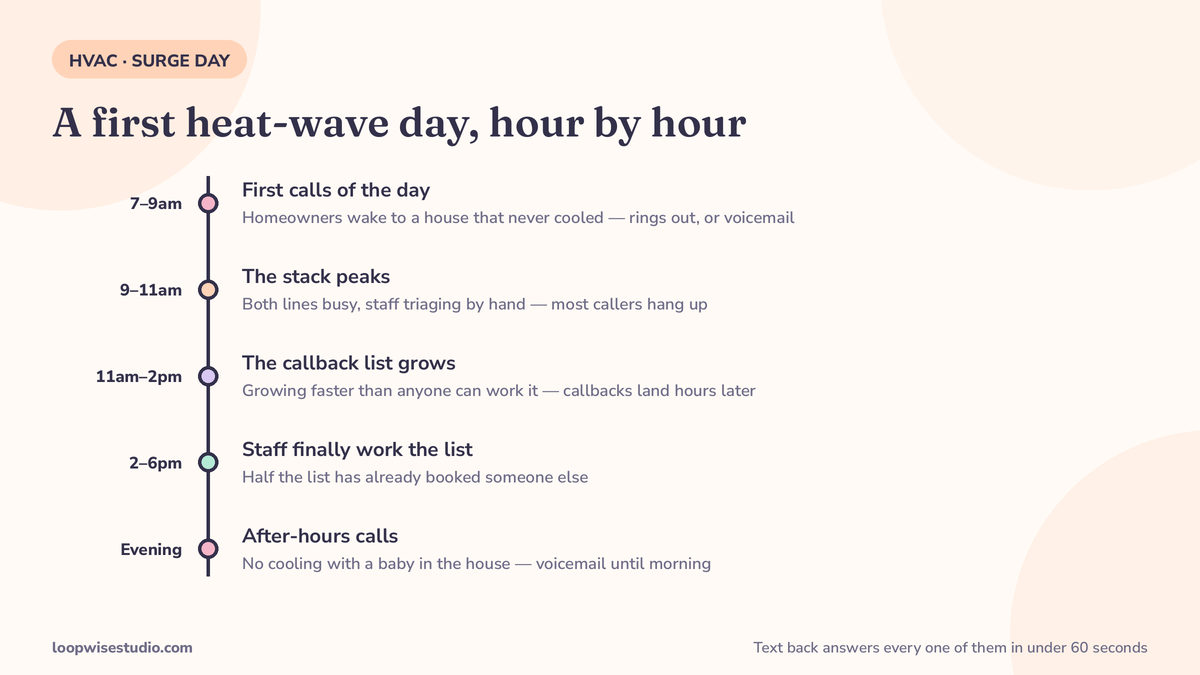
Here is the situation this article is about. It is the first 95-degree day of June. By 10am your office has taken more calls than it took all of last Tuesday. Two lines, both busy. The third caller hears ringing, then voicemail. The fourth and fifth do too.
Nothing is broken in your business. Your techs are good, your office staff are working flat out. You simply have more callers than phone lines for about six weeks a year — and those six weeks decide your year.
This article walks through what that day actually looks like hour by hour, what one missed call costs once you count installs and maintenance plans, the full text sequence with the exact words, and how to set it up before the season instead of during it.
What a surge day actually looks like, hour by hour
Peak season is usually described as “busy.” That hides the real problem, which is timing. Calls do not spread evenly across the day. They stack.
| Time | What is happening | What happens to the caller |
|---|---|---|
| 7–9am | Homeowners wake to a house that never cooled overnight. First calls arrive before the office opens. | Rings out or hits voicemail. |
| 9–11am | The stack peaks. Both lines busy, office staff triaging by hand, techs calling in between jobs. | Busy signal or a long ring. Most hang up. |
| 11am–2pm | Still heavy. The morning’s callback list is growing faster than anyone can work it. | If they left a message, they get a callback hours later — if at all. |
| 2–6pm | Calls slow. Staff finally work the callback list. | Half the list has already booked someone else. |
| Evening | After-hours calls: no cooling with a baby in the house, no heat in January. | Voicemail, until morning. |
The callers you lose are not lost at 6pm when the callback happens. They are lost at 9:40am, in the ninety seconds after they hang up, when they tap the next company on Google.
The numbers behind this are not exotic. Diligentic, an automation agency, cites Contractor Magazine’s 2024 HVAC Business Analysis putting the average HVAC contractor’s missed-call rate at 27% of inbound calls — and that is an average across the year, not a surge-day figure. Leadra, another agency in this space, cites a 2023 Hatch survey finding that 85% of callers who reach voicemail do not leave a message when contacting a service business for the first time. Put those together and the surge-day picture is plain: on your busiest days, a large share of callers reach nobody, and most of them say nothing before they move on.
A callback list cannot fix a timing problem. A text sent in under a minute can, because it arrives while the caller is still looking at your name.
The maths, on your own numbers
Forget industry averages for a moment. Run your own week. You need three numbers: how many calls you missed, what share were real jobs, and what a job is worth to you across its life — not just today’s ticket.
A worked example, with the assumptions stated so you can swap in your own:
- Your call log shows 30 missed calls in a peak week (check your phone system or carrier app — most owners are surprised by this number).
- Say half were genuine service calls — the rest are sales calls, wrong numbers, and existing customers you reached another way. That is 15 real jobs in play.
- Say text back starts a conversation with most of them, and 5 book. That is a deliberately modest recovery rate, not a vendor promise.
- At a $550 average service ticket — the figure Leadra uses in its own published example — 5 recovered jobs are $2,750 in one week.
Now the part most missed-call maths leaves out. An HVAC job is rarely one job. The no-cooling call you recover in June becomes a repair today, a replacement conversation when the unit is 14 years old, a maintenance plan, and the neighbour they mention you to. Installs are where this compounds: Leadra’s published example uses a $7,800 install ticket. You do not need many recovered install conversations a season to dwarf the cost of the system that captured the number.
And every captured number stays yours. The tune-up customer who texted you in October gets your pre-season reminder in April — from a thread already sitting in their phone.
Do your own version of this arithmetic before you buy anything. If your missed-call count is near zero, you do not have this problem. Most companies that check find it is not near zero.
How the system works: text in under 60 seconds, triage, then booked or escalated
The mechanism is short enough to fit in one paragraph, and this article carries the full version for the trade cluster — the companion pieces for electricians and garage door companies summarise it and go deep on their own trades instead.
- A call is missed — line busy, after hours, or no answer after a set number of rings.
- A text goes out in under 60 seconds from your business number. Speed is the whole game: a text at minute one is a rescue, a text at hour three is spam.
- The text asks one triage question. Emergency or routine? The reply routes the conversation.
- Emergencies escalate. No heat in freezing weather, no cooling with elderly residents or infants, a commercial site down — the on-call tech gets an alert with the caller’s details, and the caller gets a text saying a human is on it.
- Routine jobs book. The thread offers real slots from your diary, or a booking link into your website’s booking page, and confirms by text when it is set.
- Nobody falls off the list. Anyone who does not reply gets a nudge at two hours and a final message the next day with the booking link. Then the sequence stops — no nagging.
One setup detail the sales pages skip: in the US, business texting runs on A2P 10DLC carrier registration. Your number has to be registered with a short vetting step before texts go out at volume, and that takes days, not minutes. It is a one-time paperwork step — but it is exactly why this gets set up in April, not on the first hot day in June.
If you want the short version of what this looks like when it is built for you — website, booking page, and text-back as one system — that is what we do at Loopwise. You can get a free audit and we will count your missed calls from your own call data first, before talking about building anything.
The same first-minute logic runs the other trades in this cluster, each with its own twist: for multi-crew shops the closest cousin is missed call text back for plumbers, and once the jobs are booked, the follow-through that fills your review profile is automatic Google review requests for HVAC companies by text.
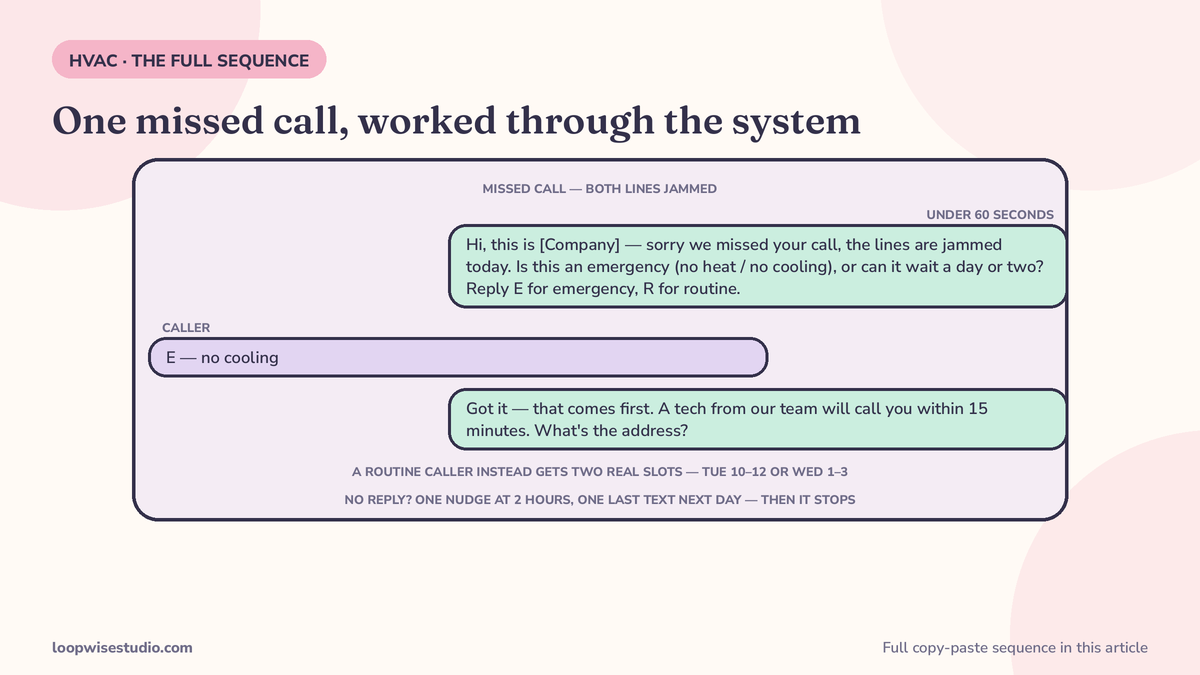
The full message sequence, with the words
Most vendors show you the first text and stop. The first text is the easy part. Here is the whole sequence, written for HVAC. Copy it, adjust the voice, use it wherever you set this up.
Message 1 — instant (under 60 seconds):
Hi, this is [Company] — sorry we missed your call, the lines are jammed today. Is this an emergency (no heat / no cooling), or can it wait a day or two? Reply E for emergency, R for routine.
Emergency branch — immediately after an E reply:
Got it — that comes first. A tech from our team will call you within [15] minutes. If anyone in the house is unwell from the heat or cold, please call 911 first. What’s the address?
Emergency branch — to your on-call tech (internal alert, not to the customer):
MISSED CALL — EMERGENCY. [Name/number], no cooling, address pending in thread. Caller told: callback within 15 min.
Routine branch — after an R reply:
Thanks — we can help with that. Our next routine slots are [Tue 10–12] and [Wed 1–3]. Reply with the one that suits you and we’ll lock it in, or book any time here: [booking link]
Nudge — 2 hours, no reply to Message 1:
Just closing the loop from [Company] — we’re still holding today’s missed callers in order. Tell us what the system is doing (no cooling, strange noise, due a tune-up?) and we’ll get you a time.
Close — next day, still no reply:
Last one from us — your call from yesterday matters, we just couldn’t get to the phone. Book a visit whenever it suits you here: [booking link]. Reply STOP to end these texts.
Three things to notice. The emergency text never tries to book — it promises a human, fast, and it says so in minutes. The routine text offers two real slots before it offers a link, because picking a time is easier than browsing a calendar. And the sequence ends. Two follow-ups and out; a system that pesters homeowners gets blocked and reported, and then your number stops landing for everyone.
Emergency vs routine: what escalates, what safely waits
The triage question only works if the sorting rules behind it are written down before the season. A starting table most HVAC companies can adopt as-is:
| Escalates to the on-call tech now | Books a normal slot |
|---|---|
| No heat when it is below freezing | Annual tune-up / maintenance visit |
| No cooling with elderly, infant, or medically vulnerable residents | Thermostat replacement or upgrade quote |
| Burning smell, sparking, or a tripped breaker that will not reset | Duct cleaning, air-quality add-ons |
| Commercial site down (restaurant, care facility, server room) | Second opinion on a replacement quote |
| Water leaking from the unit into the ceiling | “It is making a noise” with cooling still working |
The left column gets a human within minutes, day or night. The right column gets a good slot and a confirmation text. The mistake to avoid is treating every missed call as an emergency — your on-call tech will start ignoring the alerts within a week — or treating none of them as one, which is where the real damage and the one-star reviews live.
Set it up before the season, not during it
Every HVAC owner who adopts text back in a crisis sets it up badly, because the phones are already ringing. The pre-season checklist is short:
- Count last season’s missed calls. Pull the same week from last June or January. This is your baseline and your business case.
- Register the number (A2P 10DLC). Allow days for carrier vetting. Do it while nothing is urgent.
- Write the triage table with your lead tech, not your marketing person. They know what cannot wait.
- Load the real message sequence — not the vendor’s default template. Your slots, your callback promise, your service area.
- Test it yourself. Call your own number from your mobile, let it ring out, and time the text. Then reply E and check the on-call alert lands.
- Brief the office. When a text thread books a job, it has to appear in the diary the same way a phone booking does, or techs get double-booked in week one.
Text back vs answering service vs AI voice agent
All three are real options, and each wins somewhere. An honest comparison:
| Missed call text back | Answering service | AI voice agent | |
|---|---|---|---|
| Catches the caller | In under 60 seconds, by text | Immediately, by voice — if no queue | Immediately, by voice |
| Handles 20 simultaneous callers | Yes — texts run in parallel | Struggles in a surge; queues form | Yes |
| Books a real slot | Yes, via your diary/booking page | Usually takes a message; booking varies | Varies by product |
| Emergency triage | By reply — good, and alerts your tech | Good, if briefed well | Good, if configured well |
| What it feels like to the caller | A text, clearly a text | A person who is not your company | A robot voice, quality varies |
| Published cost signals | Leadra’s published bands put text-back-only setups at $300–600/mo in agency builds | Twig’s published comparison puts answering services around $200–500/mo, per-minute | Usually bundled in higher tiers |
The surge case is where text back separates itself: a heat wave is a simultaneous problem, and voice — human or AI — is one conversation at a time per line or agent, with a queue behind it. Texts all go out at once, and the callers sort themselves by replying.
Plenty of companies run text back as the first layer and a human callback for the emergencies it surfaces. That is the pattern this article recommends for most 1–10 truck shops.
What to measure in the first month
Three numbers, weekly:
- Missed calls. Should be counted even after text back is live — this is the size of the fire, and it tells you whether you also have a staffing problem at predictable hours.
- Reply rate. Replies divided by texts sent. If it is low, the first message is wrong — usually too formal, or sent too late.
- Booked from text. Jobs in the diary whose first contact was the text thread. This is the number that pays for the system, and the only one worth reporting to anyone.
Leadra publishes a case study of its own Charlotte HVAC client — 94 calls in 30 days, 43% missed, with 26 of the missed calls recovered as booked jobs after its system went in. That is the agency’s own client and its own reporting, so treat it as a vendor claim, not a benchmark. Your three numbers, from your own diary, are the benchmark that matters.
The short version
A surge day costs an HVAC company more than any quiet day earns it, because the calls stack faster than any office can answer and most callers leave no message. Text back within 60 seconds turns that stack into parallel conversations: emergencies escalated to a human in minutes, routine jobs booked into real slots, every number kept for the next season.
If you would like us to run the count on your own call data and show you what last season actually cost, get a free audit — no system pitch until the numbers are on the table.
FAQs
How fast does the text need to go out?
Within 60 seconds of the missed call. The text’s job is to arrive while the caller is still on Google looking at your listing, before they tap the next company. Systems that batch messages or send after a delay lose most of the value.
Does text back work after hours?
Yes — that is one of its main uses. The sequence runs the same at 9pm as at 9am: the emergency branch alerts your on-call tech, and routine requests book into the next day’s slots. You decide which hours the emergency alert rings a phone and which hours it queues for the morning.
What is A2P 10DLC registration, and do I need it?
It is the US carrier registration for business texting from a local number. Without it, your texts risk being filtered or blocked. Registration involves a short vetting of your business identity and typically takes a few days — one more reason to set this up before peak season rather than during it.
Will customers actually reply to a text from a number they do not know?
Enough of them do to matter, and the setup helps: the text comes from your business number, names your company in the first line, and references their call (“sorry we missed your call”). A 2023 Hatch survey cited by Leadra found 85% of first-time callers who reach voicemail leave no message at all — a text gives those callers something they can answer in ten seconds, one-handed.
Can the text thread book into Jobber, Housecall Pro, or ServiceTitan?
In most setups, yes — either by direct integration or by sending the caller to a booking page that writes into the same diary. The detail that matters is that a text booking lands in the same system a phone booking does, so dispatch sees one diary, not two.
What does missed call text back cost for an HVAC company?
It depends on the route. Simple DIY tools are the cheapest layer; agency-built systems cost more. Leadra publishes its own bands — roughly $300–600/mo for text-back only and $900–1,500/mo for a full capture stack, plus telephony costs — and done-for-you builds are usually priced as a one-off project plus a smaller monthly. Check current pricing with any vendor before you commit; the right comparison is against one recovered install conversation, not against zero.