Missed Call Text Back for Garage Door Companies: Win the Emergency
A stuck garage door is a same-day emergency and the caller books whoever responds first. Text back diagnoses by photo and books the window in about three minutes.
For a garage door company, missed call text back is a text within 30 seconds that diagnoses the door by symptom and photo, quotes the after-hours fee, and books the same-day window before the caller dials the next company. Garage door callers are not comparing providers. The car is trapped or the house will not close, and the first company to respond with a time takes the job.
That is the whole shape of this article, and it is different from the other trades in this series on purpose. The HVAC version is about surge capacity across a season. The electrician version is about a solo operator holding leads between break points. Yours is about three minutes.
Because here is what the research for this article found: there is no guide. Not a weak guide — none. Every result for this query is a product checkout. The one garage-door-specific product with real depth, EmberNestAI, is a voice dispatcher that never shows a text conversation at all, despite citing a 411 Locals study that measured a 37.8% answer rate across 85 businesses over 30 days. And the same page cites a CallRail survey from 2025 in which 82% of 1,000 US consumers said they would call a competitor after an unanswered call, and only 42% would leave a voicemail. In an emergency trade, those two numbers are the business case: most callers reach nobody, and most of those who do will not wait.
Why garage door is the fastest-decision trade there is
A homeowner with a noisy door panel can shop around for a week. Almost nobody calling you is that homeowner. Your typical missed call is one of these:
- The car is trapped. Broken spring at 7am, one car, a job and a school run. The caller’s deadline is measured in minutes.
- The house will not close. Door stuck open at 10pm is not a repair request — it is a security problem with a bedtime. They will pay to sleep safe tonight.
- The door is off its track or hanging crooked. It cannot be left, it cannot be forced, and it looks dangerous because it is.
In all three, the caller’s shortlist is whoever answers. Not whoever is cheapest, best reviewed, or closest — whoever responds. Which means the missed call is not the failure. The silence after it is. A text that lands in 30 seconds converts a missed call into the fastest response the caller gets all night.
One circulating claim deserves a warning, because your competitors’ pages lean on it: the line that “78% of customers choose the first responder” appears on page after page in this space — a text-back vendor’s page, a garage-door template page, an HVAC agency’s guide. It is one unsourced claim being copied around, not three studies. The article you are reading does not need it. The CallRail and 411 Locals figures above, both named and dated, make the same point honestly.
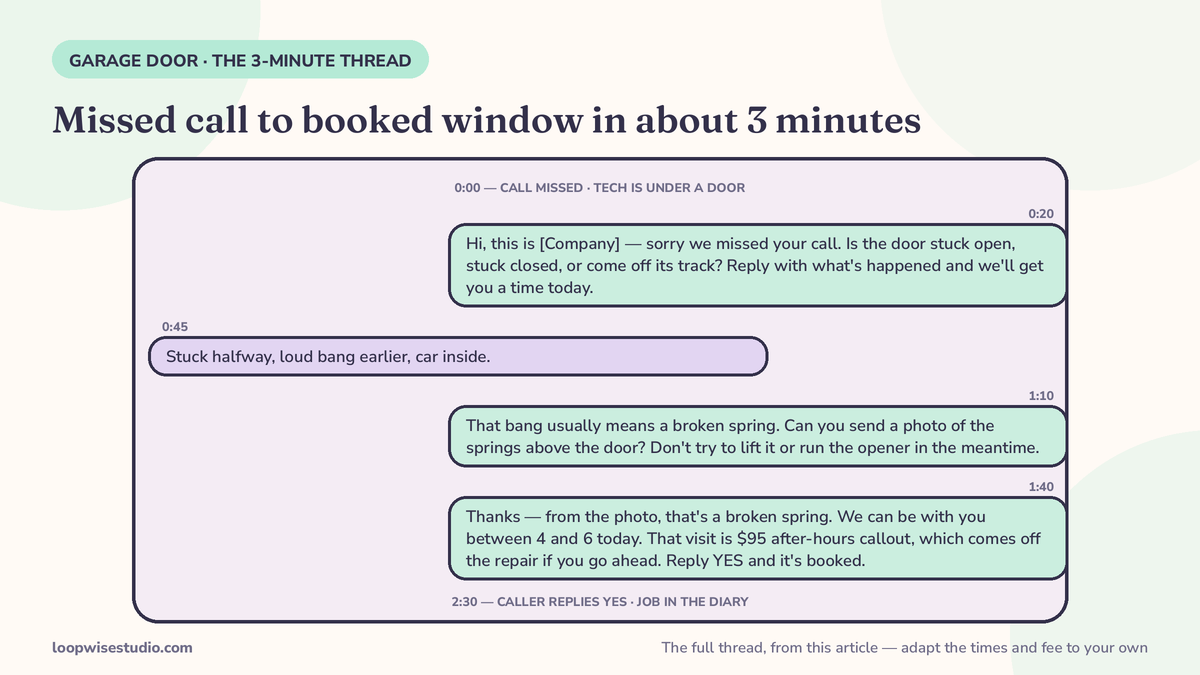
The 3-minute emergency thread, in full
This is the asset no ranking page publishes: the entire conversation, with the words and the clock. Copy it and adapt the times and fees to your own.
0:00 — the call is missed. Your tech is under a door, the office is closed, or the line is busy.
0:20 — the instant text:
Hi, this is [Company] — sorry we missed your call. Is the door stuck open, stuck closed, or come off its track? Reply with what’s happened and we’ll get you a time today.
0:45 — the caller replies: “Stuck halfway, loud bang earlier, car inside.”
1:10 — the photo ask:
That bang usually means a broken spring. Can you send a photo of the springs above the door? Don’t try to lift it or run the opener in the meantime.
1:40 — the diagnosis and the window:
Thanks — from the photo, that’s a broken spring. We can be with you between 4 and 6 today. That visit is [$95] after-hours callout, which comes off the repair if you go ahead. Reply YES and it’s booked.
2:30 — the caller replies YES. Confirmation text with the tech’s name and a live arrival window. Job in the diary. Done — while the second company on Google is still ringing out.
Three design decisions make this work. The first text asks a diagnosis question, not “how can we help?” — a caller with a trapped car answers a specific question instantly. The safety instruction rides inside the photo request, where it will actually be read. And the fee is quoted before the yes, in writing, which is why the next section exists.
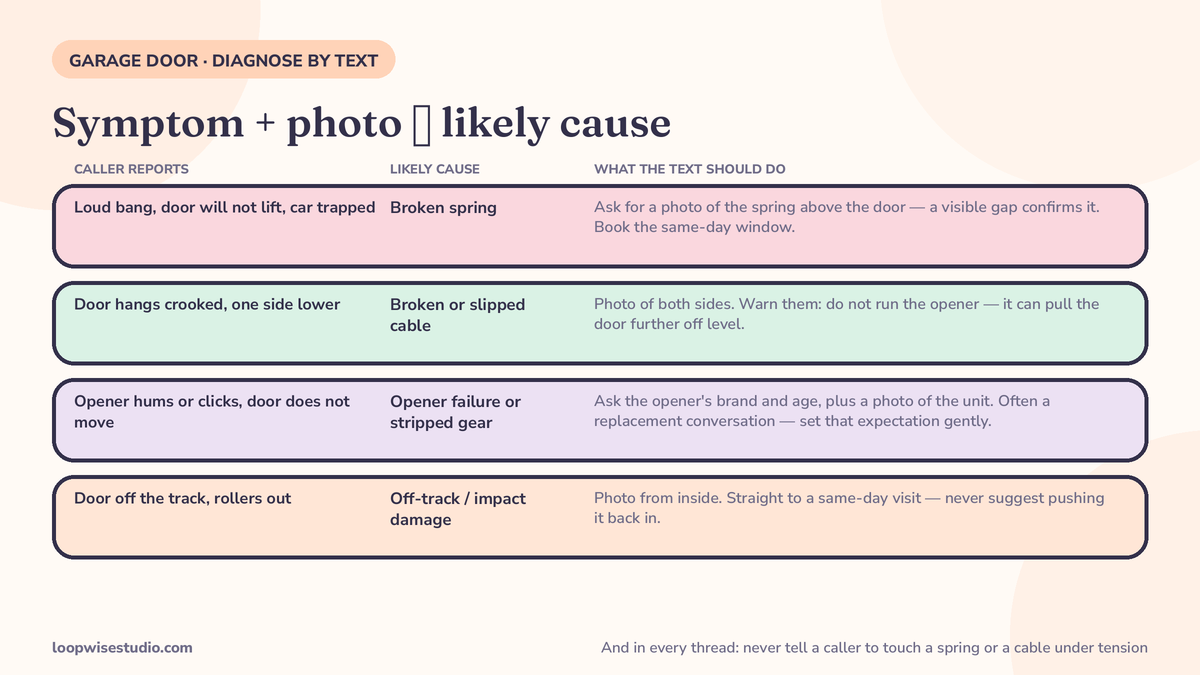
Diagnose by text: what to ask, what a photo tells you, what never to say
Garage doors are unusually diagnosable by message, because the failures look different and sound different. EmberNestAI’s voice product does this by call; the same logic works in a thread.
| Caller reports | Likely cause | What the text should do |
|---|---|---|
| Loud bang, door will not lift, car trapped | Broken spring | Ask for a photo of the spring above the door; a visible gap confirms it. Book the same-day window. |
| Door hangs crooked, one side lower | Broken or slipped cable | Photo of both sides. Warn: do not run the opener, it can pull the door further off level. |
| Opener hums or clicks, door does not move | Opener failure or stripped gear | Ask for the opener’s brand/age and a photo of the unit. Often a replacement conversation, not a repair — set that expectation gently. |
| Door off the track, rollers out | Off-track / impact damage | Photo from inside. Straight to a same-day visit; do not suggest pushing it back in. |
And the line that belongs in every thread, regardless of cause:
Never tell a caller to touch a spring, a cable under tension, or to force a door. Springs hold enough energy to cause serious injury, and a text thread that instructs a homeowner to “just release the tension and lift it manually” is a liability written in your own words. The text’s job is: diagnose enough to send the right tech with the right spring on the van, keep the caller away from the mechanism, and book the window. That is all — and it is enough to win the job.
Quote the after-hours fee inside the text
The highest-value move in this trade is one your competitors demonstrate but never teach. BeepBack, a text-back vendor, publishes an example thread in which a garage-door caller accepts a $95 after-hours fee by text. The fee conversation — the one owners assume needs a phone call, a negotiation, a human — happens in writing, at 10pm, in one reply.
Why it works better by text than by phone:
- The caller is already braced for it. They know 10pm costs more. In writing, the number simply sits there, next to the window you are offering.
- There is no awkward pause. On a call, a fee invites haggling and “let me ring around.” By text, the reply is YES or silence — and silence at 10pm with a door open usually lasts about a minute before the yes, because the alternative is an unsecured house.
- It is recorded. The accepted fee is in the thread, in the caller’s own words. No “nobody told me” at the door.
Name your real number, state what it covers (the visit, deducted from the repair if they proceed, if that is your policy), and ask for the yes. Owners who move this conversation into the text routinely find it is the easiest fee they collect all week.
Safety lines that belong in the thread
Two situations need words that are already written before the night they happen:
Door stuck open: “We know an open door tonight is a security problem, not just a repair — that’s why this visit is today, not tomorrow.” If you genuinely cannot attend, say so in the thread and give the caller the honest next step rather than a vague promise; a caller who secures the house another way and hears the truth still books you next time.
Broken spring or off-track: the do-not-operate line from the diagnosis section — don’t run the opener, don’t try to lift it, keep people and pets out from under it. Send it even if you think the caller knows. Especially if you think the caller knows.
The settings that quietly lose you jobs
Three defaults, all real, all documented in this batch’s research:
Quiet hours that hold night texts until morning. Callita, a $39/mo text-back product, discloses on its own page that its default quiet hours (9pm–8am) hold night texts until morning. For a plumber’s non-emergency work that is a defensible default. For garage door it inverts the product: a 10pm trapped-car text delivered at 8am is a job delivered to whoever answered at 10pm. If you use any text tool, check this setting first and turn the hold off for your number.
Press-1 opt-ins. Some systems make the caller press a key to opt into a text. Every extra step at the worst moment of someone’s evening sheds callers. The text should simply arrive.
Callback-only setups. A message that says “we’ll call you back” without a thread the caller can answer puts you back in the voicemail race — you, calling a stranger who has since booked someone else. The thread is the product: symptom, photo, window, fee, yes. Multi-crew shops in the neighbouring trades run the same thread at higher volume — the plumbers’ version of this system shows how it holds up when several vans are on the road.
If you would rather have the whole thing — thread, triage questions, fee script, settings — built and tested for your company, get a free audit and we will map your current missed-call pattern first, including what your night calls actually look like.
Storm weeks and cold snaps: your surge days
Your trade has surges too; they just arrive differently. A storm that bends doors and knocks tracks out of line produces a morning of calls in an hour. A hard cold snap makes old springs brittle — springs that survived five summers let go in the first freeze, several streets at a time.
The setup point is the same as the diagnosis point: on those mornings your miss rate spikes exactly when every job is a same-day emergency. Text back holds all of them at once, sorts the trapped cars from the noisy panels, and fills the day in the order the calls arrived. No special configuration — just do not be configuring it that morning.
What it costs: three routes, priced honestly
| Route | Published pricing (check current before buying) | What you get |
|---|---|---|
| Simple text-back tool | Callita at $39/mo flat, as it publishes | The instant text and the thread. You write the questions; it does not diagnose or book for you. |
| Text-back with qualification | BeepBack at $79/mo flat, as published; JobsFilled $49–99/mo tiers | Published example texts, triage by reply, tighter follow-up. Booking still largely yours. |
| AI voice dispatcher | EmberNestAI at $299/mo founding / $699/mo standard, as published | A robot answers by voice and triages mechanically. Powerful — and not a text, which is what this query asked for. |
| Done-for-you build | Project-priced | Your questions, your fee script, your windows, your settings — built and tested, on your website and number. |
The short version
In one line: for a garage door company, missed call text back is a text within 30 seconds that diagnoses the door by photo and books the same-day window before the caller dials the next company. The trade is won on response, your callers cannot wait, and the fee conversation everyone fears turns out to be the easiest one to have in writing.
If your night calls are currently going to a voicemail box, get a free audit — we will count them and show you what the thread would have caught.
FAQs
How fast does the text need to go out for an emergency trade?
Under a minute — 30 seconds is the working target. A garage door caller with a trapped car is dialling the next company within a couple of minutes of your phone ringing out. A text at minute ten reaches someone already booked elsewhere.
Can a text conversation really diagnose a garage door fault?
Enough of one to win and schedule the job, yes. The four common failures — spring, cable, opener, off-track — look and sound different, and a photo of the spring or the door’s lean confirms most of them. The text does not replace the tech’s inspection; it makes sure the right spring is on the van and the caller is booked with you, not still shopping.
What should the text never tell a caller to do?
Never instruct a caller to touch a spring or a cable under tension, release spring tension, or force a door that is off its track. The thread should say the opposite: do not run the opener, do not try to lift it, keep clear of the door. Diagnosis and booking by text; hands-on by your tech only.
Is it reasonable to quote the after-hours fee by text?
It is usually easier than by phone. State the fee, what it covers, and whether it comes off the repair, then ask for a YES reply. BeepBack’s published example shows a caller accepting a $95 after-hours fee inside a text thread — in writing, at night, the number next to a concrete arrival window gets accepted more readily than owners expect.
My current text tool holds messages overnight. Is that a problem?
For this trade, yes — it is the single most damaging setting. Callita discloses that its default quiet hours hold texts from 9pm to 8am. A held text for a 10pm emergency arrives after the job is gone. Check the setting on whatever you use and disable the hold for your business number.
Do I need an AI dispatcher instead of text back?
Only if your call volume justifies it and your callers are happy talking to a robot at 10pm. EmberNestAI’s dispatcher ($299/mo founding, $699/mo standard, as published) is a genuinely capable voice product. Text back is cheaper, simpler, and reaches callers who will not have a voice conversation with an AI — including the ones texting you from a driveway at midnight so they do not wake the house.