Missed Call Text Back for Electricians: Built for Solo Operators
A solo electrician can't answer from a ladder or a live panel. Missed call text back holds the caller with a safety-first text until your next break — then you close it.
For a solo electrician, missed call text back sends the caller a text within a minute of the missed call, asks what has happened, and holds the conversation safely until your next natural break. Anything dangerous — sparking, a burning smell, a home with no power and medical equipment in it — stops the chat and rings your phone immediately. Everything else waits, warm, instead of dialling your competitor.
The shared mechanics of text back — the sub-60-second rule, carrier registration, two follow-ups and out — are covered in full in the HVAC guide in this series. This article is about the version of the problem only electricians have.
Your problem is not volume. A big HVAC shop misses calls because twenty people ring at once. You miss calls because at the moment the phone rings, you are physically unable to answer it. You are on a ladder. Your hands are in a panel. You are driving between jobs with the phone face-down. The call is not competing with other calls — it is competing with not falling, not touching the wrong thing, and finishing the job in front of you.
So the text does not need to book the job. It needs to do something subtler: hold the caller, find out whether anyone is in danger, and keep the lead warm for the twenty minutes until you reach a break point. Then you close it, in person, the way solo electricians have always closed work.
Why you cannot just “answer more”
Advice written for offices does not survive contact with a one-person electrical business. You cannot hire a receptionist for a problem that happens six times a day in ninety-second bursts. You cannot answer from a live panel — and you should not, because a distraction at the wrong second is how electricians get hurt.
The realistic options are the ones that accept the break-point shape of your day: long stretches where you cannot talk, short gaps where you can. Text fits that shape exactly. A caller who gets a text in under a minute stops shopping. You read the thread while your hands are washing or the kettle is on, reply in one line, and ring them at the next proper break if it needs a voice.
BeepBack, a text-back vendor, publishes its reminder texts word for word and prices its service at $79 a month flat, with billing starting only when texting goes live — a useful benchmark for what the basic layer costs, and its own field test (calling 133 New Jersey plumbing shops in July 2026, it found about 1 in 6 ever picked up) shows the problem is not you being careless. Shops with staff miss most calls too. A solo operator with a hold-text is ahead of most of them.
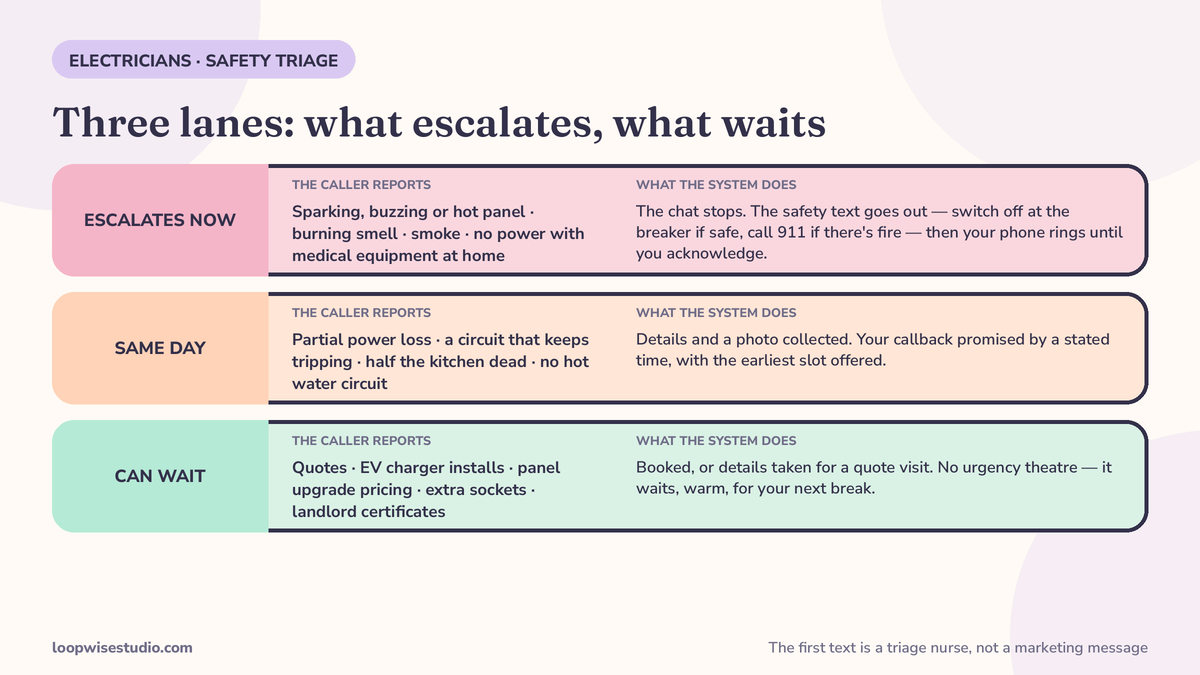
The safety table: what the text asks, what escalates, what waits
This is the part no rival page writes, and it is the part that matters most in your trade. Plumbing has flooding. You have faults that can hurt someone between the missed call and your callback. The first text is not a marketing message — it is a triage nurse.
| Lane | The caller reports | What the system does |
|---|---|---|
| Escalates now | Sparking, buzzing or hot panel; burning smell; smoke; no power with medical equipment or a vulnerable person in the home | Stops the chat. Sends the safety line below, then rings your phone and keeps alerting until you acknowledge. |
| Same day | Partial power loss; a circuit that keeps tripping; half the kitchen dead; no hot water circuit | Collects details and a photo if relevant, promises your callback by a stated time, offers the earliest slot. |
| Can wait | Quotes, EV charger installs, panel upgrade pricing, extra sockets, landlord certificates | Books or takes details for a quote visit. No urgency theatre. |
The safety line itself — copy it into your sequence:
If you can smell burning or see sparks, please switch off at the main breaker if it is safe to reach, keep away from the panel, and if there is any sign of fire call 911 now. I have your message and I am calling you back within minutes — [Your Name], [Company]
Two rules make this work. First, the escalation must be genuinely instant and genuinely hard to ignore — a text to your own phone that you might read in an hour is not an escalation. Second, the caller in the danger lane gets told to stop texting and act. A system that keeps chatting politely with someone standing next to a sparking panel is worse than no system.
Set the lanes with your own judgement before anything goes live. You know which faults you drop everything for. Write them down; the software just follows the list.
The full text sequence, with the words
Your sequence is shorter than an office’s, on purpose. Four messages maximum, and the goal of every one is the callback, not the calendar.
Message 1 — instant hold (under 60 seconds):
Hi, [Your Name] at [Company] — sorry I missed you, I’m on a job and can’t get to the phone. What’s happened? If anything is sparking or you can smell burning, reply DANGER and I’ll call you straight back.
Message 2 — details (after their reply, automated):
Thanks. Two quick things so I can price it properly: your postcode/zip, and a photo of the panel or the problem if you can take one safely. I’ll ring you at my next break — within the hour.
Message 3 — the callback promise, kept visible (sent as you finish the current job, one tap from your saved replies):
Finished up here — I’ll call you in 10 minutes. If I miss you, reply here and I’ll try again straight after.
Message 4 — next morning, only if you never connected:
Morning — [Your Name], [Company]. We missed each other yesterday. I’m on jobs from 8, but this thread reaches me: tell me a time that suits and I’ll call then.
Notice what is missing: no booking link pushed at a stranger mid-fault, no five-message drip. Signpost’s electrician follow-up guide makes the same point from the voice side — text holds the lead, the call closes it. For a solo operator that is not a compromise. It is the model.
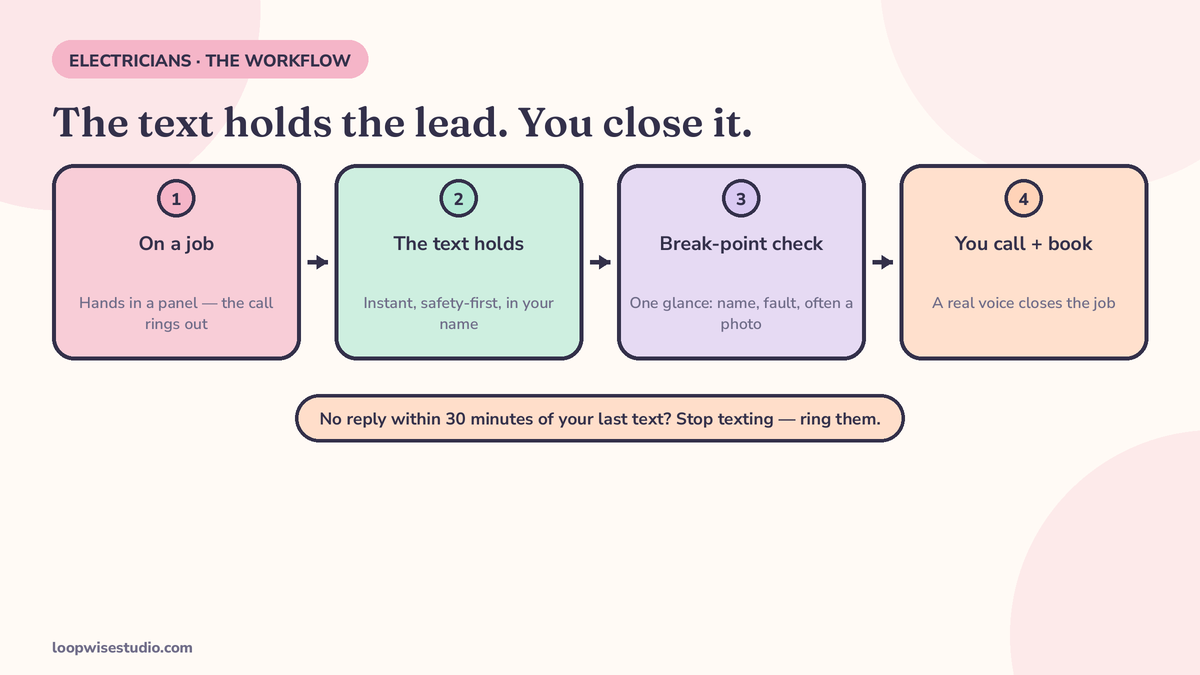
Text holds the lead, the call closes it: the 30-minute rule
The workflow that makes this pay:
- The text holds. Instant, automatic, safety-first. The caller stops dialling competitors.
- You work your break points. Between jobs, in the van, at lunch — one glance at the thread list. Danger lane already rang you. Everything else is a name, a fault, and often a photo.
- The 30-minute rule. If a thread has had no reply within 30 minutes of your last message, stop texting and ring them. Texts hold; they do not chase. One real voice call from the actual electrician closes work that five more texts will not.
- One line closes the admin. After the call, the booking confirmation goes out by text from the same thread, so the customer has your number saved before you arrive.
There is a quiet side benefit: property managers and general contractors — the callers who ring once, get voicemail, and never try again — will use a text thread. It suits how they work, in writing, between their own jobs. One facilities manager who can reach you reliably is worth a season of one-off callouts, and they are the callers least served by voicemail.
What the thread looks like from the caller’s side
It is worth reading your own sequence once as the customer, because the caller’s experience is simpler than the machinery behind it. They rang a number from Google, nobody answered — the normal small failure — and within a minute their phone buzzed with a text that named the electrician, admitted he was on a job, and asked one question they could answer in five words.
That text does three kinds of work at once. It tells them the business is real and operating, today. It gives them a way to be heard that does not involve redialling or composing a voicemail they suspect nobody checks. And for the anxious caller — the one with the buzzing panel — it asks the safety question before they have finished worrying about whether to ring someone else.
Compare it with the caller’s experience at the next electrician on the list, whose phone also rings out, into silence. You do not need to be better than that competitor’s work. At the moment of the missed call, you only need to be present and they were not — and a text is presence that fits in a pocket until your next break.
The one experience to avoid is the thread that feels like a robot’s maze: five automated questions deep before the caller has said what is wrong. That is why this article’s sequence asks one thing, then listens. The trades that share your cluster make the same trade-off at different speeds — garage door companies need the whole diagnosis in three minutes, because their caller is standing in a driveway; you usually have until the next break, and the sequence should feel like it.
What one missed call is really worth
Vendor pages throw lifetime-value claims around. Signpost’s guide argues a missed customer can represent $2,000 or more over time, starting from an average electrical service call it puts at $150 to $500 — panel upgrades, EV chargers, generator work, and referrals doing the compounding. Treat that as their argument, and do the honest version with your own numbers:
- Say you miss 3 real calls a week while on jobs — check your call log; most solo operators who count are surprised in one direction or the other.
- Say the hold-text saves 1 of those 3 — a cautious share, since many callers were never going to wait for anyone.
- At a $300 average first job, that is roughly $15,000 a year in first jobs alone, before the panel upgrade eighteen months later and the two neighbours they mention you to.
Your numbers will differ. The point of doing the arithmetic is that the break-even is low: BeepBack publishes $79/mo flat, JobsFilled publishes $49/mo for text-back and $99/mo for its booking tier, and the UK-only MissedToBooked publishes £97/mo after a free trial. One saved job a month covers any of them several times over. Check current pricing on each vendor’s page before deciding.
Setup for a solo operator: your number, your name, no new app
The setup that suits a one-person shop:
- Keep your existing number. The text goes out from the number already on your van and your Google listing. A second number nobody recognises defeats the purpose.
- Registration is handled once. In the US, A2P 10DLC carrier registration applies to sole proprietors too — BeepBack states billing starts only when texting goes live, after a registration wait of roughly two weeks, and explicitly welcomes sole proprietors without an LLC or EIN. In the UK the route differs (MissedToBooked sets UK trades up with call forwarding instead) — if you are UK-based, make sure any vendor you pick is actually set up for UK numbers.
- Replies land where you already look. The better solo products route replies to your normal messages or a simple lead inbox — not a dashboard you must remember to open.
- Cap the chattiness. A courtesy limit on unanswered follow-ups (BeepBack describes capping unreplied nudges per day) protects your number’s reputation and your sanity.
If you run your business from a website as well as a van — or you want the booking and follow-up handled as one built system rather than another app — that is the version we build. You can get a free audit and we will look at your call pattern first; for a solo operator the audit is mostly about whether the missed calls are worth catching, and sometimes the honest answer is they are not yet.
Text back vs virtual receptionist vs AI voice agent, for a solo shop
| Text back | Virtual receptionist | AI voice agent | |
|---|---|---|---|
| Answers when you are in a panel | Yes — instantly, by text | Yes, by voice | Yes, by voice |
| Safety triage | Built in — danger reply rings you | Depends on their script and briefing | Depends on configuration |
| Feels like | A text from your business | A person who is not you | A robot, however polite |
| Books the job | Holds and details; you close by voice | Can book, varies | Varies by product |
| Published cost signals | $49–99/mo (JobsFilled, BeepBack published pricing) | Signpost states services typically start around $99/mo | Usually higher tiers; check vendor pages |
For a solo electrician, the honest verdict: text back first. It matches your day, costs the least, and keeps your voice — the thing your reviews are actually about — on the calls that close. Add a human answering layer later only if your missed-call count, not a sales rep, says you need one.
The short version
You miss calls because your hands are busy, not because your business is disorganised — so the fix is a text that holds the caller, checks for danger, and hands you a warm thread at your next break. Safety lane first, callback within the hour, one saved job a month pays for it.
If you want a second pair of eyes on your numbers before you buy anything, get a free audit — we will tell you plainly if the volume is not there.
FAQs
I am a sole proprietor with no LLC. Can I still register to text customers?
Yes. US carrier registration (A2P 10DLC) has a sole-proprietor path, and vendors such as BeepBack state they onboard sole proprietors without an LLC or EIN. Expect a registration wait — BeepBack describes roughly two weeks before texting goes live — and a vendor who will not discuss registration at all is one to avoid.
What happens if a caller texts back about something dangerous?
That is decided by your triage lanes, set up in advance. A reply matching the danger lane — sparking, burning smell, no power with medical needs — sends the caller a safety line (breaker off if safe, call 911 if there is any sign of fire) and alerts your phone immediately and repeatedly. The chat does not continue as normal.
Should the text try to book the job automatically?
For most solo electricians, no. The text should hold the caller, gather the fault, a photo, and the address, and promise your callback at a stated time. You close it by voice. Automatic booking suits multi-van shops with a dispatch diary; a one-person operation closes better in person — the companion piece on missed call text back for plumbers covers the multi-crew version.
Will this work with the number already on my van?
It should — keeping your existing number is the point, since that is the number your Google listing, van, and repeat customers already use. In the US this usually means registering that number for A2P texting; in the UK, forwarding-based setups differ. Ask any vendor directly how existing numbers are handled before signing.
What about callers who will not text — older customers, property managers in a hurry?
Some callers never reply to a text, and the system should assume that. The 30-minute rule covers it: no reply means you ring them at your next break, with the thread telling you they called and when. The text costs you nothing with these callers — it is the voicemail they would have ignored, in a form some of them will surprise you by answering.
How much does it cost a one-person electrical business?
Published prices for solo-friendly products cluster at $49–99/mo in the US (JobsFilled $49 text-back / $99 booking tier; BeepBack $79 flat) and £97/mo for the UK’s MissedToBooked — all as published by the vendors, so confirm current pricing before you buy. A done-for-you build is priced differently, as a project. Against any of these, one saved $300 job a month is the break-even that matters.