Automatic Google Review Requests for HVAC Companies by Text
Automatic Google review requests for HVAC companies by text: timing by job type, the maintenance-plan flywheel, one follow-up max, and the scripts you should never send.
Automatic review requests for an HVAC company are texts triggered the moment a job closes in your field service software. The request carries your Google review link, goes to every completed job with identical wording, and follows up once at most. Repairs get asked the same evening; installs wait until day two or three.
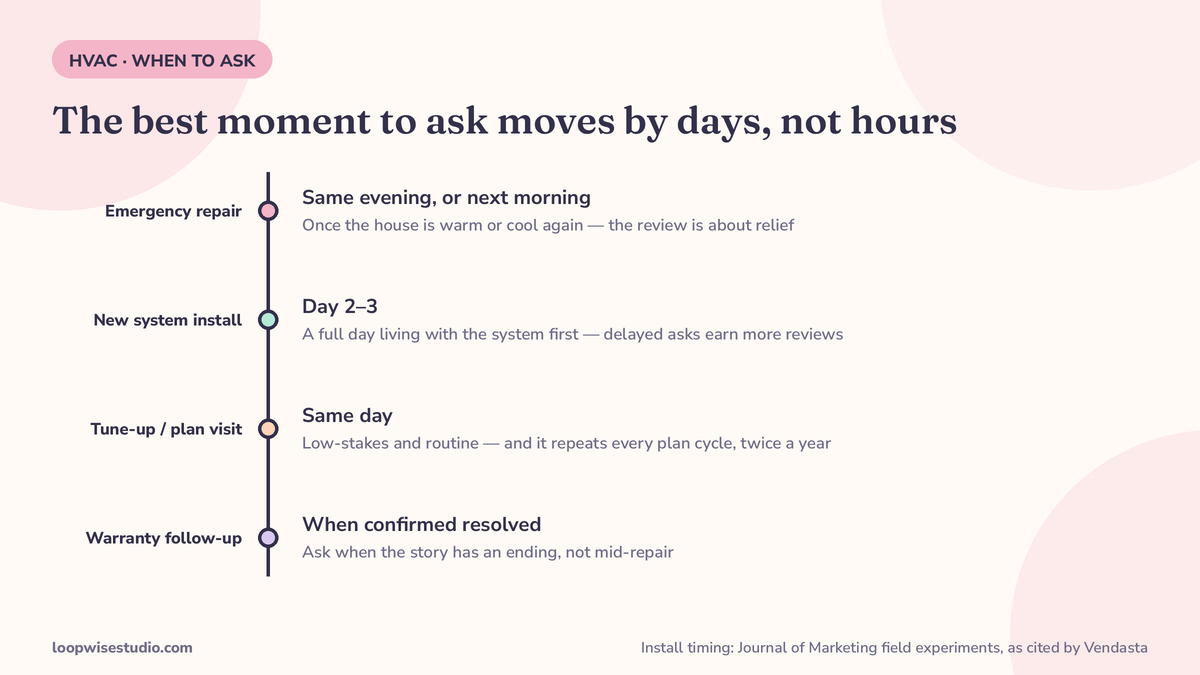
HVAC has two mechanics no other trade gets: a job-type spread where the best moment to ask moves by days, not hours — and a maintenance plan that manufactures a fresh reason to ask, twice a year, forever. Both are in this page, along with the sequence, the texts, and the rules.
Reviews decide the “near me” tap during a heat wave
In the first hot week of June, a homeowner with a dead AC does not comparison-shop. They search “AC repair near me” and call whoever looks safe. BrightLocal’s 2026 Local Consumer Review Survey (1,002 US adults, reported by Marqeable) found 97% of consumers read online reviews for local businesses, 85% are more likely to use a business with positive reviews, and 47% will not use a business with fewer than 20 reviews. A GatherUp study of 23,000 locations, reported by Vendasta, quantifies the asking gap: businesses that ask averaged 122 reviews per location against 53 for those that did not.
During peak season your techs are running ten calls a day. Nobody is hand-asking consistently in July — which is exactly why the shops that win the heat-wave search results are the ones whose ask is automatic. The system has to be built before the season, and it has to survive the season. More on that below.
When to ask, by job type
| Job type | Send the text | Why that moment |
|---|---|---|
| Emergency repair (no-heat / no-cool) | Same evening or next morning, once the house is warm or cool again | The review is about relief. Ask when the temperature is fixed and felt, not while the tech is still in the attic |
| New system install | Day 2–3 | The customer needs a full day living with the system — airflow, noise, thermostat — before they know what they think of it |
| Tune-up / maintenance-plan visit | Same day | Low-stakes visit, everything routine; the ask is light and the cadence repeats every plan cycle |
| Follow-up / warranty visit | After the issue is confirmed resolved | Same rule as any trade: ask when the story has an ending, not mid-repair |
The install delay is not just a hunch. Vendasta’s guide cites a Journal of Marketing study based on two randomized field experiments: reminders sent immediately after a purchase reduced the chance of a review, while delayed reminders increased it. One ranking contractor guide independently lands on the same 2–3 day timing. For a five-figure install, patience is the strategy.
Everything else goes out at a reasonable hour, with an open dispute or unresolved callback as the one hard exclusion — a human calls first, and the automated text waits.
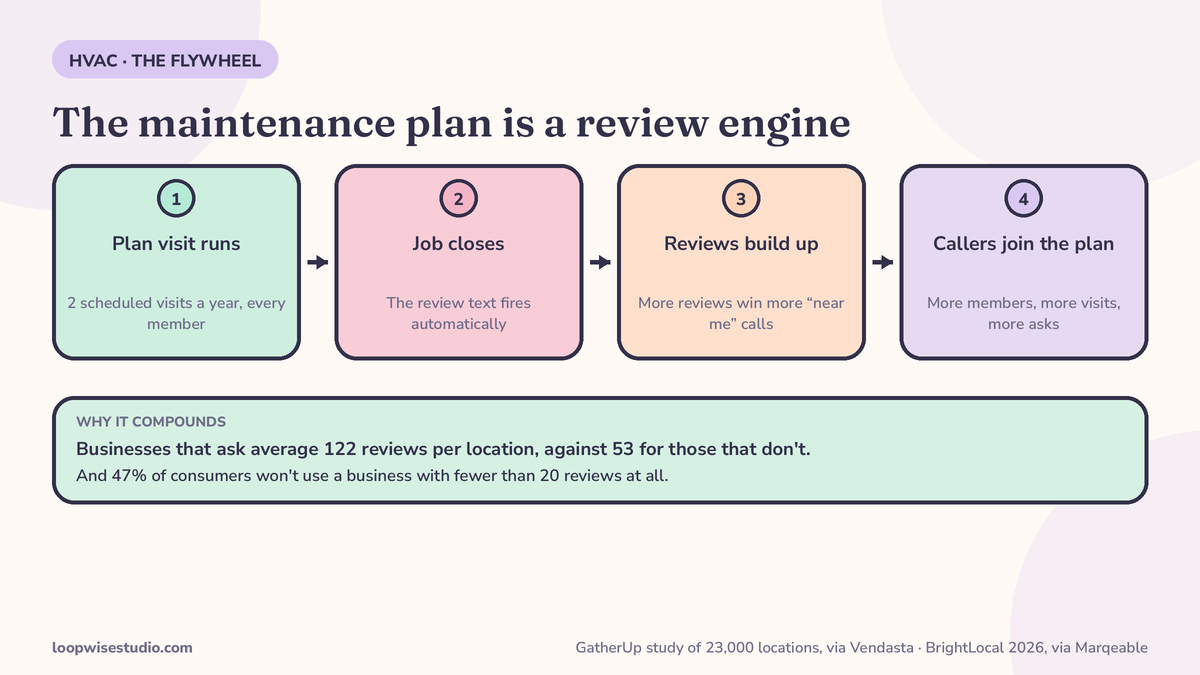
The maintenance-plan flywheel: the review engine your competitors don’t have
Plumbers ask after emergencies. Electricians ask after panels. Only HVAC owns a scheduled, recurring reason to be back inside the customer’s home: the maintenance plan.
Run the math on what that means. Every plan member gets two visits a year. Every visit closes a job. Every closed job fires the same automatic ask. A customer who ignored the spring ask may answer the fall one — and BrightLocal’s figure, reported by Spokk, says 28% of consumers always write a review when asked. Your plan members become a review source that renews itself on a schedule you control, while competitors wait for breakdowns and hope.
Two disciplines keep the flywheel honest. The ask after a tune-up is the same ask as after any other job — identical wording, no checking whether the visit “went well” first. And a member who has already left a review this cycle doesn’t get nagged again; the sequence’s stop conditions (below) handle that. The flywheel is volume plus consistency, not pressure. It is the same compounding logic as automatic review requests for plumbing companies by text, except plumbing has to manufacture its occasions and HVAC gets them on the calendar.
The automatic sequence: trigger, text, one follow-up, stop
- The job closes in Jobber, Housecall Pro or ServiceTitan. That status change fires the sequence — not a CSR’s end-of-day memory.
- The text goes out inside the job-type window above, with your direct Google review link.
- One follow-up, maximum. Marqeable’s published automation caps the sequence at one text plus at most one email at 3–4 days; Spokk’s guidance is one reminder. One text and one follow-up is the ceiling this article uses.
- Stop on any signal. Review posted, any reply, or an opt-out ends it for that customer.
Copy-paste HVAC texts
No-heat repair (same evening):
Hi [Name], [Company] here — hope the house is warming up nicely. If you’ve got a minute, an honest review of today’s visit helps neighbours find us when their furnace quits: [Google review link]. Reply STOP to opt out.
No-cool repair (next morning):
Morning [Name] — [Company] checking in. Slept cool last night, we hope. If the repair went the way you expected, a quick review means a lot: [Google review link]
Install (day 2–3):
Hi [Name], it’s been a couple of days with the new system — how’s it feeling? If you’re happy with how the install went, we’d appreciate a review of the experience: [Google review link]. And if anything feels off, reply here and we’ll sort it.
Tune-up / plan visit (same day):
Thanks for having us out for your tune-up, [Name]. Quick favour: a short review of today’s visit helps other homeowners pick a company they can trust: [Google review link]
The one follow-up (3–4 days later, no review yet):
Hi [Name], one nudge from [Company] — if you meant to review your [repair/install/tune-up], here’s the link again: [Google review link]. No worries if not.
Notice what none of these texts do. None asks for five stars. None asks the customer to mention the tech’s name — Google treats requesting specific content, a staff name included, as a violation. And the install text offers a reply path for problems alongside the public link — never as a filter in front of it. A private feedback channel offered instead of the Google link is gating; offered in addition, to everyone, it’s service.
Set it up before peak season
The worst week to build this is the first heat wave. The setup is a few hours of work done once, in the quiet season:
- Map the triggers. Job-closed events in Jobber (job completed), Housecall Pro (finished job) or ServiceTitan (completed booking) each get assigned a send window by job type — repair, install, tune-up. Tag job types at booking so the timing is automatic.
- Load the texts. One per job type plus the single follow-up, all using the direct Google review link for the right location if you run more than one.
- Set the caps in the tool, not in a policy doc. One follow-up maximum, quiet hours respected, and stop-on-reply enforced by the sequence itself.
- Build the exclusion list. Open dispute, unresolved callback, or a job the tech flagged — a human calls, the text doesn’t fire.
- Route replies to a watched inbox. A customer answering a review text with “actually, it’s making a noise” needs a person within the hour, in July above all months.
When the surge hits, the ask keeps happening at 40 jobs a week exactly as it did at 15 — which cannot be said for any process that runs on a tech remembering to mention it at the door. If the surge problem is bigger than reviews, missed call text back for HVAC companies covers the other end of the same week: catching the calls your team can’t pick up.
A note on email, QR codes and the invoice
Text carries the system because it’s automatic and timed, but two additions are worth having. Marqeable’s flow allows an email at 3–4 days as the one follow-up channel if the text went unanswered — particularly useful for install customers, who live in their email more than a repair customer does. And a QR code linking to your Google review form, printed on the invoice and the maintenance-plan leave-behind, catches the customer who’d rather scan than tap a text link. Neither replaces the trigger. Both assume it’s running: the email follows the text’s silence, and the QR code repeats the same link the text already sent. What neither should ever become is a separate ask with separate wording and separate rules — one system, one identical invitation, several delivery paths.
The rules: no “if you’re happy” scripts, no incentives, no gating
Google’s rules, consistent across every serious guide in this space (Marqeable, Spokk, HomeTrade AI, Socio AI): no incentives of any kind for posting, editing or removing a review; no selective solicitation; no requesting specific content. The FTC’s Consumer Review Rule, effective October 21, 2024, bans incentives conditioned on sentiment and carries civil penalties (via HomeTrade AI). Better Business Bureau data reported by Socio AI puts the stakes plainly: 82% of consumers read online reviews for local businesses — the asset is too valuable to risk on a shortcut.
Two widely-copied practices fail those rules, and both are worth naming as practices — because your competitors’ scripts may already include them:
Scripts that open with a happiness filter — the “if you’re happy with our work, would you mind leaving a review?” pattern. It reads as friendly. It functions as selective solicitation: the unhappy customer hears that the invitation wasn’t really for them. Spokk’s words-to-avoid table flags the same phrasing, and Vendasta’s templates deliberately avoid it for the same reason. The compliant version asks everyone, identically, for an honest review — the word “honest” doing the work the filter was trying to do.
Follow-up ladders of three or more asks. Some contractor advice runs text, then email a week later, then one more try. The sourced caps are lower: one text plus at most one follow-up (Marqeable), one reminder (Spokk). Beyond that you’re not reminding — you’re pressuring, and pressure at the kitchen table or in the text thread is itself named in the policy summaries. One follow-up also happens to be what the delayed-reminder research supports.
The honest version of this system is also the effective one: same ask, every job, timed to the job type, once. Shops chasing the review mechanics used by med spas asking for reviews by text follow the same rulebook — the trades are not exempt from it, and the clinics are not stricter than you need to be.
Replying to the reviews HVAC companies actually get
The ask is half the system; the reply is the half future customers read. HVAC reviews cluster into a few predictable shapes, and each deserves a written, calm answer:
The price complaint on an install quote or repair:
Thanks for saying it plainly, [Name]. A repair bill should never be a surprise — we quote before we start, and if that didn’t happen clearly on your visit, that’s on us. Call us at [number] and we’ll walk the invoice line by line.
The “they tried to sell me a whole system” complaint:
We hear this concern, [Name], and we take it seriously. Our techs are expected to show you the repair option and the replacement option with honest numbers for both — the decision stays yours. If your visit felt like pressure, we’d like to hear about it directly at [number].
The peak-season wait complaint (“three days with no AC”):
You’re right that the wait was too long, [Name], and we’re sorry. During the first heat wave our board fills faster than we can honestly promise, and we’d rather tell you the real date than a hopeful one. Thank you for the feedback — it’s how we size the crew for next season.
Never offer anything in exchange for editing a review, never litigate the facts in public, and answer the fair 3-star reviews with the same care as the 1-stars. The homeowner reading your replies in the next heat wave is deciding whether you sound like a company that stands behind its work.
And one discipline that closes the loop: route review replies into the same watched inbox as the request sequence. A customer who answers your review text with a complaint has handed you a private chance to fix it before it becomes a public one — but only if a human sees it fast. That private channel exists alongside the public ask, offered to everyone; it never replaces the ask or filters who receives it.
What done-for-you looks like
Loopwise Studio sets the whole sequence up inside the software you already run: job-type timing configured, the text set written for repairs, installs and tune-ups, the follow-up cap and exclusions hard-coded, and replies monitored so nothing sits unanswered in peak season. Your techs close jobs the way they already do. The reviews accumulate on their own — including the twice-a-year plan visits your competitors aren’t asking about at all.
Want the number first? Get a free audit — we’ll count your completed jobs and plan visits, show you the review gap against shops that ask automatically, and map the exact setup for your platform.
Frequently asked questions
When should an HVAC company send the review request text?
By job type. Emergency repairs: the same evening or next morning, once the house is warm or cool again. Installs: day two or three, after a full day living with the system — a Journal of Marketing field study reported by Vendasta found delayed reminders outperform immediate ones. Tune-ups and maintenance visits: same day.
How many times can I follow up on a review request?
Once. The published caps in the guides that document their flows are one text plus at most one follow-up message (Marqeable), or a single reminder (Spokk). Three-ask ladders go past what the sourced guidance supports and start to read as pressure, which Google’s policy summaries warn against.
Is it against the rules to ask “if you’re happy with our work, leave a review”?
Treat it as a violation risk. That phrasing filters the audience — it invites the happy and quietly excuses everyone else — which is selective solicitation in effect. Spokk’s words-to-avoid table and Vendasta’s template guidance both flag or avoid it. Ask every customer the identical question: an honest review of the visit.
Can I offer a discount on the next tune-up for a review?
No. Google bans incentives — discounts included — tied to posting, editing or removing a review, and the FTC’s Consumer Review Rule bans incentives conditioned on sentiment. A loyalty discount for plan members is fine as a standalone offer; connecting it to a review is not.
Do maintenance-plan customers get asked after every visit?
They get the same automated ask as any completed job — that’s what makes the plan a review engine. Stop conditions protect it from becoming nagging: once a customer has reviewed or replied in a cycle, the sequence ends for them. Same wording, every visit, no screening by how the visit felt.
What if a review comes in that’s unfair?
Reply in public, calmly, with the facts you’re sure of, and move the detail to a phone call. Never offer anything in exchange for changing or removing it — that’s an incentive violation on top of a bad week. A professional reply is read by every homeowner who finds that review during the next heat wave.