Pakistan Aesthetic Clinics Booking Report 2026: 62% Cannot Be Booked Online
We audited 225 aesthetic clinics across Peshawar, Islamabad and Rawalpindi in October 2026. 62% offer no online booking, 33% have no website, and only 14% passed every check.
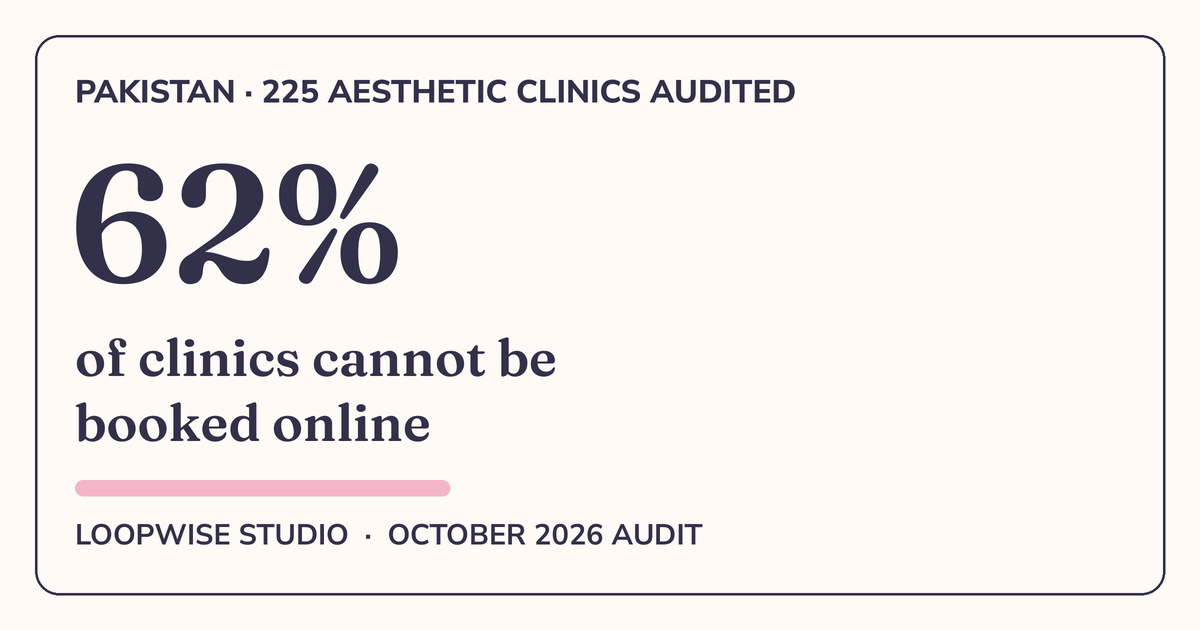
Short answer: In October 2026 we audited 225 aesthetic clinics across Pakistan’s three most-audited city markets — Peshawar (78), Islamabad and Rawalpindi (147). 139 clinics (62%) offer patients no way to book online. 74 (33%) have no website at all. Only 31 clinics (14%) passed every check in the audit. Every figure in this report comes from that primary research; the methodology, city breakdowns, and data table are below, and the full dataset summary is available for citation.
Pakistan’s aesthetic medicine industry sells some of the most visual, high-consideration treatments in healthcare. Its patients research on Instagram, compare on Google, and decide at night. This report measures what those patients find when they try to book — and for most clinics, the answer is a phone number and a closed door.
Key findings — Pakistan combined
| Finding | Clinics | Share |
|---|---|---|
| No online booking of any kind | 139 of 225 | 62% |
| No website at all | 74 of 225 | 33% |
| Has a website, but it cannot take a booking | 65 of 151 | 43% of websites |
| Weak or inactive social media presence | 104 of 225 | 46% |
| No WhatsApp button on the website | 67 of 225 | 30% |
| Slow website | 43 of 225 | 19% |
| No public contact email | 46 of 225 | 20% |
| Website down when checked | 16 of 225 | 7% |
| Three or more problems found | 117 of 225 | 52% |
| No problems found | 31 of 225 | 14% |
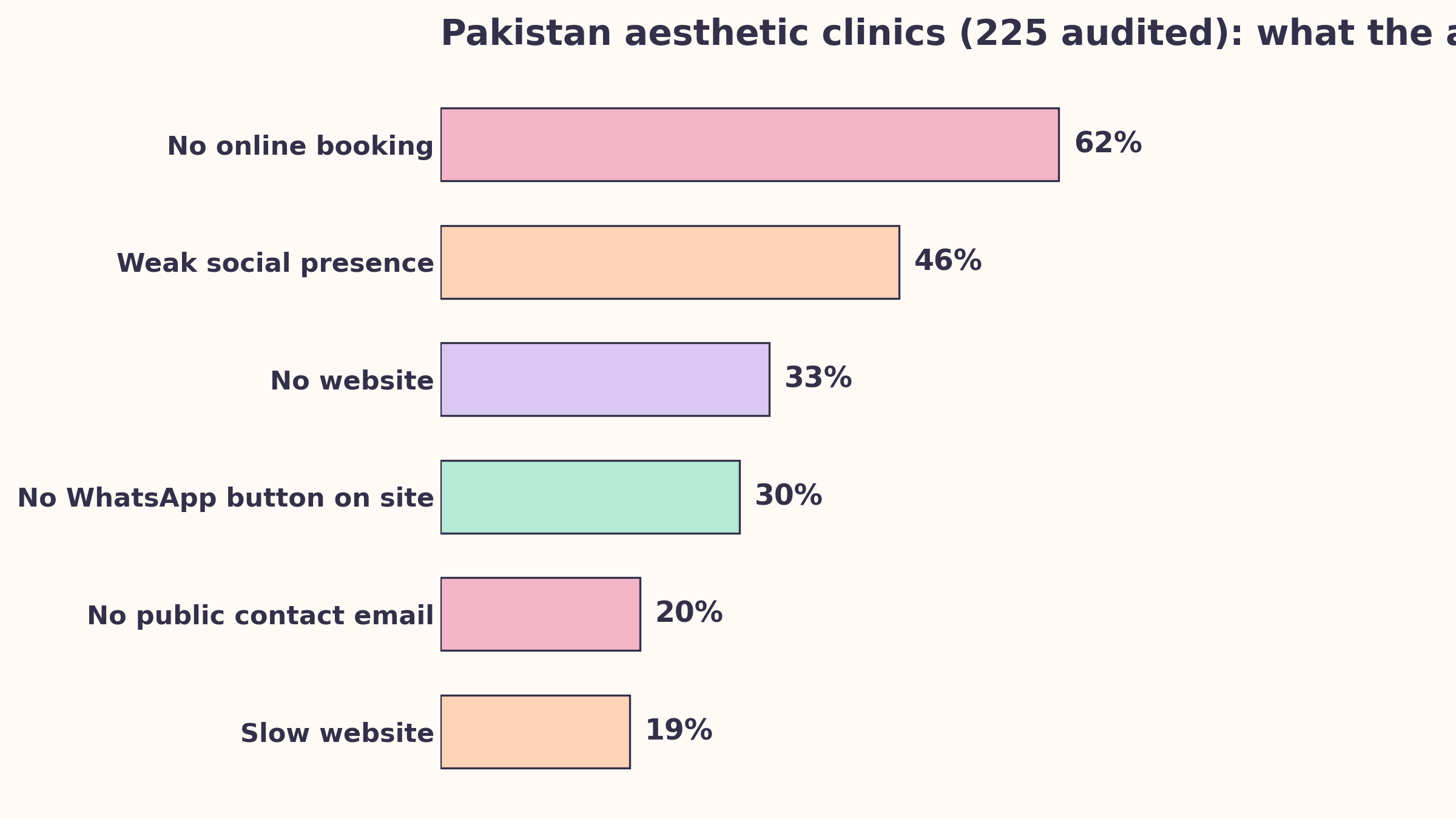
The headline: demand is not the problem
The clinics in this audit are not struggling to be found. The median clinic has 92 Google reviews; the most-reviewed clinic in the dataset has over 6,500. Patients are searching, comparing, and choosing. What they cannot do, at 62% of clinics, is act on that choice online.
The funnel tells the story in three numbers: 225 clinics listed → 151 with a website → 86 that can be booked online. Nearly two-thirds of the industry’s demand leaks out at the last step, not the first. Marketing is not the bottleneck in Pakistani aesthetic medicine. Booking infrastructure is.
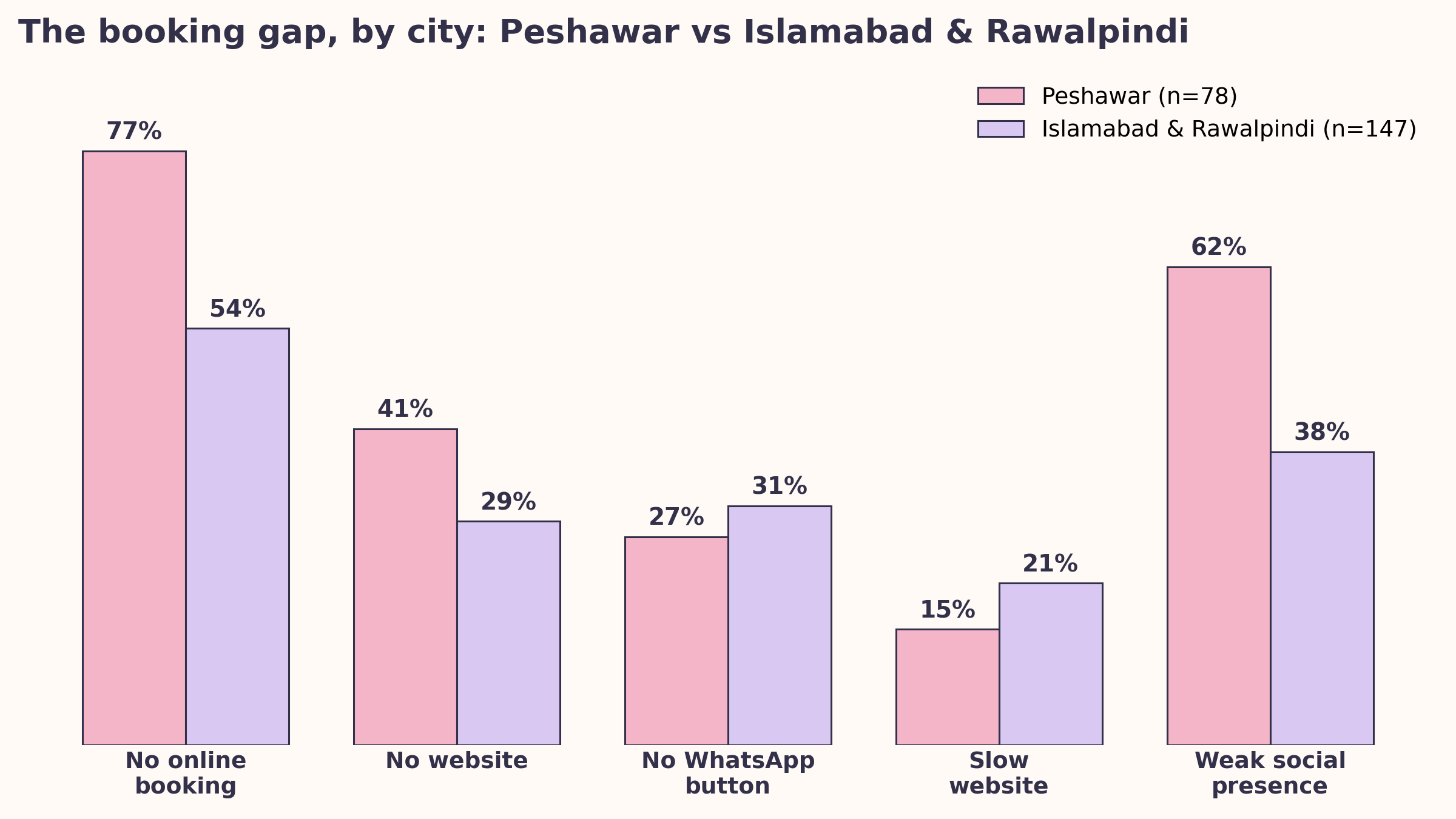
City comparison: Islamabad ahead, Peshawar behind, same disease
| Measure | Peshawar (n=78) | Islamabad & Rawalpindi (n=147) |
|---|---|---|
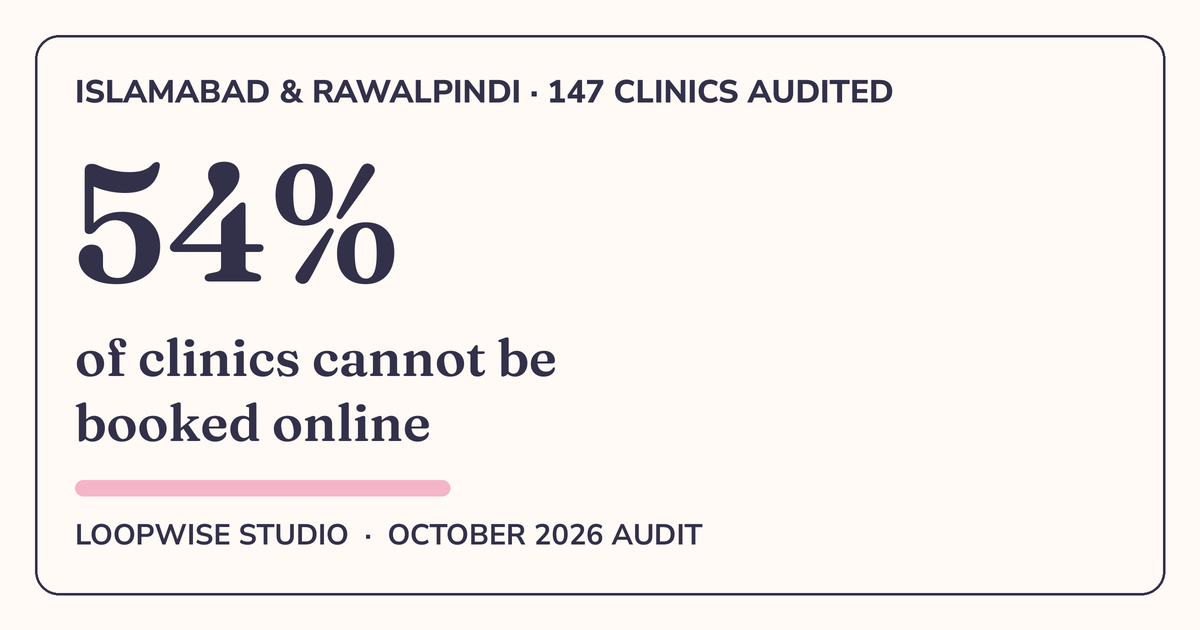
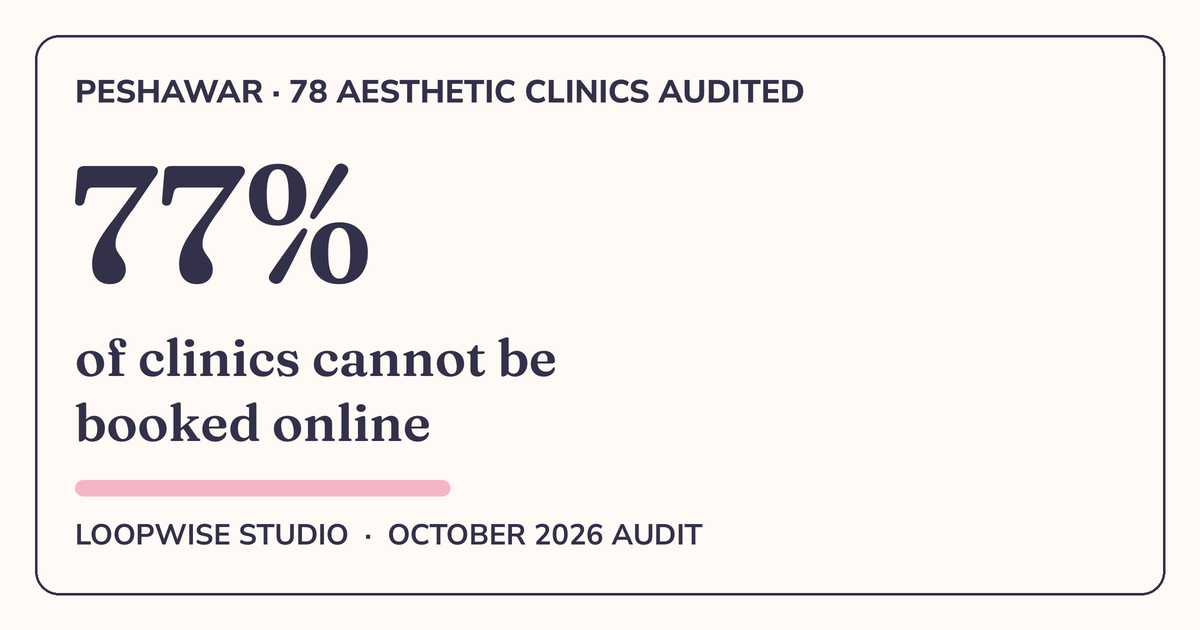
| No online booking | 77% | 54% |
| No website | 41% | 29% |
| Website that cannot take a booking | 61% of websites | 35% of websites |
| Weak social presence | 62% | 38% |
| No WhatsApp button | 27% | 31% |
| Slow website | 15% | 21% |
| Passed every check | 10% | 16% |
The full city reports: Peshawar aesthetic clinics audit and Islamabad & Rawalpindi aesthetic clinics audit.
The pattern is the same in both markets, at different stages. Islamabad’s clinics have spent more — more websites, more social presence — and further along the path the leak is smaller but still majority-sized. Peshawar is earlier: two in five clinics have no website at all. Neither market has a demand problem. Both have a finishing problem: the last step of the patient journey, the booking itself, is the least developed part of the business.
Five findings that define the industry in 2026
1. The phone is still the booking system. 62% of clinics can only be booked by calling or messaging and waiting for a reply. Every one of those bookings depends on staff availability. During treatments, at lunch, and after closing, the booking system is off. Our guide to missed call text back for med spas exists because this is where the demand goes to die.
2. A third of the industry has no website. 74 clinics run on a Google listing and social profiles alone. They own no page, control no booking path, and have nowhere to send a patient who wants details at midnight.
3. Websites that cannot book are the single most fixable waste. 65 clinics — 43% of all clinic websites in the audit — present treatments and prices and then ask the patient to call. The website, the expensive part, exists. The booking path, the cheap part, does not.
4. WhatsApp is understood and under-connected. 97% of clinics (218 of 225) publish a WhatsApp number — the industry knows where its patients are. But 30% of clinics have no WhatsApp button on their website, and clinics without websites have no tap-to-chat path at all. The channel is right; the connection to it leaks at every step that asks the patient to copy, save, and type a number.
5. Hygiene failures stack. 52% of clinics had three or more separate problems. 43 clinics have slow websites; 16 were down when checked; 11 had no SSL certificate. When we re-checked all 151 clinic websites on 22 October 2026, 21 of them (14%) failed to return a working page. These are not exotic technical failures. They are the basics, unfinished.
What the 14% do differently
31 clinics passed every check. They are not concentrated in one city, one chain, or one price bracket. What they share is a complete, boring, finished path: working website, bookable on that website, WhatsApp one tap away, social profiles active and pointing at the booking path. In an industry where the median competitor fails three checks, a finished basics stack is a genuine competitive advantage — and it is available to any clinic in this report within weeks, not quarters.
If you run a clinic and want to know where yours stands, the free audit on our homepage runs the same checks used in this report.
What the gap is worth (illustrative, with the maths shown)
We do not publish revenue estimates for other people’s businesses, so this report contains none. The calculation any clinic can run with its own numbers:
Weekly enquiries × share that arrive when you cannot answer × average treatment value = the demand your booking path puts at risk.
For illustration only: 35 enquiries a week, a third arriving when nobody can answer, an average treatment value of PKR 20,000 — that is roughly PKR 230,000 a week of demand flowing through a path that is switched off a third of the time. Multiply or divide by your real numbers; the shape of the problem survives at almost any scale. Clinics that want to see a working path can try our clinic booking demo — book as a patient, then watch the bookings land on the owner dashboard.
How this research was done
- Sample: every aesthetic, skin, laser, and cosmetic clinic listed on Google Maps for Peshawar, Islamabad, and Rawalpindi that we could identify in October 2026 — 225 clinics after de-duplication. Clinics with no public listing are excluded, which likely makes these figures optimistic: unlisted clinics are unlikely to have better booking infrastructure.
- Dates: data collected and checked 19–22 October 2026. All 151 clinic websites were re-requested on 22 October 2026 as a verification pass; 130 returned a working page and 21 did not (unreachable, error page, or blocked).
- What “online booking” means here: the patient can select a treatment or time and confirm an appointment online — a booking system, calendar, or appointment form. A phone number, a WhatsApp link by itself, or a “contact us” page does not count.
- What was checked per clinic: website exists and loads, booking path, WhatsApp click-to-chat button, SSL, site availability, load speed, public contact email, Facebook and Instagram presence, Google review count.
- Limitations: a snapshot of one week, from public information, in three city markets — not a census of Pakistan’s whole aesthetic industry. A clinic may have fixed an issue since the audit, or may take bookings through a channel we could not see. Two Islamabad listings pointed to hijacked third-party domains at audit time; those clinics are counted by their listing. If you run a clinic in this audit and believe a finding is wrong, contact us and we will re-check and correct it.
- Data availability: the full statistics table behind this report (every metric, every city) is published with it as a downloadable CSV. Journalists and researchers may use any figure from this report with a citation and a link.
How to cite this report
Loopwise Studio (2026). Pakistan Aesthetic Clinics Online Booking Report 2026. Audit of 225 clinics across Peshawar, Islamabad and Rawalpindi, October 2026. loopwisestudio.com
Frequently asked questions
What percentage of aesthetic clinics in Pakistan offer online booking? In this audit of 225 clinics, 38% — 86 clinics. 62% offer no online booking of any kind.
Which city has the most bookable clinics? Islamabad and Rawalpindi: 46% of their 147 clinics can be booked online, versus 23% of Peshawar’s 78.
Why don’t clinics just use WhatsApp for bookings? Most do use WhatsApp — 97% publish a number. The problem is the path: a number that must be copied and saved, a chat that waits for staff to reply, and no confirmed appointment at the end of it. That is a conversation, not a booking system, and it stops working when the clinic is busy or closed.
Is this report based on a survey? No. It is an audit of public information — the clinics’ own listings, websites, and social profiles — checked clinic by clinic in October 2026. No clinic was surveyed or interviewed.
Will this audit be repeated? We plan to re-audit annually so the industry can see whether the gap is closing. Clinics that fix their booking path will be counted correctly in the next edition if they tell us — or if they simply fix it, since the audit reads public information.
Can I get my clinic’s individual results? Yes. The free audit on our homepage covers the same checks for your clinic, or contact us and we will send your clinic’s row from the audit data.